 +965 2224 8361


Kuwait: Eid & Al Saidi join NBK Board of Directors
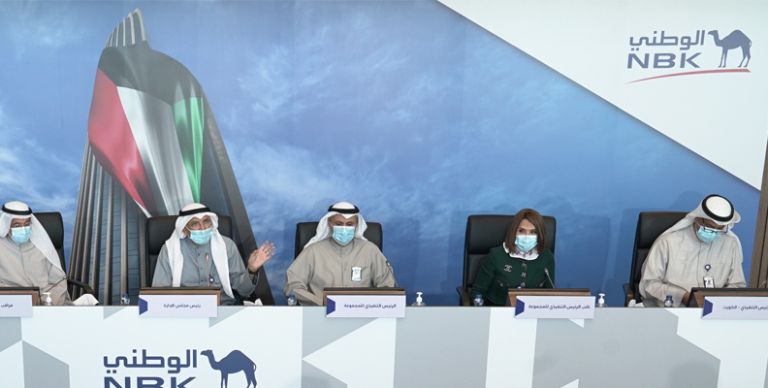
10.03.2021Dr. Robert Maroun Eid and Dr. Nasser Al-Saidi were elected by National Bank of Kuwait’s Annual General Assembly (AGM) as independent members for the remainder of the membership term of the current session of the Board.
The appointment of the new independent board members is part of the bank’s compliance with corporate governance regulations issued by the Central Bank of Kuwait (CBK) and its amendments introduced to the formation of boards of directors and sub-committees.
Dr. Eid and Dr. Al- Saidi have outstanding academic and professional expertise based on years of experience in leading regional and international financial institutions.
Dr. Robert Eid
Dr. Eid has over 40 years experience in the financial industry. He held numerous positions at the National Bank of Kuwait and the Arab National Bank (ANB) KSA, as well as other financial institutions. He held many executive positions in a number of leading financial institutions including Saudi Home Loans Company, Arab National Investment Company, MetLife AIG & ANB Cooperative Insurance Company.
He served as Managing Director and CEO of Arab National Bank - KSA from 2005 to 2021, and as Managing Director and CEO of National Bank of Kuwait (International) plc – London from 1995 to 2005.
Dr. Eid holds a PhD degree in Money and Banking from the Sorbonne University in Paris, having read Economics at the American University of Beirut.
Dr. Eid won the “World Finance” award of “Best Banker in the Middle East” for the year 2016.
Dr. Nasser Al-Saidi
Dr. Al-Saidi has vast experience in macroeconomics, banking, and investments. He held many executive positions at various financial institutions in several Arab countries and in Europe. He worked as a professor of economics at the University of Chicago and the Graduate Institute in Geneva, Switzerland. He was also a lecturer at the American University of Beirut and Saint Joseph University in Lebanon.
Throughout his tenure, Dr. Saidi held several key positions. He served as the Minister of Economy, Trade and Industry in Lebanon from 1998 to 2000 and the First Vice Governor of Banque du Liban (Central Bank of Lebanon) from 1993 to 2003.
He also was a Member of UN Committee for Development Policy (UNCDP) from 2005 to 2006, and the Chief Advisor to the Minister of Finance - UAE from 2005 to 2006 and the Chief Economists & Strategist and Head of External Relations for Dubai International Financial Center (DIFC) from 2006 to 2012. He also served as the Executive Director of the Hawkamah Institute for Corporate Governance and Mudara Institute of Directors from 2006 to 2012.
Since 2013, Dr. Al-Saidi has served as a member of the advisory board of the Official Financial and Monetary Institutions Forum (OFMIF). He has also been a member of the Regional Advisory Group of the International Monetary Fund (IMF) since 2009.
Al-Saidi holds a PhD and a master’s degree from the University of Rochester in USA. He also obtained a master's degree in economics from the University of London in the UK.
NBK is committed to supporting the best governance practices through setting forth a clear and sound Corporate Governance framework aimed at enhancing accountability and the evaluation processes, including the oversight over the responsibilities of members of the Board of Directors and its sub-committees in line with the best international practices to ensure consistency with the highest possible standard for ethical behavior across the bank and its subsidiaries. NBK also continuously strives to adhere to the highest levels of transparency and disclosure, in addition to its diligent efforts to achieve sustainability.
Kuwait: NBK Posts Strong Net Profits of KD 575.6 Million in FY2025
28.01.2026National Bank of Kuwait (NBK) has announced its financial results for the financial year ended 31 December 2025.The Bank reported a net profit of KD 575.6 million (USD 1.9 billion), compared to KD 600.1 million (USD 2.0 billion) for the financial year 2024. Earnings per share (EPS) stood at 64 fils for 2025, compared to 66 fils for 2024.
Profit before tax increased by 5.4% on a year-on-year basis, reaching KD 734.6 million (USD 2.4 billion) at the end of 2025, compared to KD 696.8 million (USD 2.3 billion) in 2024.
Total assets as of December 2025 grew by 13.1% year-on-year, reaching KD 45.6 billion (USD 149.4 billion), while customer deposits grew by 14.0%, totaling KD 26.1 billion (USD 85.3 billion) by the end of 2025.
Meanwhile, Group loans and advances reached KD26.8 billion (USD 87.8 billion) by December 2025, reflecting a growth of 13.1% year-on-year. In the meantime, shareholders' equity also saw an increase, standing at KD 4.3 billion (USD 14.0 billion), up by 9.2% year-on-year.
In terms of distributions, the Board of Directors has proposed a cash dividend of 35 fils per share for the financial year 2025, equivalent to 53% of net profits. In addition, the Board has recommended the distribution of bonus shares at a ratio of 5%. These proposed distributions are subject to the approval of the Annual General Assembly (AGM).
A Prudent Approach
Commenting on the Bank's annual financial results, Mr. Hamad Al-Bahar, NBK Group Chairman, affirmed that, despite the challenges posed by the global economic environment in 2025, including the repercussions of geopolitical tensions, tariff pressures, and the accommodative trajectory of interest rates, the Bank succeeded in further consolidating its position as a leading financial institution. This performance was underpinned by a prudent operating approach and a flexible strategy anchored in diversification and financial discipline.
Al-Bahar noted that the Bank’s financial results for the year ended 31 December 2025 reflect NBK’s ability to adapt and navigate a wide range of economic conditions, supported by a diversified business model, a strong capital base, high-quality assets, comfortable liquidity position, and a robust governance and risk management framework.
He added that the Bank continues to successfully execute its strategy of balancing the delivery of superior returns to shareholders with meeting the evolving needs of its customers. He further emphasized that sustainability has become a central pillar of NBK’s long-term growth agenda. The Bank recorded a significant year-on-year increase of approximately 23% in the value of its sustainable assets, reaching USD 6.10 billion by the end of 2025. This represents 61% of its strategic 2030 target of USD 10 billion. Al-Bahar added that 2025 marked a year of significant achievements that further reinforced NBK’s position as the largest contributor to corporate social responsibility initiatives in Kuwait. Among the most notable milestones were the inauguration of the Shuwaikh Beach Development and Beautification Project, funded by the Bank at a cost of KWD 3 million, as well as the laying of the foundation stone for the expansion of the NBK Children’s Hospital for Hematology, Oncology, and Stem Cell Transplant. The expansion includes the construction of a new building at an estimated cost of nearly KWD 19 million.
Solid Operating Performance
Meanwhile, Mr. Isam J. Al-Sager, NBK Group Vice Chairman and CEO, said: “The Group’s 2025 results reflect the solid operating performance delivered across its various business segments, led by its core banking activities, despite the volatile global operating environment and its spillover effects on regional and local markets. During the year, the Group recorded a year-on-year growth of 3.6% in net operating income, reaching KWD 1.3 billion (USD 4.2 billion).”
He noted that the Group’s profit before tax recorded a year-on-year increase of 5.4% in 2025, while net profits were impacted by the application of the domestic top-up minimum tax on multinational entities operating in Kuwait. He emphasized that this impact on profit growth is transitional in nature, reflecting the base-year effect of 2025 as the first year of the tax’s implementation.
Al-Sager emphasized that NBK Group’s diversified business mix, carefully calibrated strategic investments, and disciplined risk management have mitigated the impact of adverse global economic conditions. He added that NBK continues to invest in technology and innovation as fundamental pillars of inclusive and sustainable growth, while also expanding its customer base and capitalizing on opportunities across promising markets and key sectors.
He further noted that, throughout 2025, the Bank continued to roll out innovative banking services and products specifically designed to meet the evolving needs of its customers. In addition, the Group’s Consumer and Digital Banking arm launched its new five-year strategy through 2030, marking a strategic shift from mere digitization of services to a fully customer-centric, underpinned by data collection and advanced analytics. This transformation further reinforces NBK’s leadership position locally and regionally, offering an exceptional banking experience.
Furthermore, Al-Sager pointed to the key contribution of both NBK Group’s corporate banking and international operations, as well as Boubyan Bank— the Group’s Islamic banking arm— in strengthening the Group’s profits. He further highlighted that NBK Wealth has continued to consolidate its position as the largest wealth management entity in Kuwait and among the largest in the region, by offering an integrated suite of private banking, investment management, and advisory services through a globally connected network of operations.
On major financing transactions, Al-Sager stated: “During 2025, NBK led a KWD 1.5 billion syndicated term facility with Kuwait Petroleum Corporation (KPC). This transaction represents the largest financing of its kind denominated in Kuwaiti Dinars. The Bank served as the mandated lead arranger and bookrunner for the facility, as well as the agent for the conventional tranche. NBK’s share amounted to KD 495 million of the total financing, making it the largest contributor among all participating conventional and Islamic banks, accounting for approximately 60% of the KD 825 million conventional tranche.”
Al-Sager noted that this transaction reinforces NBK’s position as the largest financier of Kuwait’s oil sector and the primary banking partner for energy companies in supporting their expansion and growth plans.
He further noted that Kuwait Clearing Company’s selection of NBK as the country’s main settlement bank represents a testament to the Bank’s substantial investments in digital infrastructure and its high level of operational readiness. This milestone further strengthens NBK’s role in advancing the development of Kuwait’s capital market infrastructure.
On the sustainability front, Al-Sager affirmed that NBK continues to deepen its leading role in shaping a more sustainable future through its green financing initiatives and the development of products and solutions that reflect global best practices in sustainable finance. In this context, he pointed to the Bank’s signing in 2025 of Kuwait’s first-ever green loan agreement. He also highlighted NBK’s ongoing efforts to strengthen its environmental, social, and governance (ESG) framework through measurable initiatives that support emissions reduction and the achievement of carbon neutrality by 2060.
The Operating Environment
Al-Sager expressed his optimism regarding an improvement in the domestic operating environment in 2026, supported by a number of key factors.
He explained that the Financing and Liquidity Law enacted in 2025 has established an advanced framework for long-term sovereign debt issuances, thereby enhancing banking system liquidity through high-quality sovereign assets and supporting the financing of large-scale projects. He added that the Real Estate Financing Law—once approved—would enable banks to provide long-term financing for the residential sector, helping address the housing challenge and stimulating activity across construction and real estate–related sectors.
Moreover, Al-Sager noted that the value of government-awarded projects in 2025 exceeded KWD 4 billion, surpassing 2024 levels by well over 60%. Meanwhile, bank credit recorded solid performance, with credit to residents growing by approximately 7.63% year-on-year as of the end of December 2025, the fastest pace since 2023.
He indicated that project awards are expected to gain further momentum in 2026, supported by the broad pipeline of initiatives under the government’s capital projects program across multiple sectors, alongside a gradual pace of interest rate cuts. This combination bodes well for the outlook and is set to create a favorable environment for credit growth for both corporates and individuals during the year.
He emphasized, however, that while the domestic outlook remains positive, it is accompanied by certain regional and global challenges, including persistent geopolitical tensions, tariffs, and their associated negative economic repercussions.
Prestigious Awards
During 2025, NBK further consolidated its leadership position by receiving a series of prestigious awards from leading global institutions and publications.
Among these accolades, MEED named NBK Best Retail Bank and Best SME Bank in Kuwait, in addition to awarding the Bank several regional honors across the Middle East and North Africa, including Best Loan Offering, Best Contactless Payment Experience, and Best Payment Solutions for SMEs. NBK’s digital subsidiary, Weyay Bank, was also recognized with the Most Innovative Product Award for its children’s card, “Jeel.”
NBK also received three prestigious awards from Global Finance, including Best Digital Payment Solutions and Best Online Product Offerings in Kuwait, while Weyay Bank was named Best Digital Bank in Kuwait. Furthermore, the Bank won four awards from Euromoney, including Kuwait’s Best Bank for ESG, Kuwait’s Best Bank for Large Corporates, Kuwait’s Best Bank for Diversity and Inclusion, as well as Kuwait’s Best Digital Bank for Weyay Bank.
Key financial indicators for the financial year ended December 31, 2025
• Net operating income stood at KD 1.3 billion (USD 4.2 billion), up 3.6% year-on-year
• Total assets grew by 13.1% year-on-year, at KD 45.6 billion (USD 149.4 billion)
• Total loans and advances increased by 13.1% year-on-year to KD 26.8 billion (USD 87.8 billion)
• Customer deposits grew by 14.0% year-on-year to KD 26.1 billion (USD 85.3 billion)
• Total shareholders’ equity amounted to KD4.3 billion (USD 14.0 billion), registering an annual growth of 9.2%.
• Strong asset quality metrics, with NPL/gross loans ratio at 1.36% and an NPL coverage ratio of 240%
• Robust Capital Adequacy Ratio of 17.0%, comfortably exceeding regulatory requirements.