 +965 2224 8361


Kuwait: NBK... 68 Years of Leadership and Growth
16.11.2020There is no doubt that the history of National Bank of Kuwait, which was established in 1952, not only represents a unique and inspiring success story of a bank that rose to success and leadership in the banking business consolidating its position as one of the leading banks in the region today, but also documents the key historical milestones of Kuwait and how the bank contributed to achieving economic and financial independence for Kuwait even before full political independence was attained, and the instrumental role it played in supporting the national economy during critical stages of the country's history.
Today, NBK celebrates the anniversary of opening its doors to the public for the first time in 1952, as the first national bank in Kuwait and the first joint stock company in Kuwait and the Arabian Gulf region.
This year, the celebration is particularly significant as it marks the 68th anniversary of the bank’s actual operation and service provision to customers, which represents a culmination and a continuation of a success journey during which NBK transformed from a small bank that started with a 3-store area and a few employees using rudimentary manual work, to one of the largest, most profitable, leading and innovative banks in the entire Arabian Gulf region.
Everyone knows well the history of Kuwait’s political independence in 1960. However, most people do not know is that 1952 saw another kind of independence that is no less important than political independence, which is the economic independence of Kuwait, by launching the operations of National Bank of Kuwait as the first wholly-owned national bank in Kuwait.
National Bank
In 1952, a small joint stock company with a capital not exceeding one million Kuwaiti Dinar only emerged under the name of “National Bank of Kuwait Limited”, marking the beginning of a new era of economic freedom and independence for Kuwait, which was under British mandate for a long period, and declaring the independence of the region as a whole, which did not have a single national financial institution at that difficult time in its history, since before 1952, there was only one foreign bank in Kuwait, the British Bank of the Middle East in Kuwait, which was officially inaugurated in February 1942 during World War II.
Since 1949, those in charge of the British Bank in Kuwait have felt that Kuwaiti citizens are not satisfied with its activities and services, and they have also learned that some Kuwaiti merchants have thoughts and a tendency to establish their own bank.
Recently, a number of secret letters written by the British Commissioner in Kuwait to the British Foreign Office, in which he expressed his concern and fear about establishing the national bank and the attempts that were made to hinder its incorporation and continuation of its operation.
Incorporation Idea
The idea of establishing a Kuwaiti national bank that basically serves national interests, takes upon itself developing the Kuwaiti economy, boosting the commercial market, and preserving and growing depositors’ savings emerged for the first time in 1952.
To materialize the idea, a group including the following founders: Ahmed Saud Al-Khaled, Khalid Zaid Al-Khalid, Khaled Abdullatif Al-Hamad, Khalifa Khalid Al-Ghunaim, , Sayed Ali Sayed Sulieman Al-Rifai, Abdulaziz Hamad Al-Sager, Mohamed, Abdulmohsen Al-Khorafi, Yousef Ahmed Al-Ghanim and Yousef Abdulziz Al-Fulaij, held a meeting with the late Sheikh Abdullah Al-Salem Al-Sabah, who endorsed their idea and promised them support.
Under the memorandum of association of the British Bank branch in Kuwait with the government of Kuwait, it was not allowed to incorporate other banks in Kuwait, and the opinion of the Amir of Kuwait Sheikh Abdullah Al-Salem at the time was that this does not apply to the incorporating Kuwaiti banks inside the country.
Amiri Decree Law
Accordingly, the incorporation of National Bank of Kuwait was permitted on 19 May 1952, by virtue of an Amiri Decree Law to this effect. On 15 November 1952, NBK started official operation as a Kuwaiti shareholding company conducting banking business.
National Bank of Kuwait is the first ever national bank in Kuwait and the Gulf, with all board members and founders from Kuwaitis who have a long-standing business activity inside and outside Kuwait.
The bank was incorporated with a capital of 13.1 million rupees, equivalent to only one million Kuwaiti Dinars, divided into 13.1 thousand shares of one thousand rupees each.
In a small building located on the new street, NBK started operation with a small number of people, not exceeding the number of fingers, and with an area not exceeding 3 stores, and at the beginning, it conducted simple and basic banking activities including LCs, currency exchange, simple bank transfers, deposits and withdrawals.
This was how the beginning was, but as time went by, NBK proved its efficiency and worthiness as a participant and supporter of the renaissance movement in Kuwait, providing all kinds of support to individuals and institutions to finance the construction of infrastructure projects in Kuwait of the 50’s, where it was the only Kuwaiti bank at that time.
Replacement of Currency
NBK played a key role in replacing the local currency twice, first in May 1959 when the Indian Rupee notes were replaced by new rupee notes called the Gulf rupees.
As for the second replacement, it was in April and May 1961 when the Kuwait Currency Board issued Kuwaiti Dinars instead of Gulf rupees banknotes. This replacement was a necessity for independence giving Kuwait an independent character and manifesting the country’s sovereignty over its economy and currency.
Financing Development
NBK is the largest major financier of all government development projects as well as the private sector. The bank also has a dominant share in trade finance and financing of foreign companies working in these projects. This represents an extension of a long record of supporting economic development and contributing to building modern Kuwait.
In the 1970s, NBK continued to finance infrastructure and development projects in modern Kuwait. These projects comprised water desalination plants, power stations, road networks, construction and development of oil fields, refineries and support services, import services, construction of hospitals and schools, and support for urban expansion in the country, thus opening vistas for the future of Kuwait.
The bank began to develop its real corporate character through development, restructuring and re-organization plans, the period which acted as the basis for NBK’s progress and booming.
A Safe Haven
During the 80’s, NBK went through a tough test, when the stock market crashed in the so-called "Souk A;-Manakh Crash” in 1982. However, thanks to the balanced and conservative banking methodology of adopted by NBK during this period, it was the only bank that was not adversely impacted by the crisis.
As a result, it was called "The Sole Surplus Bank". NBK also warned several times in its economic reports and publications from the risk of this crash before it occurred and impacted many institutions.
Then came the crisis of the Iraqi invasion of Kuwait in 1990, which was a hard test for the solidity of the bank’s position, as it continued to perform its business from outside Kuwait and meet all its obligations towards its customers and banks abroad, and it also had an instrumental role in financing Kuwait's reconstruction projects.
This outstanding performance of NBK during these two crises has promoted the support and continued trust provided by the bank’s customers as well as strengthened international banks’ trust in it.
Continuous Development
During the 90’s and after the liberation of Kuwait, NBK played a leading and essential role in serving the Kuwaiti economy by arranging mega loans, including the loan arranged in favor of the government after the liberation of Kuwait in 1991 amounting USD 5.5 billion, which is the largest loan the Arab region has ever known by that time.
It can be said that the 90’s and the end of the 20th century was the golden era of the bank, during which it showed the signs of maturity and banking prosperity and regional as well as international expansion. Today, the bank has dozens of branches in Kuwait, as well as branches and representative offices and overseas companies in New York, London, Paris, Geneva, Singapore, Vietnam, Turkey and China, in addition to Lebanon, Bahrain Jordan, Qatar, UAE, Iraq and Saudi Arabia.
With the beginning of the 21st century, NBK succeeded in developing into an integrated financial market for advanced banking and financial services and for all customer segments, including individuals, companies and large institutions. It also consolidated its position as a comprehensive investment and financing bank through many deals in the Middle East region.
Digital Transformation
The COVID-19 pandemic has highlighted the importance of digital banking and electronic payment methods for the future of the banking sector. This proves the success of NBK's insightful and forward-looking vision in its implementation of Digital Transformation Strategy and the development of its digital banking services over the last years, which added greater flexibility to the bank’s methodology and contributed to enriching customers’ banking experience and meeting their various banking needs.
Among all regional banks, NBK was the first to launch a digital transformation map, which contributed to consolidating its leadership in providing the latest digital banking services and electronic payment methods, as the digital culture has become part of the fabric of the bank’s system that is spread across all the group’s business units and different markets in which it operates.
In recognition of these efforts, NBK was awarded the Best Consumer Digital Bank as well as the Best in Mobile Banking in Kuwait for 2019 by the international Global Finance magazine.
Expansion and Diversification
Thanks to its founders, employees, customers and all stakeholders, NBK has become a leading Kuwaiti brand that crosses borders and spans 4 continents.
Although the main operations of NBK are concentrated in the Middle East and North Africa region, it seeks to preserve its international character and its presence in many countries which is best manifested in the group's international footprint comprising China, France, Singapore, Switzerland, Turkey, UK and USA.
The bank’s operations also range from consumer and private banking, corporate banking, Islamic banking through the group’s subsidiary Boubyan Bank, as well as investment banking and asset management through the group’s subsidiary NBK Capital Investment Company.
The diversification of income sources, both geographically and sectorally, represents a key pillar of NBK's strategy to achieve sustainable growth, as international operations have contributed to increasing the volume of the group's business, while focusing on growth in the main markets in Saudi Arabia and Egypt, in addition to continuing growth in the Kuwaiti market.
As part of the bank’s efforts to expand in the main markets in which it operates, NBK supports the activities of the wealth management company in KSA and links it to the bank’s global wealth management platform, while striving to increase commercial banking products and services to sell the group’s products and services to the bank’s customers in KSA. In Egypt, the bank aims to expand in the retail market, by focusing on enhancing customer acquisition, facilitating their transactions, and investing in digital banking services.
Sustainable Development
NBK has an unwavering commitment to the community to which it belongs, which made it one of the largest contributors to the development of Kuwaiti society, with contributions exceeding half a billion US Dollars over the past decades, with a rich record of social initiatives in all fields and activities.
NBK Children’s Hospital remains an icon of NBK's social contributions, as the bank continued its endeavor to develop this hospital by opening a "Stem Cell Therapy Unit" in Al-Sabah Medical Area three years ago, which is the first of its kind in Kuwait that us specialized in spinal cord transplants for children under 16 years of age free of any charge, for which the bank engaged international consultants specialized in designing children's specialized hospitals.
In appreciation of its achievements in the area of sustainable development, environmental conservation and social responsibility, NBK continues to receive international recognitions, the latest of which was the bank’s inclusion in Refinitiv AFE Low Carbon Select Index for MENA region, which was launched by Refinitiv this October in cooperation with Arab Federation of Stock Exchanges (AFE).
Strength and Growth
NBK enjoys a solid financial position based on a diversified and stable deposit base, strong capitalization ratios, high assets quality and comfortable liquidity levels, which reflect on the bank’s solid financial position and the continuous growth of its balance sheet as the growth of the bank’s assets reached about USD 100 billion by the end of last September, supported by the continuous growth in loan portfolio that reached USD 57.6 billion.
NBK is the largest financial institution in Kuwait and has de facto dominance in the commercial banking sector. NBK maintained the highest credit ratings among all banks in the region, from all global credit rating agencies: Moody's, Standard & Poor's and Fitch. NBK is also distinguished by its large local and global network.
Despite the COVID-19 pandemic, the bank has shown its ability to overcome crises and maintain its assets growth and financial strength. When the global financial crisis in 2008 proved the validity of NBK's strategic and investment choices and its ability to deal with unfavorable economic conditions, representing an example to follow at a time when a wide range of financial sector institutions in Kuwait and the region badly suffered.
Pride and Leadership
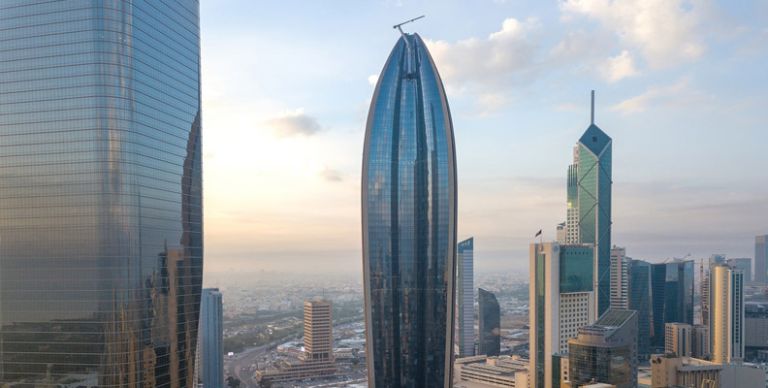
Skyscrapers usually cry for attention. However, in the new NBK headquarters, the bank did not aim at all to construct a building that competes as an ordinary building, but rather wanted to present an architectural icon that reflects NBK’s pride and leadership.
NBK has succeeded in providing an example for green modern architecture through its new headquarters building, which will be an inspiration for all remarkable engineering works for many years to come.
Additionally, the bank’s new headquarters represents an example of a workplace that takes into consideration all environmental and other sides, as it is a green building conforming to the standards of Leadership in Energy and Environmental Design (LEED) Gold certification, and all the building’s interior details make it not only a workplace but an integrated environment in which the employees feel themselves and their ability for self-realization.
Kuwait: NBK Reports Net Profit of KD 135.5 Million in 1Q2026
26.04.2026National Bank of Kuwait (NBK) has announced its financial results for the three months ended 31 March 2026. The Bank reported a net profit of KD 135.5 million (USD 441.3 million), compared to KD 134.1 million (USD 436.8 million) for the first quarter of 2025.
Total assets as of the end of March 2026 rose by 10.7% year-on-year, reaching KD 46.1 billion (USD 150.2 billion), while Group loans and advances grew by 10.9%, compared to the corresponding period of 2025 to reach KD 27.3 billion (USD 88.9 billion).
Meanwhile, customer deposits increased by 10.0% year-on-year to reach KD 25.9 billion (USD 84.3 billion), while shareholders’ equity rose by 6.0% year-on-year, reaching KD 4.3 billion (USD 13.9 billion) as of the end of March 2026.
Delivering with Efficiency and Discipline
Commenting on the Bank's financial results, Mr. Hamad Al-Bahar, NBK Group Chairman, stated that the Bank’s financial performance in 1Q2026 underscores the strength and resilience of its business model, sustaining stable performance with consistency and discipline amid heightened regional and global uncertainty.
Al-Bahar noted that NBK Group navigated these conditions with efficiency, anchored in a prudent strategic approach, diversified operations and strong operational flexibility, supported by a solid capital base, high asset quality, comfortable liquidity levels, and a robust governance and risk management framework. This enabled the Group to manage the rapidly evolving geopolitical developments with discipline and foresight; effectively mitigating their impact on overall performance.
“In light of the exceptional global and regional developments, we at NBK reaffirm our unwavering commitment to our national responsibility, as well as our continued dedication to supporting the State’s strategic direction and future aspirations. We remain firmly committed to contributing to the effective execution of development plans and advancing sustainable development, in a manner that strengthens the resilience of the national economy and serves the interests of the nation and its citizens. We pray for the continued safety, security, and stability of Kuwait,” Al-Bahar said.
He emphasized NBK’s commitment to its role as a key partner in supporting the stability of the national economy and serving the community with consistency and reliability under all circumstances. He highlighted that the Bank continues to operate in close coordination with the Central Bank of Kuwait, in collaboration with other Kuwaiti banks, to reinforce confidence in the banking sector, ensure the uninterrupted continuity of banking services and to extend support across all economic sectors.
Furthermore, Al-Bahar highlighted that the strength of Kuwait’s banking sector, underpinned by robust capitalization, ample liquidity, and a well-established regulatory framework, constitutes a fundamental pillar reinforcing the economy’s resilience and its capacity to navigate prevailing challenges with confidence.
Operational Resilience
Meanwhile, Mr. Isam J. Al-Sager, Vice Chairman and Group CEO of NBK, highlighted that the Group’s financial performance in 1Q2026 reflects the underlying strength and consistency of its operating model, supported by a well-diversified business mix, a balanced geographic footprint, and disciplined long-term strategic investments, underpinned by a prudent and forward-looking risk management framework.
He emphasized that the diversification of NBK Group’s business portfolio and its broad geographic footprint have materially strengthened its resilience, effectively mitigating the impact of recent geopolitical tensions on performance.
Furthermore, Al-Sager highlighted that the Bank’s operations continued with a high degree of efficiency and stability, without disruption, despite challenges in certain regional markets. “During 1Q2026, NBK continued to deliver the full spectrum of banking services to both retail and corporate customers, within Kuwait and across its international network, in a secure and uninterrupted manner. This was facilitated through its domestic branch network, as well as the International Business Group (IBG)”
He added that all banking systems and customer service platforms remain fully operational and efficient, with no impact on business continuity or the quality of service delivery.
Al-Sager also emphasized that digital channels, including the NBK Mobile Banking App and NBK Online Banking platforms, continue to operate with full efficiency, alongside the Bank’s ATM network deployed across multiple locations and operating on a 24/7 basis. He further emphasized that all critical and support functions continue to perform seamlessly, ensuring uninterrupted service delivery, particularly across trade finance and corporate banking activities.
He also underscored that the safety of employees and customers remains a paramount priority, with all necessary measures and precautionary protocols firmly in place to maintain a secure and stable working environment, while upholding the highest standards of operational readiness and business continuity across all markets.
Core Business Segments
Al-Sager stated that NBK Group’s core business segments delivered a resilient and well-balanced performance during 1Q2026, reflecting the depth and quality of its earnings base. This translated into a 6.6% year-on-year increase in net operating income, reaching KD 331.2 million (USD 1.1 billion) during the period.
He noted that NBK continued to expand its customer base through the disciplined rollout of innovative digital products and services, complemented by a consistently differentiated customer experience. Moreover, he added that the Bank’s sustained investments in technology and innovation are strategically positioned to reinforce its leadership in digital banking, enabling scalable growth, enhancing operational efficiency and driving long-term value creation for both customers and shareholders.
In parallel, Al-Sager highlighted that NBK Group’s international operations, alongside its Islamic banking arm, Boubyan Bank, played a pivotal role in supporting the growth of net operating income and net profit during 1Q2026, reflecting the strength of the Group’s strategic vision and the effectiveness of its diversified business model.
Al-Sager further emphasized that NBK Wealth continues to reinforce its standing as the largest wealth management entity in Kuwait and among the region’s leading players, reflecting the strength of its platform and the consistency of its performance. He added that this momentum has been recognized through a series of prestigious international awards, including “Best Private Banking Services for the Next Generation in the World 2026” and “Best Private Bank in Kuwait 2026” from Global Finance magazine, as well as the “Best Regional Investment-Focus in the Middle East 2026” award from MandateWire.
Sustainability and Organizational Excellence
Al-Sager reaffirmed NBK’s continued commitment to advancing its sustainability agenda through the expansion of green financing initiatives and the development of products and services aligned with leading global practices, while supporting the State’s direction toward achieving carbon neutrality by 2060.
As part of its efforts to further enhance the workplace environment, he highlighted the launch of the Diversity, Equity, and Inclusion (DEI) Council during 1Q2026, reflecting the Bank’s commitment to fostering a fair and inclusive workplace that leverages diversity as a source of strength and innovation.
Business Environment
Commenting on the business environment in Kuwait, Al-Sager said: “The business environment demonstrated early signs of improvement at the start of the year, supported by credit expansion, heightened real estate activity, and a surge in project awards. However, recent geopolitical tensions in the region have weighed on the broader outlook, rendering economic prospects more susceptible to elevated uncertainty”.
Al-Sager added that, despite prevailing uncertainty, Kuwait continues to benefit from strong financial buffers that reinforce its capacity to navigate current challenges. He emphasized that the strength of the country’s financial assets, alongside sustained momentum in economic reforms and infrastructure investments in the period ahead, constitute key pillars underpinning the stability of Kuwait’s economy.
He further noted that NBK will continue to reinforce its operational resilience, deepen the diversification of its income streams, and uphold its disciplined and prudent approach, ensuring the sustained creation of value for shareholders and customers across evolving economic conditions.
Al-Sager concluded by commending the recent regulatory and precautionary measures introduced by the Central Bank of Kuwait, underscoring their critical role in further strengthening the stability and resilience of the domestic banking sector and enhancing its capacity to sustain support for the broader economy under prevailing conditions.
Key financial indicators for the financial in1Q2026
• Net operating income stood at KD 331.2 million (USD 1.1 billion), up 6.6% year-on-year
• Total assets grew by 10.7% year-on-year, at KD 46.1 billion (USD 150.2 billion)
• Total loans and advances increased by 10.9% year-on-year to KD 27.3 billion (USD 88.9 billion)
• Customer deposits grew by 10.0% year-on-year to KD 25.9 billion (USD 84.3 billion)
• Shareholders’ equity amounted to KD 4.3 billion (USD 13.9 billion), registering an annual growth of 6.0%.
• Strong asset quality metrics, with NPL/gross loans ratio at 1.35% and an NPL coverage ratio of 241%
• Robust Capital Adequacy Ratio of 16.4%, comfortably exceeding regulatory requirements.
Kuwait: NBK Posts Strong Net Profits of KD 575.6 Million in FY2025
28.01.2026National Bank of Kuwait (NBK) has announced its financial results for the financial year ended 31 December 2025.The Bank reported a net profit of KD 575.6 million (USD 1.9 billion), compared to KD 600.1 million (USD 2.0 billion) for the financial year 2024. Earnings per share (EPS) stood at 64 fils for 2025, compared to 66 fils for 2024.
Profit before tax increased by 5.4% on a year-on-year basis, reaching KD 734.6 million (USD 2.4 billion) at the end of 2025, compared to KD 696.8 million (USD 2.3 billion) in 2024.
Total assets as of December 2025 grew by 13.1% year-on-year, reaching KD 45.6 billion (USD 149.4 billion), while customer deposits grew by 14.0%, totaling KD 26.1 billion (USD 85.3 billion) by the end of 2025.
Meanwhile, Group loans and advances reached KD26.8 billion (USD 87.8 billion) by December 2025, reflecting a growth of 13.1% year-on-year. In the meantime, shareholders' equity also saw an increase, standing at KD 4.3 billion (USD 14.0 billion), up by 9.2% year-on-year.
In terms of distributions, the Board of Directors has proposed a cash dividend of 35 fils per share for the financial year 2025, equivalent to 53% of net profits. In addition, the Board has recommended the distribution of bonus shares at a ratio of 5%. These proposed distributions are subject to the approval of the Annual General Assembly (AGM).
A Prudent Approach
Commenting on the Bank's annual financial results, Mr. Hamad Al-Bahar, NBK Group Chairman, affirmed that, despite the challenges posed by the global economic environment in 2025, including the repercussions of geopolitical tensions, tariff pressures, and the accommodative trajectory of interest rates, the Bank succeeded in further consolidating its position as a leading financial institution. This performance was underpinned by a prudent operating approach and a flexible strategy anchored in diversification and financial discipline.
Al-Bahar noted that the Bank’s financial results for the year ended 31 December 2025 reflect NBK’s ability to adapt and navigate a wide range of economic conditions, supported by a diversified business model, a strong capital base, high-quality assets, comfortable liquidity position, and a robust governance and risk management framework.
He added that the Bank continues to successfully execute its strategy of balancing the delivery of superior returns to shareholders with meeting the evolving needs of its customers. He further emphasized that sustainability has become a central pillar of NBK’s long-term growth agenda. The Bank recorded a significant year-on-year increase of approximately 23% in the value of its sustainable assets, reaching USD 6.10 billion by the end of 2025. This represents 61% of its strategic 2030 target of USD 10 billion. Al-Bahar added that 2025 marked a year of significant achievements that further reinforced NBK’s position as the largest contributor to corporate social responsibility initiatives in Kuwait. Among the most notable milestones were the inauguration of the Shuwaikh Beach Development and Beautification Project, funded by the Bank at a cost of KWD 3 million, as well as the laying of the foundation stone for the expansion of the NBK Children’s Hospital for Hematology, Oncology, and Stem Cell Transplant. The expansion includes the construction of a new building at an estimated cost of nearly KWD 19 million.
Solid Operating Performance
Meanwhile, Mr. Isam J. Al-Sager, NBK Group Vice Chairman and CEO, said: “The Group’s 2025 results reflect the solid operating performance delivered across its various business segments, led by its core banking activities, despite the volatile global operating environment and its spillover effects on regional and local markets. During the year, the Group recorded a year-on-year growth of 3.6% in net operating income, reaching KWD 1.3 billion (USD 4.2 billion).”
He noted that the Group’s profit before tax recorded a year-on-year increase of 5.4% in 2025, while net profits were impacted by the application of the domestic top-up minimum tax on multinational entities operating in Kuwait. He emphasized that this impact on profit growth is transitional in nature, reflecting the base-year effect of 2025 as the first year of the tax’s implementation.
Al-Sager emphasized that NBK Group’s diversified business mix, carefully calibrated strategic investments, and disciplined risk management have mitigated the impact of adverse global economic conditions. He added that NBK continues to invest in technology and innovation as fundamental pillars of inclusive and sustainable growth, while also expanding its customer base and capitalizing on opportunities across promising markets and key sectors.
He further noted that, throughout 2025, the Bank continued to roll out innovative banking services and products specifically designed to meet the evolving needs of its customers. In addition, the Group’s Consumer and Digital Banking arm launched its new five-year strategy through 2030, marking a strategic shift from mere digitization of services to a fully customer-centric, underpinned by data collection and advanced analytics. This transformation further reinforces NBK’s leadership position locally and regionally, offering an exceptional banking experience.
Furthermore, Al-Sager pointed to the key contribution of both NBK Group’s corporate banking and international operations, as well as Boubyan Bank— the Group’s Islamic banking arm— in strengthening the Group’s profits. He further highlighted that NBK Wealth has continued to consolidate its position as the largest wealth management entity in Kuwait and among the largest in the region, by offering an integrated suite of private banking, investment management, and advisory services through a globally connected network of operations.
On major financing transactions, Al-Sager stated: “During 2025, NBK led a KWD 1.5 billion syndicated term facility with Kuwait Petroleum Corporation (KPC). This transaction represents the largest financing of its kind denominated in Kuwaiti Dinars. The Bank served as the mandated lead arranger and bookrunner for the facility, as well as the agent for the conventional tranche. NBK’s share amounted to KD 495 million of the total financing, making it the largest contributor among all participating conventional and Islamic banks, accounting for approximately 60% of the KD 825 million conventional tranche.”
Al-Sager noted that this transaction reinforces NBK’s position as the largest financier of Kuwait’s oil sector and the primary banking partner for energy companies in supporting their expansion and growth plans.
He further noted that Kuwait Clearing Company’s selection of NBK as the country’s main settlement bank represents a testament to the Bank’s substantial investments in digital infrastructure and its high level of operational readiness. This milestone further strengthens NBK’s role in advancing the development of Kuwait’s capital market infrastructure.
On the sustainability front, Al-Sager affirmed that NBK continues to deepen its leading role in shaping a more sustainable future through its green financing initiatives and the development of products and solutions that reflect global best practices in sustainable finance. In this context, he pointed to the Bank’s signing in 2025 of Kuwait’s first-ever green loan agreement. He also highlighted NBK’s ongoing efforts to strengthen its environmental, social, and governance (ESG) framework through measurable initiatives that support emissions reduction and the achievement of carbon neutrality by 2060.
The Operating Environment
Al-Sager expressed his optimism regarding an improvement in the domestic operating environment in 2026, supported by a number of key factors.
He explained that the Financing and Liquidity Law enacted in 2025 has established an advanced framework for long-term sovereign debt issuances, thereby enhancing banking system liquidity through high-quality sovereign assets and supporting the financing of large-scale projects. He added that the Real Estate Financing Law—once approved—would enable banks to provide long-term financing for the residential sector, helping address the housing challenge and stimulating activity across construction and real estate–related sectors.
Moreover, Al-Sager noted that the value of government-awarded projects in 2025 exceeded KWD 4 billion, surpassing 2024 levels by well over 60%. Meanwhile, bank credit recorded solid performance, with credit to residents growing by approximately 7.63% year-on-year as of the end of December 2025, the fastest pace since 2023.
He indicated that project awards are expected to gain further momentum in 2026, supported by the broad pipeline of initiatives under the government’s capital projects program across multiple sectors, alongside a gradual pace of interest rate cuts. This combination bodes well for the outlook and is set to create a favorable environment for credit growth for both corporates and individuals during the year.
He emphasized, however, that while the domestic outlook remains positive, it is accompanied by certain regional and global challenges, including persistent geopolitical tensions, tariffs, and their associated negative economic repercussions.
Prestigious Awards
During 2025, NBK further consolidated its leadership position by receiving a series of prestigious awards from leading global institutions and publications.
Among these accolades, MEED named NBK Best Retail Bank and Best SME Bank in Kuwait, in addition to awarding the Bank several regional honors across the Middle East and North Africa, including Best Loan Offering, Best Contactless Payment Experience, and Best Payment Solutions for SMEs. NBK’s digital subsidiary, Weyay Bank, was also recognized with the Most Innovative Product Award for its children’s card, “Jeel.”
NBK also received three prestigious awards from Global Finance, including Best Digital Payment Solutions and Best Online Product Offerings in Kuwait, while Weyay Bank was named Best Digital Bank in Kuwait. Furthermore, the Bank won four awards from Euromoney, including Kuwait’s Best Bank for ESG, Kuwait’s Best Bank for Large Corporates, Kuwait’s Best Bank for Diversity and Inclusion, as well as Kuwait’s Best Digital Bank for Weyay Bank.
Key financial indicators for the financial year ended December 31, 2025
• Net operating income stood at KD 1.3 billion (USD 4.2 billion), up 3.6% year-on-year
• Total assets grew by 13.1% year-on-year, at KD 45.6 billion (USD 149.4 billion)
• Total loans and advances increased by 13.1% year-on-year to KD 26.8 billion (USD 87.8 billion)
• Customer deposits grew by 14.0% year-on-year to KD 26.1 billion (USD 85.3 billion)
• Total shareholders’ equity amounted to KD4.3 billion (USD 14.0 billion), registering an annual growth of 9.2%.
• Strong asset quality metrics, with NPL/gross loans ratio at 1.36% and an NPL coverage ratio of 240%
• Robust Capital Adequacy Ratio of 17.0%, comfortably exceeding regulatory requirements.