
 +965 2292 4888


Daily Economic Update
11.05.2026
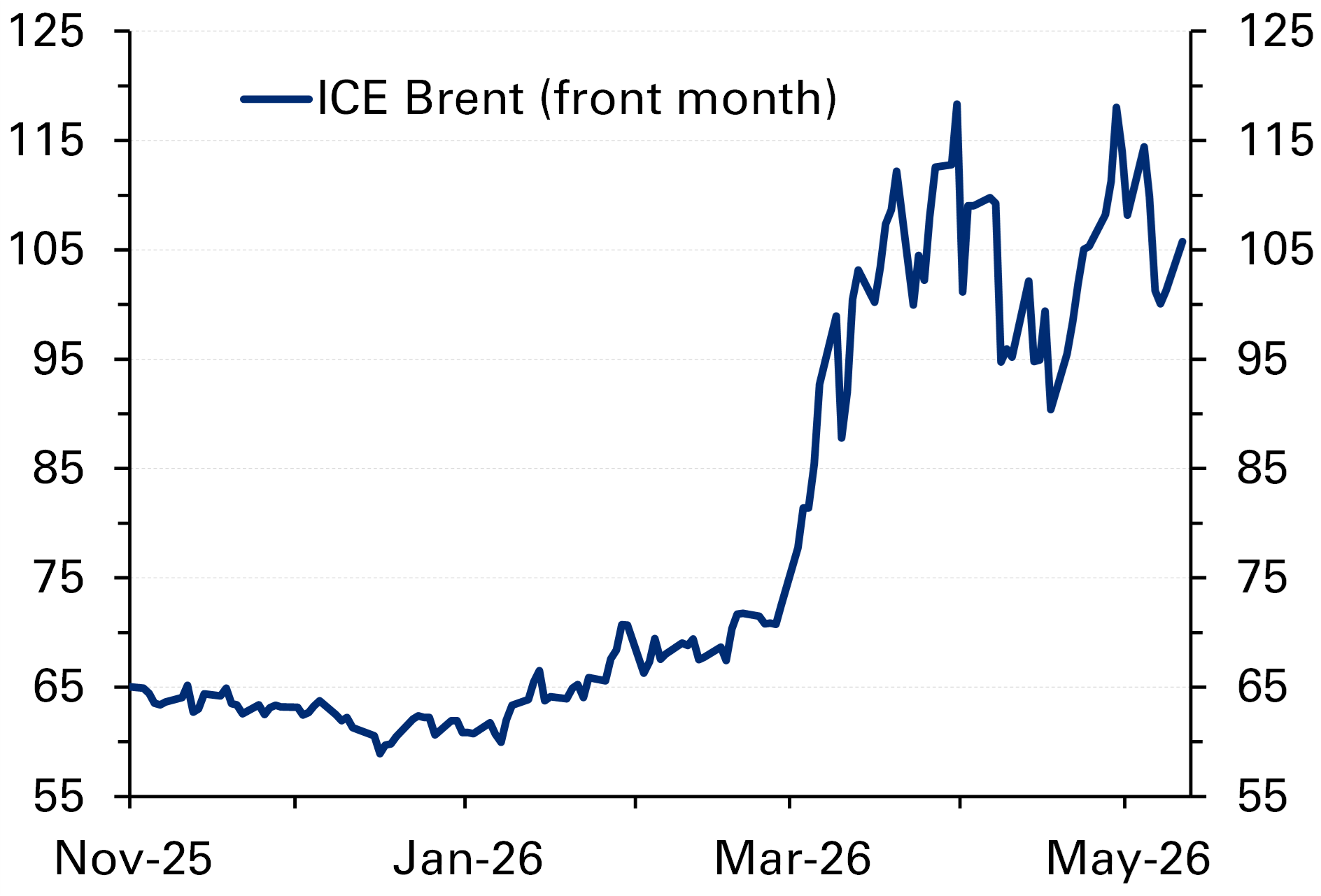
Oil: Prices rebound as optimism for an imminent US-Iran deal fades. Brent futures are up 4.5% in early Asian trading, hovering near $106/bbl, after US President Trump rejected Iran’s response to Washington’s latest proposal, describing it as “inappropriate” and “unacceptable.” The oil price rebound partially reverses last week’s 6.4% w/w decline, which had been driven by mounting optimism that both sides were nearing a peace agreement. However, prices remain below the levels of early last week, tempered perhaps by news that Trump’s visit to China this week could yield positive results on that front. Iran’s response to the US proposal reportedly included a series of maximalist demands, notably calling for a comprehensive end to the war rather than a ceasefire, the full removal of US sanctions, and the release of frozen Iranian assets. The nuclear issue remains a key sticking point, with the Iranian response reportedly envisaging that discussions on Iran’s nuclear program would only commence during the 30-day follow-on negotiation phase, after an initial understanding is reached, an approach that appears misaligned with US priorities. With both sides continuing to signal their maximalist demands, the negotiations impasse – and the current no-war no-peace status quo – is likely to continue.
Saudi Arabia: PIF returns to global debt markets, attracting strong investor demand. The Public Investment Fund (PIF) has returned to the international debt market for the first time since the outbreak of the regional conflict, raising $7 billion through a three-tranche bond issuance. The deal attracted strong investor appetite, with the order book exceeding $29 billion, more than four times the final issuance size. The strong demand allowed the PIF to tighten pricing across all maturities. The issuance included three-year, seven-year, and 30-year notes, with final pricing coming in at 95bps, 105bps, and 135bps over the respective US Treasuries. Notably, the 30-year tranche pricing was tightened by around 35bps from the initial guidance, highlighting robust confidence from global investors. The transaction marks PIF’s first public foreign-currency issuance since regional tensions overshadowed GCC capital markets. The PIF last tapped markets in January through a $2 billion 10-year sukuk, before heightened geopolitical uncertainty pushed many regional issuers toward private placements and domestic funding channels. The latest issuance sends an important signal that international public debt markets are reopening for GCC borrowers. While the deal is separate from Saudi Arabia’s sovereign borrowing program, its success could help improve market access for other Saudi issuers in the second half of 2026, particularly as the National Debt Management Center has indicated that most of this year’s sovereign funding has so far relied on private placements and local issuances. Overall, the strong investor demand reflects continued confidence in Saudi Arabia’s long-term credit story despite the ongoing regional uncertainty.
Saudi Arabia: Industrial production contracts sharply in March as oil output hit. The industrial sector recorded a sharp setback in March, reflecting the early economic impact of the ongoing regional conflict and reinforcing signs of the slower momentum already seen in broader economic indicators. According to preliminary data from GASTAT, the Industrial Production Index contracted 14.1% y/y (-22% m/m) in March, reversing February’s strong and upwardly-revised growth of 15% y/y (+3.8% m/m). The sharp decline was driven primarily by the oil sector, where activity contracted by 20% y/y, compared with a 20.5% expansion in February. This reversal was largely due to weaker output in both crude petroleum and natural gas extraction, which fell 22% y/y, and coke and refined petroleum products, which declined 11.6% y/y. The deterioration is closely linked to the disruptions caused by the regional conflict, particularly the impact on energy logistics and export flows during March. Meanwhile, the non-oil sector stagnated after growing 2.3% in February. While utilities-related activities remained positive, including gains in electricity and gas supply as well as water and waste management, these were offset by a 1% contraction in manufacturing activity, pointing to softer domestic industrial demand. The March reading aligns with other indicators showing a clear slowdown in economic activity during that period. It is consistent with the sharp drop in Saudi Arabia’s PMI, which fell into contraction territory in March, as well as with the weaker Q1 GDP growth of 2.8% y/y, the slowest pace in seven quarters. Taken together, the data suggests that the regional conflict had a tangible impact on economic activity by the end of the first quarter, with the industrial sector bearing the brunt of the initial shock.
Egypt: The World Bank approves $1 billion package in support of the reform agenda. The World Bank has approved $1 billion in concessional financing for Egypt under the second phase of its Growth Program, reinforcing the international support for the country’s ongoing structural reform effort. The package includes $800 million in direct financing by the World Bank and a $200 million credit guarantee backed by the UK government. This marks the second tranche of a three-stage Development Policy Financing program, launched in coordination with the IMF and the EU in June 2024. Unlike traditional project-based lending, this type of financing is disbursed directly into the state budget once the agreed reform milestones are achieved. The latest tranche is linked to reforms focused on state-owned enterprise governance, improving domestic debt market efficiency, enhancing competition frameworks, and expanding social protection integration, including the automatic enrollment of Takaful and Karama beneficiaries into the Universal Health Insurance System. Looking ahead, the World Bank is also working with Egyptian authorities on mechanisms to attract private sector investment into desalination, water infrastructure, and electricity projects, which will form the third and final phase of the program next year. The bank continues to identify tourism, agriculture, agribusiness, healthcare, renewable energy, infrastructure, and manufacturing as Egypt’s highest-potential sectors for driving exports, strengthening energy security, easing food inflation pressures, and creating jobs. In parallel, the Asian Infrastructure Investment Bank is expected to provide complementary financing support in the coming period. Overall, the financing approval reflects continued confidence in Egypt’s reform trajectory and provides an additional boost to external financing at a critical stage of economic adjustment.
Global: Trump-Xi summit in China, US April CPI, and UK Q1 GDP key matters this week. President Trump will visit China on 13-15 May for a summit with Chinese President Xi. Trade and overall economic relations between the two countries will be the focus of discussions. However, there is also the firm expectation that the situation in the Middle East and the closure of the Strait of Hormuz will be discussed, possibly opening a window for a breakthrough, given China’s good relations with Iran and the fact that it is significantly impacted by the Strait’s closure. Meanwhile, the US Senate will vote this week on confirming Kevin Warsh as the new Fed Chair as Powell’s term ends on Friday. In terms of data releases, in the US, CPI inflation for April is due on Tuesday and the consensus forecast is for a higher headline rate of 3.4% y/y from 3.3% in March with the core rate increasing to 0.4% m/m from 0.2% in March. Similarly, April’s core PPI inflation (Wednesday) is expected to accelerate to 0.3% m/m from 0.1% in March. Retail sales growth in April (Thursday) is seen slowing to 0.6% m/m after a solid 1.7% rise in March. In the Eurozone, industrial production for March (Wednesday) is expected to increase by 0.3% m/m, following a 0.4% rise in February while employment (Wednesday) is seen increasing by 0.2% q/q in Q1, in-line with Q4. In the UK, the Q1 GDP print is due on Thursday, with growth expected to improve to 0.6% q/q from just 0.1% in Q4. Finally in Japan, household spending for March (Tuesday) is expected to fall by 1.5% y/y, remaining in the red for the fourth-consecutive month.
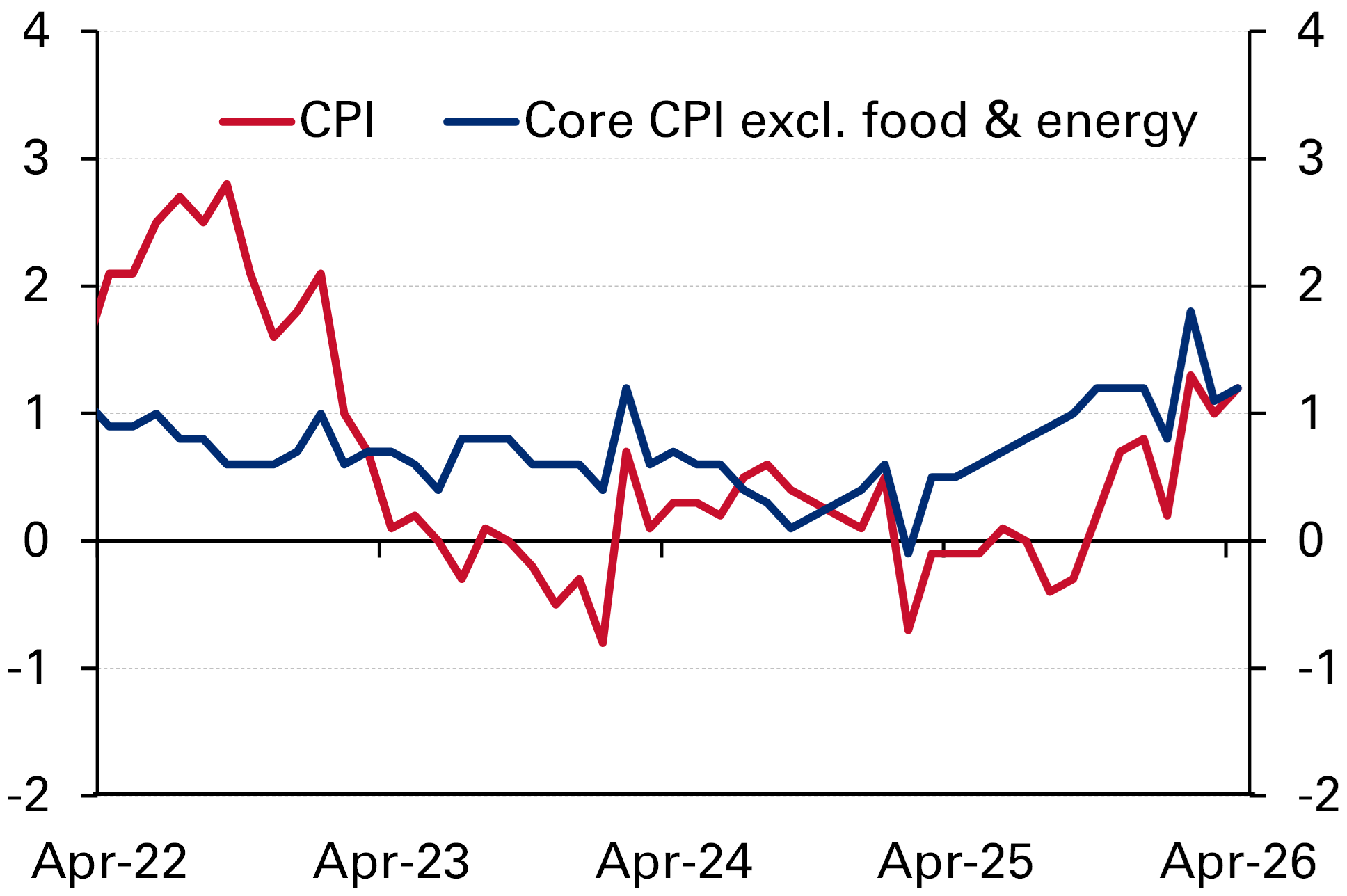
China: CPI and PPI inflation much higher than expected in April. April inflation data showed a firming in price pressures with headline CPI rising 1.2% y/y, up from 1.0% in March and sharply above market expectations of 0.8%. Price pressures were generally concentrated in fuel, transport, and some commodity linked items, while food prices fell 1.6% y/y. Core CPI (excluding food and energy) edged up only gradually to 1.2% y/y (1.1% in March), indicating that the underlying inflation momentum remained broadly contained so far. However, producer price inflation jumped to a much higher-than-expected 2.8% y/y in April (0.5% in March), reaching a 45-month high, as higher energy and commodity prices due to the Middle East war pushed up input costs. Overall, while domestic demand remains fragile, and likely not a reason for higher inflation going forward, the sustained energy price shock as well as the disruption to global supply chains are strong forces putting upward pressure on inflation in the months ahead.