
 +965 2292 4888


Daily Economic Update
25.03.2026
Oil: Prices range below $100/bbl amid reports of US submission of a plan to end the war. Brent futures were down about 4.8% this morning in Asian markets to below $100/bbl, having closed at $104.5/bbl yesterday, as a sustained US diplomatic push fueled optimism that the conflict in the Middle East could be approaching an end. Overnight, media reports indicated that the US had submitted a 15-point draft proposal to Iran via Pakistan outlining a pathway toward ending the war, with negotiations potentially leading to a one-month ceasefire between the parties. Key US demands, according to the reports, include that Iran (i) dismantle its nuclear infrastructure, including facilities at Natanz, Fordo, and Isfahan; (ii) transfer its enriched uranium stockpiles to the IAEA; and (iii) commit to refraining from pursuing nuclear weapons. In return, Iran would receive full sanctions relief, US support for its civilian nuclear program, and the removal of the “snapback” sanctions mechanism. US President Trump stated that Iran had already agreed to parts of the proposal, although Tehran has previously denied that any formal negotiations have taken place. Meanwhile, reports suggest that the Pentagon is deploying 3,000 troops from an elite airborne division, in addition to the 5,000 marines already on their way to the region. This dual track of diplomatic engagement and military buildup, alongside prior instances of strategic mistrust between the parties, underscores the uncertainty surrounding whether this round of negotiations will lead to a durable resolution of the conflict. Nevertheless, the geopolitical risk premium has eased for now, supported in part by Iran’s statement that “non-hostile vessels” may be permitted to transit the Strait of Hormuz provided they coordinate with Iranian authorities.
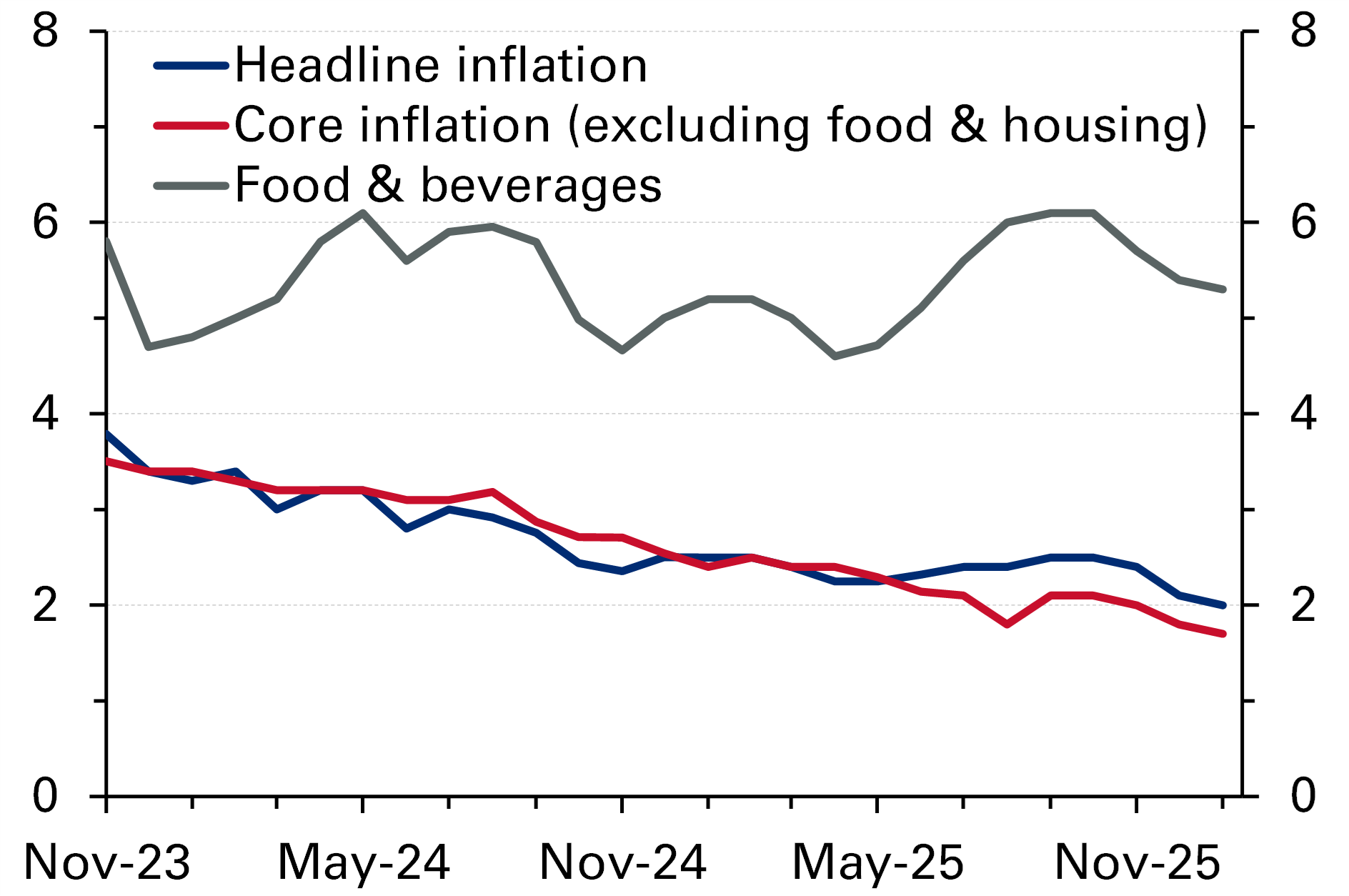
Kuwait: Inflation in January eases to multi-year low of 2%. CPI inflation eased to 2% y/y in January, its lowest level since September 2020 as disinflation continued to broaden across major CPI components. Food & beverage inflation slowed to 5.3% y/y, the third consecutive month of moderation, driven largely by easing pressures in fruits and vegetables, where price growth – elevated since the start of the pandemic – finally returned to 2019 levels. Housing services inflation held at 0.5% y/y, also helping to keep the headline rate low. Core inflation eased to a six-year low of 1.7% y/y, as disinflation persisted across the clothing & footwear (1.4% y/y) and furnishings & household maintenance (1.6%) categories. This was sufficient to offset the ongoing rise in the services & miscellaneous goods category (+6.9% y/y), which continues to reflect higher precious metals prices. The transportation index recovered from last month’s brief dip into deflation territory, but was flat (0% y/y), while price growth across the recreation, education, and healthcare components was unchanged. Looking ahead, the current geopolitical climate could have an uneven effect on domestic inflation both due to consumer behavior as well as supply chain dynamics. For instance, consumer spending growth, which was negative in 2025, is likely to remain weak as consumer preferences shift more toward essential items and precautionary saving. Indeed, the latest ARA consumer confidence survey reveals that the spending on durable goods component fell sharply in February (survey period 28 February – 4 March, covering the start of the war) – on a par with Covid levels. Meanwhile, Kuwait’s import dependence is a significant point of vulnerability, particularly for food and basic commodities as shipping activity through the Strait of Hormuz remains disrupted. And while some shipments are being diverted to land routes, prices are likely to rise further given the reduced supply volume and costlier freight expenses from higher oil prices.
Egypt: Remittances surged ahead of regional tensions. Remittances from Egyptians working abroad continued their strong upward trend during the first seven months of FY25/26. According to the Central Bank of Egypt, remittance inflows rose by 28% y/y to $25.6 billion during the period from July 2025 to January 2026, compared with $20 billion in the same period last year. On a monthly basis, remittances increased by 21% y/y to $3.5 billion in January 2026, highlighting sustained inflow momentum at the start of the year. The latest data does not yet reflect the impact of recent regional geopolitical tensions, with any potential effects likely to appear starting from March. However, despite the uncertainty, remittances are expected to remain a key and relatively stable source of foreign currency inflows for Egypt. This is particularly important given the potential downside risks to other foreign currency generating sectors, such as tourism and Suez Canal revenues, should the current conflict persist over the coming months.
US: S&P Global PMI drops to an 11-month low in March with inflation accelerating. The S&P Global flash composite PMI declined to an 11-month low of 51.4 in March from 51.9 in February as price pressures intensified and demand conditions diverged across sectors. Services weakened to 51.1 from 51.7, also the lowest in 11 months, but manufacturing was more robust at 52.4 versus February’s 51.6, remaining in expansion territory for eight consecutive months. The services sector reported falling export orders and weak demand, but manufacturing saw accelerated growth in output and new orders. Amid higher energy prices and some Middle East war-related supply chain disruptions, input and output prices recorded quick increases, with selling prices showing the biggest rise in over three-and-a-half years. Employment dropped for the first time since February 2025, albeit modestly. The survey noted that the Middle East war presented additional uncertainty about demand and inflation, impacting travel, tourism, transport as well as financial markets. Meanwhile, labor productivity growth in Q4 was revised down to a slower than initially estimated level of 1.8% (annualized) from a very solid 5.2% in Q3, though it remained robust overall. Finally, Fed Governor Michael Barr pitched to “keep [interest] rates steady for some time,” awaiting evidence of inflation retreating sustainably “before considering reducing the policy rate further, provided labor market conditions remain stable.” He also noted additional risks from the Middle East war on energy prices.
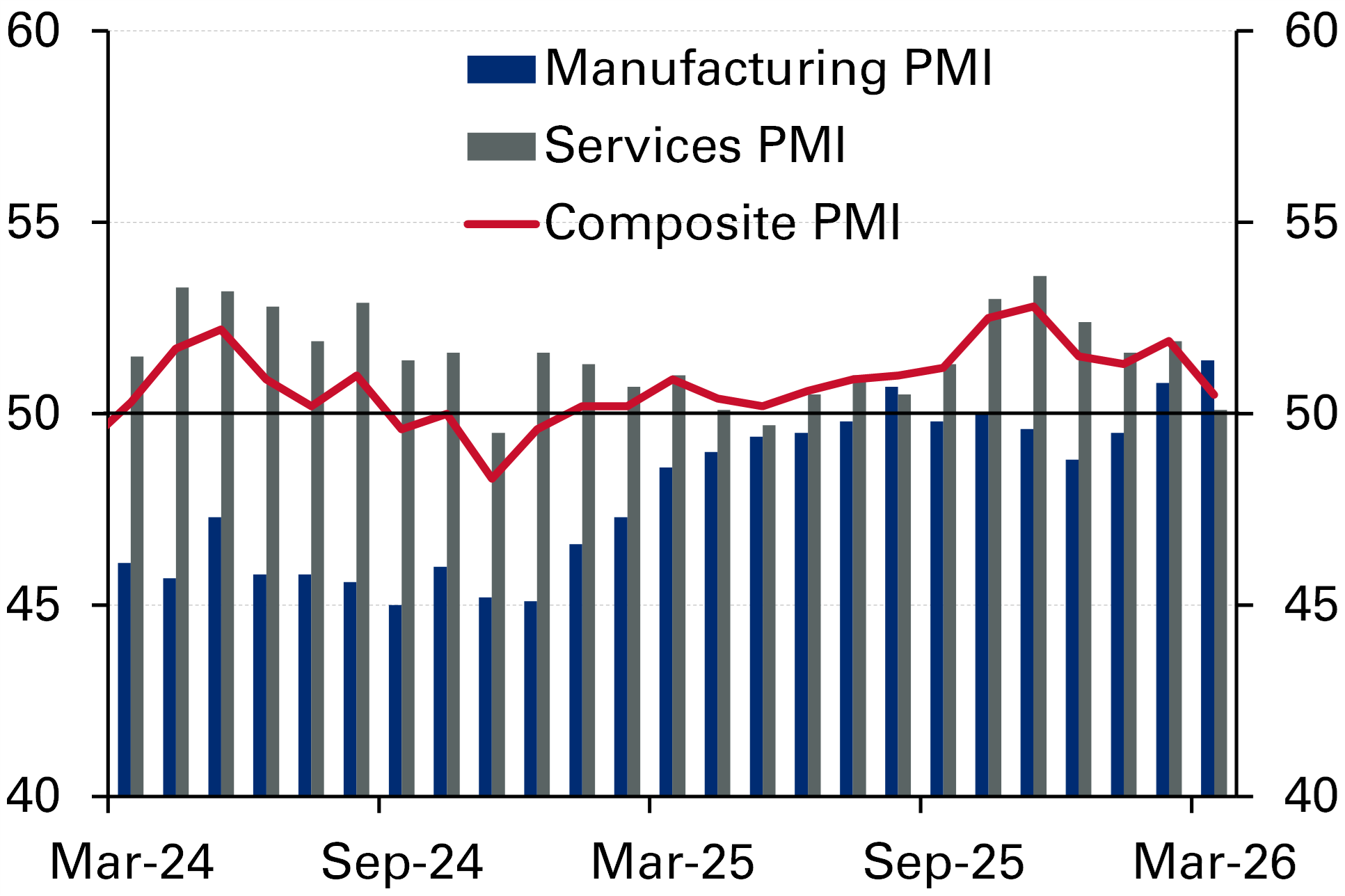
Eurozone: PMI falls to a 10-month low as the Middle East war fuels an inflation surge. Flash PMI readings point to a clear loss of momentum across the Eurozone in March, with the composite PMI falling to 50.5 from 51.9 in February, its slowest pace of expansion since May 2025. The services sector PMI fell to a 10-month low of 50.1 (51.9 in February) with firms reporting slower demand and rising cost pressures. However, the manufacturing PMI increased to 51.4 from 50.8 in February, beating expectations. Companies across both sectors faced the fastest increase in input costs in more than three years, while output charges rose at the sharpest rate since early 2024—reflecting resurgent energy prices and renewed supply chain disruptions linked to the Middle East war. Taken together, March’s readings reflect a fragile expansion with mounting stagflation risks, underscoring the increasingly complex environment confronting the ECB as it weighs growth headwinds against a potential re-acceleration in underlying price pressures.
UK: Composite PMI drops to a six-month low amid the fallout from the Middle East war. The S&P Global flash composite PMI fell to a six-month low of 51 in March from 53.7 in February, widely missing the consensus forecast of 52.9. The services gauge dropped to 51.2 from February’s 53.9, the weakest since September 2025, while the manufacturing measure eased to a three-month low of 51.4 from 51.7. Firms were generally concerned about rising cost pressures, supply chain disruptions, weakening demand, and impairments to cargo and tourist movements amid the fallout from the ongoing war in the Middle East. Both input and output price inflation rose, with input cost inflation surging steeply to hit the highest level since February 2023. Margin pressure and weakening demand drove a further decline in employment, and at a faster pace than in February. The expectation gauge also fell to a nine-month low as a worsening geopolitical situation dampened business confidence. We note that if the current surge in energy prices sustains for long, the UK economy will face several challenges including higher inflation, a squeezed consumer wallet and potentially higher BoE policy rates in 2026, besides limited government fiscal headroom to support growth.