
 +965 2292 4888


Daily Economic Update
09.07.2026
Global: IMF cuts 2026 global growth forecast to 3.0% from 3.1% and raises the inflation forecast to 4.7%. In its World Economic Outlook update published yesterday, the IMF trimmed its 2026 global growth forecast again, down to 3% from 3.1% seen in April. The IMF noted that the adverse effects of the Middle East war were being partially offset by accelerated artificial intelligence related demand/investment, resulting in only a modest decline in the 2026 growth forecast. The global inflation forecast for 2026 was raised to 4.7% from 4.4% seen before (4.1% in 2025), mainly reflecting the impact of higher energy and food prices. The IMF anticipates a gradual easing in underlying price pressures, with core inflation projected to return to target by mid-2027 in the UK, by end-2027 in the US and Japan, and by 2028 in the Eurozone. Among the major economies, the IMF forecasts 2.3% growth in the US in 2026 (unchanged from the April forecast), 0.9% in the Eurozone (down from 1.1%), 1% in the UK (up from 0.8%), 0.6% in Japan (down from 0.7%) and 4.6% in China (up from 4.4%).
US: FOMC June meeting minutes reveal a split between members about the expected level of interest rates by year-end. Minutes of the FOMC meeting in June revealed a split between participants about their expected level of the policy rate by year-end. Specifically, “many participants indicated that the appropriate level of the federal funds rate would be within or slightly below the current target range at the end of this year”, while “many other participants, however, assessed that the appropriate level of the federal funds rate would be above the current target range at the end of this year”. On inflation versus labor market risks, “participants generally assessed that information received over the intermeeting period suggested that upside risks to price stability remained elevated while downside risks to achieving maximum employment had moderated a bit”. On the possibility of having raised rates in the June meeting, few participants believed there was a case for that, although they eventually supported the decision to keep rates unchanged. On economic growth, the general expectation was that it will continue to be solid for the remainder of this year. On the FOMC’s communications topic, only “some” participants mentioned that they welcome the opportunity to review the current tools and practices. Finally, the minutes mention that the AI buildout is one factor pushing up inflation forecasts this year and next year.
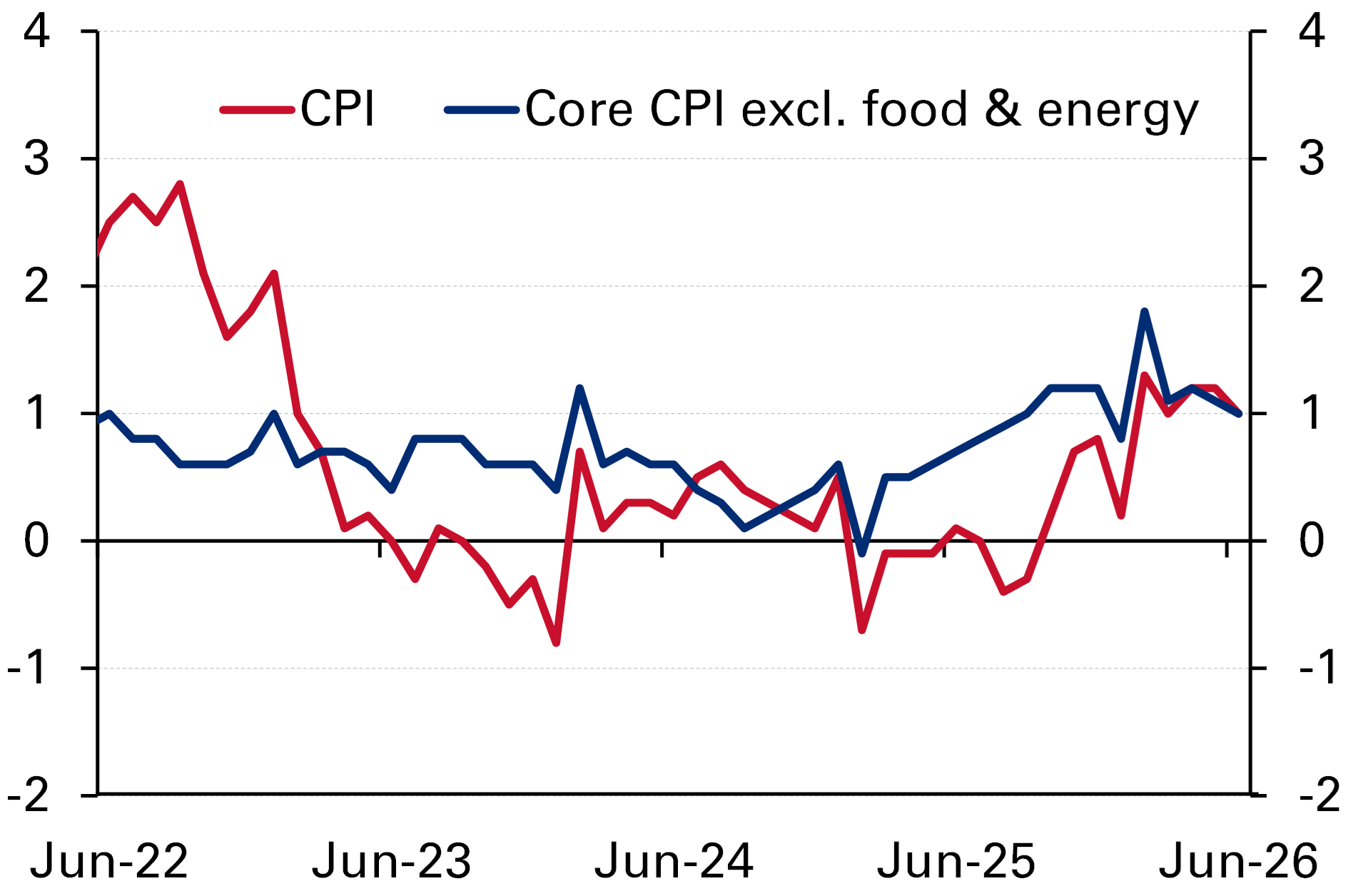
China: Consumer price inflation softens in June while PPI inflation hit a four-year high. Headline CPI inflation eased to 1.0% y/y in June from 1.2% in May, slightly below expectations of 1.1%, while the core rate also softened to 1.0% from 1.1%, highlighting still-modest underlying consumer price pressures. This was driven in part by non-food inflation, which moderated to 1.5% y/y in June from 1.9% in May, due to softer transport costs following declines in domestic fuel prices. In contrast, producer price inflation accelerated to 4.1% y/y in June from 3.9% in May, marking its highest level since July 2022. The increase was driven by stronger price growth in selected industrial and technology-related sectors, including industries linked to AI and advanced manufacturing. The June inflation data reinforces the picture of a two-speed economy, with stronger industrial activity contrasting with still-modest consumer price pressures and subdued household demand.
Oil: Prices rise amid continued US-Iran escalation. Brent crude futures rallied 5.2% yesterday and have gained a further 1.2% in early trading today, pushing prices close to $79/bbl, their highest level in roughly two weeks. The move reflects a renewed build-up in geopolitical risk premia as tensions between the US and Iran continue to escalate. The latest gains come after the US and Iran exchanged strikes for a second consecutive night, with US President Trump declaring that the ceasefire agreed earlier this year was effectively “over.” In response to the latest US strikes, Iran launched attacks targeting Bahrain, Kuwait, and Qatar. Despite the escalation, there have yet to be signs of a significant disruption to energy flows through the Strait of Hormuz. S&P Global data shows that vessel traffic has remained broadly stable, with transit volumes holding near recent levels rather than experiencing a renewed collapse. The recent developments suggest that a new escalation cycle may be emerging as key elements of the US-Iran memorandum of understanding come increasingly under strain: (i) Washington has continued efforts to advance regional security arrangements outside of direct Iranian involvement such as the US-brokered Lebanon-Israel agreement, (ii) Washington continues to advance different security arrangements in and around the Strait of Hormuz, and (iii) the re-imposition of US sanctions on Iranian oil exports, all of which have added further pressure to an already fragile diplomatic framework. While President Trump has adopted a more confrontational tone, diplomatic channels remain open and technical discussions linked to the broader agreement have not been formally abandoned. Nevertheless, the continued exchange of strikes highlights the fluid nature of the situation and raises the risk that further military incidents could reintroduce a larger geopolitical premium into oil prices.
Egypt: CBE expected to hold rates steady while turning to liquidity tools. The CBE’s Monetary Policy Committee (MPC) is widely expected to leave policy interest rates unchanged at today’s meeting, maintaining the overnight deposit rate at 19% and the overnight lending rate at 20%. While inflation has eased for two consecutive months, price pressures remain elevated and continue to sit well above the CBE’s inflation target. The recent resurgence in regional tensions over the past few days has also added a new layer of uncertainty to the inflation outlook, particularly through its potential impact on global energy prices, transportation costs, and supply chains. Against this backdrop, we believe the CBE is likely to maintain its current cautious stance and continue with a wait-and-see approach until the disinflation trend becomes more firmly established. At the same time, the CBE has other instruments at its disposal to manage domestic monetary conditions without adjusting policy rates. Recent fixed-rate deposit auctions under the Open Market Operations (OMOs) framework suggest that liquidity conditions in the banking sector have become tighter, as reflected by lower participation levels from banks in recent weeks. As a result, we believe the CBE may consider reducing the Reserve Requirement Ratio (RRR) by 200 basis points, bringing it back to 14%. Such a move would inject additional liquidity into the banking system and help accommodate funding needs without altering the overall monetary policy stance. With real interest rates remaining comfortably positive, the CBE still has ample room to keep policy rates unchanged while monitoring the impact of regional developments on inflation and financial conditions. For now, preserving monetary stability appears to take precedence over resuming the easing cycle.
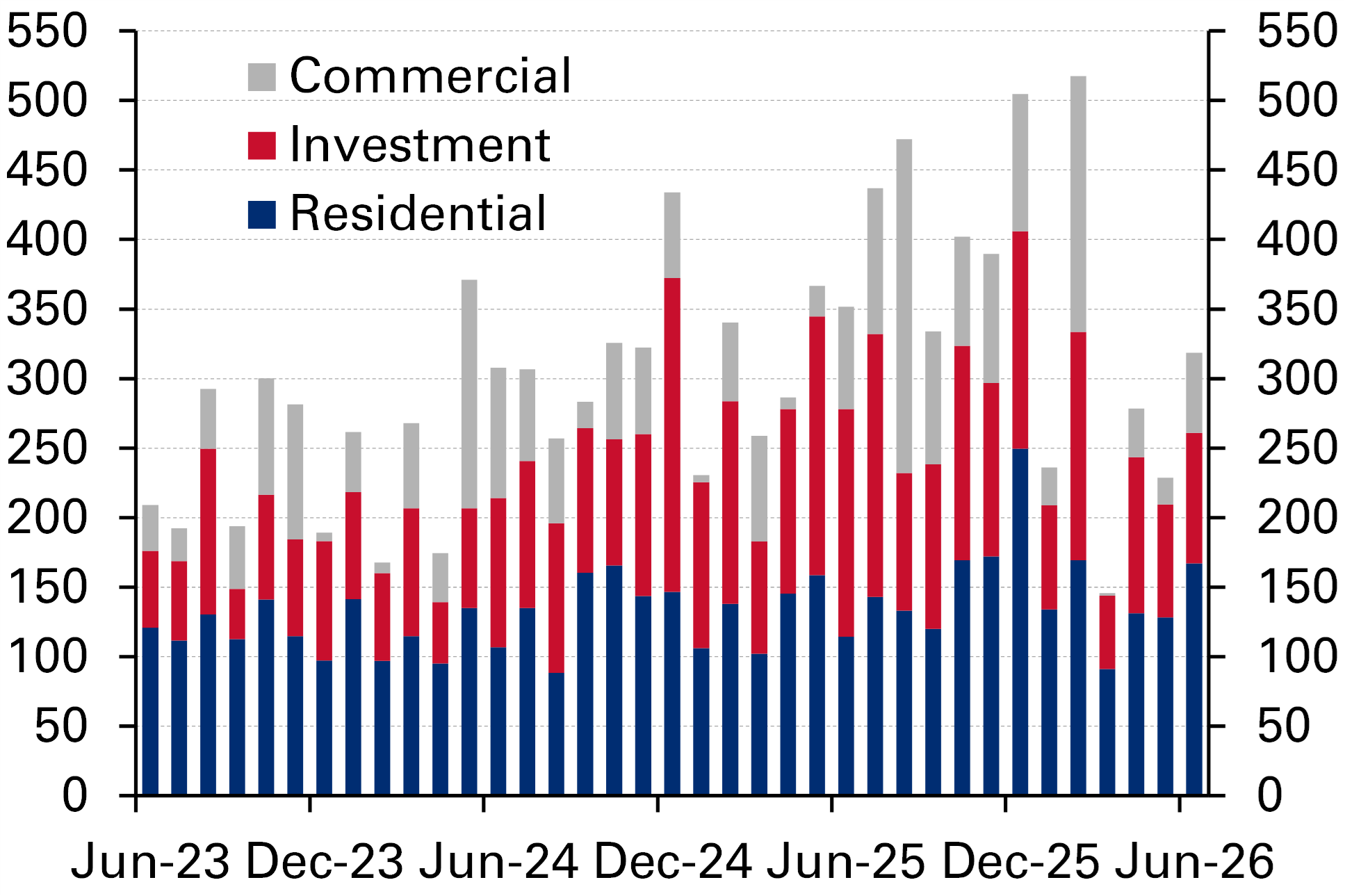
Kuwait: Real estate sales continued to recover in June amid an improving geopolitical sentiment. Property sales continued to recover in June following the sharp weakness recorded during the Middle East war, reaching their highest level since February, coming at KD 319 million (+39% m/m, -9.4% y/y) supported by stronger monthly activity across all three sectors. Residential sales rose to KD 167 million (+30% m/m, +46% y/y), broadly returning to their pre-war level in February, while residential transactions climbed to their highest monthly level since June 2022. Investment sales also improved to KD 94 million (+16% m/m, -43% y/y), supported by stronger transaction volumes, although activity remained well below year-ago levels, reflecting still-cautious investment sentiment. Meanwhile, commercial sales rebounded to KD 58 million (+194% m/m, -22% y/y), reversing the decline recorded in May. Despite the improvement in June, total sales in H1 2026 declined by 6% y/y to KD 1.7 billion, with the weakness concentrated in the investment segment with a drop of 30% y/y to KD 579 million. By contrast, residential sales expanded by 7.4% y/y to KD 821 million, while commercial sales increased by 34% to KD 325 million, largely driven by strong activity during the pre-war first two months of the year. Looking ahead, the real estate market should continue to benefit from the easing geopolitical tensions, though occasional breaches of the US-Iran agreement could continue to weigh on sentiment in the near term.
Saudi Arabia: Construction sector records in June its strongest growth of 2026. Saudi Arabia’s construction sector gained significant momentum in June, supported by stronger activity across residential, commercial, and infrastructure projects as regional conditions stabilized and delayed projects resumed. The Saudi Construction Index rose sharply from 51.2 in May to 56.3 in June, marking its strongest reading since the survey began in January 2026, and signaling a solid expansion in sector activity. The improvement was broad-based across all major segments of the market. Residential construction remained the strongest performer, supported by robust housing demand, while non-residential activity accelerated to the fastest pace since February on the back of growing commercial and industrial project pipelines. Infrastructure activity also returned to growth, driven by ongoing investment in utilities and transportation projects. Construction firms reported stronger new orders and improving business conditions during the month, reflecting both the easing of regional uncertainty and continued government spending under Vision 2030. June’s figures suggest that Saudi Arabia’s construction sector is regaining momentum after the disruption seen earlier in the year. The recovery in infrastructure and commercial projects, alongside continued strength in housing, points to a stronger second half of 2026 as Vision 2030 investments continue to move forward.