
 +965 2292 4888


Daily Economic Update
01.04.2026
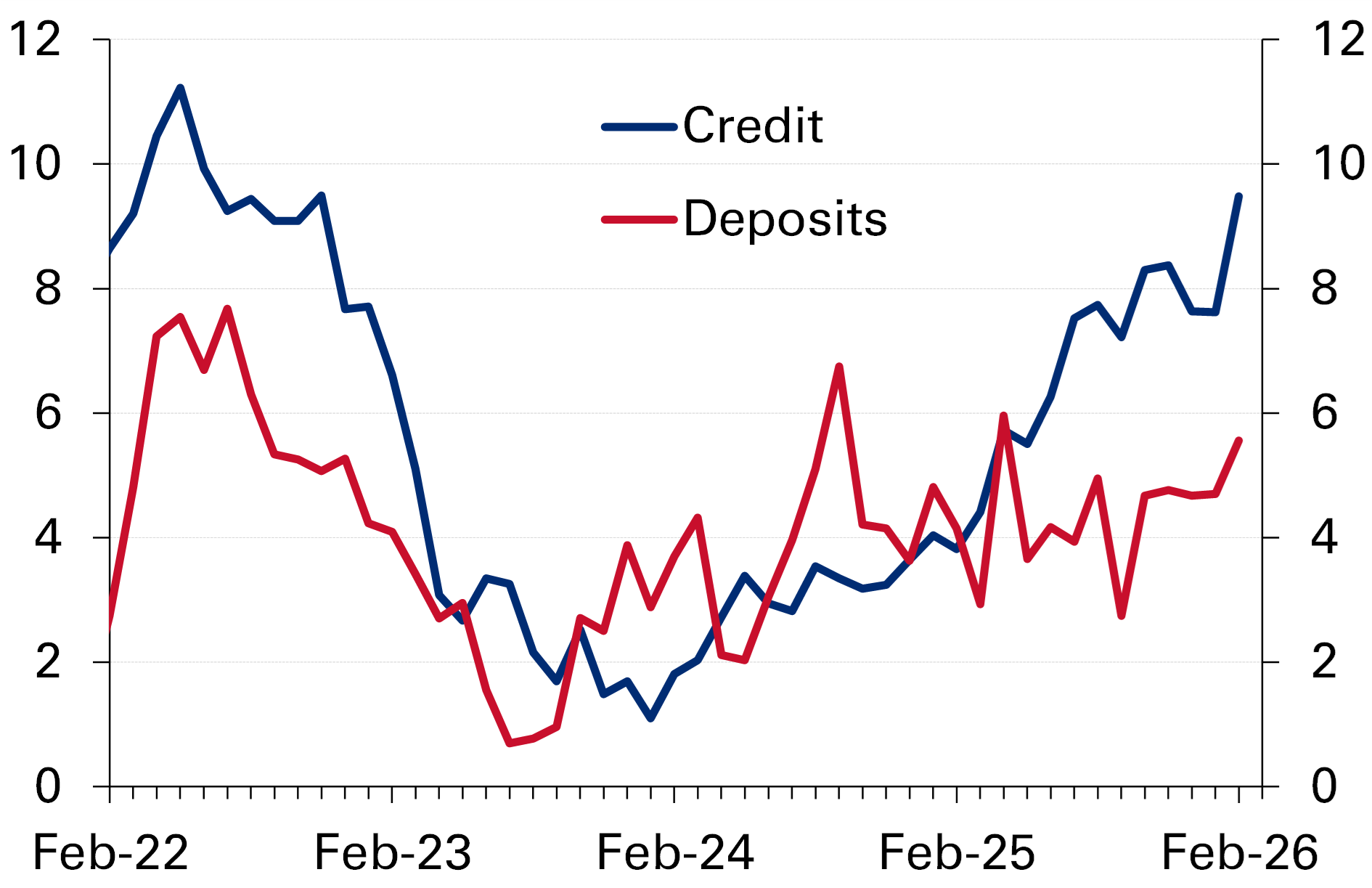
Kuwait: Solid credit growth in February led by credit to businesses and banks. Domestic credit increased by a very solid 2.2% m/m in February, the fastest growth since the pandemic, driving up YTD growth to 2.5% (9.5% y/y). Growth was mostly driven by business credit, which remained strong for the second consecutive month (1.3% m/m), pushing up the YTD increase to 2.3% (6.9% y/y). Growth in credit to businesses was broad-based with credit to Industry (1.4% m/m), Oil & gas (3.1%), and public services (70.5%) particularly strong in February. In addition, credit to the household sector increased by 0.2% m/m, slightly easing from 0.3% in January, and driving YTD growth to a limited 0.5% (3.9% y/y). Outside of these ‘core’ sectors, credit to banks and other financial institutions jumped 26% m/m, pushing the YTD increase to 21% (50% y/y) and boosting overall credit growth. Meanwhile, credit to non-residents logged a monthly decline of 3.4% for the first time in four months. On the liabilities side, residents’ deposits inched up by 1.2% m/m in February (+2.1% YTD and 5.6% y/y), the highest since August 2025, supported by a 0.9% increase in private sector deposits and a solid increase (1.7%) in public sector deposits. Within private-sector KD deposits, CASA logged the highest increase in deposits at 4.5% m/m (3.5% YTD), while KD time deposits growth slowed to -0.9% m/m (-0.1% YTD). Looking ahead, the ongoing Middle East war and the associated disruptions to regional supply chains, particularly following the closure of the Strait of Hormuz, will affect business sentiment and financing needs with the impact on domestic credit demand to begin appearing in the March data.
Qatar: Fitch places Qatar’s rating on negative watch; Central Bank passes liquidity support measures. Fitch Ratings has placed Qatar’s rating (AA) on negative watch, citing heightened uncertainty around the security environment and the risk of further damage to LNG infrastructure. The agency noted that security risks have “permanently deteriorated”, suggesting that even if the current conflict was to end soon, the likelihood of renewed military escalation in the Gulf would remain elevated. The risk of additional damage to Qatar’s LNG facilities remains high, but beyond that, the conflict is having a deleterious effect on the non-oil economy, through sharply reduced tourism and investor confidence as well as more broadly through lower consumer activity. On risks to Qatar’s all-important energy sector, the conflict has already caused around 17% of liquefaction capacity to be taken offline, with QatarEnergy (QE) estimating repair timelines of up to five years and annual revenue losses of approximately $20 billion, excluding potential delays to North Field expansion projects. Fitch further highlighted that any escalatory US/Israeli strikes on Iran’s hydrocarbon infrastructure would likely trigger retaliatory attacks on GCC energy assets, including those in Qatar. The disruption to LNG operations is also weighing on public finances, given that hydrocarbon revenues account for roughly 80% of total government income. Partially offsetting these pressures, Golden Pass LNG - a joint venture between QE (70%) and ExxonMobil (30%) in the US - has commenced production, with exports of up to 18 mtpa expected to ramp up this quarter. More broadly, Qatar retains a strong balance sheet and is well positioned to absorb a temporary loss in hydrocarbon revenues, supported by sovereign net foreign assets estimated at 226% of GDP. Meanwhile, in a bid to support domestic liquidity, the Qatar Central Bank (QCB) has introduced several measures, including: (i) lowering the reserve requirement ratio on deposits from 4.5% to 3.5%; (ii) offering unlimited Qatari riyal repo facilities against eligible securities; and (iii) introducing new term repo facilities with maturities of up to three months. On the borrower side, the QCB will also allow banks to defer loan principal and interest payments for up to three months, providing temporary relief to households and businesses.
Oil: Prices post largest monthly gain on record as Trump tells countries to go “get your own oil”. Brent (May contract) topped $118/bbl (+4.9% d/d) on Tuesday, its highest end-of-day finish since the conflict began and its largest monthly increase on record at 63%. Once again, a social media post by President Trump was the trigger: he suggested that countries dependent on the Strait of Hormuz for jet fuel especially buy from the US (“we have plenty”) or failing that, just “go get your own oil”. The remarks added to reports that the US and Iran were more open to a resolution than before and further comments from the president that he saw the US withdrawing from the conflict within two to three weeks. The fate of the Strait of Hormuz could be left to the Iranians and countries dependent on it to sort out, Trump seemed to suggest. The White House announced that President Trump will be addressing the nation on Wednesday for an important update. Brent futures prices (June contract) were ranging around $104/bbl this morning in Asian trading.
US: JOLTS report shows a gradual easing in job market conditions; US stocks see sharp relief rally on Middle East war-related optimism. Job openings in February (JOLTS report) dropped to 6.9 million from January’s eight-month high of 7.2 million. Indicating some further loosening in employment conditions, the hiring rate fell to the lowest level since April 2020 at 3.1% from 3.4% in January, with the quits rate easing to 1.9% from 2%. The layoffs rate also ticked up but was overall modest, signaling no material increase in joblessness, corroborating well with other data points such as moderate levels of weekly unemployment claims and underscoring the ongoing decreased hiring and low firing landscape. Separately, the Conference Board’s consumer confidence index unexpectedly increased to 91.8 in March from February’s 91, supported by an uptick in the present situation measure which offset the weakness in the expectations subindex. More consumers saw jobs were ‘plentiful’, but a higher number also stated jobs were ‘hard to get’, implying a mixed outlook on the job market. Amid concerns about higher energy prices, consumers’ year-ahead inflation expectations also rose. Meanwhile, lifted by improved investor optimism about a resolution to the Middle East war soon, US stocks staged a massive relief rally yesterday, with the S&P 500 rising by 2.9%, the biggest daily increase since May 2025, which helped trim the loss since the war began to 5.1%. Yields on UST 10Y bonds also decreased somewhat to close at around 4.3%.
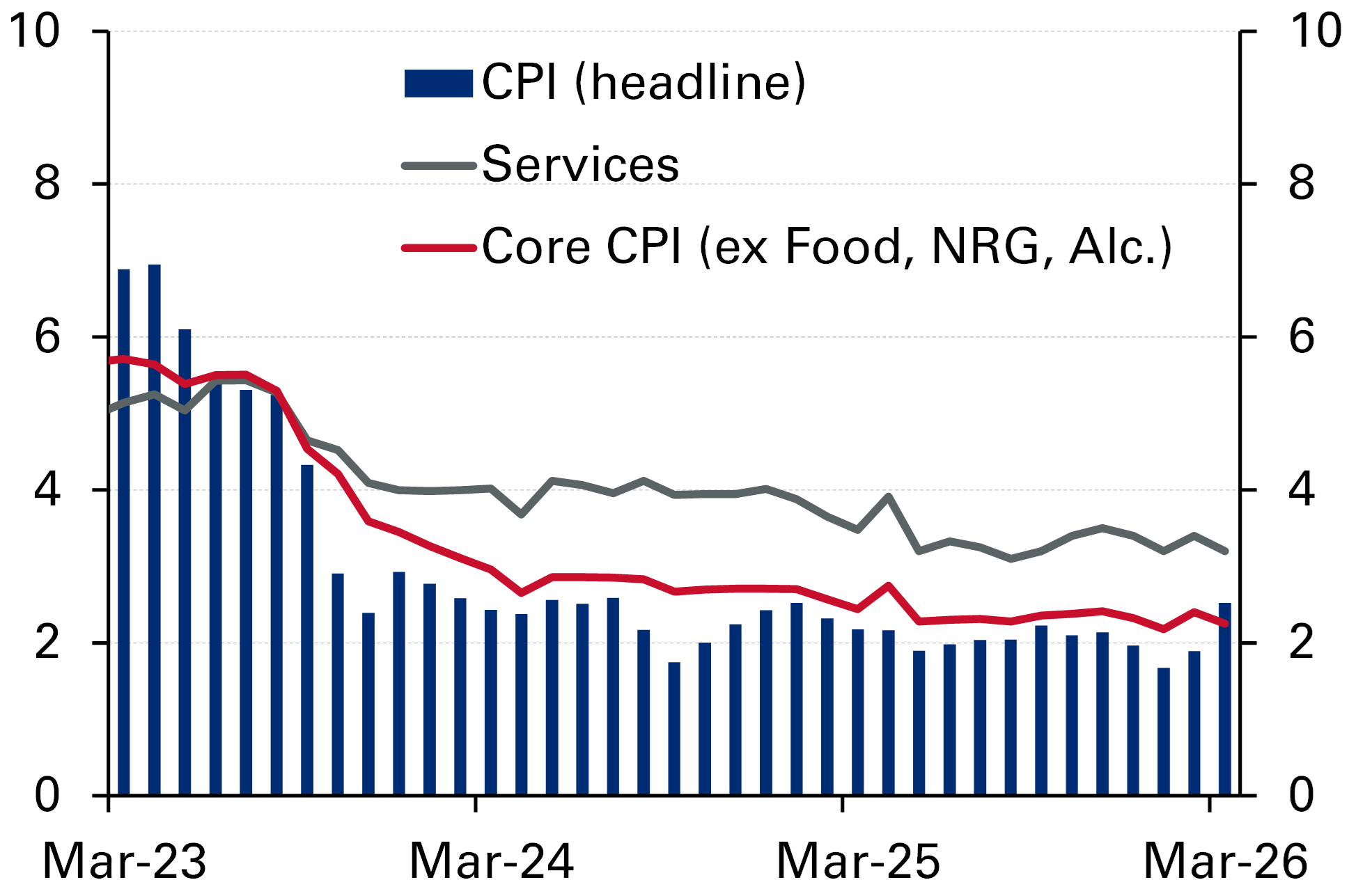
Eurozone: Inflation spikes to 2.5% in March on higher energy costs. Flash Eurozone inflation accelerated to 2.5% y/y in March 2026, rising from 1.9% in February, but a touch lower than expectations of 2.6%. The main driver of this jump was a strong rebound in energy prices (9% of the HCIP basket), which surged by 6.8% m/m in March, leading to a 4.9% y/y increase, rebounding from a 3.1% decrease in February. The key services inflation moderated to 3.2% y/y in March from 3.4% in February. Non-energy industrial goods inflation slowed to 0.5% y/y (from 0.7%) signaling continued softness in goods-related price dynamics. Core inflation, meanwhile, dipped marginally to 2.3% y/y in March from 2.4% in February, coming below expectations of 2.4%. We note that the ECB forecasts headline inflation to average 3.1% in Q2, and has signaled it is prepared to raise rates if upside pressures persist. While things are developing given the Middle East war, the markets currently see the 30 April ECB meeting, and if not, the 11 June meeting as the timing for a first rate hike by the bank.
UK: House prices accelerate in March but the outlook is more cautious. The Nationwide House Price Index showed an unexpected acceleration in March, rising by 0.9% m/m after a 0.3% increase in February, recording the fastest monthly rise in 16 months. On an annual basis, house prices climbed by 2.2% following February’s 1% growth. Nonetheless, the current energy price shock following the Middle East war and the resulting higher inflation on top of slowing wage growth will likely squeeze UK household finances over the coming months, which, along with potentially higher mortgage rates later this year may weigh on the UK residential property market in 2026.