
 +965 2292 4888


Daily Economic Update
15.12.2025
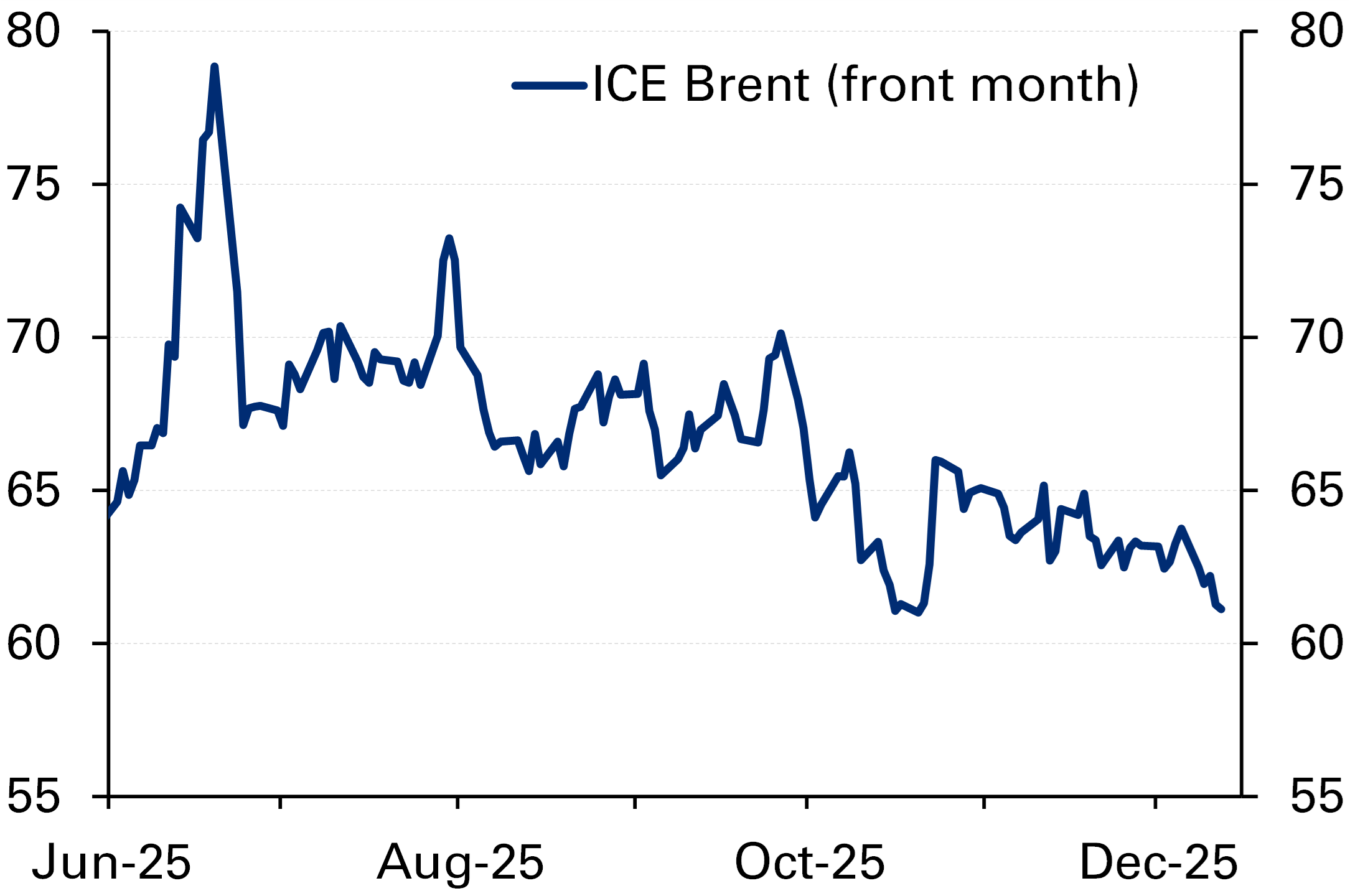
Oil: Prices post weekly losses on supply concerns; IEA revises up demand outlook. Brent futures closed at $61.1/bbl on Friday, shedding 4.1% w/w as oversupply concerns and a potential Russia-Ukraine peace deal dominated sentiment last week. These bearish catalysts also outweighed the increase in geopolitical risk caused by the US’s seizure of an oil tanker off the coast of Venezuela last Wednesday. This incident may not be an isolated one, either, with concerns that the US intends to ramp up the pressure further on the Maduro regime in the weeks and months ahead, which could lead to a curtailment of oil exports from the Latin American country. The International Energy Agency (IEA) highlighted this risk in its December monthly oil market report, revising down its supply glut estimate for next year by 250 kb/d to (a still huge) 3.8 mb/d partly on the prospect of such supply losses from sanctioned countries and partly on the expectation that oil demand will prove better than expected (+90 kb/d to 860 kb/d) amid improving economic activity. The IEA also upped its oil demand growth forecast for this year, by 50 kb/d to 830 kb/d. Transportation fuels and petchems are expected to drive annual gains over the forecast period. The IEA also acknowledged the disconnect between its consistently voiced view of a developing market surplus and the observation that inventory readings at key pricing hubs are at decade-lows, but explained this as being due to record volumes of oil on water; the IEA did note also the difficulty in reconciling these record oil-on-water volumes with a Brent forward curve that trends lower over time (backwardation), usually a disincentive for oil storage. Meanwhile, OPEC, in its own monthly oil market report, kept its oil demand growth forecasts unchanged from November’s at 1.3 mb/d and 1.4 mb/d for 2025 and 2026, respectively. In contrast to the IEA, it sees a market in relative balance next year. In terms of oil production, according to OPEC secondary sources, OPEC-8’s crude output jumped by 126 kb/d m/m in November to 32.96 mb/d, slightly below the pledged 137 kb/d increase. Production increased the most in Saudi Arabia (+54 kb/d) and Kazakhstan (+36 kb/d). Group-wide production, including quota-exempt members, rose by a smaller 43 kb/d m/m to 43.06 mb/d amid declines in Venezuela (-27 kb/d), Iraq (-21 kb/d), and Iran (-19 kb/d).
China: November’s retail sales, industrial production, and investment much weaker than expected. China’s industrial production figures continued to deteriorate in November, growing by a weaker-than-expected 4.8% y/y (4.9% in October), the lowest growth since August 2024. Similarly, retail sales growth fell to an almost three-year low of 1.3% y/y in November (2.9% in October) despite the ongoing subsidy programs, well short of the 2.9% consensus estimate. Meanwhile, the contraction in fixed asset investment deepened to 2.6% y/y in 11M2025 (-1.7% in 10M2025), marking its weakest level since the middle of the pandemic in June 2020 and falling well below already subdued expectations. Finally, new home prices fell 2.4% y/y in November (-2.2% in October) with the drop accelerating for the first time in over a year. All indicators show that the Chinese economy continues to lose momentum, increasing chances of a stronger policy support in the first quarter of 2026.
Global: ECB, BoE, and BoJ meetings as well as jobs and inflation data in the US key matters this week. In the US, the delayed non-farm payroll reports for October and November will be released on Tuesday, with the consensus forecast indicating job growth of 35K in November and an unemployment rate of 4.4%. CPI inflation for November (on Thursday) is seen at 3.2% y/y for both the headline and core. The latest available inflation rates (for September) stand at 3% for both. Retail sales for October (Tuesday) are expected to increase by 0.2% m/m, matching September’s rise. In the Eurozone, the ECB is widely expected to leave rates unchanged on Thursday, while providing updated projections for GDP and inflation. Meanwhile, the HCOB Eurozone flash PMIs for December (Tuesday) are seen edging up for both services (to 53.9 from 53.6 in November) and manufacturing (49.9 from 49.6). In the UK, the BoE’s MPC meeting outcome is on Thursday, with the market expecting a 25bps cut in the bank rate. November CPI inflation will be released on Wednesday, and the street forecasts a slower headline rate of 3.5% y/y (3.6% in October) but a steady core rate (3.4%). Meanwhile, the consensus forecast for the S&P Global flash PMIs for December (Tuesday) is for no-change in manufacturing (50.2) but a slight improvement in services (to 51.5 from 51.3 in November). Finally in Japan, the BoJ meets and is expected to hike rates by 25 bps on Friday, the first increase since January. On the same day, November inflation is due with the core rate seen steady at 3% y/y. The S&P Global flash PMIs for December are due on Tuesday with the manufacturing gauge seen inching up to 48.8 from 48.7 in November.
Oman: Trade surplus shrinks amid lower oil prices and higher importation. Oman's external trade surplus declined by 42% y/y during the first nine months of this year, to OMR3.9 billion ($10 billion) from a surplus of OMR6.7 billion during the same period in 2024, according to preliminary official statistics. The data also showed a 9.1% y/y decrease in the total value of merchandise exports, reaching OMR17.2 billion by the end of September 2025, down from OMR18.9 billion during the same period last year. The main reason behind the drop was the lower oil price that caused oil and gas exports to decrease by 16.5% y/y to OMR10.9 billion, down from OMR13.1 billion in the same period of last year, more than offsetting the increase in non-oil exports by 10.3% y/y to OMR5 billion. Also, merchandise imports increased by 9.3% y/y, putting more pressure on the trade balance after recording OMR13.3 billion, up from OMR12.2 billion in the same period of last year.