
 +965 2292 4888


Daily Economic Update
12.05.2026
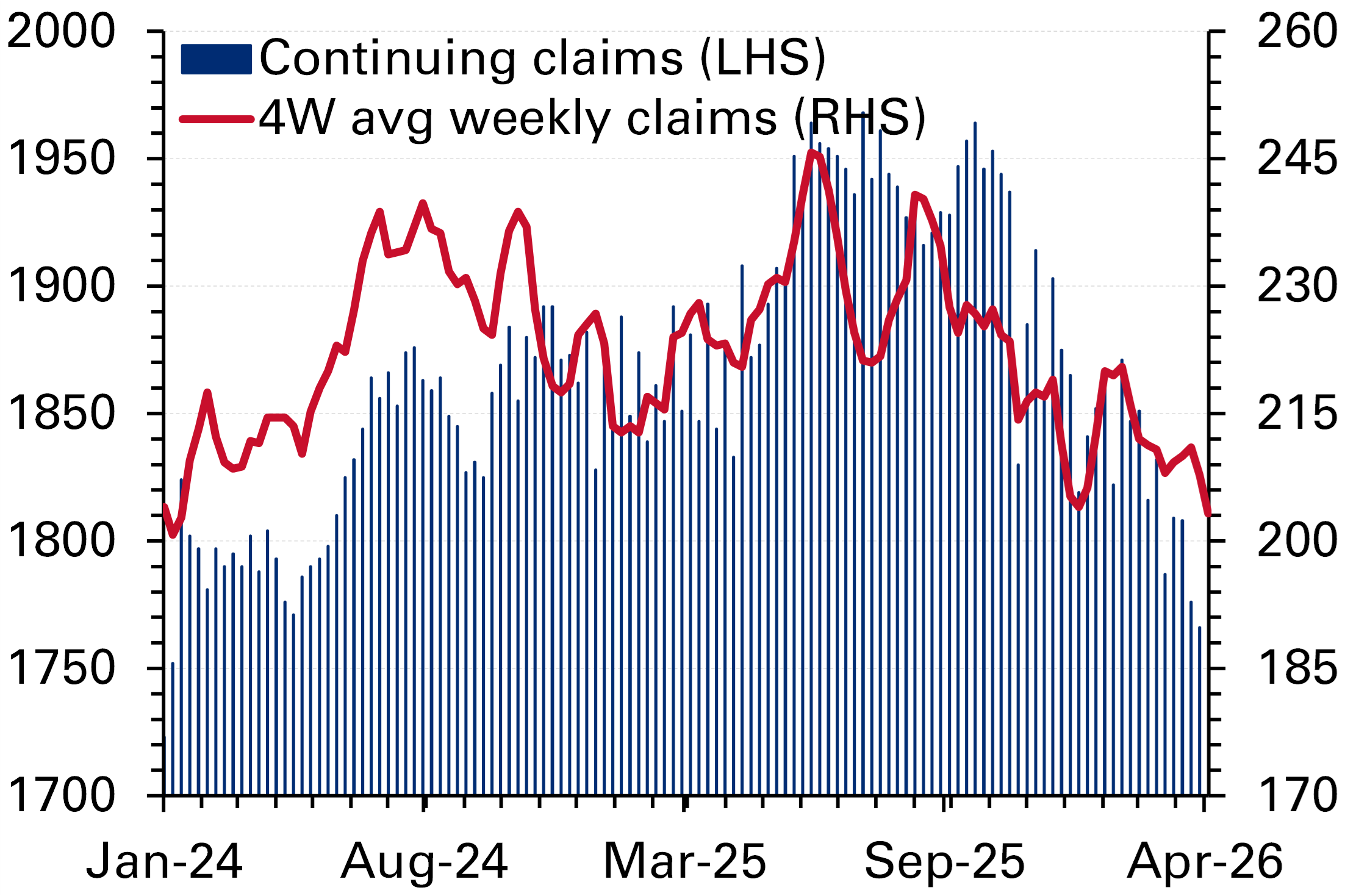
US: Labor market indicators have been improving, and if sustained, will further complicate incoming Fed Chair Warsh’s easing plans. Several US labor market indicators increasingly signal steady improvement in conditions in recent months. Non-farm job growth has averaged 76K per month in the first four months of this year versus just 10K in the whole of 2025, helped by fading trade and immigration policy uncertainty. Moreover, there has been some broadening in the sectors driving job growth after the private education and healthcare sector was the lone bright spot in 2025. Besides higher job growth, unemployment has remained modest with the unemployment rate (4.3% in April) hovering in a narrow range of 4.0%-4.5% since June 2024, which is not far from levels considered to be “full employment”. This was helped by a low layoff environment with four-week average weekly jobless claims (w/e May 2) and continuing claims (w/e April 25) at their lowest level since January 2024. While job openings remain on a downward path, the pace of decline has substantially eased recently. However, despite the recent improvement and the better headline numbers, some pockets of stress persist. For example, the broader rate of unemployment, U6 (including unemployed, marginally attached to labor force, and total part-timers due to economic reasons), has risen for three straight months and (currently at 8.2%) sits at an over four-year high outside of the period just after the record-long government shutdown in October and November last year. In addition, given stricter immigration curbs, the labor force has dropped to the lowest level since December 2024. The upshot is that the recent improvement in the job market has driven renewed optimism, and if that is sustained, Fed officials’ focus will shift further towards combatting higher inflation risks as opposed to downside risks to the labor market. Therefore, incoming Fed Chair Kevin Warsh will likely face greater dissent if he tries pushing for lower policy interest rates anytime soon.
UK: PM Starmer’s defiant speech fails to instill confidence in his premiership; more Labor MPs call on him to quit. Prime Minister Starmer, in a much-awaited speech after the Labor Party’s very poor performance in council elections last week, remained defiant, saying he was “not going to walk away,” and “I have my doubters, and I know I need to prove them wrong, and I will.” However, his fight to stay on has yet to instill confidence in his premiership as more than 70 Labor MPs have called on him to step down and reportedly some cabinet ministers now privately pressing him to announce his departure. Starmer’s position appears increasingly shaky but there seems little consensus yet about his probable successor. UK bond markets have been reacting to the current unstable political environment and the potential leadership change given its impact on the already-stretched public finances, with yields on long duration gilts rising yesterday.
Japan: Household spending sharply below estimates in March, down for the fourth straight month. Real household spending fell 2.9% y/y in March, down from February’s 1.8% fall and sharply below consensus estimates of a 1.3% decline. This represents the fourth consecutive month of falling household spending and was driven by a 17% fall in transportation and communication spending, 3.2% drop in utilities spending, 2.9% in food, and 2.6% in clothing. Meanwhile, the BoJ’s summary of opinions of the April 27-28 meeting indicated that Japan's economic growth is likely to decelerate due to factors such as a “deterioration in the terms of trade reflecting the rise in crude oil prices”, but that the economy is expected to continue growing moderately, since it is likely to be “underpinned by factors such as the government's various measures and accommodative financial conditions”. As a reminder, the BOJ had cut its forecast for GDP growth for FY2026 to 0.5% y/y from 1% previously.
Egypt: IMF review approaches as Egypt recalibrates macroeconomic targets and deepens ties with India. The government has submitted its updated reform package ahead of the upcoming International Monetary Fund mission scheduled for mid-June, as the country prepares for the combined seventh and eighth program reviews, which could unlock around $3.3 billion in additional financing. At the same time, the Central Bank of Egypt (CBE) revised some of its macroeconomic targets in light of the ongoing regional situation. The CBE now expects inflation to return to single digits during the second half of 2027, while GDP growth forecasts were slightly lowered due to weaker expected contributions from tourism and the Suez Canal. The bank now sees headline inflation averaging 16-17% in 2026 and 12-13% in 2027. GDP growth is now projected at 4.9% in FY25/26 (down from a previous forecast of 5.1%) and 4.8% in FY26/27 (down from 5.5%). The CBE also acknowledged that inflation risks remain elevated if the geopolitical pressures persist. Separately, Egypt and India are moving closer toward implementing a currency swap agreement, which would allow trade settlements in local currencies instead of relying on the US dollar. The agreement is expected to come into effect later this year following advanced technical discussions between the two central banks. This move aims to ease pressure on foreign currency demand and strengthen bilateral trade and investment ties. India is also exploring new investments in Egypt across pharmaceuticals, food industries, clean energy, and phosphate production, reinforcing Egypt’s growing role as a regional manufacturing and export hub.
Oman: Increased efforts to facilitate cargo flows. The Ministry of Transport, Communications, and Information Technology has taken several measures to facilitate the entry and exit of shipments through Omani ports and logistics hubs amid increased shipping volume from the GCC. The efforts focus on speeding up customs clearance and expediting the movement of foreign and domestic trucks through Omani ports, supported by digital solutions such as the OneWB platform for unified documentation and tracking. Authorities are also implementing operational improvements, including fast-track lanes for compliant vehicles, 24/7 port operations, streamlined permits for oversized cargo, and better coordination among transport, customs, and free zone bodies. Additionally, businesses experiencing shipment delays are encouraged to report issues with full documentation so authorities can intervene directly and resolve logistical bottlenecks. The adverse geopolitical backdrop is driving increased demand for Omani ports and terminals, which depending on the longevity of the ongoing trade disruptions, could deliver a sizeable boost to the growth of the transportation sector.