
 +965 2292 4888


Daily Economic Update
09.02.2026
Saudi Arabia: Kingdom prepares to recalibrate its economic transformation strategy. Saudi Arabia is preparing to announce an updated strategy for its $2 trillion economic transformation plan, signaling a recalibration of priorities and spending policies amid tighter financial conditions and increased oil price volatility. The move reflects a broader review of how best to advance Saudi Vision 2030 growth ambitions while balancing fiscal sustainability requirements. The next phase of the transformation agenda is expected to focus more heavily on tourism, manufacturing, logistics, and technology. Policymakers are placing greater emphasis on improving spending efficiency, empowering the private sector, and attracting foreign investment, as the Kingdom seeks to sustain growth while moderating the pace of public spending. Despite running a budget deficit since 2022, the government has reiterated that the deficit is a deliberate policy choice aimed at supporting investment and economic expansion. Authorities expect the deficit to narrow gradually in the coming period, supported by a flexible financing strategy and strong access to funding. Official projections point to a deficit of 3.3% of GDP this year, down from 5.3% in 2025, while our estimates suggest a more moderate improvement to around 4% of GDP. To finance the shortfall, Saudi Arabia expects total funding needs to reach approximately $58 billion this year. In this context, the finance minister noted this week that discussions have already begun on how to communicate the next five-year strategy to the public, highlighting the importance of clarity around policy direction. The International Monetary Fund has been among the institutions calling for clearer communication, particularly as the Kingdom revisits the scope and sequencing of several large-scale projects. While preparations continue for major initiatives such as infrastructure linked to the 2034 FIFA World Cup, other projects have been recalibrated. These include the deferral of the 2029 Asian Winter Games, scaled-back plans for Neom’s “The Line”, and the recent decision to put Riyadh’s Mukaab project on hold. Overall, the emerging strategy points to a more selective and disciplined phase of economic transformation, prioritizing efficiency, private sector participation, and long-term returns over the heavy scale of spending.
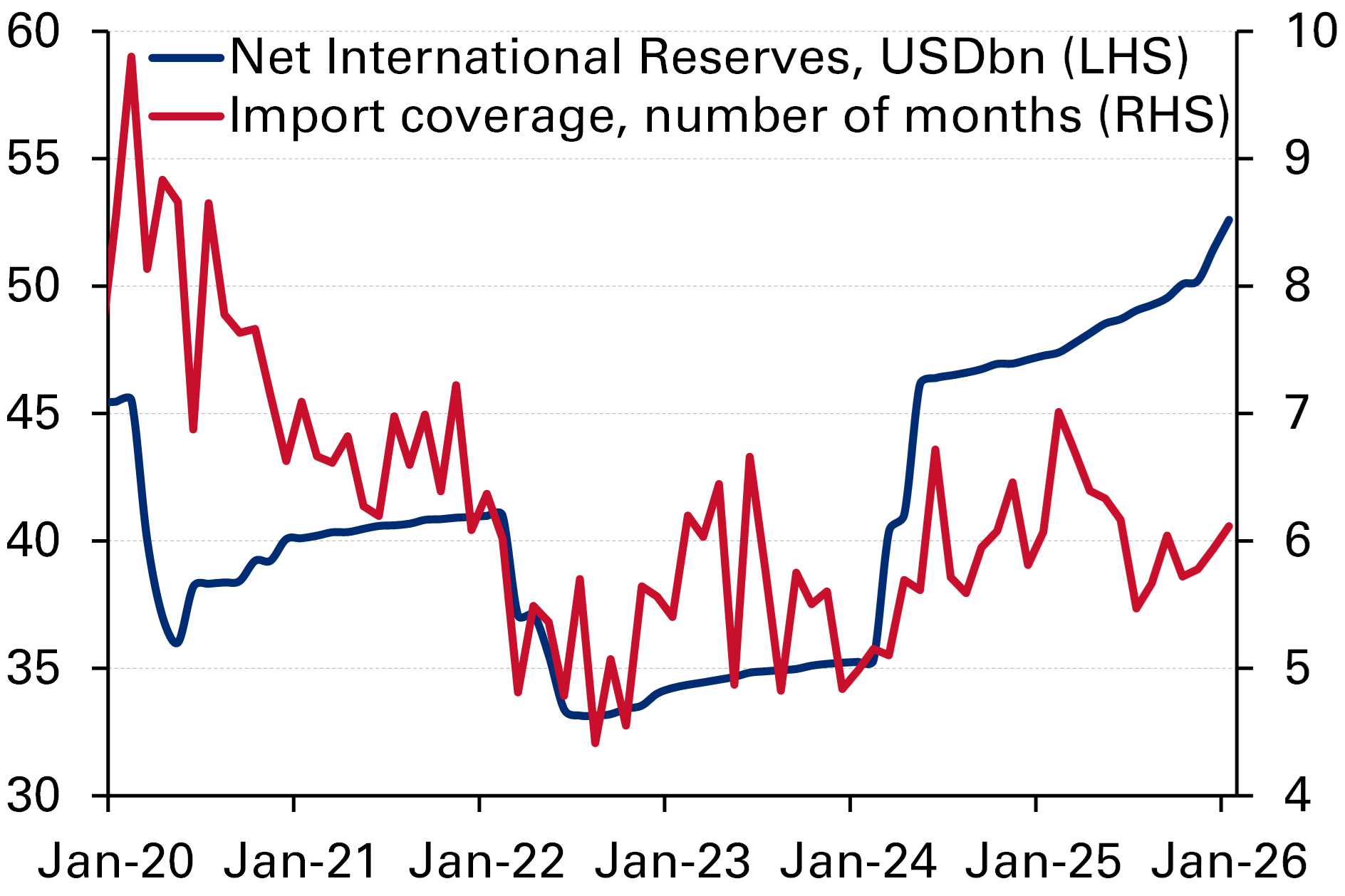
Egypt: Foreign reserves hit a new record, driven by higher gold holdings. Net international reserves rose to a new all-time high of $52.6 billion at the end of January 2026. At this level, reserves cover roughly six months of imports, reinforcing Egypt’s external buffers. The increase, however, was largely driven by a $2.6 billion rise in gold reserves, which more than offset a $1.5 billion decline in foreign currency holdings. As a result, international reserves excluding gold declined to $31.9 billion in January, down from $33.3 billion in December. Gold remains a strategic reserve asset and a last-resort buffer, but it is less liquid than foreign currency holdings. Gold prices significantly dropped toward the end of January before regaining momentum in early February, introducing short-term volatility to headline reserve figures. That said, such fluctuations are largely valuation-driven and do not alter the broader trajectory of Egypt’s external position, especially as other reserve components remain broadly stable. Beyond official reserves, unofficial reserve buffers strengthened notably. Deposits not included in the official reserve rose by $3.4 billion in January to reach $13.7 billion, providing an additional layer of protection against potential external shocks. Overall, while the composition of reserves matters, the combination of record headline reserves and rising auxiliary buffers continues to instill confidence in Egypt’s external liquidity position.
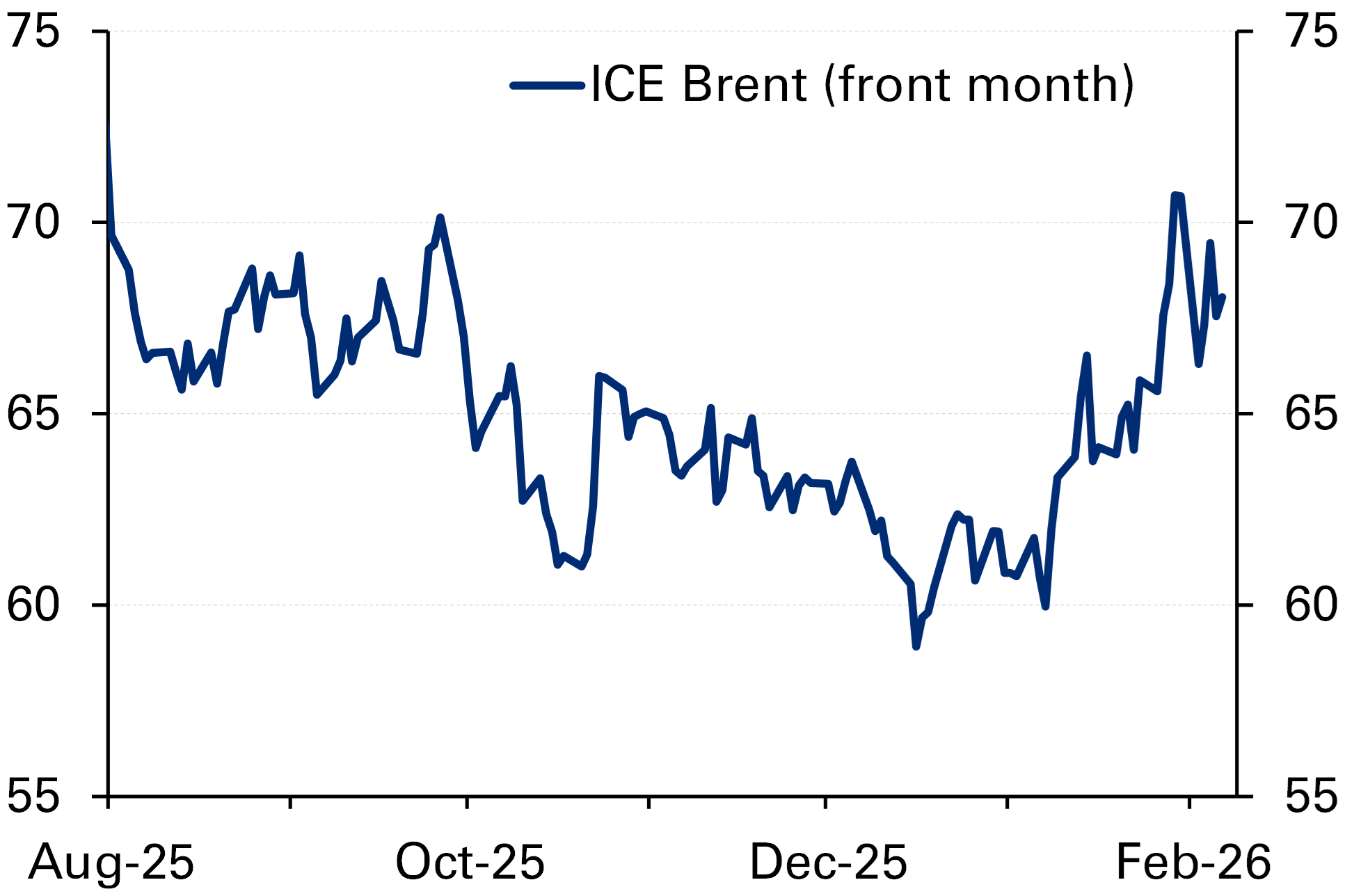
Oil: Brent records first weekly decline of 2026 on easing US-Iran tensions. Brent futures closed Friday at $68.1/bbl (-3.7% w/w; 11.8% ytd), posting their first weekly decline of 2026 as Iran-US negotiations in Muscat got underway which helped to partly ease market anxieties. Volatility has been elevated, though, amid shifting US-Iran dynamics, with prices falling sharply on Monday after US President Trump stated that Washington was “talking” with Tehran and that both sides had agreed to meet later in the week. Tensions were simmering ahead of the meeting in Oman with the two sides struggling to agree on the agenda or a location for the talks, while the US continued to deploy additional military assets to the region and shot down an Iranian drone approaching a US aircraft carrier. Both countries described the eventual discussions as a promising start. Meanwhile, the US reached an interim trade deal with India, under which India committed to halt purchases of Russian oil and replace them with US crude in exchange for the US reducing tariffs on Indian goods from 50% to 18%. Trump had signed an executive order late last year adding 25% tariffs on India for importing Russian oil. Even so, it will be difficult for India to fully shift away from Russian oil. India’s imports of Russian crude peaked at 2 mb/d last year before falling to 1 mb/d in January 2026 after the US administration ratcheted up the pressure to diversify its crude import sources. A deeper reduction would face economic and logistical hurdles. Indian refiners are generally configured to process medium-grade crudes while lighter US grades require some additional steps to refine. Shipping US crude from the Gulf Coast to India would also be more expensive and time-consuming than sourcing from Russia. Should India scale back further its Russian crude purchases, it is likely that China would absorb redirected volumes, potentially at even greater discounts, resulting in no significant changes to Russia’s export volumes.
Japan: Ruling LDP wins a historic two-thirds majority in yesterday’s snap elections. Projections show that Prime Minister Takaichi’s LDP party has secured 316 seats (out of 465) in yesterday’s snap elections, giving it the largest single-party majority in post-war Japan. Together with its coalition partner, the LDP is expected to control 352 seats in the Lower House (from 233 before the elections). PM Takaichi is expected to use this majority to pass her aggressive fiscal plan, which includes suspending the consumption tax in the country for a period of two years. The finance minister allayed some fears related to the funding of such cuts, mentioning that they intend to explore securing funding without relying on issuing additional sovereign bonds. The Japanese stock market rallied, with the Nikkei 225 Index last seen trading up more than 4%. Long term bond yields were up slightly while the yen was broadly steady. In data releases, average cash earnings rose 2.4% y/y in December, beating the previous month’s upwardly-revised 1.7% figure but lower than consensus estimates of a 3% rise.
Global: US January jobs/CPI inflation and UK Q4 GDP key data releases this week. In the US, the delayed jobs report for January is due on Wednesday, with consensus forecasts pointing to a higher job growth of 70K m/m from 50K in December and a steady unemployment rate of 4.4%. Importantly, the BLS will also publish the final annual benchmark revisions to employment for the twelve months through March 2025, with the preliminary figures previously pointing to 911K fewer job additions (-76K per month) than initially reported for the April 2024-March 2025 period. CPI inflation prints for January (Friday) are expected to show the headline rate easing to 2.5% y/y from 2.7% in December but steady m/m at 0.3%. The core rate is seen rising m/m to 0.3% from 0.2%. Retail sales (Tuesday) are forecast to rise 0.5% m/m in December after increasing 0.6% in November. In the UK, fallout from the Epstein-Mandelson correspondences is presenting the most serious challenge to Prime Minister Starmer’s premiership, especially after his Chief of Staff and Labour’s election campaign manager, Morgan McSweeney, was forced to resign yesterday. In terms of data releases, the preliminary estimate for Q4 GDP is due on Thursday, with the street projecting 0.2% q/q growth, up from 0.1% in Q3. In China, CPI inflation (Wednesday) is expected to ease to 0.4% y/y in January from a near three-year high of 0.8% in December. In Japan, attention will be on the markets’ reaction post the landslide super-majority victory for the ruling LDP party in yesterday’s parliamentary elections. In terms of data releases, PPI inflation (Thursday) is seen edging down slightly to 2.3% y/y in January from 2.4% in December.