
 +965 2292 4888


Daily Economic Update
13.04.2026
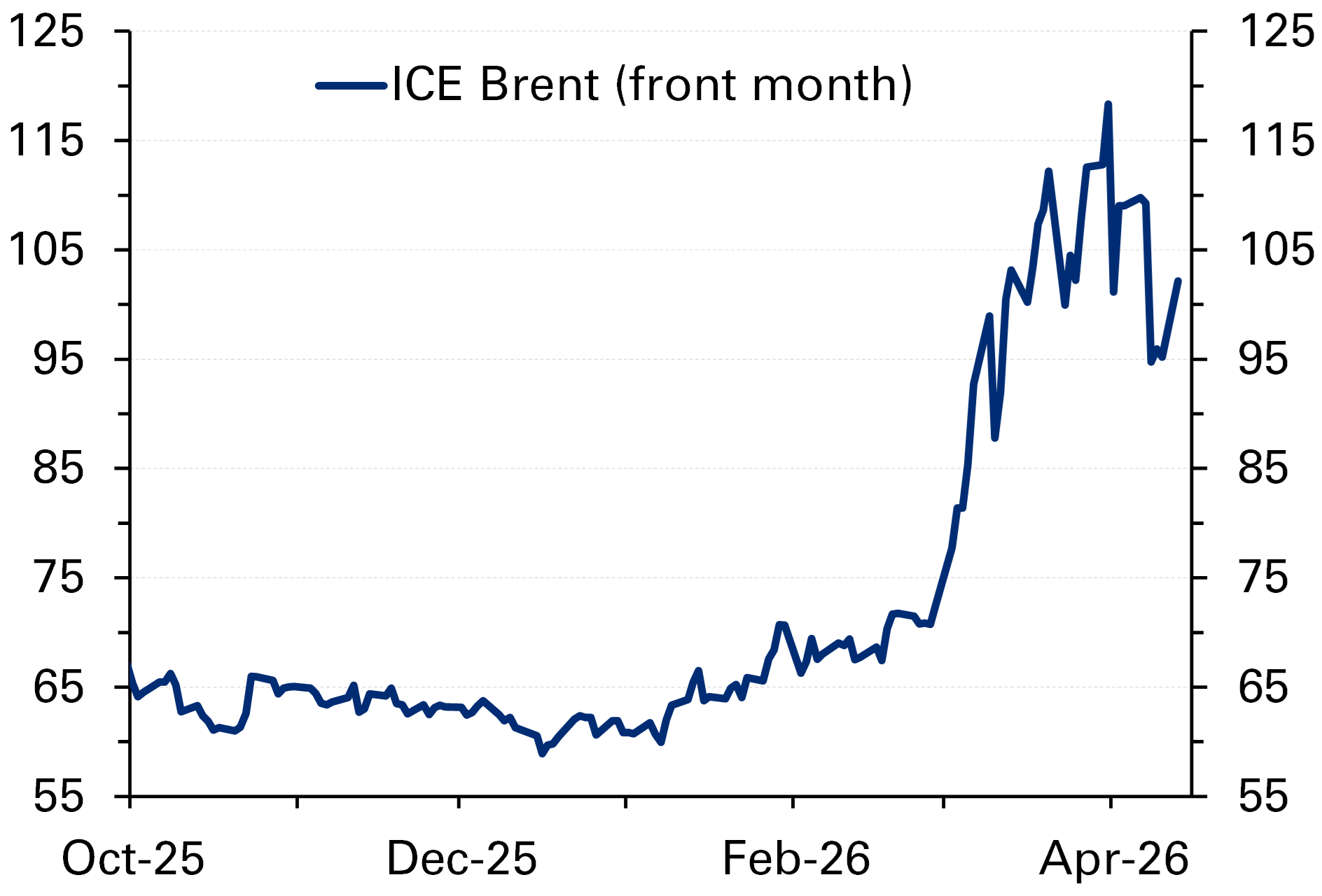
Oil: Prices surge this morning after President Trump imposes a naval blockade of the Strait of Hormuz. Oil prices were back over $100/bbl this morning in Asian markets, with Brent surging more than 7% to $102/bbl at the time of writing, in response to President Trump’s move to use the US Navy to impose a seaborne blockade of the Strait of Hormuz effective from 5pm today Kuwait time. The President, accusing Iran of “World Extortion”, announced that the US will target all vessels, Iranian or otherwise, that stopped to load cargoes at Iranian ports or that were forced to pay Iran’s toll. Iran had ramped up crude exports to an estimated 1.6–2.0 mb/d in the last few weeks, taking advantage of higher prices and a temporary US sanctions waiver on sales of its oil at sea (to help mitigate the shutting-in of GCC crude caused by Iran’s own blockade of the Straits). While it is not clear how effective this US blockade will be, clearly the US has decided it needs more leverage in this fight, ostensibly to pressure Iran to return to the negotiating table. As a gambit it has its risks: potentially triggering a Iranian retaliation on US and GCC shipping, assets or interests, which could break the current, tentative ceasefire; higher oil prices by further disrupting supplies; and also its potential to draw China into the conflict at least diplomatically, which could of course be part of the goal. The US may be hoping that China will use its considerable influence as the Islamic Republic’s main oil importer—as it did in encouraging Iran to attend the recent Islamabad talks—to resume diplomatic negotiations to end the conflict.
Saudi Arabia: Business confidence declines in March amid regional tensions. Saudi Arabia’s non-oil business confidence weakened in March, reflecting the impact of heightened regional uncertainty on firms’ expectations. The Business Confidence Index (BCI), published by GASTAT, fell by 14.2% m/m to 52.1, down from 60.7 in February, remaining only marginally above the neutral 50 threshold. The survey serves as a forward-looking indicator similar to the widely-followed Purchasing Managers’ Index (PMI), but focused on expectations rather than current activity, captures sentiment across output, demand, employment, and expansion plans in the non-oil sector. The drop in the March BCI contrasts slightly with the PMI reading, which fell below the 50 mark into contractionary territory, suggesting that while actual business activity has already weakened, firms’ expectations remain relatively more resilient for now. Despite the sharp decline in BCI, all major sectors remained in expansionary territory. Industrial confidence recorded the largest drop, falling to 50.8 (down 15.8% m/m), followed by services at 52.0 (down 14.9%), and construction at 53.0 (down 12.6%). Overall, the March reading points to a significant deterioration in business sentiment amid the regional escalation, although confidence has not yet slipped into contraction territory.
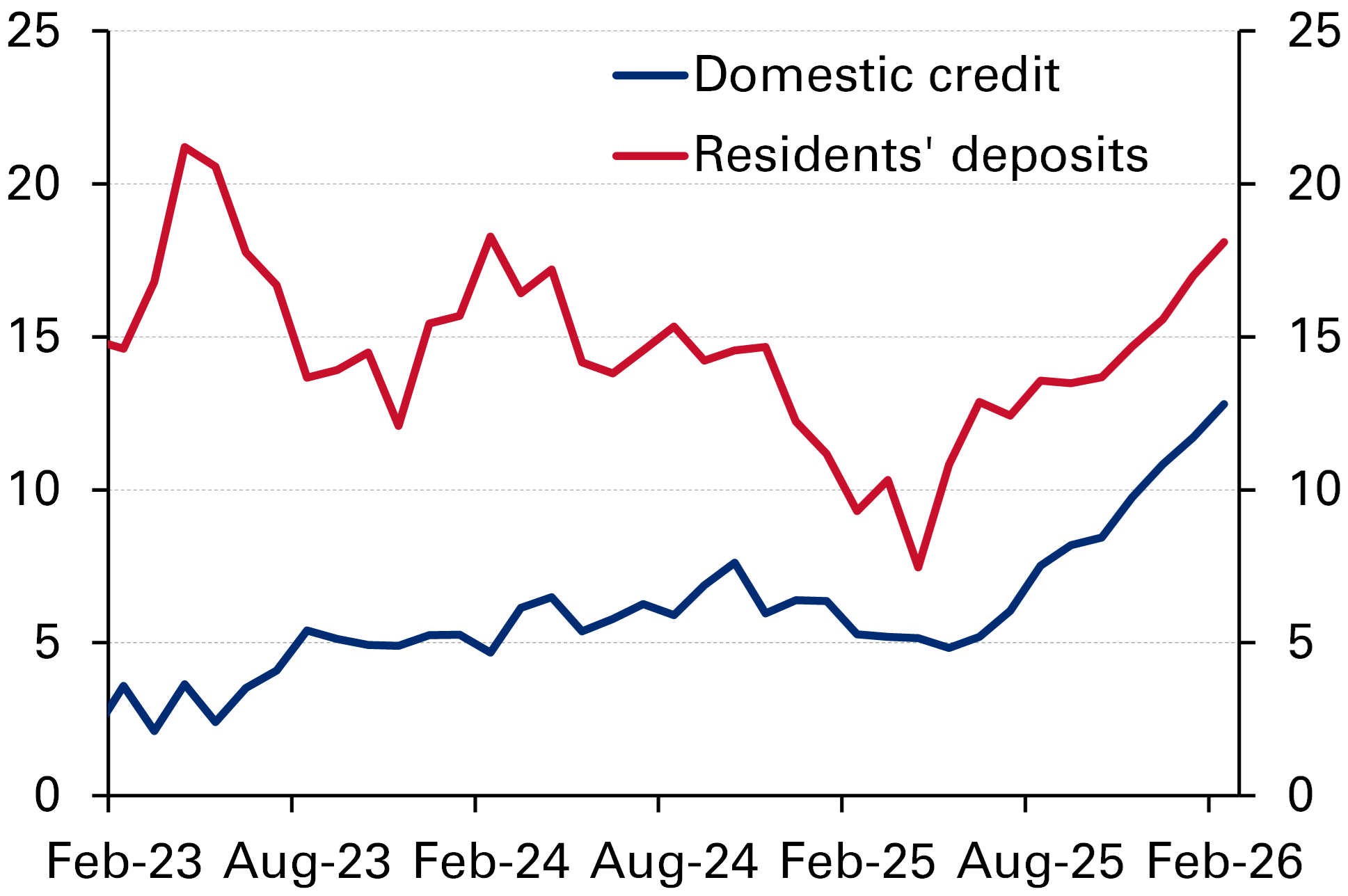
UAE: Domestic credit growth hit a series high in February. Domestic credit expanded by 12.8% y/y in February, accelerating from 11.7% in January and marking the fastest pace in more than a decade under the current data series. Growth continued to be led by the private sector, which accounts for 73% of total domestic credit, with lending rising 11.9% y/y, mainly due to solid growth in credit to businesses at 9.7% and personal credit growth at 15.7%. Public sector credit (government plus GREs) also recorded a notable acceleration, rising by 14.7% y/y in February, driven primarily by a sharp increase in government credit (19.7% y/y), alongside a pickup in credit to GREs of 11.3% y/y. On the funding side, residents’ deposits remained highly supportive, growing by 18.1% y/y in February. Private sector deposits, which constitute 75% of all deposits, expanded by 21.5% y/y, underscoring solid liquidity conditions. Public sector deposits also increased but at a more moderate pace of 7.0% y/y, reflecting softer government deposits ( 0.8% y/y). Looking ahead, the impact of the US-Iran conflict would start to become evident from the March data onward. Moreover, a recent Fitch Ratings report noted that UAE banks remain supported by strong liquidity, solid capital positions, and a high likelihood of sovereign support if needed while a more challenging external environment could weigh on confidence and activity in non-oil related sectors, especially tourism and logistics, though the central bank’s recent liquidity support measures should help in preserving financial stability and sustain credit conditions in the short term.
Global: The reaction to the naval blockade of Iran, and data-wise, US PPI/China GDP key matters this week. The reaction to President Trump’s decision to impose a naval blockade on Iran will dominate the scene this week. Other than the markets’ reaction, key would be China’s reaction as that country imports the majority of Iran’s oil. China has good relations with Iran, supposedly has some leverage over it, and the blockade effectively would push China to be more involved in this Middle East conflict. In terms of data releases, in the US, PPI inflation for March is due on Tuesday and is expected to show another sharp jump of 1.2% m/m following a much higher-than-expected increase of 0.7% in February. The Fed’s latest Beige Book (Wednesday) will show early anecdotal evidence of the impact of the Middle East war on the US economy while several Fed officials will be speaking this week, offering clues about their thinking ahead of the FOMC meeting at the end of the month. In the Eurozone, industrial production for February (Wednesday) is seen increasing a muted 0.2% m/m after falling by 1.5% in January. In the UK, GDP is seen rising by a limited 0.1% m/m in February after being flat in January. Finally in China, Q1 GDP growth (Thursday) is expected at 5% y/y, above the 4.5% recorded in Q4 but in-line with the increase for 2025 as a whole. Retail sales and industrial production (Thursday) are forecast to grow by 2.4% and 5.9% y/y, respectively, in March, down from 2.8% and 6.3% y/y in January-February combined. Exports (Tuesday) are also seen increasing by a softer 8.3% y/y in March compared with 22% in January-February.