
 +965 2292 4888


Daily Economic Update
01.02.2026
US: Trump nominates Kevin Warsh for Fed Chair; Warsh’s key challenge will be his need to build consensus among FOMC members. President Trump on Friday nominated former Fed Governor Kevin Warsh as new Fed Chair to replace Jerome Powell when his term ends in May. Warsh’s nomination now needs to be confirmed by the Senate, but the process is likely to be bumpy as a Republican member (Senator Thom Tillis, who is not seeking re-election) of the Senate Banking Committee, whose vote is critical to approve the nomination, has vowed to block it until the criminal investigation case involving Powell is resolved. During his stint as a Fed Governor in 2006-11, Warsh pitched to keep interest rates elevated, warning of high inflation even in the aftermath of the global financial crisis. He was also critical of the bank’s quantitative easing program and called for a substantial reduction in the Fed’s balance sheet. However, based on his recent comments, he is currently seen as a dove advocating for lower interest rates predicting that the AI-driven labor productivity boost will keep inflation under control. He has continued to support a reduction in the Fed’s balance sheet, besides asking for “regime change” in the bank’s approach towards forecasting and modelling tools, and has been a vocal critic of the Fed. Warsh, if confirmed, will face a challenging situation given his need to build consensus among FOMC members and he would obviously have to assure the financial markets of the Fed’s bedrock independence and that it is not politically influenced. US financial markets came under selling pressure on Friday, with the S&P 500 down 0.4% and UST 10Y yields up slightly, but the US dollar rose sharply. Gold and silver prices tanked on Friday (almost 12% and over 30%, respectively) but that was also likely driven by the CME increasing margin requirements for various metals, and for the second time in one week.
US: A partial government shutdown began on Saturday but will likely be short-lived. A limited government shutdown began on Saturday despite the Senate passing a funding deal hours earlier, which included five bills that the House approved but which stripped out the funding for the Department of Homeland Security (DHS), and instead voted on a two-week stopgap measure that gives Congress more time to work out disputes over DHS funding. Democrats’ opposition to fund the DHS came after recent killings by the Immigration and Customs Enforcement (ICE), which falls under the DHS. Since many appropriations were already passed by Congress previously, several other government functions will operate as normal. The House will return from a break on Monday, and a vote is likely to follow soon (likely on Monday) that should pave the way to lift the limited shutdown. Meanwhile, on the data front, PPI inflation in December came in hotter than expected, with a headline rate of 3% y/y (0.5% m/m), matching November’s reading, but core rising to 3.3% (0.7% m/m) from 3.1% on accelerating wholesale services costs.
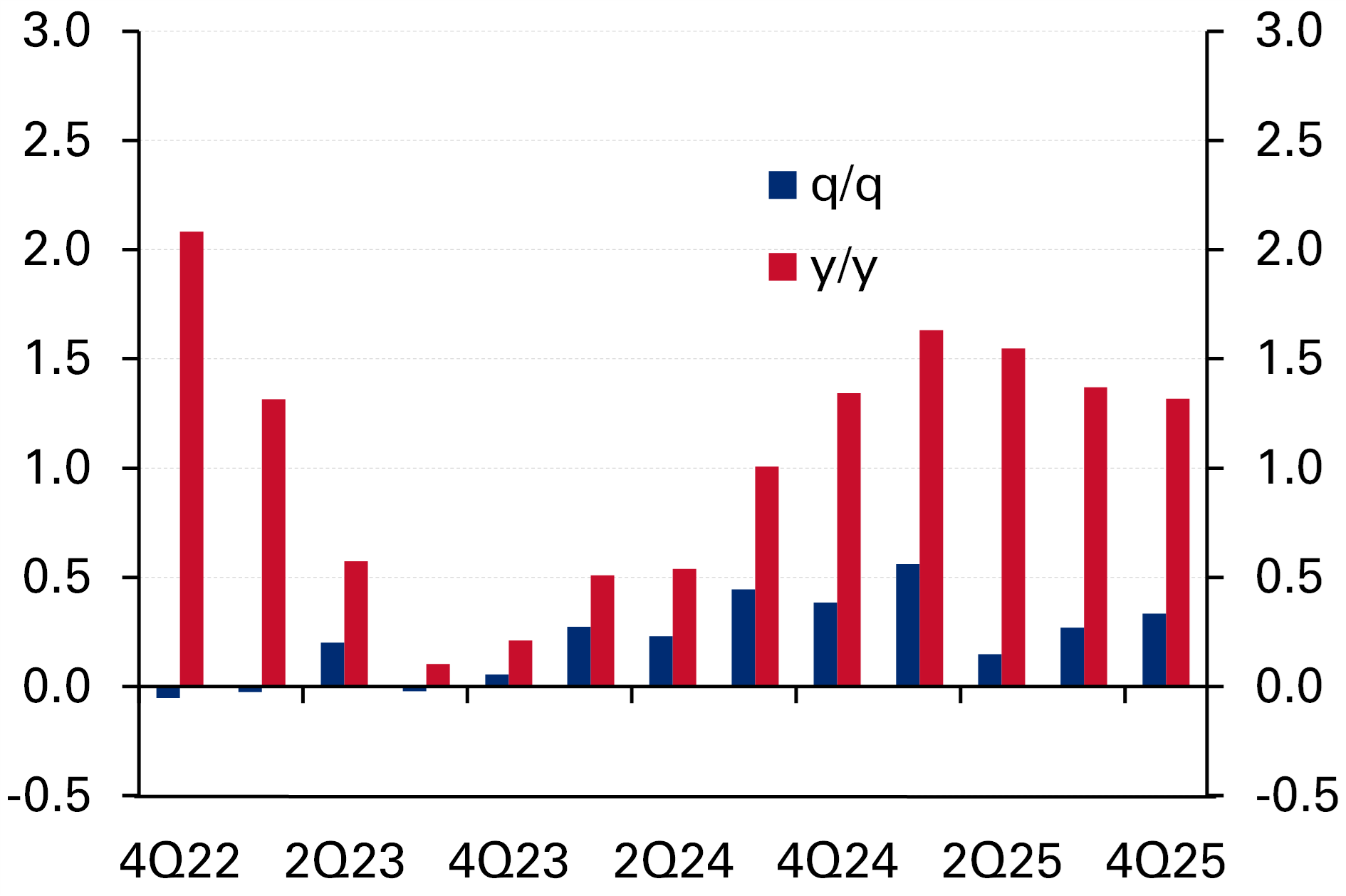
Eurozone: Fourth quarter GDP growth holds steady at 0.3% q/q. Preliminary GDP estimates for the fourth quarter of 2025 show that growth remained steady in the Eurozone at 0.3% q/q, though exceeded market expectations of 0.2%. GDP increased by 0.4% q/q in Germany, the Eurozone’s largest economy, while Italy and Spain posted growth of 0.3% and 0.8%, respectively, but France showed slower growth of 0.2%, possibly held back by the political situation around the budget. On an annual basis, growth slowed to 1.3% from 1.4% in Q3 but exceeded estimates (1.2%). On the outlook, the Eurozone may be poised for faster growth in the coming quarters, with January’s economic sentiment indicator hitting its highest level since January 2023.
China: January PMI data shows a renewed loss of momentum. China’s official manufacturing PMI slipped back into contraction at 49.3 in January, down from 50.1 in December. New orders softened to 49.2, reversing December’s improvement. The non-manufacturing PMI gauge also fell below the 50-threshold, at 49.4 from 50.2, marking its weakest level since December 2022, driven by a notable pullback in construction activity. Meanwhile, the composite PMI declined to 49.8 in January from 50.7 in December, pointing to a broad-based moderation at the start of 2026.
Japan: Tokyo inflation softens by a wide margin in January; December retail sales weak. Tokyo’s consumer price inflation fell to a nearly four-year low of 1.5% y/y in January, down from 2% in December. Similarly, core inflation (excluding fresh food) ticked down to below the consensus (2.2%) and a 15-month low of 2%. These measures reflect positive developments for the Bank of Japan, which has been battling above-target inflation for the past three years. The softer readings may reinforce the bank’s outlook and market expectations that it will not raise interest rates until the middle of the year. Elsewhere, December’s retail sales decreased by 0.9% y/y, defying consensus estimates of a 0.7% rise and the previous month’s upwardly-revised 1.1% increase. Likewise, industrial production decreased 0.1% m/m, falling for the second consecutive month but beating consensus estimates of a 0.4% fall.
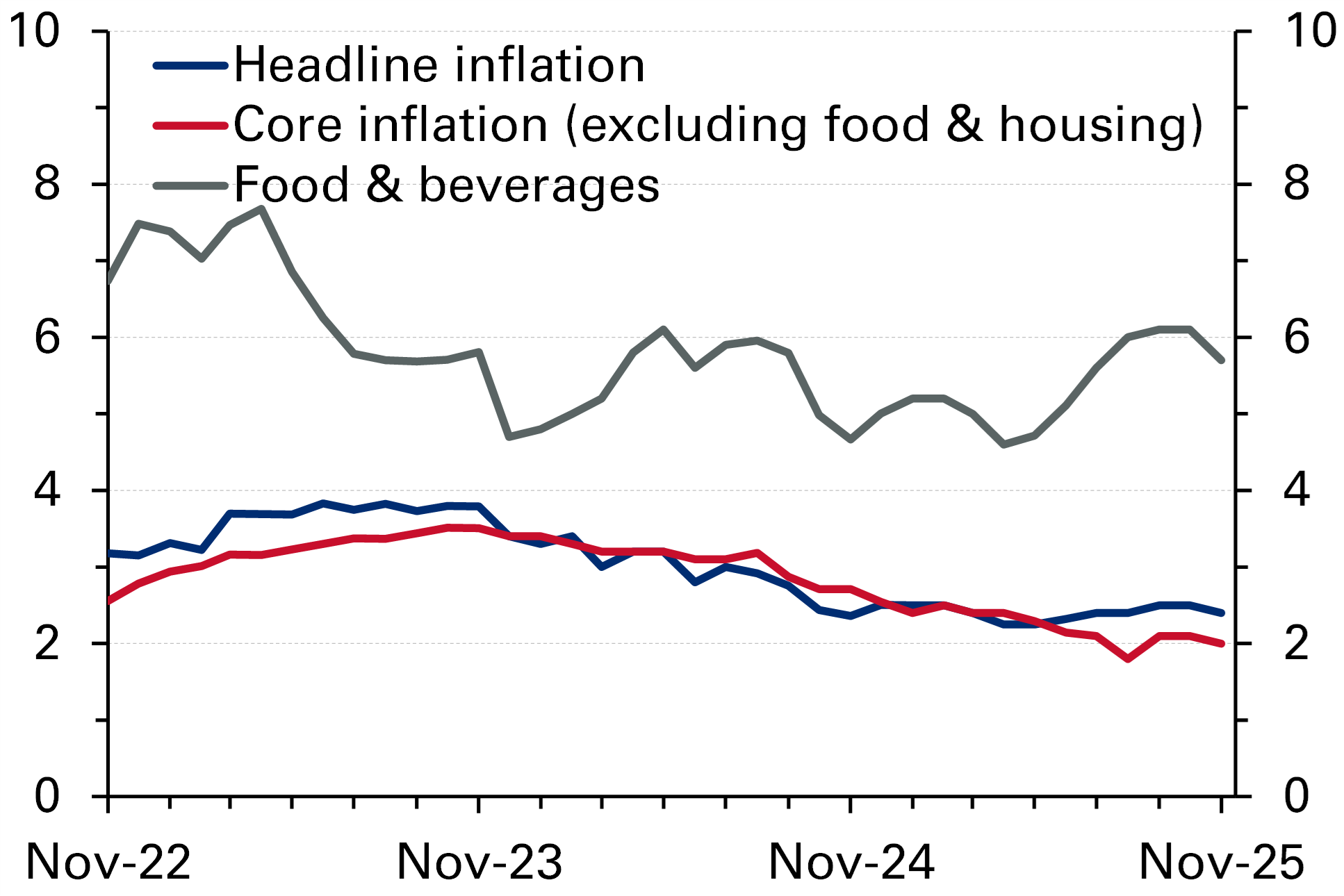
Kuwait: CPI inflation slightly eases in November. CPI inflation came in at 2.4% y/y in November, softening from 2.5% in October amid moderate increases across most components. In the food & beverage category, price rises slowed for the first time since April but remained elevated at 5.7% y/y (down from 6.1% in October), with price pressures still strong in the fish & seafood category (+19.6% y/y). However, a disinflationary trend is emerging across the stubborn fruits and vegetables subcomponents, which saw average rises of 8% y/y and 7.3% y/y YTD, respectively. Meanwhile, housing services inflation, the largest component by weight in the CPI, remained steady at 0.9% y/y. Core inflation eased to 2% y/y following an uptick in the prior two months, supported by softer price increases in clothing, household furnishings, communication, and recreation & culture. As for the remaining components, prices rose at a similar pace from October, with the ‘services & miscellaneous goods’ category, which has notably been impacted by the recent increase in precious metals prices, holding at a record 6.5%. Annual price rises in health, transportation, education, and restaurants & hotels subindices also remained broadly unchanged from October. Looking forward, the rise in gold prices during December and January (before last Friday’s fall) could push the overall CPI slightly higher, offsetting the emerging softening trend in the food & beverage subcomponents (particularly fruits and vegetables).
Egypt: Budget deficit edges higher to 4.2% of GDP in H1 FY25/26 amid rising debt service costs. The government’s budget deficit widened slightly to 4.2% of GDP during the first half of FY25/26 (July–December), up by 0.2 percentage points from the same period last year, reaching EGP 882 billion, according to the Finance Ministry’s latest financial performance report. Despite continued efforts to contain spending growth, total public expenditures rose by 27% y/y to EGP 2.2 trillion. This increase was driven by higher wages, subsidies, and public investment, alongside a sharp rise in debt servicing costs. Interest payments climbed by 35% y/y to EGP 1.3 trillion, reflecting elevated debt levels and still-high borrowing costs. On the revenue side, performance remained strong (+30% y/y to EGP 1.4 trillion) as tax revenues increased by 32% y/y to EGP 1.2 trillion, marking a new record and highlighting improving collection efficiency, while non-tax revenues grew by 12.8% y/y to EGP 178 billion. While the widening deficit underscores the continued burden of debt servicing on public finances, the solid revenue performance provides some offset and supports the government’s medium-term fiscal consolidation strategy, particularly as interest rates gradually move lower.