
 +965 2292 4888


Daily Economic Update
16.02.2026
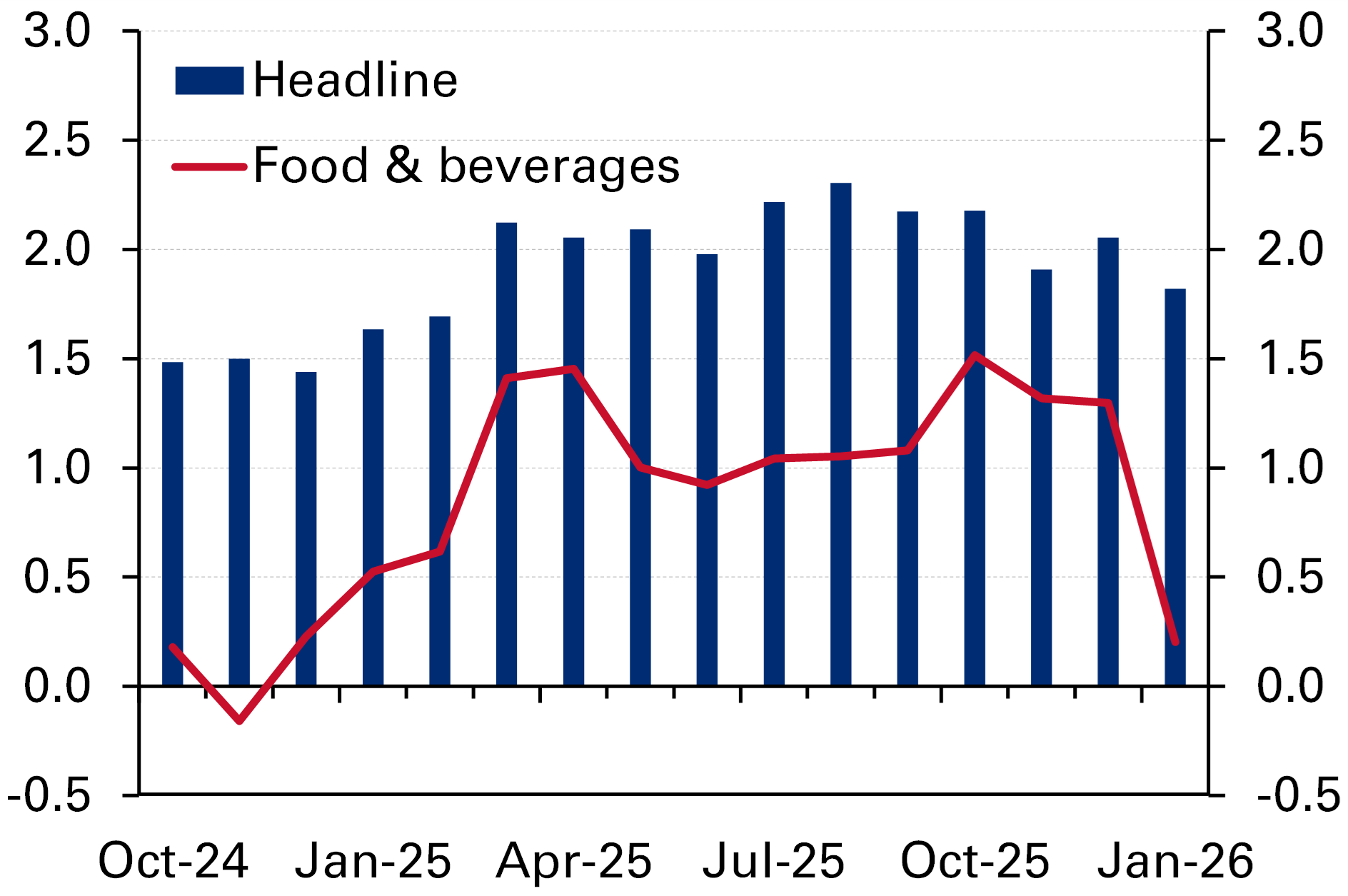
Saudi Arabia: Inflation eases to an 11-month low as food prices soften. Inflation slowed to 1.8% y/y in January, down from 2.1% in December and below last year’s average of 2%, according to GASTAT. The deceleration was primarily driven by a sharp slowdown in food price inflation to 0.2% y/y (-0.6% m/m) from 1.3% in December. Food and beverages account for around 22% of the CPI basket. Additional downward pressure came from a decline in furnishings (-0.3% y/y) and health related items (-0.1% y/y), which helped to offset persistent inflation in the housing, water, electricity & other fuels category (4.2% y/y), the housing component of which was steady at a still-elevated 5.3% y/y. Rental inflation remains particularly elevated in Riyadh and the Northern Borders regions, where increases exceed 10% y/y. The five-year rental freeze introduced in Riyadh in September 2025 has begun to influence monthly inflation readings. However, its impact on annual inflation will become more visible starting September 2026, once the base-year effect fully materializes. This suggests further disinflationary momentum in Q4 2026, potentially pushing headline inflation lower toward year-end. Overall, while housing remains a structural pressure point, the latest figures confirm that inflation in Saudi Arabia remains contained and well within manageable levels.
Egypt: The IMF is set to consider the fifth and sixth reviews next week. The IMF’s Executive Board is scheduled to meet on 25 February to review Egypt’s fifth and sixth program assessments under the Extended Fund Facility (EFF). If approved, Egypt is expected to receive around $3 billion, including $2.7 billion under the EFF and $300 million from the Resilience and Sustainability Facility (RSF). Due to delays in completing the current reviews, the original timetable of the program is being adjusted. The seventh review, initially expected in mid-March, is now likely to be postponed to late April or May, following the IMF and World Bank Spring Meetings. As a result, the overall program timeline, which was originally set to conclude in September with an eighth and final review, may extend toward the end of the year. Looking ahead, the focus will remain on accelerating the state privatization program and advancing fiscal consolidation. These steps are central to sustain the reform momentum, strengthen private sector participation, attract investment, and improve key macro indicators, particularly the budget deficit and the public debt trajectory.
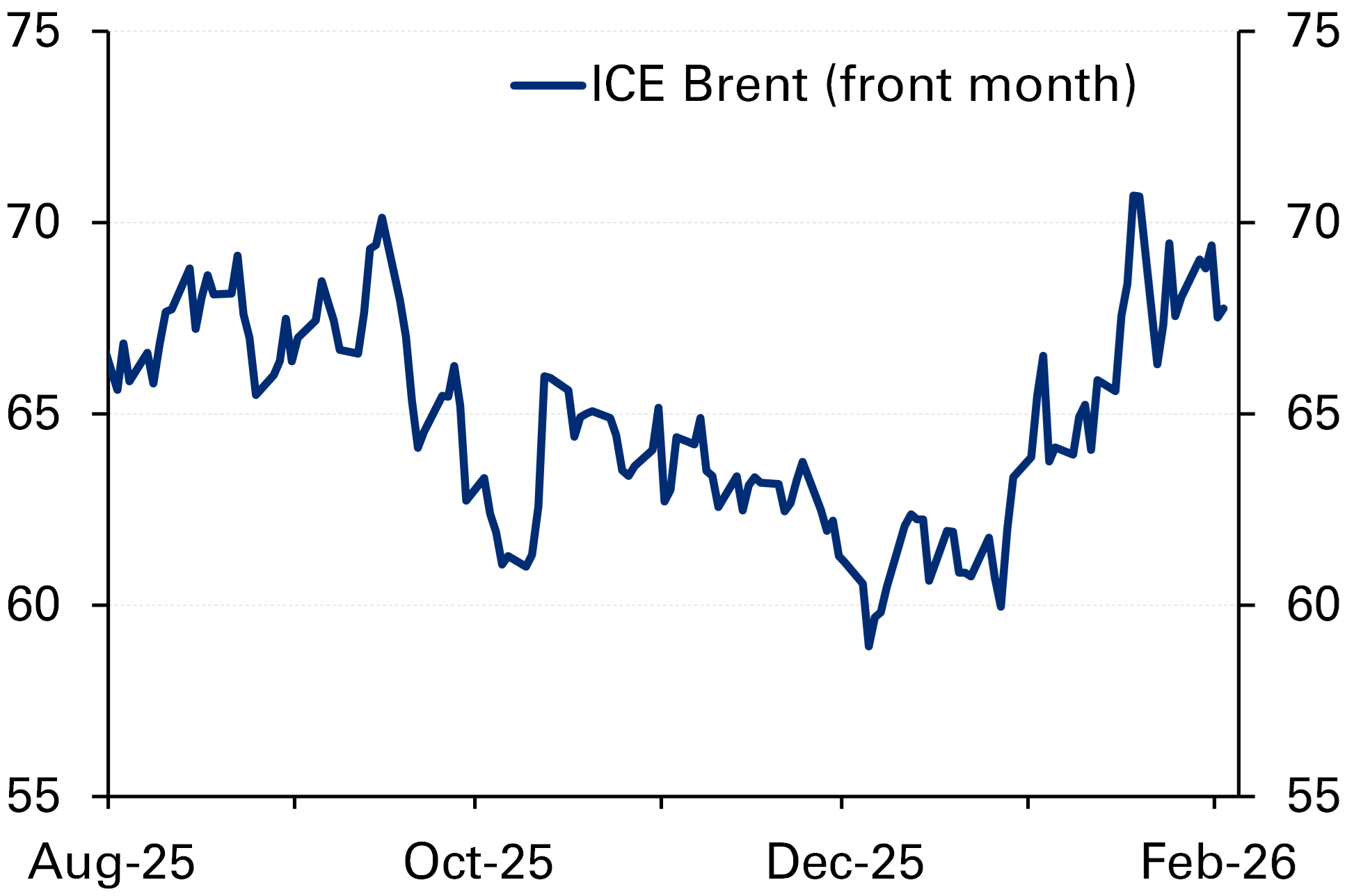
Oil: Prices end week mostly unchanged amid heightened geopolitical tensions; OPEC keeps oil demand forecasts steady. Brent futures closed Friday at $67.8/bbl, posting a marginal 0.4% w/w decline and the first back-to-back loss of 2026 with price movements dominated by developments surrounding the ongoing US-Iran standoff. Prices initially firmed on Monday after the US Department of Transportation warned US-flagged vessels transiting the Strait of Hormouz to steer clear from Iranian territorial waters. By the end of the week, however, comments from President Trump suggesting that Washington and Tehran could “make a deal“ within the next month weighed on prices, adding another layer of volatility. Even so, the situation remains highly fluid. The US is deploying a second aircraft carrier to the Gulf region, extending the military buildup of recent weeks. Both the IEA and OPEC made only brief reference to the escalating geopolitical tensions in their latest monthly oil reports. The IEA revised down its 2026 oil demand growth forecast by 80 kb/d to 850 kb/d, reversing last month’s upward revision. The agency cited economic uncertainty and the dampening effect of higher oil prices driven by geopolitical volatility linked to the US-Iran situation. With demand growth expectations softening, the IEA still sees the market surplus at a hefty 3.7 mb/d. OPEC, in contrast, left its oil demand growth projection for 2026 and 2027 unchanged at 1.4 mb/d and 1.3 mb/d, respectively. Its report also revealed a notable decline in DoC output in January, with production falling 439 kb/d m/m to 42.45 mb/d. The drop was driven by sizeable reductions in Kazakhstan (-249 kb/d), Venezuela (-87 kb/d), Iran (-81 kb/d), and Russia (-58 kb/d). Production should improve in February, especially as Kazakhstan’s output begins to recover from the severe power-related disruptions that curtailed production in January.
US: Study by New York Fed staff finds that US firms and consumers are bearing the bulk (86%) of the economic burden of higher tariffs. A recent study by staff from the New York Fed estimated that US firms and consumers have shouldered 86% of the economic burden of the higher tariffs in the first eleven months of 2025. As per that study, the average tariff rate is estimated at 13% by the end of 2025 compared with 2.6% in January 2025. The BLS import price data largely corroborates this as import prices before custom duties (tariffed plus non-tariffed goods) in the 12 months through December 2025 were broadly flat. The Germany-based Kiel Institute, in a recent analysis, found generally similar results, estimating that 96% of the tariff burden is being borne by US firms and consumers. The findings of these studies are not in line with the Trump’s administration claims that foreign exporters are the ones bearing the bulk of the tariff burden. However, that administration has recently started focusing on the affordability problem in the US, and has scaled back tariffs on a wide array of products. This implicitly acknowledges, despite the administration’s reluctance to admit, that higher tariffs are, at least partly, being shouldered by US firms and consumers, worsening the affordability problem.
Japan: GDP growth weaker than expected in the fourth quarter. Preliminary estimates for GDP growth in Q4 came in at 0.1% q/q, missing consensus expectations (0.4%), but better than Q3’s downwardly revised 0.7% fall. Private consumption, the biggest component of GDP, increased by just 0.1% q/q in Q4 (+0.4% in Q3) as consumers continued to struggle with high inflation. This weaker-than-expected growth should encourage Prime Minister Takaichi to stick to her plan of an aggressive fiscal policy boost to revitalize the economy. These policies, along with last November’s stimulus package of 21.3 trillion yen ($135.5 billion), are expected to boost GDP with the Bank of Japan already revising its FY2026 (ending March 2027) growth forecast upward to 1% y/y from 0.7%.
Global: Possible Supreme Court ruling on tariffs, US Q4 GDP, and UK/Japan inflation key matters this week. In the US, the Supreme Court has set Friday as an opinion day, meaning that a verdict on the legality of the reciprocal tariffs is possible, though not guaranteed. In terms of data releases, GDP for Q4 is due on Friday, and the consensus forecast is a very solid 3% growth (q/q, annualized) despite the record-long government shutdown during that quarter yet slowing from 4.4% in Q3. December’s PCE inflation (Friday) is seen rising to 2.9% y/y (2.8% in November) and 3% (2.8% in November) for headline and core, respectively. Finaly, the minutes of the FOMC’s January 27-28 meeting will be released on Wednesday. In the Eurozone, December’s industrial production is due today and is seen falling 1.5% m/m. Meanwhile, February’s HCOB Flash PMI is due on Friday, with the manufacturing and services gauges expected to improve to 49.9 (from 49.5) and 51.9 (from 51.6), respectively. In the UK, labor market data is due on Tuesday, with the unemployment rate seen unchanged at 5.1% in the October-December period compared with the September-November period. Total pay growth is expected to ease to 4.6% y/y from 4.7% over the same periods. The focus will also be on January’s payroll data, which has been mostly declining since November 2024. January’s CPI inflation (Wednesday) is expected to moderate to 3% y/y and 3.1% from 3.4% and 3.2% in December for headline and core, respectively. Finally in Japan, CPI inflation for January is due on Friday with the core rate seen falling to 2% y/y from 2.4% in December. Meanwhile, exports (Friday) are expected to grow by a solid 12% y/y in January after a decent 5.1% increase in December.