
 +965 2292 4888


Daily Economic Update
19.04.2026
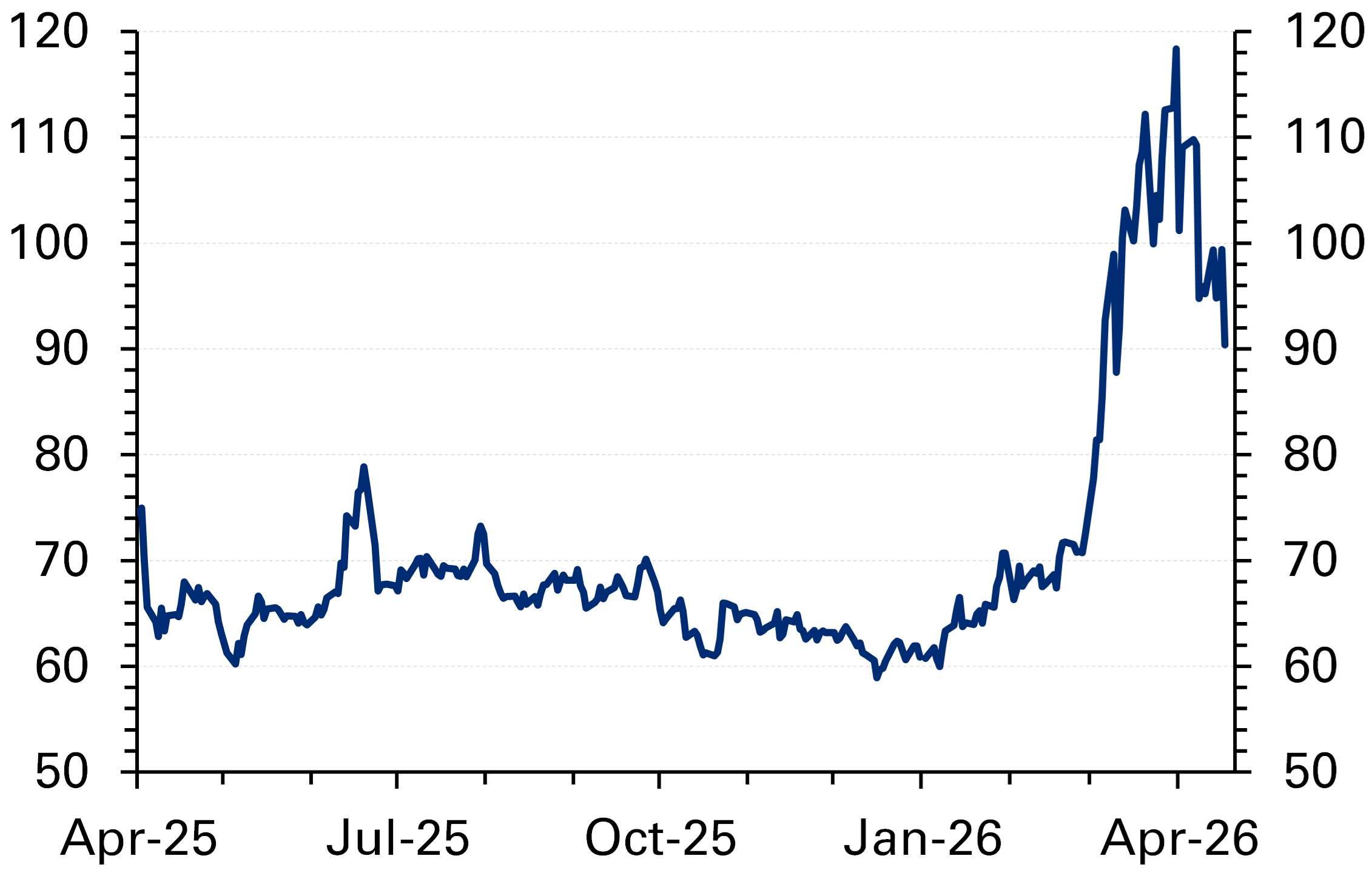
Oil: Brent plunged on Friday after Iran signaled Strait of Hormuz open – before reclosure. Brent tumbled 9.1% d/d on Friday to $90.4/bbl (-5.1% w/w), its lowest level since 10 March after Iran’s foreign minister Abbas Araghchi announced that the Strait of Hormuz is now “completely open” for the remainder of the 10-day ceasefire. Dated Brent, the benchmark for the physical barrels also dropped to below $100/bbl for the time since early March; natural gas and refined product prices also declined. However, the ‘risk-on’ sentiment may prove to be temporary ahead of markets reopening on Monday as Iran later announced that it would be handing back control of the Strait to the military due to alleged violations of the ceasefire by the Americans and the Israelis. It’s not immediately clear what sparked this about turn, nor the sequencing of events that followed Iran’s initial announcement on Friday, whether Iran understood as part of a quid pro-quo that the US was expected to have lifted its own blockade of Iranian shipping, which has remained in place, and/or that the reopening was contingent on a cessation of hostilities between Israel and Hezbollah, which looks to have been the case at one point but not for long. President Trump had also announced that Iran had agreed to suspend its nuclear program indefinitely, an assertion that remains uncorroborated by the Iranians. Diplomatic negotiations look to be taking place behind the scenes. But as it stands, the Iranians have once more closed the Strait and the US looks to be preparing to board and impound Iranian and associated vessels if required to enforce the blockade. Oil prices will likely reflect these developments in Monday trading tomorrow.
US: Fed officials cautious on the near-term interest rate outlook amid heightened Middle East war-related uncertainty; S&P 500 rally continues. Fed Governor Waller cautioned of higher inflation risks which could “bleed into other prices” if the war continued and energy prices remained high. He also mentioned that if energy flows through the Strait of Hormuz normalize soon, which would allow underlying inflation to move towards the 2% target, he would be “more inclined toward [interest rate] cuts to support the labor market later this year.” Separately, New York Fed President Williams (an FOMC voting member) warned against giving strong forward guidance given that things “keep changing day to day, week to week,” as he sees “the current stance of monetary policy is well positioned.” He added that the war and a potential large supply shock could raise inflation but also simultaneously dampen economic activity. Williams predicted US GDP growth of 2-2.5% this year, with headline inflation ending the year at 2.75-3%. On the data front, industrial production in March missed expectations, falling 0.5% m/m, but February’s reading was upwardly revised to +0.7% from +0.2%. Initial weekly jobless claims (w/e April 11) decreased to 207K from 218K the previous week, indicating continued low firing rates, but continuing claims rose to a still relatively low 1.82 million (w/e April 4) from the previous week’s 22-month low of 1.79 million. Finally, developments around the Middle East war propelled US equity markets to hit a new record high, with the S&P 500 rising 1.2% on Friday, extending the weekly gain to 4.5% and to over 12% since March 30. However, UST long-term bond yields remain much higher than pre-war levels, with the 10-year yield around 30 bps higher from its pre-war level.
UK: GDP growth exceeds forecast in February, but momentum likely to slow given the Middle East war. UK GDP growth in February notched an over two-year high reading of 0.5% m/m (1% y/y), accelerating from 0.1% (0.7% y/y) in January, which was upwardly revised from the previously reported no change, and far exceeding the consensus forecast of 0.1%. While services and production both rose by 0.5% m/m, construction jumped by 1%. However, since then, the Middle East war and the resulting surge in energy costs due to shipping disruptions through the Strait of Hormuz as well as the government’s limited fiscal space and the higher policy interest rate outlook have amplified the headwinds for the UK economy. Therefore, growth momentum is unlikely to be sustained, with the recent S&P composite PMI reading for March dropping to a six-month low of 50.3 (from 53.7 in February) signaling slowdown. The IMF also recently trimmed its UK GDP growth forecast for 2026 by 0.5% pts to 0.8%. Meanwhile, BoE Governor Bailey, while acknowledging that the Middle East war is presenting a “very big energy shock,” emphasized that the bank is “not going to rush to judgments on those things, because there are a lot of uncertainties around this”.
Egypt: Privatization drive accelerates with Misr Life Insurance and Banque du Caire IPOs set for IPOs. Egypt is moving ahead with its State-Owned Enterprises privatization program, with the IPO of Misr Life Insurance Company and Banque du Caire expected to launch during May and June, according to the Minister of Investment and Foreign Trade. The announcement marks the start of the executive phase of the offerings, with authorities aiming to structure highly liquid transactions capable of attracting major international investors. In parallel, the government is preparing six additional profitable companies across various sectors for potential listings, while also studying a plan to consolidate petroleum assets under a single entity to enhance value and efficiency. These steps are part of a broader strategy to expand private sector participation and deepen capital markets, while generating foreign currency inflows. The minister also highlighted ongoing economic reforms aimed at maintaining market stability, including energy price adjustments and greater exchange rate flexibility. These measures have recently helped restore foreign investor appetite for local debt instruments, signaling improving confidence despite external volatility.