
 +965 2292 4888


Daily Economic Update
14.06.2026
Oil: Prices fall on growing US-Iran deal optimism. Brent futures fell a sharp 6.2% w/w last week to settle at $87.3/bbl, marking their lowest level since early March, as optimism around an imminent US–Iran peace agreement rose. Market sentiment was buoyed by reports that a Memorandum of Understanding to halt the conflict could be signed as early as Sunday, a timeline later echoed by President Trump, who also suggested that the Strait of Hormuz would be reopened immediately. While an Iranian Foreign Ministry spokesman pushed back on the precise timing, he did not rule out a signing in the near term, helping sustain expectations of a breakthrough. Although details of the agreement remain limited as both sides have reportedly advanced different conditions, the critical element for markets is the restoration of safe maritime passage through the Strait, effectively easing the oil supply chokehold imposed by Iran. Attention is now shifting to the speed of normalization in tanker traffic, particularly amid concerns over potential mining of the waterway. According to Rystad Energy, flows could recover to around 85% of pre-war levels by October under a swift resolution scenario, though this remains highly contingent on clearance operations and security guarantees. Meanwhile, OPEC’s latest monthly report highlighted the war’s growing impact on oil demand growth, with the group issuing a second consecutive downward revision, taking global oil demand growth down to 970 kb/d y/y for 2026 from 1.2 mb/d previously. The downgrade reflects the impact of elevated prices and supply disruptions on consumption. Looking further ahead, however, OPEC expects demand to rebound strongly in 2027 (+1.73 mb/d y/y), driven by improved supply availability, a recovery in consumption, and inventory restocking dynamics. Supply conditions remain stressed. DoC production was broadly stable in May, but Iran recorded a significant 546 kb/d m/m drop, reflecting the growing impact of the US naval blockade and storage constraints on its output.
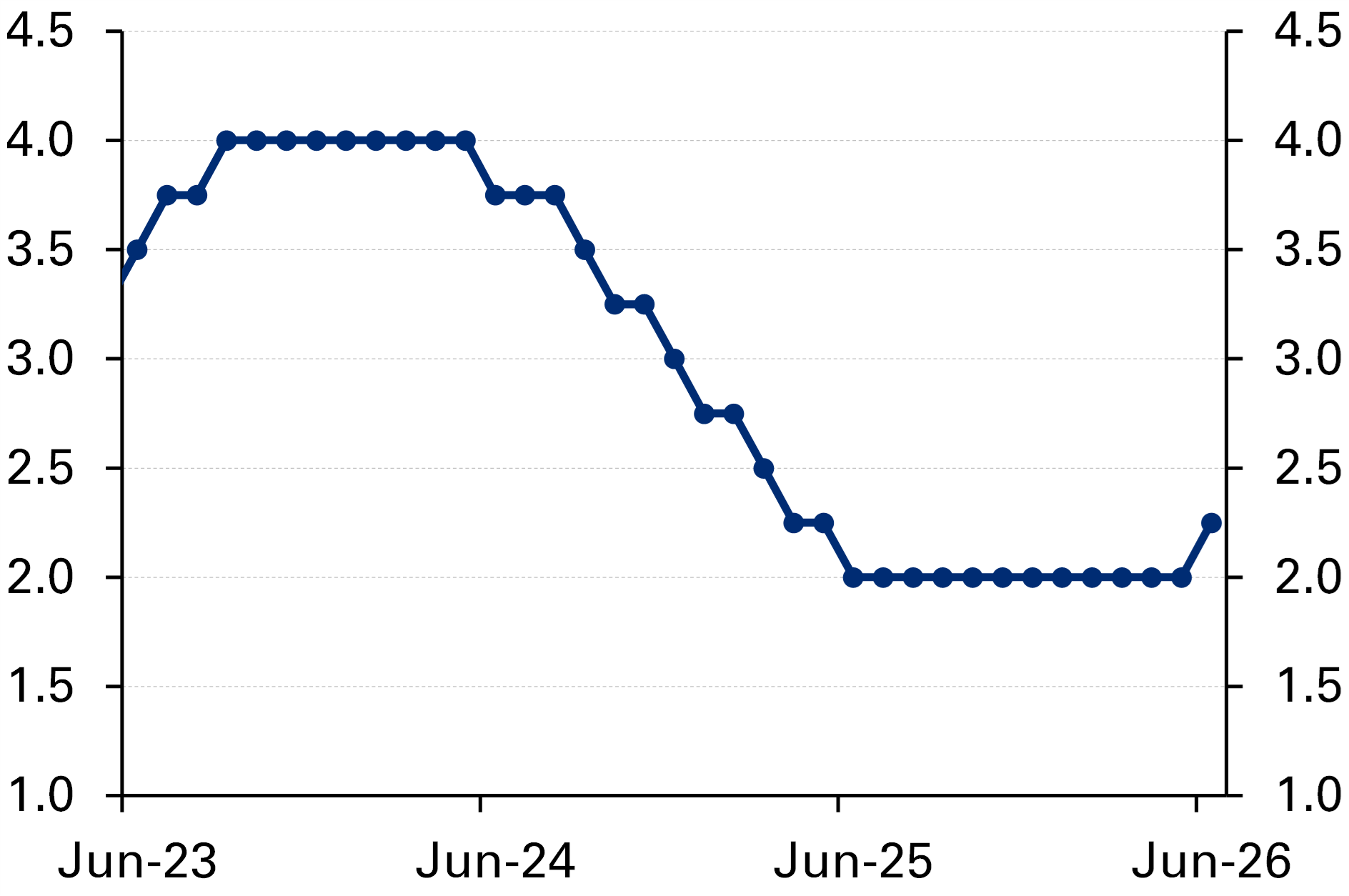
Eurozone: ECB hikes rates by 25 bps as the energy shock rebuilds inflation pressures. As widely expected, the ECB delivered a 25-bps rate hike on Thursday, raising the deposit facility rate to 2.25%, marking a clear shift away from the 2024–25 easing cycle and given renewed concerns over inflation’s persistence. The ECB is responding to a renewed supply-side shock, primarily via energy markets, rather than domestic demand reacceleration. Updated staff projections reflect this shift, with the baseline projection now seeing headline inflation averaging 3.0% y/y in 2026 (seen at 2.6% in the March projections), and 2.3% in 2027 (+2.0% prior), alongside core inflation holding at 2.5% in 2026 and 2027, indicating more persistent second-round effects than previously expected. In parallel, growth forecasts were revised down to 0.8% y/y in 2026 (+0.9% prior) and 1.2% in 2027 (+1.3% before), reinforcing a deteriorating macro mix. The policy statement mentioned that there are upside risks for inflation and downside risks for economic growth. In the press conference, President Lagarde framed the decision explicitly around uncertainty and resilience across scenarios, stating that “the war in the Middle East is generating inflation pressures, and the decision to raise rates is robust across a range of scenarios,” highlighting that policy is being calibrated against a highly uncertain external shock with potentially persistent inflation spillovers. Importantly, Lagarde mentioned that “the main risk would be not to take that kind of decision, because if you let inflation start running out without control, then it becomes a much more difficult situation to bring it back to the level of price stability”. Lagarde added that the shock is starting to broaden “throughout the economy” and that inflation is widening beyond energy. At the same time, the ECB maintained deliberately open-ended forward guidance, reiterating that it is “not pre-committing to a particular rate path” and will proceed on a data-dependent, meeting-by-meeting basis, with decisions anchored in the evolving inflation outlook, underlying price dynamics, and transmission strength. In addition, it is worth noting that the Q&A reinforced a subtly firmer reaction function than the statement alone, with Lagarde rejecting the notion of an “insurance” move and also signaling that policymakers can no longer “look through” energy-driven price pressures.
UK: Economy contracted in April as previous momentum falters. The economy shrank 0.1% m/m (+1.3% y/y) in April, in line with the consensus expectations, after a solid 0.3% (+1.2% y/y) increase in March as higher energy prices and the wider fallout from the Middle East war took a toll on economic activity. Services output fell 0.2% in April following 0.3% growth in March, while production was unchanged and construction rose 0.1%. The ONS attributed the fall in services to cancellation of sporting events in the Middle East that affected the output of UK businesses as one of the primary reasons. Looking ahead, elevated energy prices and the anticipation of higher policy interest rates along with ongoing weak labor market conditions underscore a fragile operating environment as seen in the recent PMI surveys.
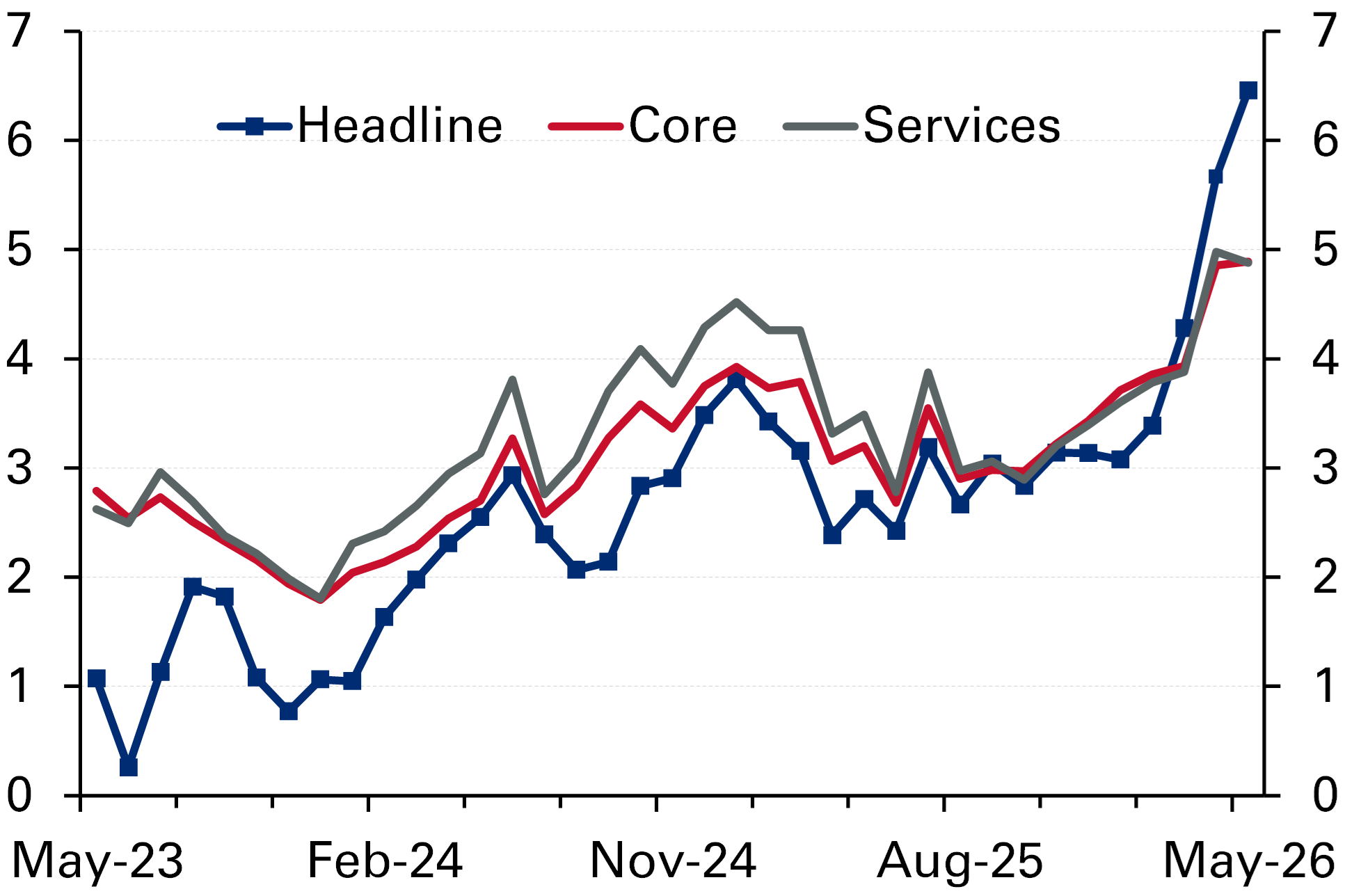
US: PPI inflation surges to the highest level since late 2022 on soaring energy prices. PPI inflation for final demand further accelerated to hit the highest level since November 2022 at 6.5% y/y (+1.1% m/m) in May from a downwardly revised 5.7% (+1.1% m/m) in April as energy goods prices surged by 10.7% m/m (+37% y/y). The core inflation rate was stable at 4.9% y/y but softened on a monthly basis to 0.4% from 0.7% in April. While overall goods prices rose at a faster pace than in April, services inflation was slightly milder at 4.9% y/y versus April’s more-than-three-year high of 5%. Surging PPI inflation signals further pipeline pressures for consumer prices, with the previously reported CPI inflation hitting an over three-year high in May. Meanwhile, likely impacted by the Memorial Day holiday, initial weekly jobless claims rose more than forecast to 229K (w/e June 6) from 225K the previous week, though they remained modest overall, with continuing claims (w/e May 30) also increasing to 1.8 million from 1.78 million the week before. Broader labor market data continues to point to an improving landscape in the last few months, which should keep Fed officials more focused on combating rising inflation at the FOMC’s upcoming meeting on June 16-17.
Egypt: Military-owned fuel network takes first privatization step ahead of planned IPO. Egypt has taken another step in its state ownership reform agenda, as the military-affiliated National Service Projects Organization (NSPO) begins the privatization process of part of Wataneya’s fuel station network, paving the way for a future stock market listing. Under the agreement, Taqa Arabia will acquire a 10% stake in 172 fuel stations currently operated by Wataneya through a newly established company, Quick Fuel for Petroleum Products Trading and Distribution, which will manage and operate these assets ahead of a planned IPO. Wataneya currently operates around 294 fuel stations nationwide, representing an estimated 7% of Egypt’s fuel retail market, meaning the deal covers more than half of its network. As part of the arrangement, Taqa Arabia will also have the option to increase its stake by an additional 15% once Quick Fuel is listed on the Egyptian Exchange. The move represents an initial practical step toward increasing private sector participation in military-owned assets, in line with Egypt’s broader privatization and state ownership reform program. The Sovereign Fund of Egypt has been restructuring Wataneya since 2025, alongside other military-affiliated companies, in preparation for potential market listings, although timelines have faced repeated delays. Overall, the transaction signals renewed momentum in Egypt’s privatization agenda and could help attract additional private investment into state-owned and military-affiliated assets over the coming period.