
 +965 2292 4888


Daily Economic Update
04.05.2026
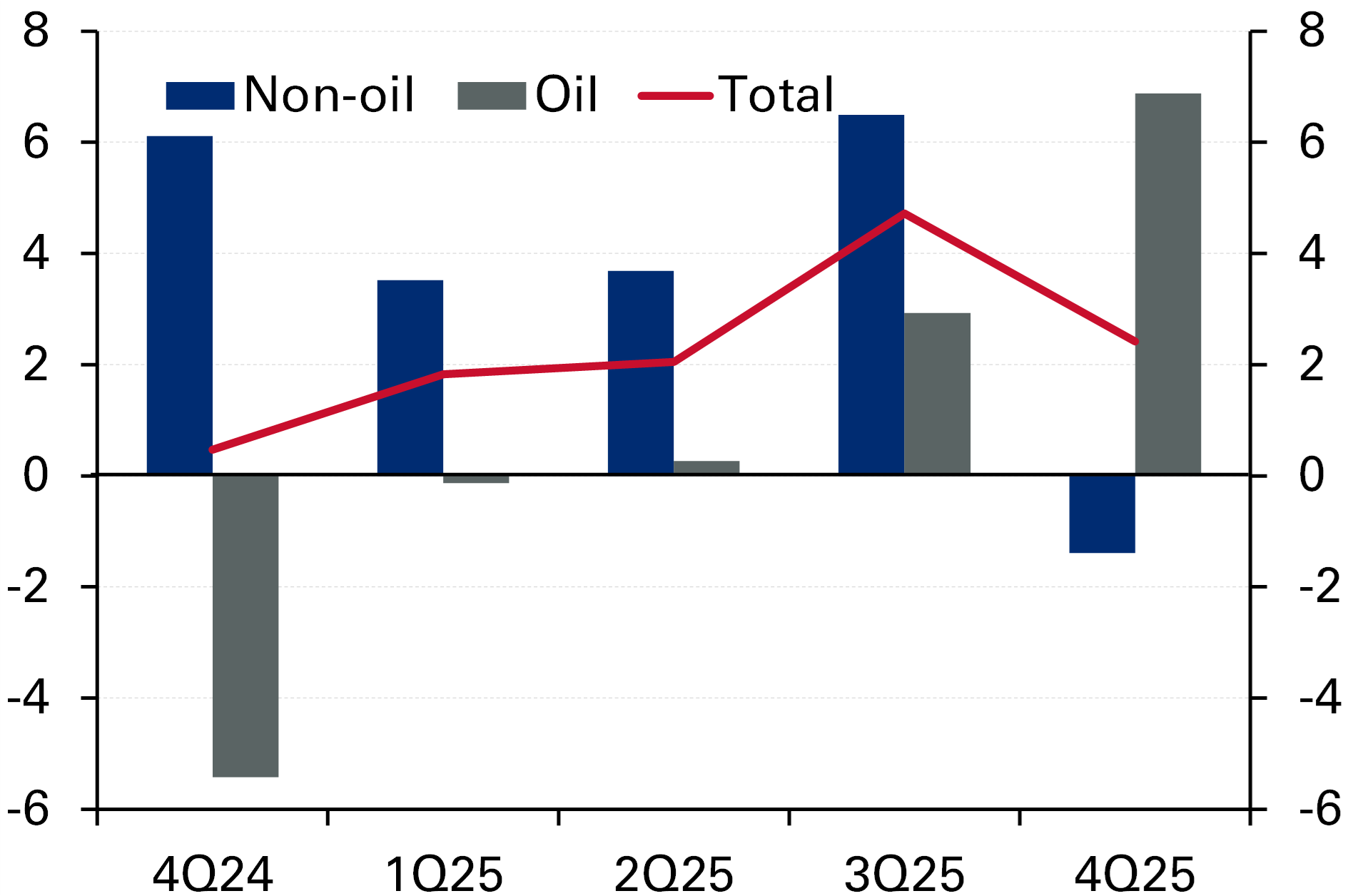
Kuwait: Growth softens in Q4 2025 as non-oil sector declines; full-year GDP returns to growth. Preliminary data from the Central Statistical Bureau show that GDP growth slowed to 2.4% y/y in Q4 2025, down from 4.7% in Q3, weighed by a contraction in non-oil activity. Despite the deceleration, the reading still marked the second highest quarterly rate since 2023, supported by a sharp acceleration in the oil sector. Oil GDP expanded 6.9% y/y, up from 2.9% in the previous quarter, reflecting higher production amid the unwinding of OPEC+ voluntary cuts. By contrast, non-oil GDP contracted 1.4% y/y, reversing the strong 6.5% expansion seen in Q3 and marking the first decline since Q3 2024. The slowdown was broad based, led by a 9.8% y/y contraction in manufacturing output (likely linked to lower oil refining activity in the quarter), while sectors that had driven growth in the prior quarter including hotels & restaurants, telecommunications, real estate, and construction, softened notably. The data release did not include revisions to previous quarterly figures. As for the full 2025, the economy returned to growth, expanding 2.7% after a 1.5% contraction in 2024, marking the first annual expansion since 2022. The recovery was supported by a 2.5% increase in oil production, while the non-oil economy expanded at a faster 2.9%, lifting its share of GDP to a record 52.7%. Nevertheless, non-oil growth slowed from 3.7% in 2024, reflecting weak momentum in manufacturing (+0.8% y/y) and a sharp deceleration in financial intermediation, where growth more than halved to 1.5%. This was partially offset by stronger outcomes in hotels & restaurants, construction, and transport. Looking ahead, the economy faces a large external shock in 2026 via the closure of the Strait of Hormuz, leading to oil production shut-ins amid disrupted export channels as well as softening non-oil activity from lower trade and travel, softer consumer spending, and higher uncertainty.
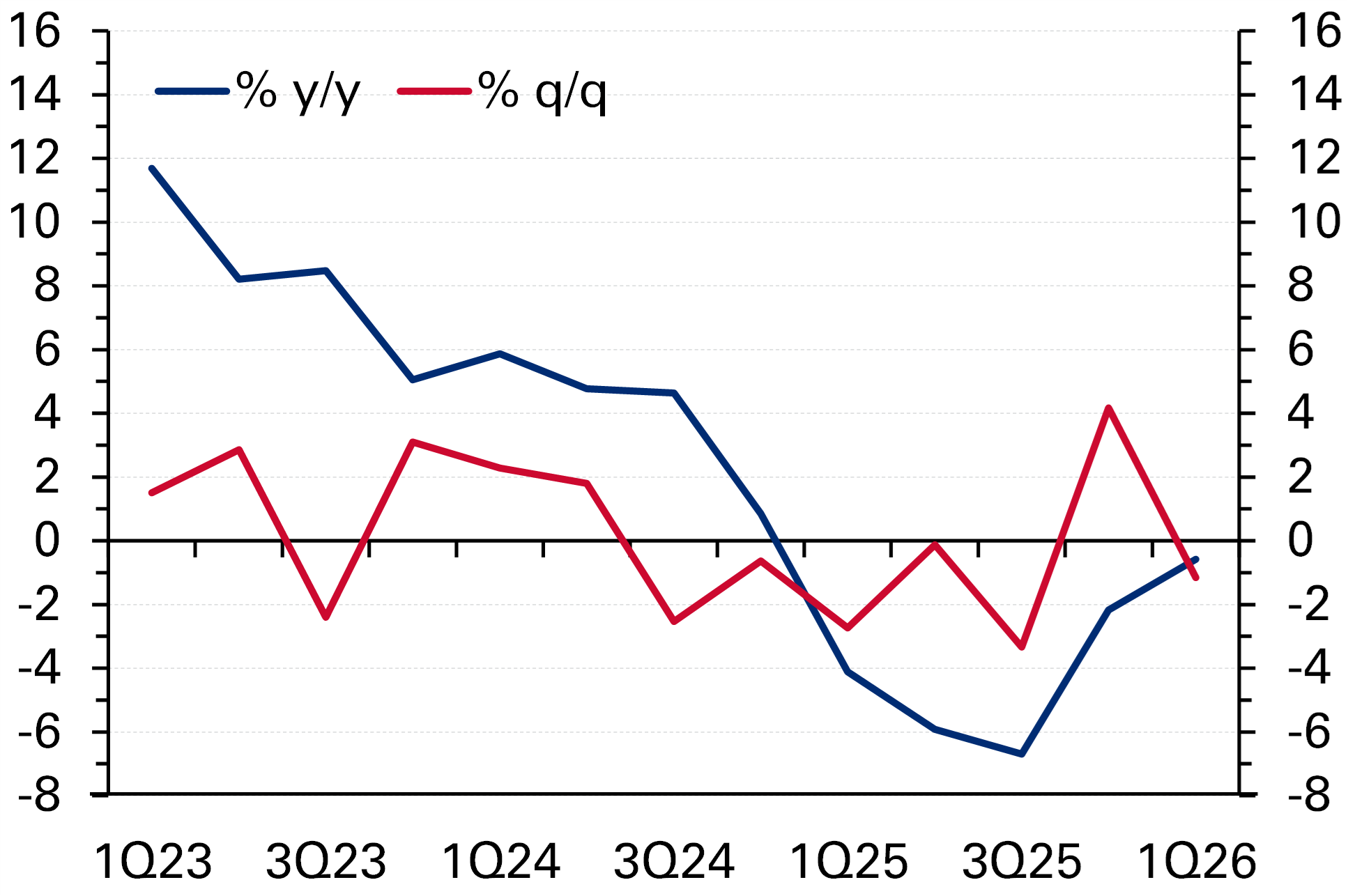
Kuwait: Card transactions decline in Q1, though March figures reveal minimal conflict impact. Central Bank of Kuwait figures show that the value of local electronic payment transactions (POS, ATM, and payment gateway) – a proxy for consumer activity – declined by 1.2% q/q in Q1 2026. The decline came mostly from an 8.5% m/m drop in February, possibly linked to seasonal effects and the start of the Holy month of Ramadan, with notably lower spending seen in all three of the above-mentioned spending channels and especially in POS transactions (-12% m/m). That said, the onset of the conflict in the Gulf in March did not appear to have a deleterious effect on card spending and February’s decline was partly reversed that month (+4.7% m/m), driven almost fully by a notable jump in ATM withdrawals (23% m/m), which we also interpret as a sign of caution (cash frontloading) with consumers possibly concerned about the liquidity and the continuity of banking services amid the ongoing conflict. For Q1, WAMD instant payments fell 1% q/q after double-digit quarterly growth since inception in June 2024. In annual growth terms, the decline in card spending witnessed over the previous four consecutive quarters eased in Q1 (to -0.6% y/y from -2.2% in Q4 2025), suggesting ongoing improvement. Despite the continuation of the regional conflict and general economic uncertainty, upcoming April data could potentially show marginally improved sentiment, helped by optimism over the US-Iran ceasefire, in addition to CBK measures to support liquidity and reassurances of uninterrupted service by local banks.
Saudi Arabia: PIF advances its AI strategy through new AWS partnership. Saudi Arabia is accelerating its push into artificial intelligence as the Public Investment Fund continues to align its updated investment strategy toward high-growth technology sectors. In this context, PIF’s AI arm, Humain, has partnered with Amazon Web Services (AWS) to launch Humain One, a new generative AI operating system designed to transform enterprise operations. The platform, described as a first-of-its-kind solution, builds on the $5 billion joint investment plan announced between the two sides last year. It aims to provide a fully integrated AI ecosystem that combines application development, quality assurance, data management, and governance within a single operating framework. Powered by AWS’s global infrastructure, the system will enable businesses to develop and scale secure autonomous AI agents across 39 global regions. It will also be made available through the AWS Marketplace, allowing broader international enterprise access. The launch is closely aligned with PIF’s evolving strategy, which is increasingly focused on scaling high-return sectors such as AI, advanced manufacturing, and digital infrastructure, as the fund shifts from broad capital deployment toward building globally competitive technology platforms. This move reinforces Saudi Arabia’s ambition to position itself as a regional AI hub and highlights how PIF’s revised roadmap is translating into concrete investments in next-generation technologies.
Egypt: Samurai bond issuance nears while government raises industrial gas prices. The government is moving closer to issuing Samurai bonds in the Japanese market, with plans to raise up to $500 million during May as part of its broader strategy to diversify funding sources and optimize borrowing costs. The initiative gained momentum following Egypt’s participation in the recent IMF-World Bank Spring Meetings in Washington, where the Egyptian delegation authorized Japanese financial institutions to begin finalizing issuance procedures. If completed on schedule, the offering is expected this month, with early June as a fallback timeline. The planned issuance reflects Egypt’s continued efforts to expand access to alternative debt markets, reduce reliance on conventional Eurobond financing, and secure more competitively priced funding. Meanwhile, the government has also announced a new increase in natural gas prices for energy-intensive industries, effective May 1, as part of a broader restructuring of industrial energy pricing. Under the new pricing framework, the cement sector will pay $14 per MMBtu, up from $12, while iron and steel, petrochemicals, and non-nitrogenous fertilizers will face prices of $7.75 per MMBtu, compared to $5.75 previously. Other industrial activities will be charged $6.75 per MMBtu, with a minimum floor of $6.5 per MMBtu. The move reflects growing pressure on the state’s energy bill and signals a continued shift toward cost-reflective pricing, supporting fiscal consolidation while gradually reducing subsidy burdens.
Oil: Prices steady as Trump announces Hormuz plan; OPEC-7 agrees to hike June quotas. Brent futures were little changed around $108/bbl in early Asian trading, after US President Trump announced plans to begin guiding stranded commercial vessels through the Strait of Hormuz starting today. In remarks made just ahead of futures markets opening, Trump unveiled “Project Freedom,” a plan aimed at facilitating the passage of ships from neutral countries not involved in the Middle East conflict, which he described as being coordinated with Iran. The announcement initially pushed prices lower, with Brent opening near $106.6/bbl, but losses were quickly pared after reports clarified that the US Navy would not provide escorts and a senior Iranian parliamentarian dismissed the initiative. Separately, OPEC 7 agreed to raise production quotas by 188 kb/d for June, marking the group’s first meeting following the UAE’s exit. The effective supply impact of the hike will largely depend on conditions in the Strait of Hormuz next month, particularly as around half of the additional volumes remain stranded on the wrong side of the chokepoint amid ongoing maritime disruptions.
Global: April’s US jobs report and China’s trade data key matters this week. In the US, the non-farm payroll report for April will be released on Friday, and the consensus forecast is for a still relatively resilient 73K rise in jobs, though slowing from March’s outsized 178K increase, with a steady unemployment rate of 4.3%. Job openings for March (Tuesday) are seen inching down very marginally to 6.87 million from February’s 6.88 million. The ISM services PMI (Tuesday) is expected to ease slightly to 53.8 in April (54 in March) while the focus would also be on the prices paid measure. Several Fed officials will speak this week, offering their views on the economy and policy, the monitoring of which should warrant even more importance given the upcoming change in the Fed’s chairmanship. In the Eurozone, retail sales in March (Thursday) are forecast to fall by 0.4% m/m, a contraction for the second consecutive month (-0.2% in February). In the UK, after a relatively steep 0.5% m/m decline in March, the Halifax house price index (Friday) is seen rising by 0.2% in April. Also, key local and regional elections take place on Thursday which could affect the future of PM Starmer. In China, April trade figures are due on Saturday, and it is key to watch out for any possible spillover effects from the Middle East war; as a reminder, headline export numbers were weak in March while imports were strong. Finally in Japan, employees’ cash earnings for March are due on Friday with growth seen inching down to 3.2% y/y from 3.3% in February.