
 +965 2292 4888


Daily Economic Update
14.04.2026
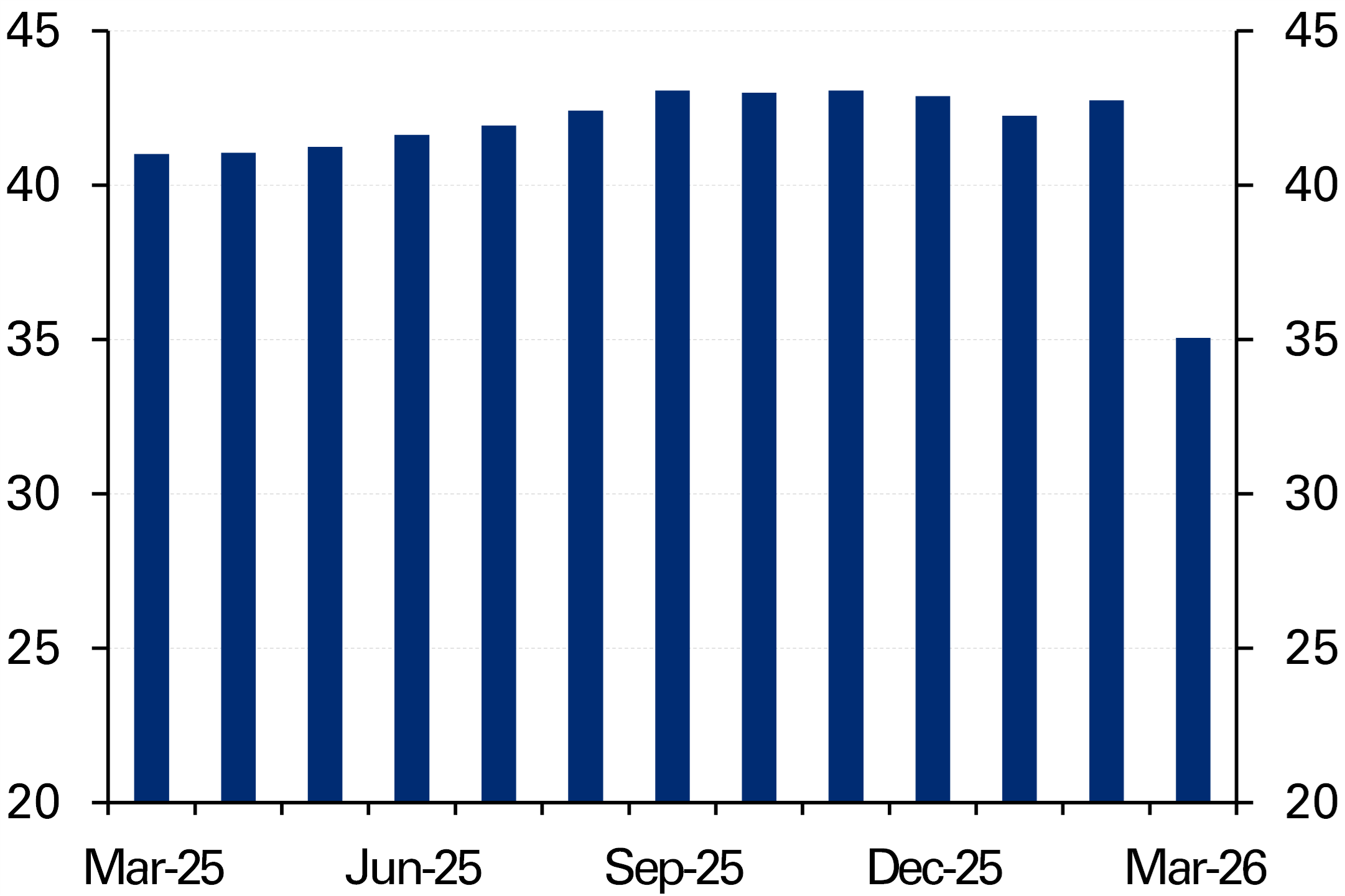
Oil: Price movement volatile as US-Iran ceasefire holds. Brent futures closed yesterday up 4.4% at $99.4/bbl, giving back part of earlier gains after having traded nearly 8% higher on Monday’s open ahead of the start of the US naval blockade on Iranian ports yesterday at 5pm Kuwait time. The partial retracement reflected a shift in market sentiment, which has continued into early Asian trading today with Brent down a further 1.2%, as immediate escalation fears eased and rumors circulated of a fresh round of US-Iran talks. While the measures are expected to take up to 2 mb/d of Iranian crude exports offline, they have, so far, not been sufficient to break the current ceasefire, tempering worst case tail risk pricing. That said, ongoing disruptions to crude flows through the Strait of Hormuz continue to tighten the near-term supply picture, reinforcing upside risks to market balances. In response, the IEA’s Executive Director flagged the potential for another Strategic Petroleum Reserve release, though in practice the binding constraint would be flow capacity (capped at 3-4 mb/d) rather than the headline volume. Diplomatic developments also weighed on prices. Media reports over the weekend suggested that Washington had offered Tehran a 20-year moratorium on uranium enrichment, signaling a potential softening from its prior zero enrichment forever stance. This, alongside reports of a second negotiating round scheduled for Thursday in Islamabad, and comments from US Vice President J.D. Vance emphasizing the administration’s preference for a negotiated end to the conflict, acted as near term bearish catalysts. On the supply side, OPEC’s latest monthly report underscored the depth of disruption already visible in production data. OPEC+ output fell by a record 7.7 mb/d m/m in March, with the sharpest losses recorded in Iraq (-2.56 mb/d), Saudi Arabia (-2.3 mb/d), the UAE (-1.53 mb/d), and Kuwait (-1.37 mb/d), bringing total DoC production to 35.1 mb/d. Offering limited relief, Kazakhstan’s output rebounded to 1.73 mb/d (+250 kb/d) after earlier disruptions. On the demand side, OPEC remains comparatively constructive, trimming its Q2 2026 consumption outlook by just 500 kb/d while maintaining its full-year growth forecast at 1.4 mb/d. In contrast, the EIA halved its 2026 oil demand growth estimate to 0.6 mb/d in its April update, highlighting a widening divergence among agencies. The IEA’s monthly report, due later today, is expected to align more closely with the EIA’s more cautious demand assessment.
US: Existing home sales decline to a nine-month low, outlook seems muted given a rise in mortgage rates and higher inflation. Existing home sales in March fell by a worse-than-expected 3.6% m/m to hit a nine-month low after posting an upwardly revised growth of 2.7% in February. The outlook for housing market activity continues to be uninspiring as the Middle East war has renewed affordability challenges for many US home buyers following a sharp jump in consumer price inflation and a resurgence in mortgage rates. The 30Y fixed mortgage rate, which had fallen to the lowest level since September 2022 of around 6.1% before the war began, climbed to 6.5% at the beginning of April as per the Mortgage Bankers Association of America.
China: Weak export growth in March impacted by the Middle East war and base effects. Exports increased 2.5 % y/y in March, missing expectations and decelerating sharply from the 22% y/y surge recorded in the combined January–February period, reflecting weaker global demand and mounting disruptions from the Middle East war. Shipments to the US contracted by a sharp 26% y/y, continuing the double-digit fall that was recorded in 2025. China’s customs vice minister mentioned that the trade environment has been “complex and severe” given the energy price shock. In addition, base effects were strong given that exports had surged last year when companies rushed to get ahead of US tariffs that were levied in April. Imports, by contrast, accelerated strongly in March, rising 28% y/y, marking the fastest pace since late 2021 and pointing to a partial rebound in domestic demand. As a result, China’s trade surplus narrowed markedly to $51 billion in March, down from the $102 billion recorded a year ago. Strategic reserves and price controls have helped cushion the oil price shock, but a prolonged disruption to shipping through the Strait of Hormuz would likely sustain upward pressure on energy and freight costs, further compress exporter margins and dampen external demand in Q2.
Japan: BoJ’s Ueda highlights upside and downside risks to underlying inflation given the Middle East war. Bank of Japan’s (BoJ) Governor Kazuo Ueda, in a statement, underscored high oil prices, supply-chain disruptions and uncertainty facing the Japanese economy due to the Middle East war that could have implications for inflation in both directions. He mentioned that “if the output gap worsens, that could weigh on underlying inflation. On the other hand, if rising crude oil prices heighten the public's medium and long-term inflation expectations, that could push up underlying inflation.” The futures market currently signals around 70% probability for no change in interest rates at the BoJ’s policy meeting on April 27-28.
Egypt: S&P joins Moody’s in affirming the credit risk rating despite rising external risks. S&P affirmed Egypt’s sovereign credit rating at B with a stable outlook, aligning with the recent stance by Moody’s, which maintained its Caa1 rating with a positive outlook. The twin affirmations reflect a balance between Egypt’s improving medium-term fundamentals and the growing risks stemming from regional geopolitical tensions. S&P highlighted that the reform momentum initiated since the 2024 exchange rate liberalization continues to support macroeconomic stability, helping the economy absorb external shocks. This is reinforced by stronger external buffers, including international reserves reaching around $52.8 billion in March 2026, alongside a solid net foreign asset position in the banking sector. Despite the recent 13% depreciation of the Egyptian pound since the start of the conflict, the authorities have maintained their commitment to a flexible exchange rate regime, a key pillar of the ongoing reform program supported by the IMF. The stable outlook is underpinned by continued adherence to fiscal and structural reforms. However, S&P cautioned that rising external pressures, including higher borrowing costs and constrained access to international markets, could weigh on public finances. The agency also flagged potential downside risks, particularly any reversal in reform policies, especially regarding exchange rate flexibility, or a renewed widening in macroeconomic imbalances. Overall, Egypt remains sensitive to regional shocks, which could affect foreign currency inflows and increase import costs in the near term.
Oman: FDI inflows eased in 2025. Oman’s foreign direct investment (FDI) stock rose by 8.1% y/y to RO 31.4bn ($80.5bn) by end 2025, reflecting continued investor interest, although annual inflows fell to RO 2.4bn from RO 3.6bn in 2024, pointing to slower new capital entry. Investment remains highly concentrated in oil and gas, which accounts for about 81% of total FDI, while manufacturing and financial services hold much smaller shares and recorded weaker inflows. In contrast, utilities, trade and construction showed modest FDI growth suggesting that infrastructure related activity continues to attract foreign capital. The UK remains the dominant source, providing just over half of total FDI, followed by the US and Kuwait, underscoring both the depth of traditional investment ties and ongoing concentration risk.