
 +965 2292 4888


Daily Economic Update
12.07.2026
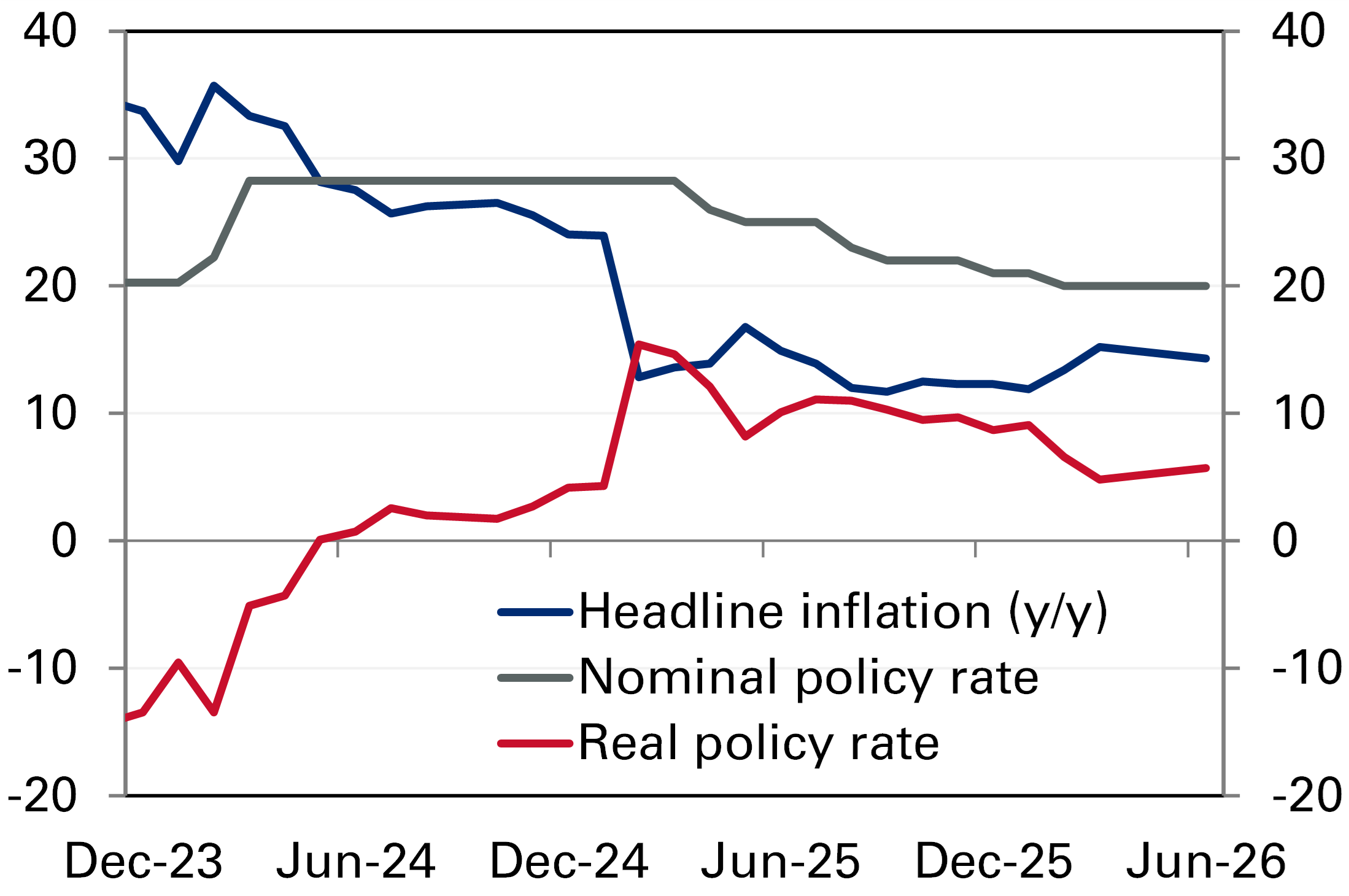
Egypt: CBE holds rates as inflation continues to ease. The Central Bank of Egypt’s Monetary Policy Committee (MPC) kept policy interest rates unchanged for the third consecutive meeting, maintaining the overnight deposit rate at 19% and the overnight lending rate at 20%, broadly in line with market expectations. The decision came as inflation continued to moderate, with urban headline inflation slowing for a third consecutive month to 14.3% y/y (-0.4% m/m) in June, down from 14.6% in May and 14.9% in April. The monthly deflation was largely driven by lower food prices, particularly vegetables (-12%), meat and poultry (-5.2%), and dairy products (-2%). However, the picture was less encouraging beneath the surface. Core inflation, which excludes volatile items such as food and energy, edged higher to 14.3% y/y in June (13.8% in May), suggesting that underlying inflationary pressures remain persistent despite the recent improvement in the headline figure. With real interest rates still standing at close to 6%, the CBE appears comfortable maintaining its wait-and-see approach while monitoring the impact of regional developments on inflation and economic activity. For now, the latest figures support the view that the easing cycle will remain on hold until the disinflation trend becomes more broad-based and sustainable.
Saudi Arabia: Fitch affirms Saudi Arabia’s A+ rating despite the growth slowdown. Fitch Ratings affirmed Saudi Arabia’s long-term foreign-currency issuer default rating at A+ with a stable outlook, highlighting the Kingdom’s strong fiscal and external buffers despite the economic impact of the US-Iran conflict. The agency expects Saudi economic growth to slow sharply to 0.6% in 2026, a significant downgrade from its January forecast, reflecting the disruption caused by the Strait of Hormuz crisis and weaker petrochemical exports. Growth is nevertheless expected to recover in 2027 before moderating to around 2.9% in 2028. Fitch noted that Saudi Arabia’s ability to redirect oil exports through the East-West Pipeline helped maintain crude production and exports at around 9 million barrels per day during the conflict, while domestic consumer spending remained resilient despite the regional turmoil. The Kingdom’s external position remains one of its key credit strengths. Foreign reserves are expected to remain in 2026 among the strongest in the rating category, covering around 11.6 months of external payments. Although sovereign net foreign assets are projected to gradually decline as government borrowing increases, they are still expected to remain sizeable at around 38.5% of GDP by 2028. On the fiscal side, Fitch expects the budget deficit to narrow in 2026 as higher oil prices offset lower export volumes. However, the deficit is projected to widen again in 2027 as oil prices moderate before improving once more in 2028 as geopolitical pressures ease and expenditure adjustment measures take effect. The agency also revised its external outlook, now expecting Saudi Arabia to record a current account surplus in 2026 instead of the deficit previously anticipated, supported by stronger oil revenues. Over the medium term, lower oil prices and robust domestic demand are expected to gradually push the current account back into deficit, although external borrowing and asset sales are expected to provide sufficient financing buffers.
US: Fed announces leaders of the five task forces, which include high-profile names. The Federal Reserve announced on Thursday the leadership of the five task forces that Chair Warsh first announced in the post-meeting press conference of the June FOMC meeting. As per the Fed, “each task force will carefully consider whether policymakers' means and methods, analytical tools and policy approaches can be improved upon”, adding that “the goal is straightforward: to ensure the Fed is best positioned to achieve our objectives in this consequential time”. As a reminder the task forces will examine the following areas: communications, balance sheet policy, data, productivity/jobs, and inflation. The leaders of the task forces include prominent academics, former central bankers, and corporate executives. Some of the high-profile names include Mervyn King (former governor of the Bank of England), Arminio Fraga (former president of the Central Bank of Brazil), Raghuram Rajan (former governor of the Reserve Bank of India), Thomas Sargent (Nobel laureate in Economics), and Doug McMillon (former CEO of Walmart). The task forces will be supported by Fed staff, they will operate independently and are expected to produce rigorous findings/recommendations. We note that the FOMC will be the ultimate decision maker on whether to act or not on the recommendations of the task forces. While the official announcement on Thursday did not specify a deadline for when the task forces should submit recommendations, Chair Warsh had previously mentioned that he expects recommendations to be submitted by year-end. In other news, New York Fed President (a permanent FOMC voter), John Williams, mentioned that among the drivers of inflation in the US, he is most focused on demand driven by artificial intelligence, and if that demand persists, it could force the Fed to raise interest rates. Williams added that if core PCE comes in at a monthly pace of 0.2% over the second half of 2026, that would suggest inflation is on track to return to the Fed’s 2% target.
Eurozone: June ECB meeting minutes show inflation concerns outweighed weaker growth outlook. The ECB’s June meeting minutes showed broad support for the Governing Council’s decision to raise interest rates by 25bp, with policymakers viewing the move as necessary to preserve price stability amid rising inflation pressures linked to the Middle East conflict. Members noted that the energy shock was no longer confined to energy prices alone, with indirect effects increasingly feeding into food, goods and services inflation across the economy. Policymakers highlighted the rise in core inflation to 2.5% y/y in May from 2.2% in April, alongside an increase in services inflation to 3.5% from 3.0%, which some members considered particularly noteworthy given its close link to domestic cost conditions. While there was no evidence of second-round wage effects, the minutes highlighted concerns that prolonged inflation could eventually influence price- and wage-setting behavior. On the growth side, the Governing Council acknowledged that the outlook had weakened, with higher energy prices eroding real incomes and weighing on confidence. Risks to growth were judged to remain skewed to the downside. Nevertheless, members generally viewed recession risks as limited, pointing to resilient labor markets, strong household balance sheets, increased public spending on defense and infrastructure, and rising investment linked to digital technologies and AI. As a result, policymakers saw the current environment as one of weaker, but still positive, growth rather than outright stagflation.
Japan: PPI inflation rises to more than a three-year high; Government urges pension fund to invest more domestically. June’s producer price index (PPI) inflation accelerated to 7.1% y/y, significantly above consensus estimates of 6.8% and the previous month’s 6.6% print. June’s figure also represents more than a three-year high, driven by sharp increases in the price of plastics, utilities, and petroleum and coal products amid the ongoing situation in the Strait of Hormuz. Elsewhere, the Yen strengthened and the stock market rose after Finance Minister Katayama stated that the government was hoping to increase the pension fund’s investment in domestic assets. The GPIF, which currently manages yen 294 trillion ($1.8 trillion) in assets, is among the world's largest pension funds, and expectations of a greater allocation toward Japanese equities and bonds were seen by markets as potentially supportive for domestic asset prices and the broader investment landscape.