
 +965 2292 4888


Daily Economic Update
27.07.2026
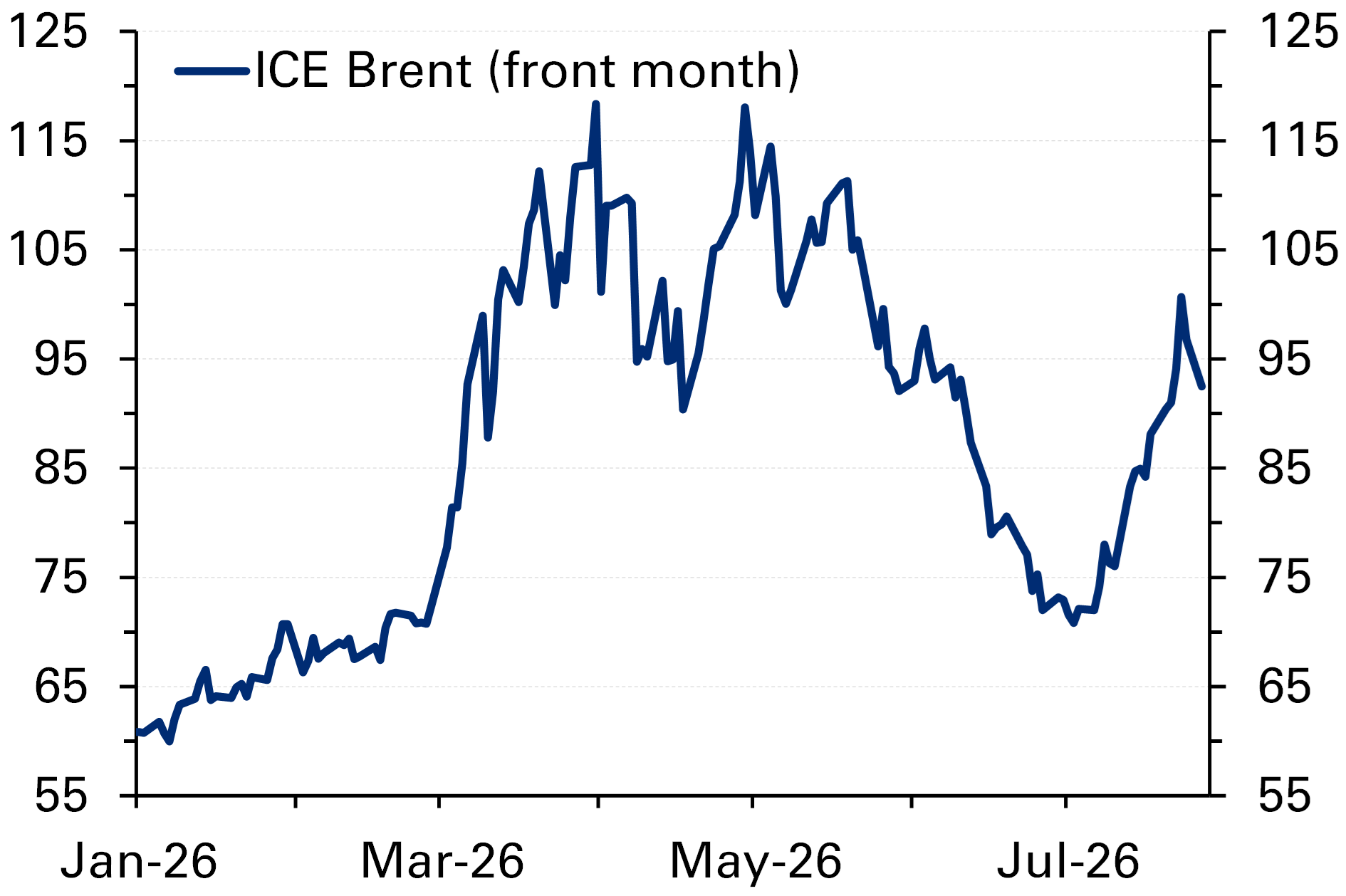
Oil: Brent falls as US-Iran hostilities pause and hopes for diplomacy grow. Brent crude futures came under heavy selling pressure in early Asian trading today, briefly falling below the $90/bbl mark before recovering some losses to currently trade around $92.5/bbl, down roughly 4% on the day. The move extends Friday's selloff (also around 4%) and reflects the pause in hostilities over the weekend, after the US halted its campaign of retaliatory strikes after 13 consecutive nights of military action linked to Iranian attacks on shipping in the Strait of Hormuz. While no formal talks or a reason for the cessation of hostilities has been announced, markets appear to be interpreting the pause as a potential opening for diplomacy, prompting a reassessment of geopolitical risk premia. The latest correction comes after a strong rally last week, in which Brent settled up 9.9% w/w on Friday and recorded a fourth consecutive weekly gain. Prices briefly closed above $100/bbl on Thursday for the first time since May as escalating tensions across the Middle East fueled concerns over oil supply security amid continued exchanges of strikes between the US and Iran, as well as rising hostilities between Saudi Arabia and Yemen's Houthi movement. While the US-Iran front has temporarily calmed, Saudi oil facilities and exports are potentially becoming a new arena. Over the weekend, the Houthis claimed responsibility for attacks on Saudi oil facilities in Jazan and Yanbu, with reports indicating a fire at the former site. Beyond the Middle East, additional supply risks have emerged in the Black Sea as Ukrainian attacks on tankers have reportedly disrupted loadings at the Caspian Pipeline Consortium terminal in Russia, which handles more than 80% of Kazakhstan's crude exports, equivalent to roughly 1.4 mb/d. The disruption adds another source of supply uncertainty at a time when markets are already grappling with elevated geopolitical tensions and constrained shipping routes.
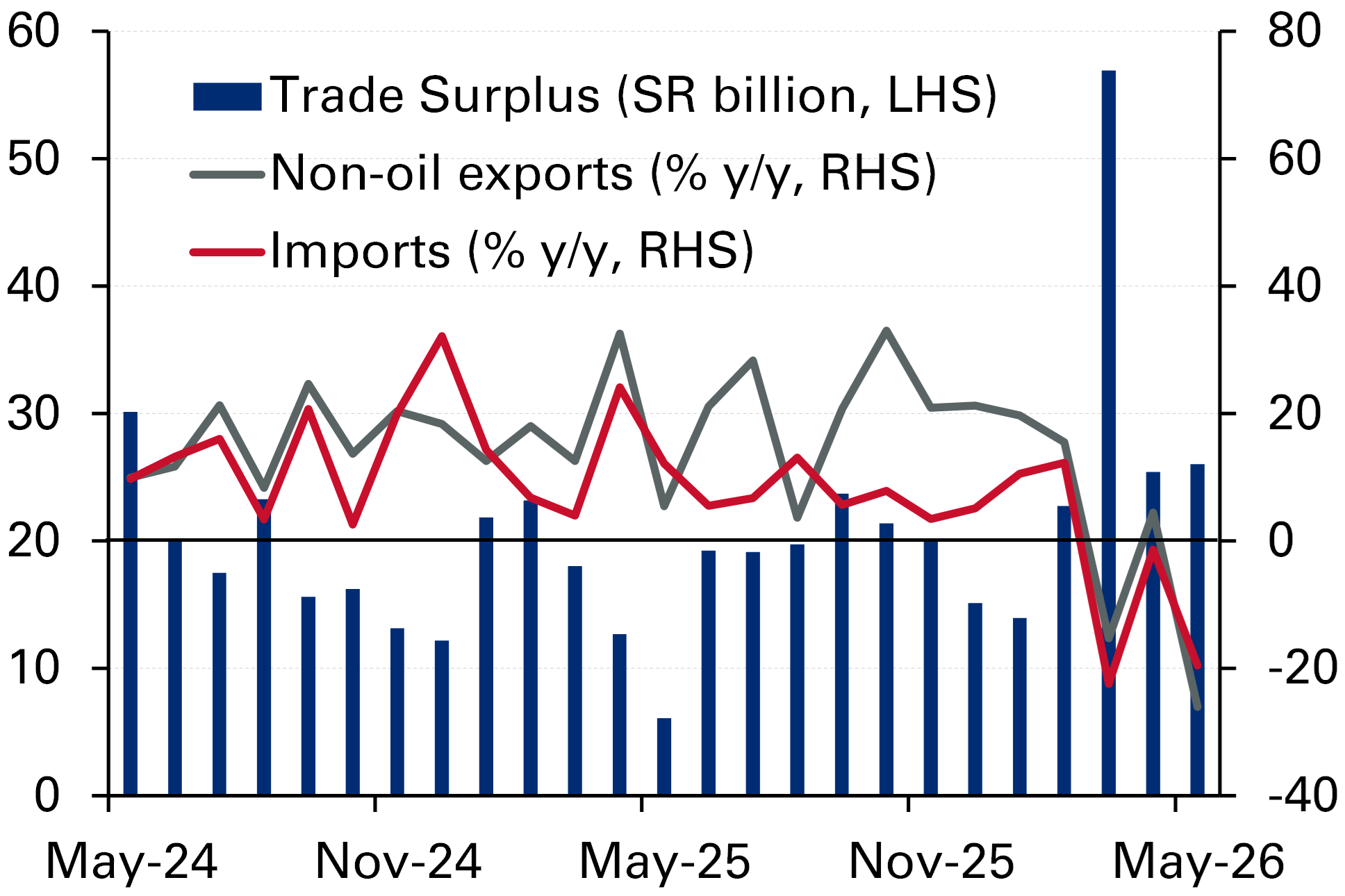
Saudi Arabia: Trade balance improved in May amid import weakness. According to official data released by GASTAT, the merchandise trade surplus strengthened in May, reaching SR 26 billion (14% m/m, 329% y/y), thanks to a jump in oil exports coupled with a drop in imports compared to a year ago. This surplus is equivalent to about 6% of GDP on a pro-rated basis. Total exports rose by 3.9% y/y, driven by a 19.5% increase in oil exports that lifted oil’s share of total exports to 76% from 66% a year earlier. Note that oil prices rose more than 50% between February and May, more than offsetting the impact on oil exports of a 31% drop in Saudi oil production linked to trade disruption caused by the US-Iran conflict. In contrast, non-oil exports, including re-exports, declined 26% y/y, reflecting weaker performance in key sectors such as machinery, electrical equipment, plastics, and rubber products. Although they have bounced around in recent months, non-oil exports in May were 27% below February (i.e. pre-war) levels, likely reflecting trade disruption linked to the US-Iran conflict. Meanwhile, imports also fell sharply by 19.5% y/y, contributing most to the increase in the trade surplus in May – and were also down substantially (-15%) from February levels. Machinery, electrical equipment, and parts dominated non-oil trading activity, with China remaining the largest trade partner on both the export and import sides.
China: Industrial profits remained robust in June despite uncertainty. Industrial profits remained resilient in June, rising 15.1% y/y, although growth moderated from 21% y/y in May. Profits grew 18.7% y/y ytd through June, supported by a strong performance in high-tech manufacturing, particularly electronics and semiconductors. However, firms continue to face an uncertain backdrop marked by a challenging external environment, volatile commodity prices, and soft domestic demand. The July Politburo meeting is expected to provide further clarity on authorities’ policy priorities; still, resilient exports and a preference for targeted support suggest broad-based stimulus steps are unlikely.
Global: Fed, BoE and BoJ policy decisions, US/Eurozone Q2 GDP, US June PCE and Eurozone July CPI inflation important matters this week. In the US, the FOMC meets on Tuesday/Wednesday, and although no change in the Fed rates is broadly expected, interest rate futures currently assign around one-third probability of a 25bps rate hike, reflecting heightened uncertainty and ambiguous Fed signals. Chair Warsh should maintain his no-forward guidance policy but may provide additional details on the recently constituted taskforces. On the data front, Q2 GDP (Thursday) is projected to grow by 2.3% (annualized), accelerating from Q1’s 2.1%. The street estimates see June’s core PCE inflation (also on Thursday) falling to 0.1% m/m from 0.3% in May, reflecting softer energy prices. In the Eurozone, Q2 GDP (Thursday) is expected to rebound by 0.2% q/q after contracting by 0.2% previously, while CPI inflation in July (Friday) is seen inching up to 2.9% y/y from June’s 2.8%, but with the steady core rate of 2.4%. In the UK, the BoE (Thursday) is seen maintaining the key policy rate at 3.75%, but the focus will be on updated staff economic projections. In China, this week’s Politburo meeting will attract attention for signals on targeted measures to support domestic demand and confidence. Data wise, official July PMIs (Friday) are expected to show easing manufacturing activity (to 49.9 in July from June’s 50.3) and broadly stable non-manufacturing around the 50-point threshold. Finally in Japan, the BoJ (Friday) is widely expected to keep its policy rate unchanged at 1% but the focus will be on the bank’s updated economic forecasts as well as commentary on the impact of the US tariffs and the Iran war. Finally, also on Friday, June’s retail sales growth is forecast to slow to 2.8% y/y from 5.3%, but industrial production is expected to accelerate to 0.7% m/m from 0.1% in the previous month.