
 +965 2292 4888


Daily Economic Update
26.11.2025
US: Weak retail sales and consumer confidence signal stalling momentum; Kevin Hassett seen as top choice for Fed Chair role. Retail sales growth in September slowed more than forecast to 0.2% m/m (4.3% y/y) from 0.6% (5% y/y) in August. A narrow measure of sales (excluding food services, auto, building materials and gasoline) contracted for the first time in five months, by 0.1% m/m from a downwardly revised 0.6% increase in August, indicating development of some fatigue in household spending. Moreover, the Conference Board consumer confidence index fell to the lowest level since April, down to 88.7 in November from October’s 95.5 on worsening outlooks for business conditions, job prospects, and future income. Consumers were also concerned about inflation, tariffs, and the government shutdown. A decreasing number of consumers saw jobs were “plentiful” but less also believed jobs were “hard to get”. In another indication of continued softening in the job market, ADP weekly jobs data showed that the US private sector continued to shed workers during the four weeks ending November 8 at a rate of 13.5K per week, worsening from an average weekly decline of 2.5K in the preceding four-week period. Meanwhile, PPI inflation in September was steady at 2.7% y/y but, excluding food and energy, wholesale inflation, at 2.6%, was the softest since July 2024. Overall, signs of weakening household spending, falling consumer confidence, softening job indicators, and relatively tame price pressures may encourage FOMC participants sitting on the sidelines to support an interest rate cut in December; the futures market is currently indicating around 85% chance for a 25-bps rate cut next month. Finally, according to media reports, White House National Economic Council Director Kevin Hassett has emerged as the top contender for the Fed Chair role, replacing Powell when his term ends in May 2026. Treasury Secretary Scott Bessent said that he expects President Donald Trump to make a decision on the new Federal Reserve Chair before Christmas. Among the five shortlisted candidates, Hassett is seen as the most closely aligned with the US administration and hence seen following through President Trump’s agenda of cutting policy interest rates.
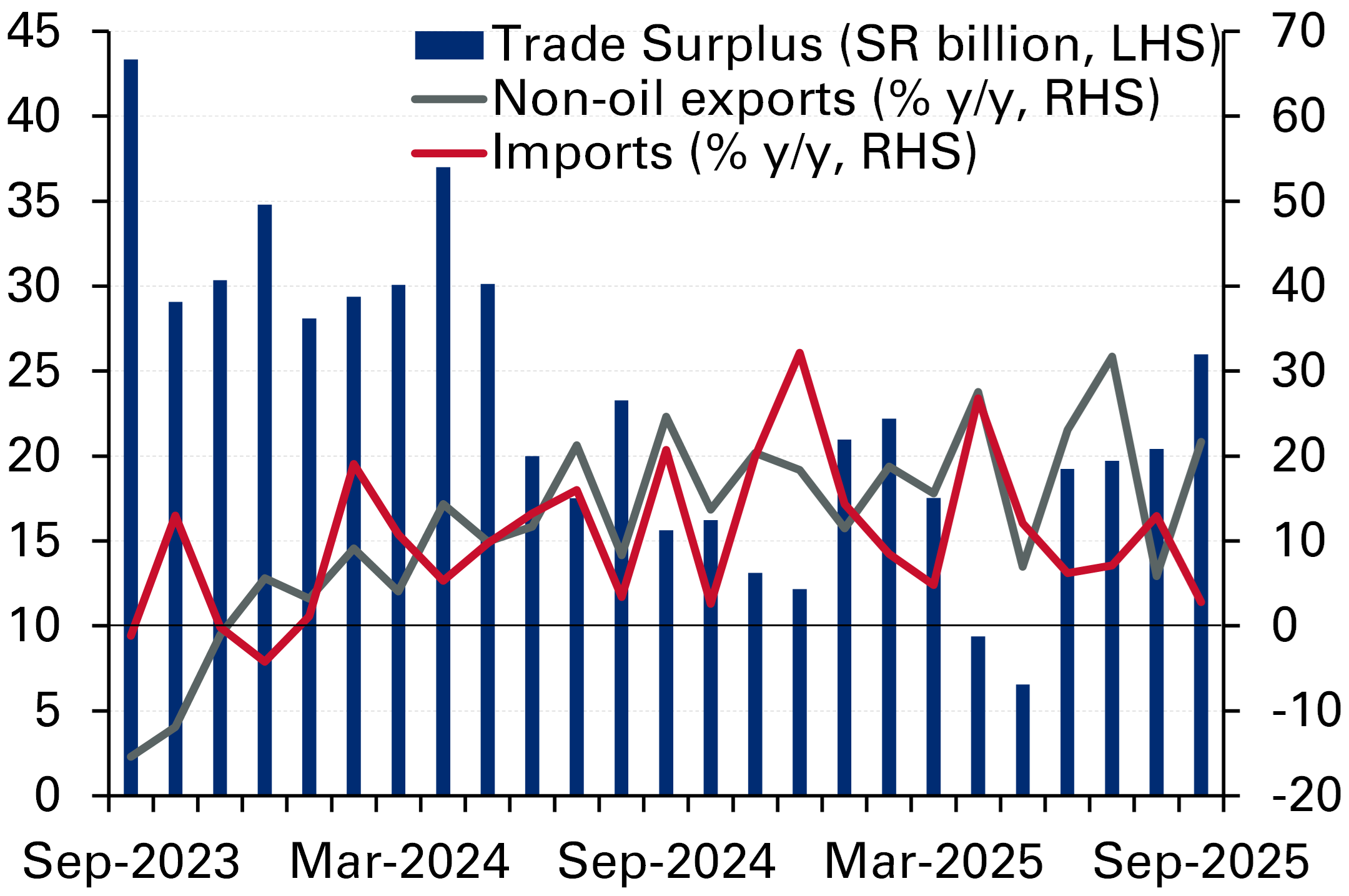
Saudi Arabia: Trade surplus continued to widen in September. The merchandise trade surplus widened to a 17-month high of SR 26 billion in September (26% y/y), from a downwardly revised SR 20 billion in August. This is the fourth consecutive month of improvement from May’s five year low surplus of SR 6.6 bn, supported in part by the biggest jump in oil exports (11% y/y) since December 2022 on recovering oil production. Additionally, non-oil exports surged by 22% y/y extending a long-term sequence of strong expansion, driven largely by exceptionally strong re-export growth (72% y/y). Non-oil export growth was led by machinery, mechanical and electrical equipment (102% y/y) and precious stones/ jewelry (105% y/y). The higher exports more than offset a 2.8% y/y rise in imports driven mostly by a continued increase in machinery imports (17%) and an exceptional jump in arms and munitions imports to nearly 10 times the level from a year ago (likely linked to the adverse geopolitical backdrop). We expect to see a continued improvement in the trade balance over coming months, helped by the ongoing recovery in oil exports and sustained non-oil export growth on the back of rising productive capacity and solid external demand.
Egypt: FX pipeline strengthens as Suez Canal rebound meets new oil and gas investments. Egypt received two encouraging updates this week, both pointing toward a gradual strengthening of foreign currency inflows and a more sustainable improvement in the external position. Maersk announced it will begin a phased return to the Red Sea shipping route starting December, following a new strategic cooperation agreement with the Suez Canal Authority. Major global carriers CMA and CGM are also preparing for a full return next month, signaling rising confidence in the route’s security and stability. While Japan’s NYK is still cautious – awaiting clarity on regional geopolitics – these commitments mark the first meaningful step toward restoring Suez Canal revenues after two years of diversion-driven losses. At the same time, Italy’s Eni pledged $8 billion in new investments over the next five years, targeting additional exploration, field development, and expansion of Egypt’s energy infrastructure. The announcement follows Eni’s recent extension of its Gulf of Suez and Nile Delta concessions through 2040, reinforcing the company’s long-term commitment to Egypt’s upstream sector and its ambition to remain a core player in the country’s energy hub strategy. Together, the expected rebound in canal traffic and fresh multibillion-dollar FDI inflows into oil and gas form a complementary boost: one revives a major channel of FX revenues, while the other strengthens medium-term hard-currency generation through investment, production, and export potential. Both developments support a more resilient external position as Egypt continues navigating its stabilization phase.
UAE: ADNOC unveils a $150 billion investment strategy to increase production capacity. The Abu Dhabi National Oil Company (ADNOC) has approved the investment plan for the next five years at $150 billion (2026-30) to strengthen oil and gas production capacity. The plan aims at raising oil production capacity to 5 mb/d while accelerating gas development including the Ghasha, Dalma, SARB, and Naser fields which are expected to produce 1.8 billion cubic feet and 150k barrel of oil daily by 2030. Moreover, the company also said that new discoveries totaling 1.2 billion barrels of oil equivalent have resulted in an increase in its reserves to 120 billion barrels of oil and 297 trillion cubic feet of natural gas, making it the world’s sixth-largest oil reserves and the seventh-largest gas reserves. Looking forward, the increased focus on gas production remains crucial in the country’s energy strategy and transition efforts as higher gas percentages in the energy mix, rising LNG exports and petrochemical production could help the UAE meet the expected increase in future demand while supporting its long-term economic and energy security goals.