
 +965 2292 4888


Daily Economic Update
12.01.2026
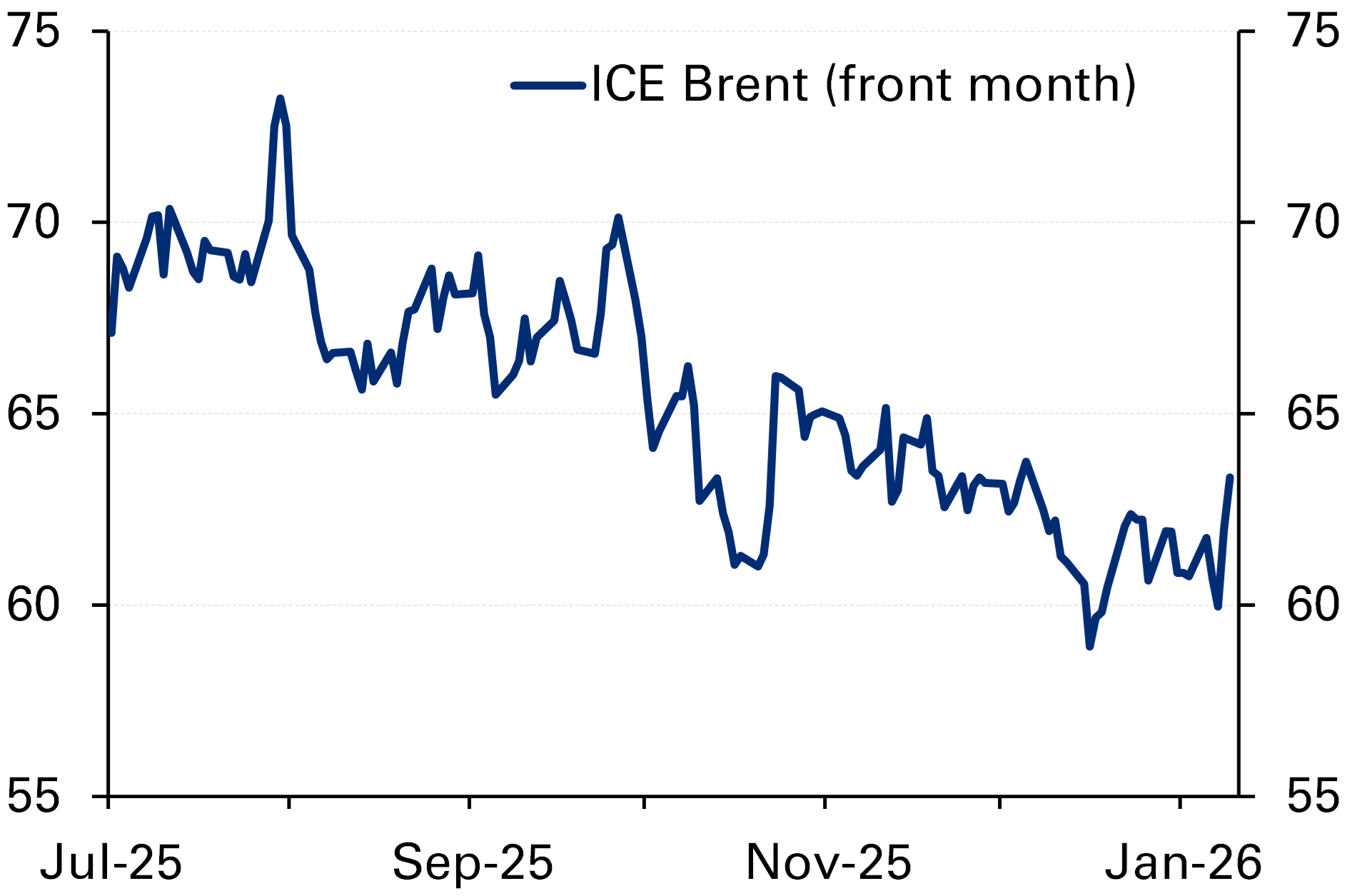
Oil: Prices rise on Iran and Venezuela-linked geopolitical risk. Brent futures closed higher for the third consecutive week on Friday, advancing by 4.3% w/w to $63.3/bbl. This was also Brent’s largest weekly gain since late October, spurred by escalating protests in Iran, uncertainty about the fate of the post-Maduro Venezuelan regime and geostrategic muscle-flexing by the Trump administration more broadly. Together, they conspired to put geopolitical risk firmly back on the table for oil markets in 2026. In Iran, street demonstrations against the regime, sparked by a currency collapse amid deteriorating economic conditions, escalated last week, bringing with it violent nationwide disruptions, a mounting death toll and heightened risk of further reprisals by the regime. Were this to involve the use of lethal force, the Trump administration has threatened to counter with airstrikes (“we are locked and loaded and ready to go”, Trump stated on social media). Markets are closely watching for any disruption to Iran’s crude oil supplies, which, despite being under international sanctions, are ranging at 7-year highs (1.7 mb/d). They are also assessing what they see as a possibility that the US (with or without Israel) spies an opportunity amid the ongoing chaos to remove Iran’s current regime once and for all. Meanwhile, in Venezuela, President Trump announced that he had cancelled a planned second wave of attacks on the country after the government of interim president Delcy Rodriguez showed “cooperation” in meeting some US demands, such as the release of political prisoners. In terms of data releases, the Energy Information Administration weekly data revealed a larger than expected drawdown in commercial crude inventories of 3.8 mb in the w/e January 2, though the report also showed a significant buildup in gasoline stocks, dampening the headline bullish effect. In focus this week for the oil markets will be the fluid situation in Iran, including any potential response by the US, further details on the US’s plan to manage Venezuela’s oil assets and the release of OPEC’s monthly oil market report for December 2025, which is due on Wednesday.
US: Justice Department initiates criminal investigation into the Fed, in another attack on the Fed’s independence. Chair Powell stated that the Federal Reserve has been served with “grand jury subpoenas, threatening a criminal indictment related to my testimony before the Senate Banking Committee last June” pertaining to ongoing renovations of Fed office buildings. Powell, for the first time, clearly underlined that such threats were “pretexts” to influence Fed interest rate setting to follow “the preferences of the President.” He highlighted these motives raise questions “whether the Fed will be able to continue to set interest rates based on evidence and economic conditions — or whether instead monetary policy will be directed by political pressure or intimidation.” However, Powell vowed to continue doing his job and therefore ruled out the possibility of stepping down before the expiry of his term as Fed Chair in May. We note that Fed independence continues to be at risk as the Trump administration launched unprecedented pressure on the bank to lower interest rates and has been trying to remove Fed Governor Lisa Cook on some disclosure irregularities; that matter is currently in the courts. Moreover, the soon-to-be-announced new Fed Chair will be appointed to serve the administration’s agenda of lowering interest rates, potentially further compromising Fed’s credibility. The financial markets reacted with US equity futures and the US dollar down, while gold was up in trading this morning.
Global: Geopolitical developments, CPI inflation in the US, and trade data in China key matters this week. Global geopolitical developments (related to Venezuela, Greenland, Iran, etc.) may continue to make headlines this week and are key matters to monitor given their important economic and political ramifications. In the US, several Fed officials are due to speak this week, likely offering clues about their thinking ahead of the FOMC meeting in late January. In terms of data, CPI inflation for December will be released on Tuesday, and the consensus forecast indicates a steady headline rate of 2.7% y/y and a slight pickup in the core rate to 2.7% from November’s 2.6%. Retail sales in November (Wednesday) are seen rising by 0.4% m/m after being flat in October. In the Eurozone, industrial production data for November will be released on Thursday, with flat projections for the month following a 0.8% m/m increase in October. In the UK, the street expects no change in GDP in November (on Thursday) following a 0.1% m/m decline in October. In China, December trade figures (Wednesday) will be the main focus with exports growth expected to soften to 2.9% y/y (5.9% in November) and imports seen inching up by 0.8% y/y (1.9% in November). In Japan, media reports over the weekend indicated that Prime Minister Takaichi is preparing to dissolve the parliament and call for a snap election in February, capitalizing on her high approval ratings. In terms of data, December’s PPI figures are due on Thursday with consensus expecting an increase of 2.4% y/y, down from 2.7% in both November and October.
Egypt: Lower LNG import costs ease pressure on the energy bill this year. Egypt is set to import LNG at a lower cost in 2026 after renewing contracts with Shell and TotalEnergies for 60 cargoes. Each shipment is priced at around $40-45 million, roughly $5 million cheaper than last year, reflecting softer global gas prices and ample supply. Deliveries are expected to begin in early February. Beyond contracted volumes, the Egyptian General Petroleum Corporation plans to launch a spot-market tender by March to secure an additional 125 LNG cargoes. Supplier appetite for the Egyptian market has improved, supported by the government’s efforts to clear arrears owed to international energy companies, helped by global LNG prices that are around $2 per MMBtu lower than a year ago. In parallel, reports indicate that an Israeli delegation is currently in Cairo to discuss amendments to the $35 billion gas export agreement. The proposed changes would allow Israel to reduce exports unilaterally if domestic gas needs rise, highlighting the importance for Egypt of maintaining diversified gas supply sources. Overall, lower LNG prices provide near-term relief to Egypt’s energy import bill and reduce fiscal and FX pressures, even as energy security considerations remain a key policy focus amid evolving regional gas dynamics.
Saudi Arabia: Strong industrial growth led by oil. Industrial production jumped 10.4% y/y in November, according to GASTAT, the strongest growth since late 2022. The pickup appeared broadly based, with oil output rising 12.9% y/y, manufacturing up 8.1%, and non-oil activities growing 4.4%. However, a closer look at the manufacturing figures suggests that the rally is still driven strongly by hydrocarbons. Growth in the manufacturing sub-index was almost entirely led by petcoke and refined petroleum products (up 14.5%) and chemical products (up 10.9%). The mining and quarrying sub-index, which dominates the IPI, gained 12.6% y/y, underpinned by a substantial increase in oil production, which reached 10.1 million bbl/d in November, compared to 8.9 million bbl/d a year earlier. On a monthly basis, the sector recorded a modest 0.5% m/m increase. On the utilities side, electricity, gas, steam, and air conditioning supply dropped sharply by 29% m/m, as colder weather in November reduced demand on the grid. Meanwhile, water supply, sewerage, and waste management rose 10.2% y/y but declined 3.1% m/m.