
 +965 2292 4888


Daily Economic Update
20.08.2026
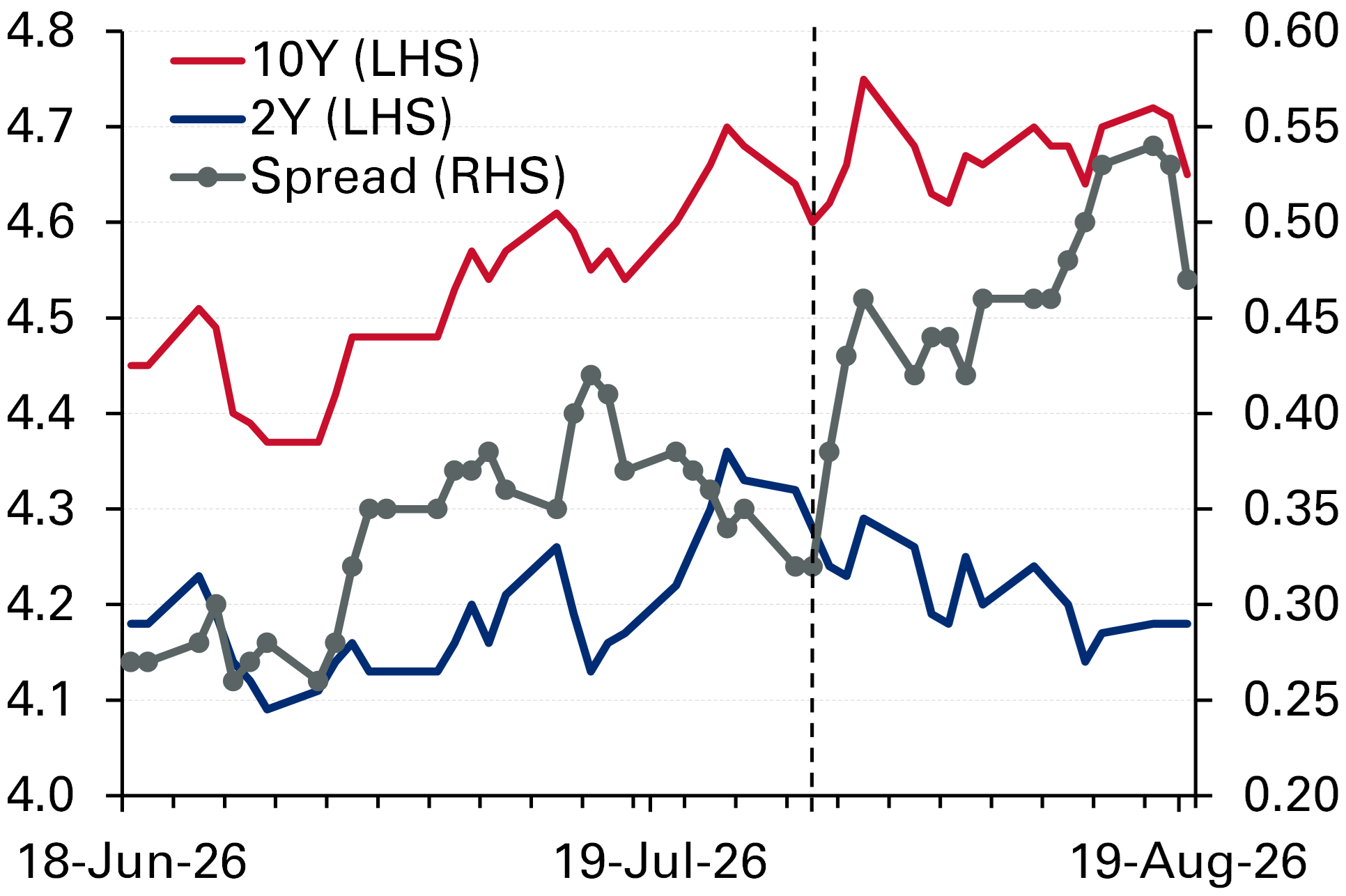
US: July meeting minutes show FOMC members wary of higher inflation risks, with several favoring raising policy rates; Treasury boosts liquidity support, driving pullbacks in long-term UST bond yields. Minutes from the FOMC July meeting showed that “several participants favored an increase of 25bps” at the last meeting, at which the FOMC voted 9-3 in favor of keeping interest rates steady. Many participants suggested that “continued elevated inflation rates could begin to affect inflation expectations and wage- and price-setting decisions,” and that policy tightening would likely be necessary if inflation did not decline. Minutes also highlighted that Chair Warsh proposed to reduce the number of FOMC policy meetings to six times a year from the current practice of eight times that would allow more information to accumulate between meetings and sought input from the committee. No decision was made, but any changes wouldn’t affect the schedule over the balance of 2026 (three more meetings remaining this year). Since the meeting, the soft labor market data and less-hot inflation prints have taken some pressure off the FOMC to increase interest rates soon, but recent commentary from several Fed officials indicates a broader preference for policy tightening. Given that inflation remains significantly above the Fed’s 2% goal, one camp favors an immediate hike in rates, while another awaits further clarity on the near-term inflation outlook, especially surrounding energy prices. The implied market probability of a 25bps Fed rate hike at the September meeting has also declined from over 60% a few weeks ago to around 33% now. Meanwhile, since the FOMC meeting in late July, the UST bond market has been not just under pressure as we reported yesterday, but showing a widening divergence between bonds of different maturities, steepening the yield curve. As yields on 10Y and 30Y bonds rose rapidly, the 2-10Y spread widened to around 55bps earlier this week from just above 30bps before the meeting. The jump in these yields over recent weeks (with the 30Y hitting the highest level since 2007) prompted the US Treasury department yesterday to announce an emergency measure of “increasing, by at least double, the size of liquidity support buyback operations” aimed at securities with tenors 10Y and more. This drove a sharp rally in long-term UST bonds yesterday, with yields on 10Y and 30Y bonds falling by almost 7bps and 10bps respectively, narrowing the 2-10Y spread to around 47bps. Still, the measures appear more like stopgap arrangements, as structural issues such as poor fiscal metrics (a fiscal deficit of around 6% of GDP, with public debt/GDP of almost 100%) remain. Additionally, market expectations of a higher medium-to-long-term inflation outlook, an above-par economic growth landscape, and an oversupply of long-term bonds from private issuers including AI ‘hyperscalers’ are also contributing to higher long-end bond yields.
UK: July CPI inflation rises in line with expectations on higher regulatory utility bills. CPI inflation in July expectedly rose to 2.9% y/y, up from June’s 15-month low of 2.6%, mainly due to the pre-announced 13.5% increase in the household energy price cap set by Ofgem, effective from July through September. Still, that impact was cushioned by a deceleration in motor fuel costs at 15.5% y/y from 21.3% in June. The core rate, however, was unchanged for the third consecutive month at 2.6%, slightly above the market forecast of 2.5%. An important services inflation measure edged down to 3.4% from 3.6%, in line with the BoE projections, helped by an 11.6% y/y decline in air fares on base-effects as they were still up 11.7% m/m. Overall there weren’t many surprises in the July CPI print, which is set to increase further to 3.2% in Q4 as per the BoE forecasts. Moreover, as European wholesale gas-based load futures are hovering near their highest level since early 2023, a further increase in household energy bills for the October-December period seems likely. Nonetheless, with employment conditions remaining soft along with a muted growth outlook, the BoE has adopted a more cautious approach in recent policy meetings, awaiting further clarity on the second-round effects of higher energy prices on underlying inflation components. Market pricing currently signals an over 70% probability of a 25bps BoE interest rate hike by the end of 2026.
China: Key rates unchanged in August despite economic weakness. The central bank left its benchmark Loan Prime Rates (LPRs) unchanged in August for the 15th consecutive month, maintaining the one-year LPR at 3.0% and the five-year LPR, the key reference rate for mortgages, at 3.5%. The decision was widely expected despite recent data indicating weaker industrial production (4.5% y/y in July from 5.3% in June), retail sales (0.6% y/y vs 1.0%), credit growth (5.1% y/y vs 5.3%), and continued softness in the property market. Policymakers appear to be relying more on targeted fiscal support while retaining room for future monetary easing if economic conditions deteriorate further.
Egypt: All eyes on today’s MPC meeting as CBE expected to keep rates unchanged. The Central Bank of Egypt’s (CBE) Monetary Policy Committee (MPC) meets today, and we expect policymakers to leave policy interest rates unchanged as they continue to assess the impact of regional developments on the inflation outlook and broader macroeconomic conditions. In its latest Monetary Policy Report, the CBE outlined three inflation scenarios depending on how geopolitical tensions evolve. Under its baseline scenario, headline inflation is expected to average 16.6% in the current fiscal year before easing to 8.1% next fiscal year. If regional tensions escalate, however, inflation could rise to 17.8%, driven by higher energy prices, exchange rate pressures, and capital outflows, potentially requiring a tighter monetary policy. In a more favorable scenario, inflation would average 15.2% this fiscal year and 7.7% next year. Despite these different scenarios, the CBE continues to expect inflation to fall into single digits during the second half of 2027. In our view, the current level of uncertainty, together with still elevated inflation and a comfortably positive real interest rate, supports a wait-and-see approach. While the CBE has signaled that further tightening remains an option if inflationary pressures intensify, we believe policymakers are more likely to preserve policy flexibility until there is greater clarity on the regional outlook and the inflation trajectory.
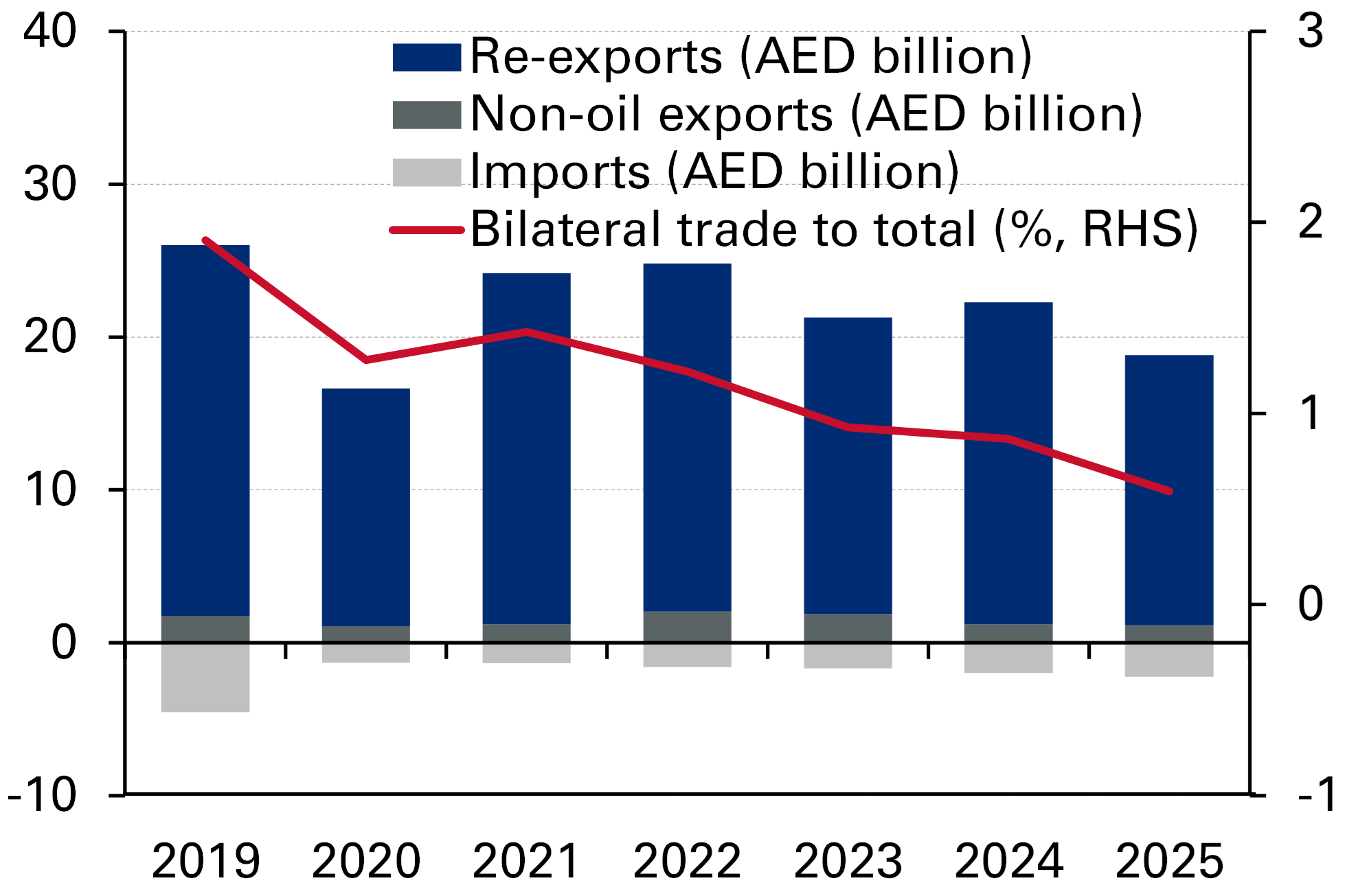
UAE: Limited economic impact expected from suspension of trade ties with Iran. The government’s decision to suspend trade, commercial exchanges, and financial transactions with Iran following the recent missile attack is expected to have a limited direct impact on the UAE economy. Bilateral trade linkages have weakened considerably in recent years, with Iran's bilateral trade accounting for only 0.1% of UAE goods imports, 0.1% of non-oil exports, and 2.4% of total re-exports, limiting the potential impact on domestic demand, inflation, and external balances. Moreover, total bilateral trade remains heavily skewed toward re-exports, representing about 84% of UAE-Iran trade ($4.8 billion out of $5.7 billion) in 2025. In addition, the importance of the Iranian market to the UAE's re-export sector has also diminished markedly as Iran's share of total re-exports declined from 13.2% in 2018 to 2.4% in 2025. However, the broader implications of the move could be more consequential with the suspension coming amid the deterioration in regional security conditions and growing US pressure with the Treasury Secretary signaling unprecedented economic measures against Iran. Possible fallout would include elevated transportation and insurance costs, tighter sanctions-compliance requirements and weaker cross-border investment and property market activity, although the UAE's diversified economy and strong underlying fundamentals should help cushion the overall impact.