 +965 2292 4888


Daily Economic Update
02.04.2026
Oil: Prices rebound as Trump’s address dampens hopes for a swift end to the conflict. Brent futures rose 6% in early Asian trading to $107/bbl, as ceasefire hopes – which had driven a 2.7% price decline yesterday – were dashed following President Trump’s national address. Market participants had anticipated that some positive signals for a potential ceasefire would be confirmed during the speech. However, Trump continued to deliver conflicting messages, notably stating that the “US will hit Iran hard over the next two to three weeks,” signaling that the conflict may persist and that further escalation remains possible. In the absence of a clear timeline for de-escalation, the Strait of Hormuz could remain closed for an extended period, with supply losses continuing to accumulate. Based on our current estimates, a one-month disruption would result in cumulative supply losses approaching the scale of the IEA’s recent emergency stock release. The IEA also warned yesterday that the impact could become more pronounced in April, particularly for Europe, as incoming oil and LNG cargoes are expected to decline relative to March, when shipments largely reflected pre-conflict contracts. Separately, according to the Reuters’ monthly survey of OPEC production, March figures revealed a 7.3 mb/d month-on-month drop in members’ output to 21.6 mb/d, the lowest level for the 12-member group since June 2020 at the height of the Covid-19 pandemic. Cutbacks in crude production due to blockage of the Strait of Hormuz export route were most acute with Iraq and Kuwait (more than 2 mb/d in cuts each), followed by the UAE and Saudi Arabia with reduction of around 2 mb/d from pre-conflict levels. Venezuela and Nigeria were the only two OPEC members to record production increases in March.
Kuwait: Finance minister presents the draft FY26/27 budget with no changes despite the regional conflict. Kuwait’s Minister of Finance Dr. Al Rifa‘i presented the FY26/27 draft budget (initially released several weeks ago), highlighting that despite a projected KD9.8 billion deficit, the country’s financial situation remains “beyond reassuring”, supported by strong liquidity and guaranteed deposits. The budget estimates KD16.3 billion in revenues versus KD26.1 billion in expenditures, based on an oil price of $57 per barrel, with non-oil revenues rising 20% to KD3.5 billion. The minister highlighted ongoing financial reform efforts, including strengthening revenue collection, expanding digital payment systems, and continuing the review and adjustment of services fees to boost non-oil revenues. He noted that expenditures remain dominated by salaries and subsidies (76%), alongside major allocations for energy, education, and social support, adding that public services will continue uninterrupted through substantial funding for electricity, water, and medical supplies. Although the government’s official projections are typically on the conservative side, the ongoing regional conflict has changed the fiscal dynamics – notably the impact on oil exports of the Hormuz blockade. Our view is that depending on the duration and intensity of the ongoing regional conflict we could now see a deficit of around KD6bn (12% of GDP), increasing if the conflict lasts for longer. The conflict may also weigh down on growth, mostly in the oil sector, while non-oil activity may also decelerate on weaker consumer and investor sentiment and slower project activity.
Egypt: MPC set to pause the easing cycle as war-driven inflation risks take center stage. The Central Bank of Egypt (CBE) is widely expected to hold policy rates unchanged at today’s Monetary Policy Committee (MPC) meeting, marking a pause in the easing cycle following the regional military escalation. The decision comes as inflationary risks are shifting to the upside. Recent fuel price hikes, coupled with an approximately 12% depreciation in the Egyptian pound since the start of the conflict, are expected to feed into domestic prices over the coming months. External pressures have also intensified. The currency has come under strain primarily due to carry trade outflows, alongside anticipated declines in two key FX sources, tourism revenues and Suez Canal receipts, amid heightened geopolitical uncertainty. At the global level, oil prices are expected to remain elevated in the near term, particularly following the closure of the Strait of Hormuz, a critical global energy transit route. This development is likely to increase global transportation costs, amplifying imported inflation pressures, especially for net energy importers like Egypt. Against this backdrop, the MPC is expected to adopt a wait-and-see approach, closely monitoring both domestic and global developments before resuming any easing steps. While the CBE remains committed to its inflation targets, achieving them by the end of 2026 has become more challenging under the current conditions. Looking ahead, if geopolitical tensions persist, the CBE is likely to reassess its policy stance, balancing between containing inflationary pressures and supporting economic growth within acceptable ranges.
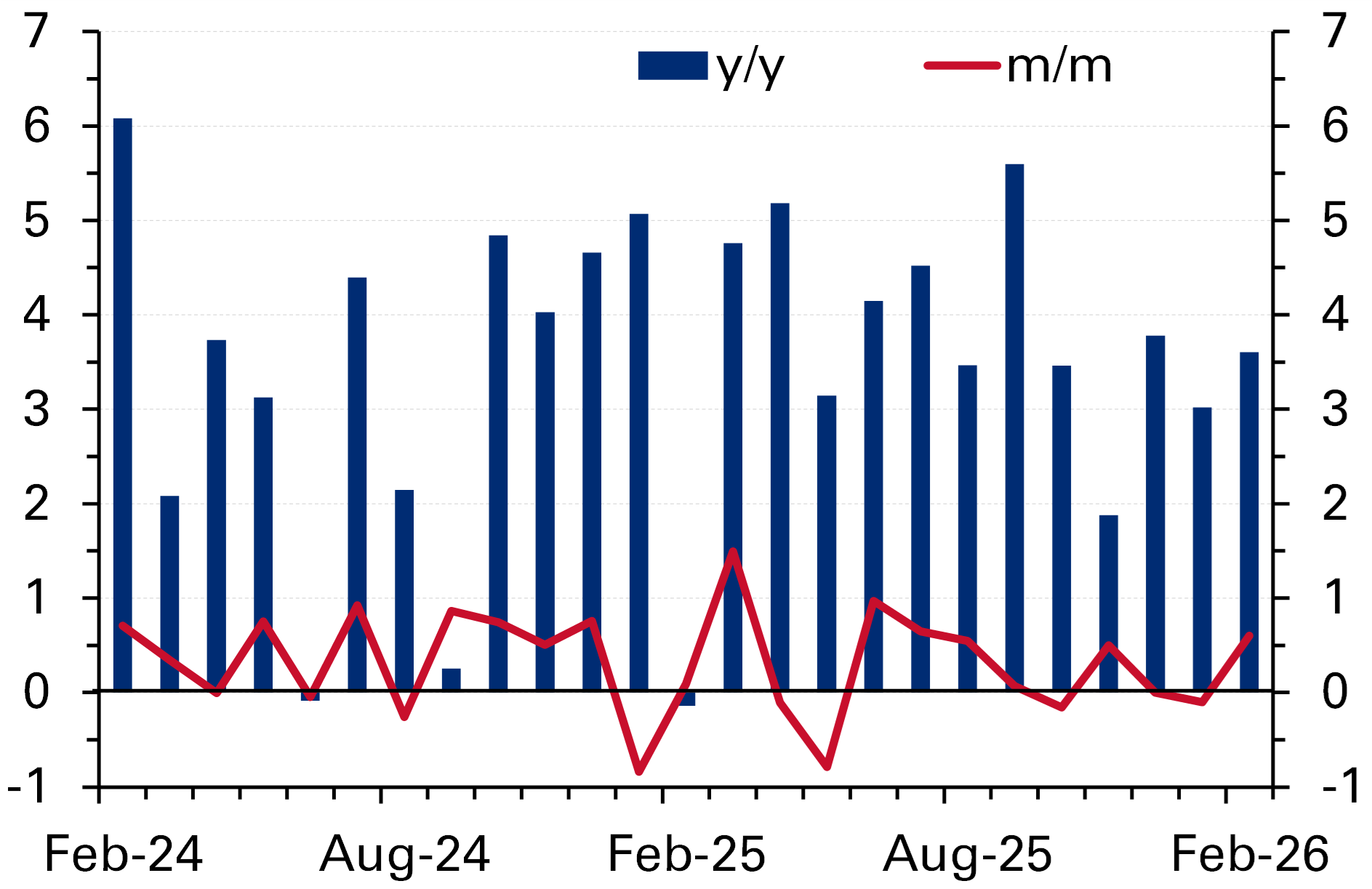
US: Retail sales rebound in February topping forecasts; ISM manufacturing PMI shows price pressures surging. Retail sales in February rebounded by a more-than-forecast 0.6% m/m (3.6% y/y), indicating a broad-based increase, following an upwardly revised drop of 0.1% (+3% y/y) in January, during which sales were hampered by bad weather conditions. A core measure of sales that feeds directly into GDP also rose by 0.5% after a smaller than previously reported increase of 0.2% in January, underscoring a robust rise in consumer spending. However, as fallout from the Middle East war, surging gasoline prices, the rising inflation readings, and the current weakness in the equity markets–if it persists longer–may weigh on household finances and consumer sentiment over the coming months. Separately, the ISM manufacturing PMI in March increased to the highest since August 2022 at 52.7 from February’s 52.4. However, details were less encouraging, as amid the ongoing war the PMI’s input price measure surged to the highest since June 2022 at 78.3 from 70.5 in February, highlighting burgeoning price pressures ahead. New orders growth moderated, remaining in expansion territory (53.5 versus 55.8), while employment shrank for the 14th consecutive month (48.7). Firms reported impaired supply chains and lengthier delivery times, suggesting Middle East war-related uncertainty and trade disruptions. Meanwhile, US stocks continued their recovery on Wednesday, with the S&P 500 rising by 0.7%. But President Trump’s prime-time speech that didn’t offer any clear outline for an off-ramp in the Middle East war revived the selloff, as most Asian stock markets and US equity futures were deep in the red in trading this morning at the time of writing. Gold and silver are also witnessing sharp drops this morning.