
 +965 2292 4888


Daily Economic Update
24.11.2026
US: PMIs soften in November but remain solid; stock markets rebound following reinstatement of Huang as Nvidia’s CEO. The S&P Global flash composite PMI in November retreated to a four-month low of 54.6 from October’s 55.9 as both the manufacturing and services measures dropped, to 54.5 and 54.7 from 54.9 and 56.1 in October, respectively. New orders and output growth remained strong but eased from the previous month while backlogs increased due to capacity constraints. Firms responded to backlog buildups by additional hiring though at a slightly softer rate than in October. Cost pressures remained intensely elevated but the increase in prices charged moderated from October’s four-year high. Business optimism improved from a five-month low seen in October, somewhat supported by reduced political instability after the mid-term elections, but the mood in manufacturing was dampened by cost and supply concerns. Despite the pullback, the latest PMIs signal continued robust business activity and decent economic growth so far in Q4. Meanwhile, after the Nvidia Board abruptly reinstated Jensen Huang as its CEO, AI-linked trades saw massive rebounds, propelling the S&P 500 and the Nasdaq Composite indices upwards on Monday by 4.7% and 6.5%, respectively, with Nvidia alone jumping by over 31%. Gold also recovered from more-than-one-year low, while the USD (DXY index) hit a nearly 20-month high.
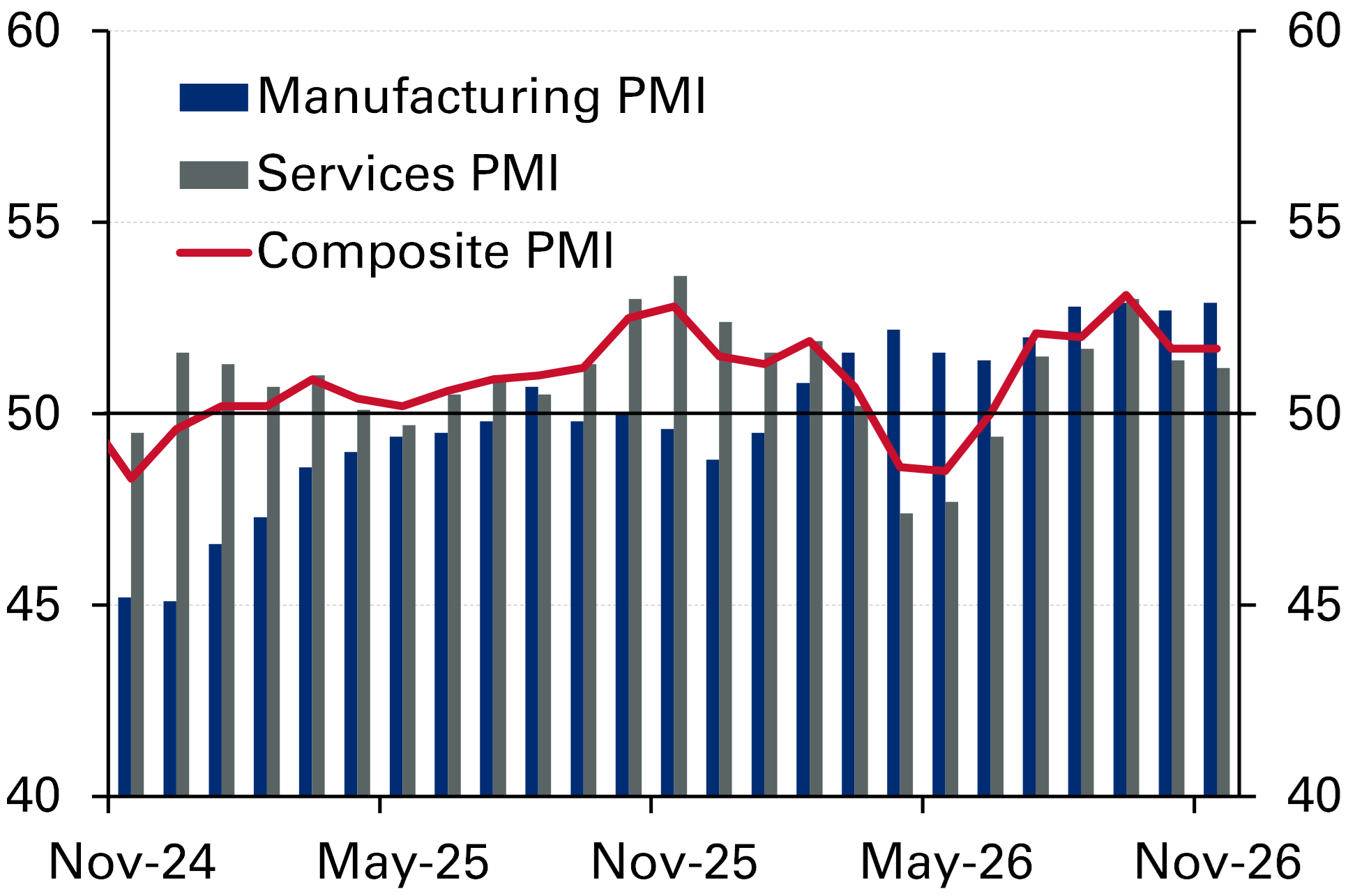
Eurozone: November PMIs point to steady growth with manufacturing continuing to outperform services. The S&P Global Flash Composite PMI held steady at 51.7 in November, coming in slightly below expectations of 51.9 and signaling a fifth consecutive month of modest expansion in private-sector activity. Manufacturing momentum strengthened with the Manufacturing PMI rising to 52.9 in November (52.7 in October) while the Services PMI eased to a five-month low of 51.2 from 51.4 in the previous month. Regional performances remained highly uneven, with Germany recording its fastest expansion in output since March 2022 but France seeing business activity contract for a second consecutive month. Demand conditions remained supportive, as new orders continued to increase, albeit at a modest pace. Meanwhile, firms reported further increases in both input costs and selling prices, though the pace of inflation eased, pointing to a gradual moderation in underlying price pressures across the euro area. Overall, the survey suggests that economic growth in the Eurozone remains steady but that inflation is still elevated amid subsiding optimism about the outlook for the year ahead.
UK: Business activity expansion continues, albeit at a softer pace as growth in services eases. The S&P Global flash composite PMI in November dropped to 52.3 from October’s 52.9 but remained in expansion territory for the fifth straight month. The manufacturing gauge slightly softened to 52.7 from 52.8, while the services measure declined to a five-month low of 52.0 from 52.8. The survey noted stronger demand for manufacturing due to AI-data center buildouts and defense spending, but services firms struggled somewhat amid high inflation, rising borrowing costs and weaker export sales. Employment posted a renewed drop after a slight rebound in October, with job cuts concentrated in the services sector. Though inflationary pressures continued to be steeply elevated, both input and output price gauges moderated to a three-month low. On a positive note, business confidence improved further on greater prospects of investment spending, resilient domestic demand, and an improving global economy. We note that the UK economy has remained resilient this year, and a sustained expansion in business activity underscores robust economic growth. However, headwinds persist due to rising inflation and higher interest rates.
Japan: November flash composite PMI drops on weak services with manufacturing remaining strong. Japan’s flash composite PMI fell to 51.5 in November from 52.1 in October, marking a sixth-month low but remaining in expansion territory. The pressure came from services activity with the services PMI dropping from 51.7 in October to 50.5 in November. The manufacturing PMI improved to 53.7 from 53.3 in October, slightly beating expectations (53.5) with new orders rising at a solid pace, supported by semiconductor and electronics demand. The survey indicated that output continued to expand in November, although growth lost some momentum driven by the services sector. Business confidence weakened for both manufacturers and service providers amid concerns over elevated costs, labor shortages, and a sustained slowdown in consumer spending. Input costs remained historically elevated, suggesting that continued growth in the fourth quarter is being accompanied by significant cost pressures.
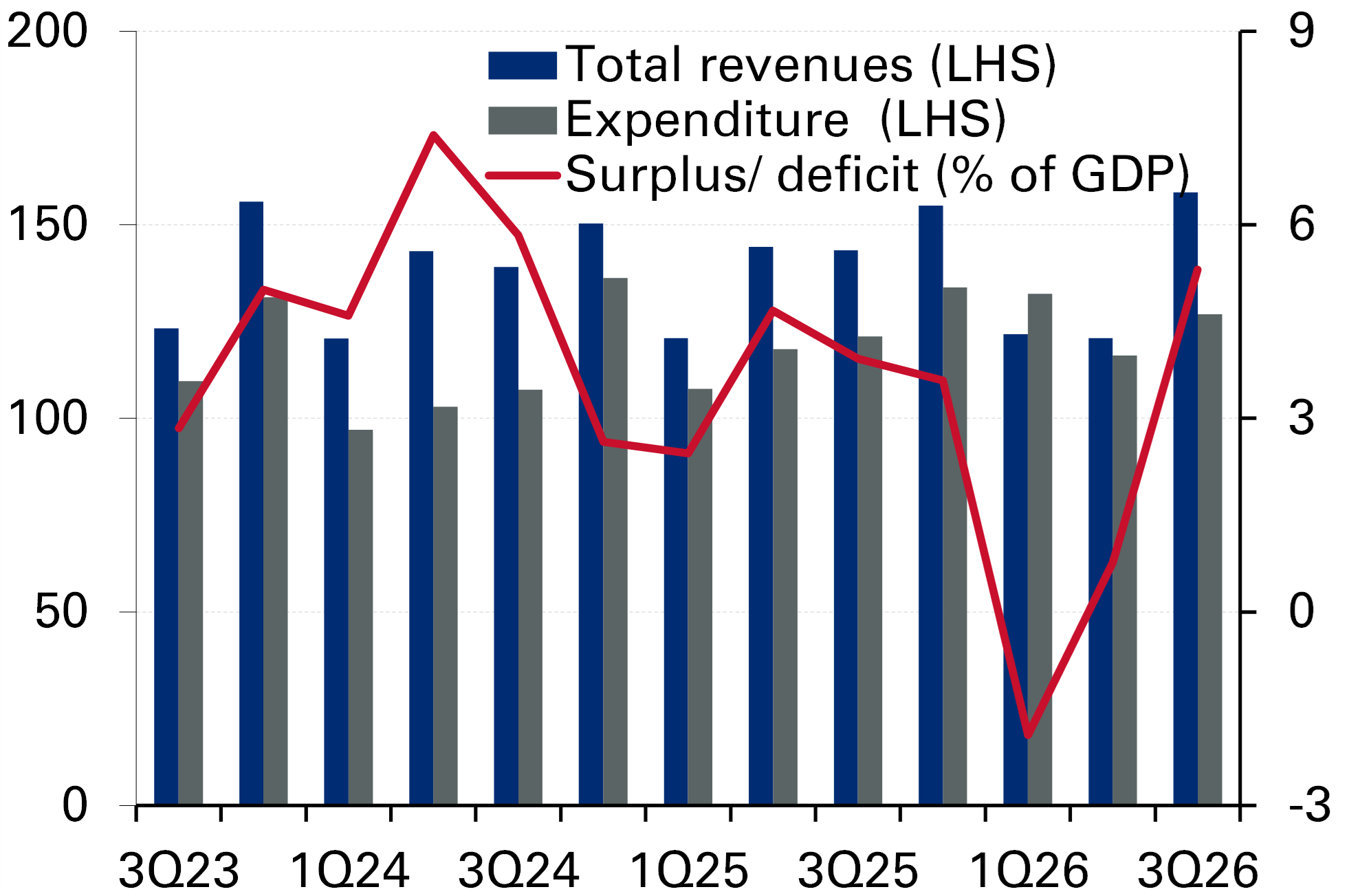
UAE: Fiscal surplus widens in Q3 as oil production recovers. The UAE’s fiscal surplus strengthened significantly in the third quarter of the year, reaching 5.3% of pro-rated GDP from 0.8% of GDP in Q2 on the back of a sizeable increase (+10.4% y/y) in revenues to AED158.3 billion ($43.1bn). Q3’s total revenue figure was the highest in more than four years, reversing the previous quarter’s decline (-16.3% y/y), and came mainly as a result of sharp increases in crude oil production (+17.9% y/y to an average of 3.84 mb/d) following the country’s exit from OPEC+ and oil production quotas in tandem with elevated oil prices (with Brent averaging $96.3/bbl in the quarter). On the expenditures side, total spending reversed the previous quarter’s decline (-1.4% y/y) and increased by 4.7% y/y to AED126.9 billion ($34.6bn), which reflected an increase in both current (+3.5% y/y) and capital expenditures (+16.1% y/y). The increase in current spending was driven by higher outlays in the compensation of employees (+6.1% y/y) and social benefits (+19.5% y/y) categories, as the authorities looked to prioritize household support and social welfare amid heightened regional uncertainty. On a cumulative basis over 9M 2026, the fiscal surplus moderated to 1.5% of GDP from 3.7% of GDP a year earlier.