
 +965 2292 4888


Daily Economic Update
31.03.2026
Oil: Price volatility persists as Trump considers ending the war without reopening the Strait. Oil prices were searching for direction this morning in early Asian trading amid mixed reports about President Trump’s intentions and after Iran struck a Kuwaiti crude tanker anchored near Dubai. Brent opened lower amid reports that US President Trump would consider ending the war with Iran without immediately reopening the Strait of Hormuz, with a potential reopening of the Strait deferred to a later stage – before rebounding after a KPC oil tanker was struck at a Dubai port. Brent was last ranging around $113/bbl. Intraday swings are likely to persist, particularly as the May contract expires today, amplifying short-term volatility. The contract rollover also appears to have contributed to choppy price movements yesterday, with Brent settling just 0.2% higher at $112.8/bbl, after briefly trading near $116.9/bbl at the session peak amid renewed US threats targeting Iranian energy infrastructure. Nevertheless, amid a sharp increase in conflicting headlines, the market’s sensitivity to news flow appears to be diminishing, with participants increasingly waiting for concrete developments before repricing oil’s geopolitical risk premium.
GCC: Mixed economic outlook as Strait of Hormuz disruption reshapes global markets. The OECD, in its latest report entitled “Testing Resilience”, highlighted the amplified impact of the export-oriented GCC economies in the current commodities-linked global supply shock. Bahrain, Oman, Qatar, Saudi Arabia and the UAE supply material inputs that are critical to global agriculture, petrochemicals, and semiconductor manufacturing. These states collectively account for 34% of global Urea exports, around 20% of Diammonium Phosphate and Ammonia exports, nearly half of global Sulphur supply, 8% of primary Aluminum production, over one third of global helium output, and two thirds of global bromine supply. While the shock has tightened global supply conditions, the OECD notes that higher energy prices will strengthen the terms of trade and income growth for the GCC, even as physical bottlenecks constrain the short-term upside. Saudi Arabia remains on a solid growth path, with GDP expected to expand by 4.0% in 2026 and 3.6% in 2027, while inflation is projected at 1.9% and 2.2%, respectively. Non-oil sectors more broadly, particularly aviation, logistics, tourism and metals, face headwinds from curtailed air travel and rising input costs. The report concludes that the trajectory for the GCC hinges on the duration of the conflict, the restoration of shipping routes, and the stability of energy markets. At the global level, growth projections have been revised slightly downward, with the world economy expanding by 2.9% in 2026, unchanged from the previous forecast (December 2025) only because the conflict-related energy shock offset what would have been a +0.3% upward revision. For 2027, the forecast for global growth has been lowered to 3.0% from 3.1%, to reflect the lagged impact of higher energy prices, tighter financial conditions, and softer global demand.
US: Powell sees monetary policy in a good place but expresses difficulty in knowing the full impact of the energy price shock. Fed Chair Powell, in a speech, stated that “our policy is in a good place for us to wait,” noting that "it is way too early to know” the impact of higher energy prices resulting from the Middle East war. He also highlighted that “inflation expectations do appear to be well anchored beyond the short term.” Powell mentioned that tariffs have added 0.5-1% to inflation, with their impact being a one-time event. He also downplayed the ‘contagion’ effect in the private credit market, saying the distress “we see is a correction” and not “a broader systemic event”, but he vowed to remain watchful of the situation. While defending QE and the Fed’s asset purchases, Powell said that “buying long-term assets does lower interest rates and does provide some support for economic activity.” Separately, New York Fed President John Williams (an FOMC voting member) also saw the current policy stance well positioned but noted “uncertainty around the future path of inflation is high” while expecting a near-term pickup in inflation following high energy prices and disruption in supply chains. He projected headline inflation to end 2026 at around 2.75% before reaching 2% in 2027, with the economy growing at 2.5% in 2026 supported by the fiscal boost, AI-related investments, and favorable financial conditions. The futures market currently signals no change in the Fed policy interest rate this year, but the pricing has been fluctuating between one rate cut to one rate hike since the Middle East war started in end-February. Amid evolving geopolitical developments and their impact on the US economy, yields on UST 10Y bonds fell by around 10 bps yesterday, after hitting the highest level since July 2025 on Friday.
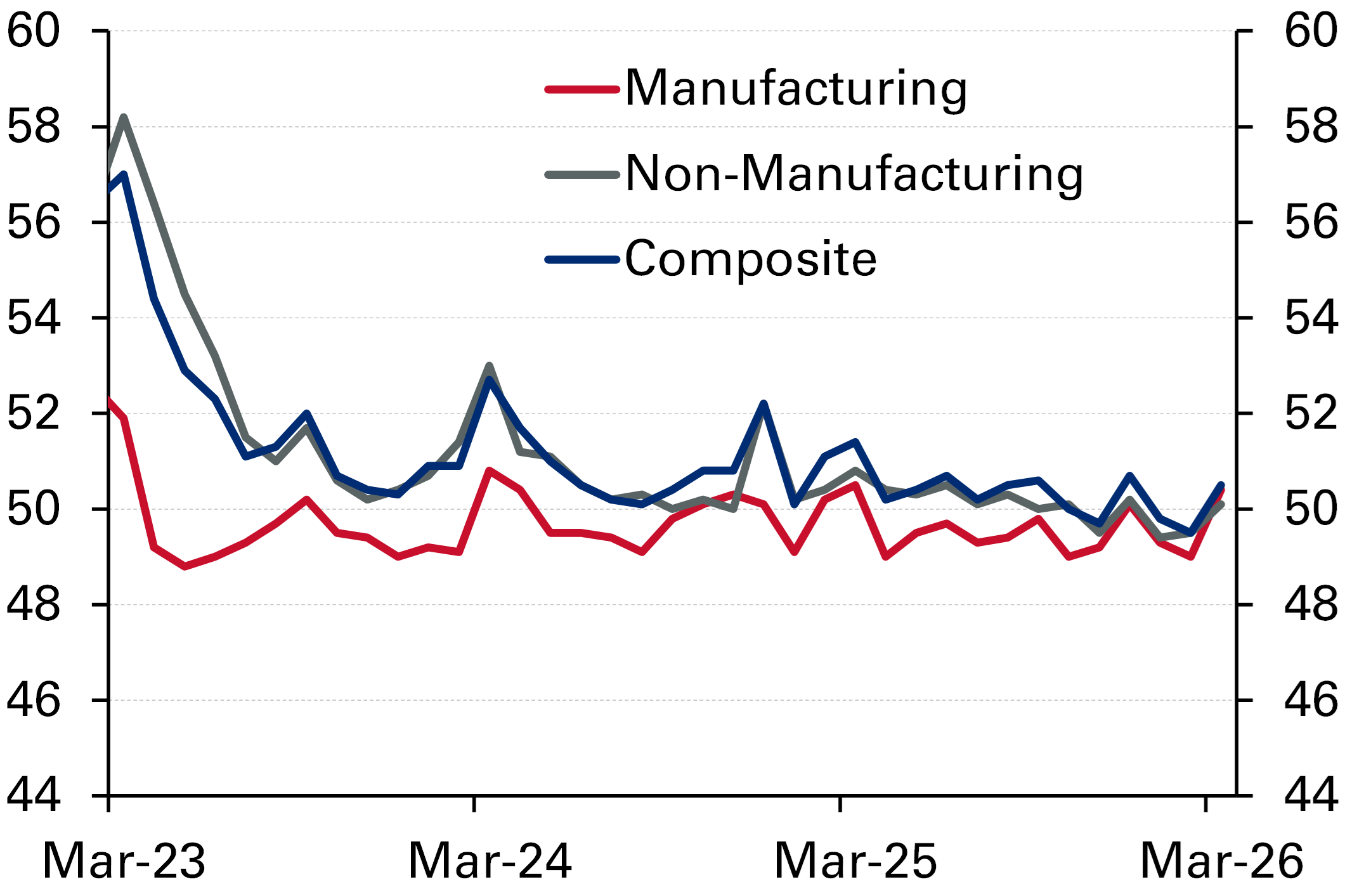
China: Manufacturing PMI rebounded in March, signaling a post holiday normalization and tentative demand improvement. China’s official manufacturing PMI rebounded to a higher-than-expected 50.4 in March from 49.0 in February, reversing two months of contraction as factories resumed normal operations after the extended Lunar New Year holiday. Production and new orders both strengthened, rising to 51.4 and 51.6, respectively, signaling an improvement in domestic demand conditions. New export orders also improved to 49.1 in March (from 45.0 previously) but remained below the expansion threshold. Meanwhile, input cost pressures intensified, and factory gate prices rose, reflecting higher commodity costs and elevated freight rates amid the Middle East war. The non-manufacturing PMI also edged back into expansion, at 50.1 in March from 49.5 in February, supported by a modest recovery in services and construction as holiday distortions faded. However, service sector new orders remained weak and employment indicators stayed in contraction, underscoring lingering demand softness. Overall, the composite PMI rose to 50.5 from 49.5 in February, marking its highest level since December and indicating a broad-based return to expansion. That said though and despite the improvement in March, the outlook remains tempered by rising input costs, geopolitical risks, and still fragile domestic demand.
Japan: Industrial production and retail sales retreat in February after January’s solid performance. Industrial production in February fell 2.1% m/m after January’s solid growth of 4.3%, matching the consensus forecast. On an annual basis, industrial production rose 0.3%, slowing from 0.7% in January. However, Japan’s Ministry of Economy, Trade and Industry said that production is expected to rebound by 3.8% m/m in March and a further 3.3% in April, according to a poll of manufacturers. Still, supply chain disruptions and higher input costs including energy and other products could weigh on the output over the coming months. Retail sales also retreated in February, declining by 2% m/m (-0.2% y/y) from January’s downwardly revised growth of 3% (+1.8% y/y), indicating a further loss in economic momentum. Separately, Tokyo’s core CPI inflation (ex-fresh food) in March eased to the lowest level since April 2024 to 1.7% y/y from 1.8% in February, with core-core inflation (ex-fresh food and energy) also moderating to 2.3% from 2.5%. However, the softness in consumer price inflation may prove to be temporary amid the fallout from the Middle East war as the futures market currently indicates around 55% probability of a 25-bps interest rate hike at the BoJ’s April meeting.