
 +965 2292 4888


Daily Economic Update
21.10.2026
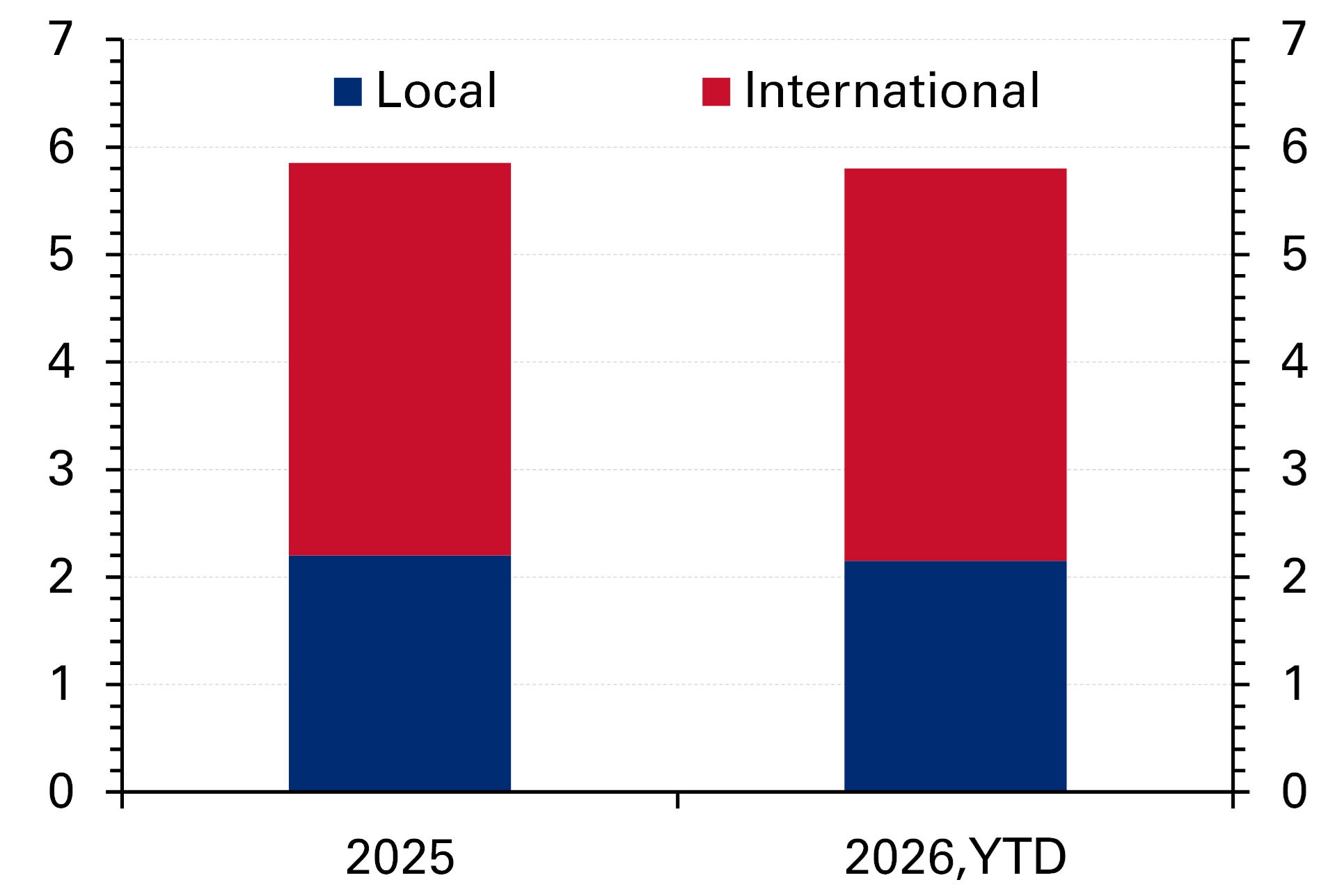
Kuwait: Government raises $3.25 billion in oversubscribed Eurobond sale. The government has successfully raised $3.25 billion through a two-tranche international bond issuance, underscoring solid investor confidence in the country’s economic and fiscal fundamentals despite conflict-related pressures. The offering consisted of $2.25 billion in three-year bonds priced at a spread of 75bps above US Treasury yields and $1 billion in ten-year bonds priced at 105bps above US Treasuries. Demand for the bonds was robust, with total orders reaching $9.1 billion, equivalent to around 2.8x of the issuance. Asset managers were the largest investor group, receiving 39% of allocations, followed by banks at 31%. The remaining allocations were distributed among institutions and central banks (15%), hedge funds (8%), insurance and pension funds (6%), and other investors (1%). Geographically, investors from the UK and Europe represented the largest share at 36%, followed by the Americas at 23%, MENA region investors at 19%, and Asia at 12%. The sale brings total government debt issuance, both local and international, this year to approximately KD5.6 billion, not far off 2025’s full-year figure of KD5.85 billion. Kuwait’s public debt level is estimated to have risen to nearly 26% of GDP in the current fiscal year (FY26/27).
Egypt: Pound weakens as foreign outflows pressure FX market. The Egyptian pound weakened beyond EGP 54.5/USD, reaching its lowest level in six and a half months, as foreign investors continued to exit local debt instruments. Interbank dollar trading rose by around 20% to $780 million, up from $650 million in the previous session and well above the typical daily range of $100-400 million. The increase was driven by stronger dollar demand, including an estimated $480 million in foreign investment outflows from local debt instruments. The pound also remained under pressure from uncertainty surrounding the US-Iran conflict and a stronger US dollar globally. Meanwhile, the Central Bank of Egypt (CBE) withdrew EGP610 billion from the banking system through its weekly fixed-rate deposit auction at 19.5%. This was more than double the EGP285 billion absorbed the previous week and marked the largest liquidity withdrawal since April 2025. The move highlights CBE’s continued efforts to manage excess liquidity, while foreign investor outflows are adding pressure to the foreign exchange market.
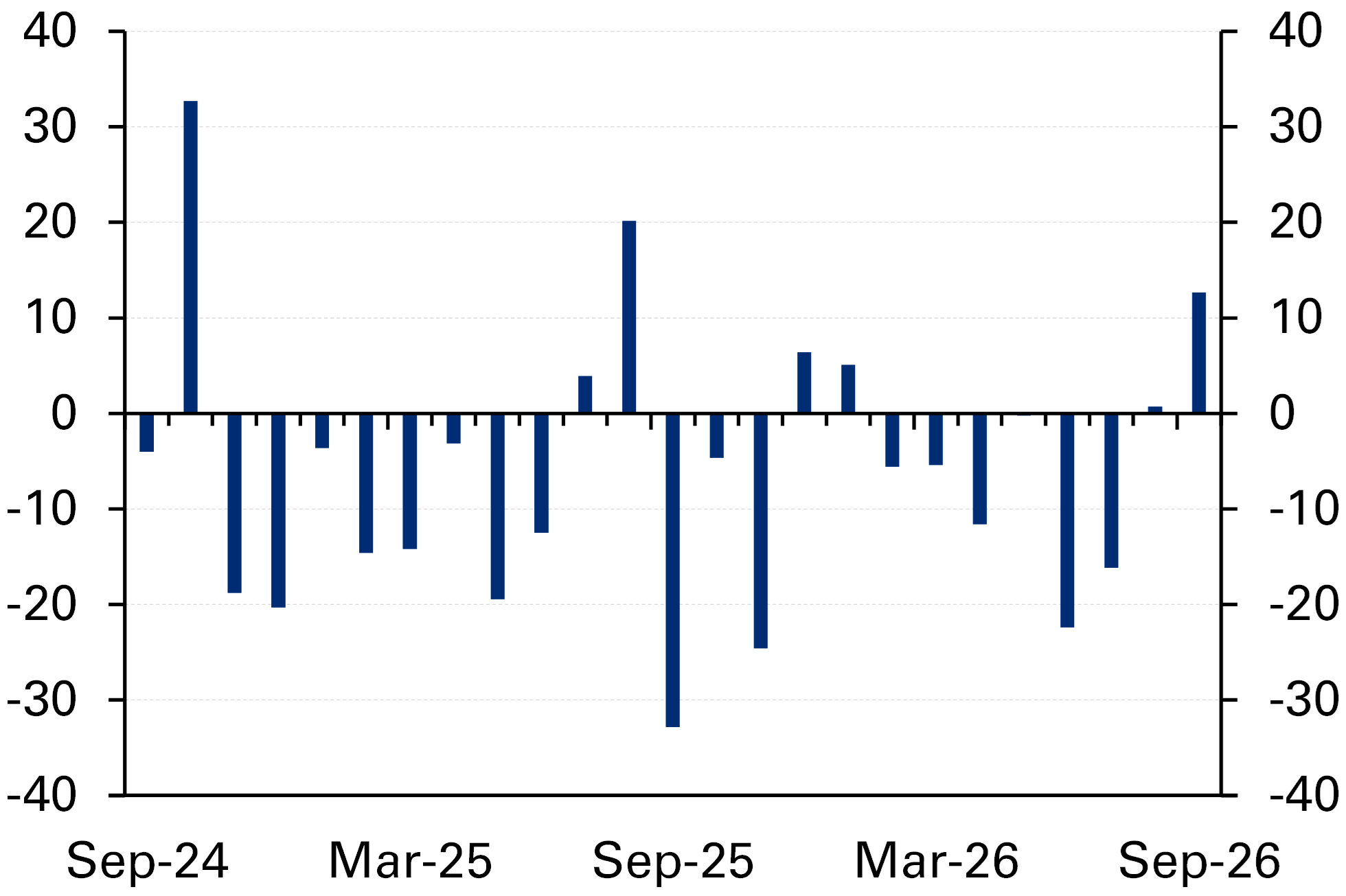
UK: Provisional data show stabilizing job count, while the unemployment rate unexpectedly falls. UK payrolls increased by 13K m/m (based on real-time payroll data) in September, and August’s previously reported 26K fall was sharply revised to show a slight increase of 0.7K. We highlight that monthly payroll data is subject to significant revisions over the subsequent months and the broader trend remains weak as jobs have declined by a total of 142K since January 2025. However, the unemployment rate in the June-August period unexpectedly fell to an over one-year low of 4.7% from 4.9% in the May-July period while the labor participation rate was steady at 63.8%. Wage growth data was mixed as regular pay growth accelerated to a seven-month high of 3.7% y/y in the three months through August from an upwardly revised 3.6% in the May-July period but total pay growth (including bonuses) eased to a nearly six-year low of 3.7% from 3.9%. Finally, vacancies again dropped to 691K in July-September, the lowest level in over five years. The latest job data signals mixed employment conditions, with relative stabilization/halting in job cuts but slowing total wage growth, which does little to change a very high market expectation of a 25bps bank rate hike by the Bank of England on November 5. As a reminder, a critical September CPI report will be released today, and both headline and core rates are expected to increase from August amid rising energy prices.
Japan: Export growth moderates further in September as high imports keep the trade balance in deficit. Japan’s trade sector remained resilient in September, although export growth eased for a second consecutive month and fell short of expectations (20% y/y). Exports rose 16.7% y/y, down from 19.3% in August, marking a 13th consecutive month of expansion. Growth was underpinned by strong demand from the US (23% y/y) and Asia (17.5%), as well as continued strength in technology-related shipments. Across product categories, transport equipment exports rose 11% y/y, supported by motor vehicle shipments. Semiconductors exports rose by 49% y/y and chip-making equipment rose by 44% y/y. Imports rose 18.9% y/y, slowing from 28% in August but continuing to outpace export growth, reflecting elevated energy and capital goods purchases. In particular, crude oil and LNG import values increased sharply despite more modest changes in volumes, highlighting the impact of higher energy prices amid ongoing geopolitical disruptions. As a result, Japan recorded a trade deficit of ¥537 billion in September, narrowing from ¥1.11 trillion in August but marking a fifth consecutive monthly deficit. That said, the data suggest that external demand remains supportive of growth, with AI-related and technology exports continuing to underpin trade performance, while elevated energy costs remain a drag on the trade balance.
US: Housing data weak amid high mortgage rates and rising construction costs. Recent housing market indicators continue to point towards weakness as high mortgage rates (30Y fixed currently at around 7.5%, nearly a three-year high) and rising construction material costs, especially energy and metals, impact demand as well as new supply. The AI-linked data center boom is also driving the surge in construction costs. Pending home sales in September fell 7.3% m/m to hit a record low, while housing starts and building permits also sustained further declines (-5.2% m/m and -0.2% in September, respectively).