
 +965 2292 4888


Daily Economic Update
10.11.2026
US: Consumers’ long-term inflation expectations steady; stock markets rebound, following the plunge on Thursday. Consumers’ inflation expectations in October were unchanged from September for one, three and five-year-ahead periods at 3.9% y/y, 3.3% and 3%, respectively, according to the monthly New York Fed survey. While year-ahead expectations remained at the highest level since May 2023, the longer-term ones (five-year) held steady for the 14th straight month, suggesting relatively anchored inflation expectations over the medium to long term. However, consumers saw a higher unemployment rate over the next 12 months, with the mean probability reaching the highest point since Covid but the mean probability of losing one’s job over the same horizon was still modest, indicating a mixed outlook. Finally, views about the expected household financial situation slightly worsened. We note that despite some deterioration in the perceived household financial situation over the past several months, aggregate household consumption has remained robust amid near record-high equity markets, supported by higher spending from the wealthier segment. Meanwhile, two regional Fed presidents, who would be voting members of the FOMC in 2027, warned of higher inflation risks, suggesting further policy tightening. Austan Goolsbee (Chicago) mentioned that there seems to be some “demand overheating” due to the AI data center build out, and that policymakers need to be “aggressive up front” about it. Similarly, Tom Barkin (Richmond) noted that inflation has been “stubbornly elevated”, with firms considering passing on input costs amid the squeeze on margins but he emphasized that “it is wise to move policy with care.” Separately, US equity markets rebounded sharply yesterday with the S&P 500 and Nasdaq Composite rising 2.4% and 2.7%, respectively, building on the gains recorded on Friday, and following their sharp plunge on Thursday.
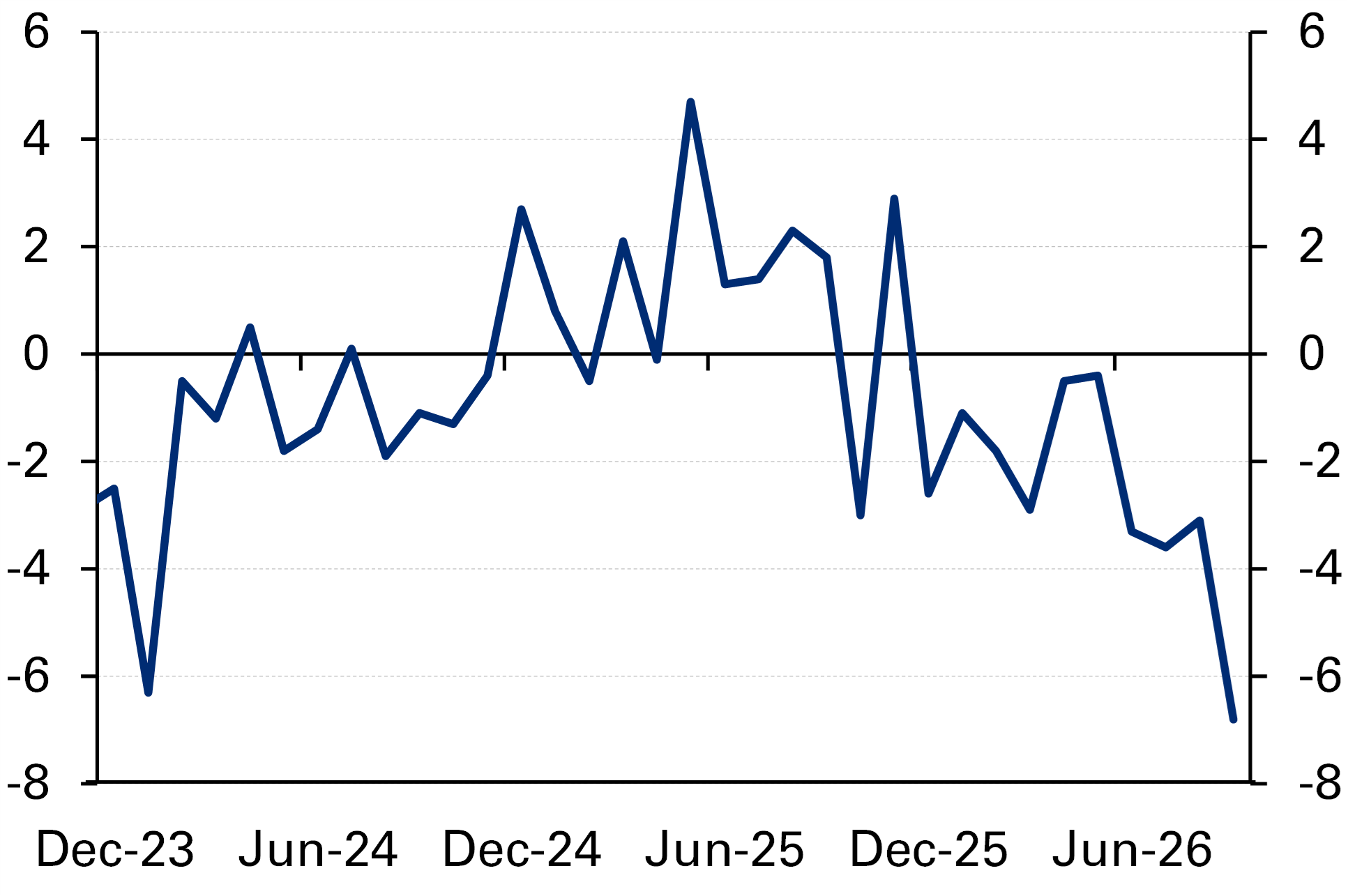
Japan: Household spending continues to be weak, falling for the 10th straight month in September. Household spending fell 6.8% y/y in September, the quickest pace in around six years, sharply underperforming expectations (-3.1%). This marked the tenth consecutive month of contraction, highlighting the continued fragility of consumer demand amid the persistent inflationary pressures. Spending remained weak across several key categories, including food (-2.5% y/y in September 2026 vs -1.4% in August) and medical care (-7.6% vs -1.9%), with most categories of household spending falling y/y. Private consumption, being an important indicator for the BOJ, remaining weak complicates the possibility of a further rate hike by the BOJ. Markets however continue to lean for a December rate hike, with a 62% probability.
China: Growth in exports and imports surpass forecasts but the trade balance narrows on a faster increase in imports. China’s external merchandise trade continued to grow at an outsized pace, helped by strong tech-goods flows. Exports rose by 35% y/y in October, slightly softening from September’s 36% rise, while imports grew by a whopping 42%, accelerating from a 31% increase during the previous month, with both easily beating consensus forecasts. In the first 10 months of 2026, exports and imports increased by 23% and 29%, respectively. Chinese exports have remained resilient despite worsening geopolitics and rising trade barriers, benefitting from strong demand for AI and other tech goods, supporting economic growth amid weak domestic consumption, while higher energy prices along with rising tech inputs have helped drive the spike in imports in recent months. Given the faster rise in imports, the trade balance in October narrowed more than forecast to $105 billion from $134 billion in September; still, in 10M2026, the trade surplus rose by 9% y/y, reaching the $1 trillion mark.
Egypt: Authorities target $77 billion in cumulative FDI by 2030. The Egyptian authorities aim to attract a cumulative $77 billion in foreign direct investment (FDI) into Egypt by 2030 under a new strategy developed by the Ministry of Investment and Foreign Trade in collaboration with the World Bank Group. The plan seeks to direct investment towards 10 priority sectors, including textiles and readymade garments, automotive manufacturing, chemicals, food processing, engineering industries, electronics, renewable energy and logistics. The selected sectors reflect Egypt’s existing industrial base, available workforce and potential to expand manufacturing, boost exports and create jobs. Egypt attracted net FDI inflows of $18 billion in FY25/26, while the private sector accounted for 57.7% of total implemented investments during the same period, highlighting its growing role in the economy.