
 +965 2292 4888


Daily Economic Update
30.09.2026
US: FOMC’s Williams expects only one more rate hike late this year, saying no need for urgency; market pricing for an October hike falls below 50%. New York Fed President John Williams (a permanent FOMC voting member) emphasized that “one further upward adjustment of the federal funds target range may be appropriate late this year,” stating that “with the policy action we took at our September meeting, there is no need for urgency.” While most Fed officials continue to see further policy tightening to contain higher inflation risks, comments from Williams, who is also the Vice Chair of the FOMC, whose comments usually carry higher weight than other FOMC members, helped push down the futures market pricing for a rate hike at the October meeting to below 50% from around 70%. The probability of at least one hike by end-2026 remains at over 90%, but the market pared the probability for two cumulative hikes to around 40% from 60%.
US: Job openings fall but layoffs moderate, signaling a stable job market; consumer confidence tanks to 12-year low. Job openings in August fell more than forecast to the lowest level in five months to 7.08mn from July’s 7.33mn. The hires rate slightly improved to 3.3% from 3.2% in July, but the layoffs and discharges rate dropped to 1% from 1.1% to stay at its lowest in over two years. In absolute terms, total layoffs and discharges were at their fewest since March 2025, signaling the continuation of a low-firing backdrop and a relative stabilization in broader job market conditions. But in more somber news, the Conference Board consumer confidence index in September tanked to the lowest level since early 2014 to 81.9 from August’s 88.6 on worsening present situation as well as expectations subcomponents. In particular, the survey noted a first negative reading for consumer appraisals of current business conditions in two years. Consumers’ perception about the job market worsened as more saw jobs were “hard to get”, while fewer believed jobs were “plentiful”. Looking ahead, consumers expected fewer job opportunities over the next six months. Inflation expectations also rose amid rising energy prices. Despite a relatively downbeat read on consumer mood, we note that aggregate private consumption has remained quite robust in recent months, as higher a wealth-effect due to the rising equity market has helped improve household balance sheets, especially amongst the wealthier ones.
Eurozone: Economic sentiment softens in September as inflation pressures remain elevated. Confidence in the Eurozone economy softened in September, with the Economic Sentiment Indicator falling to 97.9 from 98.4 in August, below market expectations of 99.0, reversing part of the improvement seen in recent months. The weaker reading suggests that heightened geopolitical uncertainty and rising energy costs are weighing on business and consumer sentiment. Survey data on inflation expectations pointed to renewed price pressures, with consumers anticipating higher inflation and firms in the industrial and construction sectors reporting a stronger willingness to raise prices. The combination of softer sentiment and firmer price expectations presents a challenging backdrop for policymakers, noting that economic activity in the Eurozone has continued to be more resilient than expected. On Monday, ECB President Lagarde re-iterated that the energy shock is "too large to look through" but that a "measured response" remains appropriate, as there is still limited evidence of price pressures becoming embedded and feeding into higher wages. We note that the Eurozone’s headline inflation rose to 3.2% y/y in August from 2.9% in July, driven largely by energy prices, while consensus expectations point to a further acceleration to 3.6% in September.
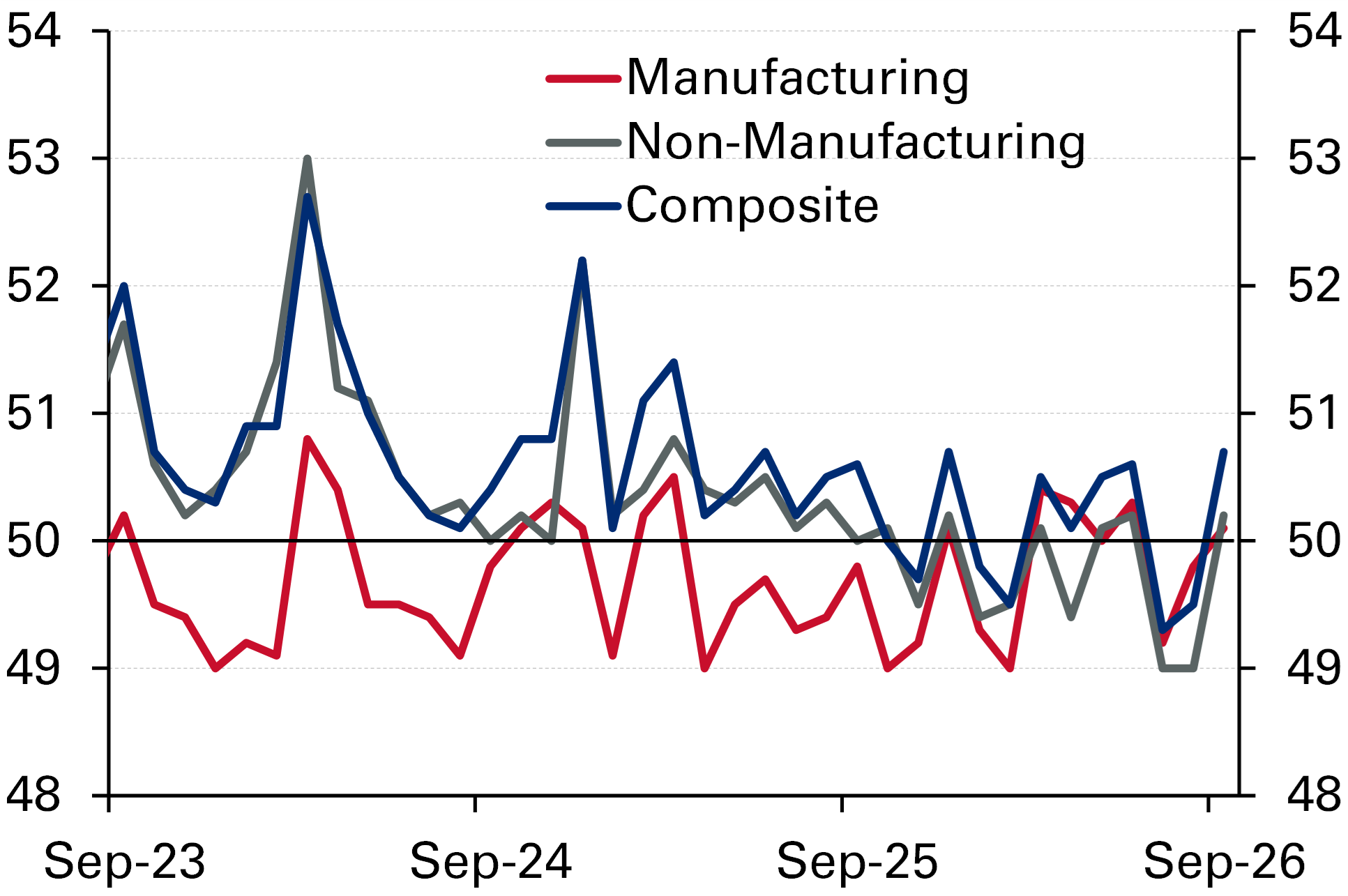
China: Authorities unveil targeted stimulus that seems aimed at lifting 2026 growth to hit target; Official PMIs return to expansion territory in September. Authorities unveiled on Tuesday targeted stimulus measures that are generally limited and seem structured to lift economic growth in 2026 to hit the 4.5% to 5% target rather than invigorate domestic demand in a sustainable way. The measures include mortgage subsidies for qualified home buyers, expanded central bank support for targeted sectors such as technology and small firms, and reduced interest rates on certain loans. On the latter point, the central bank reduced, by 25 bps, the one-year interest rate on its pledged supplementary lending facility, which is low-cost financing it provides to banks to fund investment. Meanwhile, China's official PMI surveys signaled an improvement in economic conditions at the end of the third quarter, with both manufacturing and non-manufacturing activity returning to expansionary territory. The manufacturing PMI rose to 50.1 in September from 49.8 in August, moving back above the 50-point threshold for the first time since June and suggesting that factory activity regained momentum after two months of contraction. Meanwhile, the non-manufacturing PMI increased to 50.2 in September from 49.0 in the month prior, beating market expectations of 49.3 and indicating a slight rebound in services and construction activity. As a result, the composite PMI climbed to 50.7 in September from 49.5 previously, marking its highest level in nine months and pointing to a renewed expansion in overall economic activity. The improvement appears to have been supported by stronger production, resilience in export-oriented and technology-related industries, coupled with the normalization of activity after severe weather affected parts of the country in August.
Japan: Industrial output and retail sales weak in August. Japan's latest activity data painted a more mixed picture, with both industrial production and retail sales falling short of expectations. Industrial output declined by 1.7% m/m in August from -0.2% in July, compared with market expectations for an increase, reflecting weakness across several key manufacturing sectors, including motor vehicles (-6.8% in August from 0.8% in July) and business-related machinery (-6.0% from 1.9%). Industrial production remained in positive territory on an annual basis, increasing 3.4% y/y in August, albeit at a slower pace than the 3.9% recorded in July. Meanwhile, retail sales growth slowed to 2.7% y/y from a revised 3.7% in July, while sales fell on a monthly basis (-1.2% m/m), suggesting consumer spending lost some momentum after a strong start to the third quarter. That said, despite the softer August readings, both indicators remained above year-earlier levels, pointing to underlying resilience in domestic demand and activity.
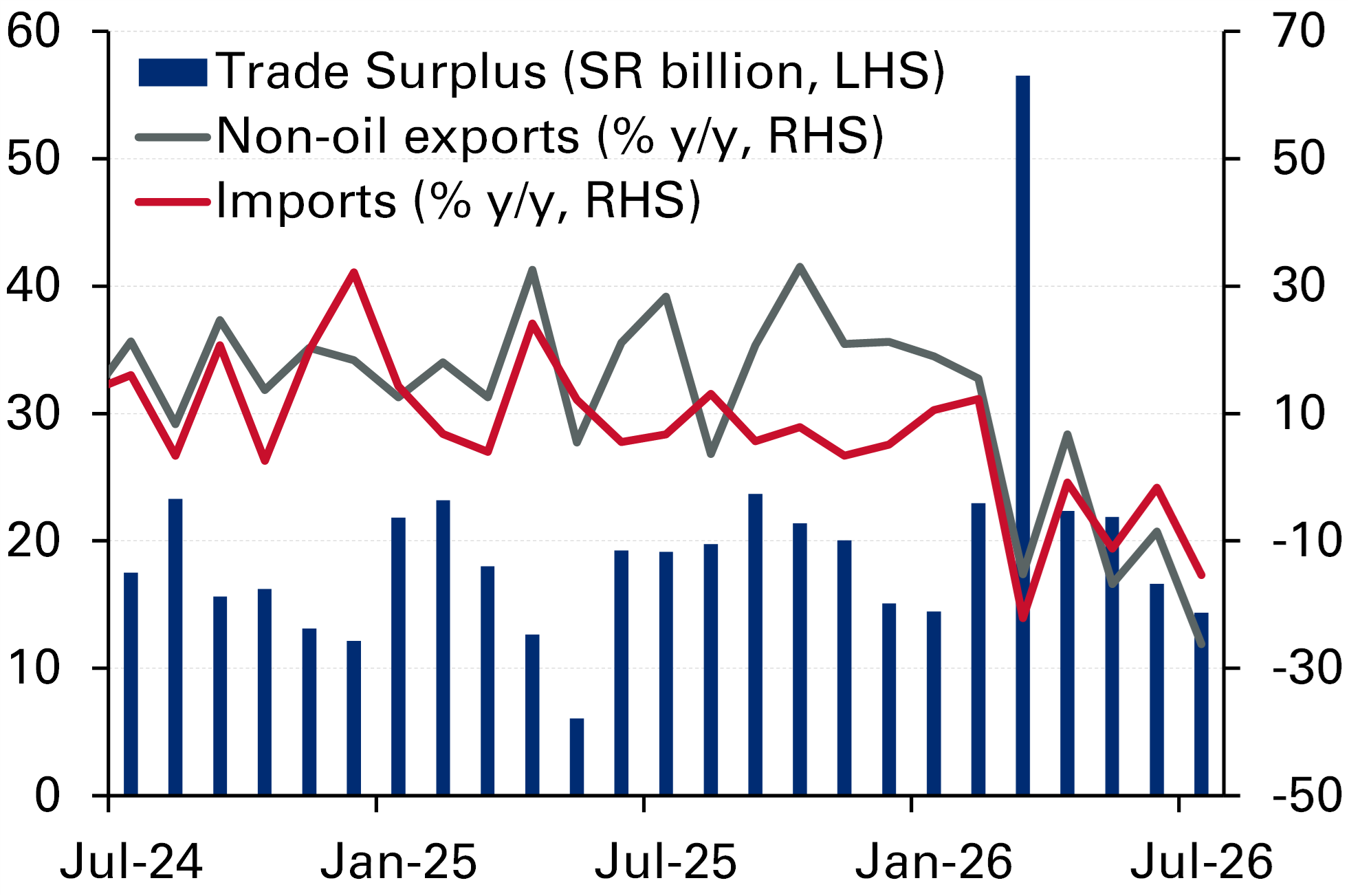
Saudi Arabia: Regional shipping disruptions weigh on trade surplus. Saudi Arabia’s merchandise trade surplus narrowed by 25% y/y in July recording SAR 14.4 billion, as exports fell 17.2% and imports declined 15.4%, according to GASTAT. The weaker trade performance reflects softer external demand as well as disruptions to regional shipping. Higher transport and insurance costs, together with supply-chain disruptions, have also increased pressure on exporters. Yanbu remained an important alternative route, handling 78% of seaborne crude exports during the month. However, continued Houthi threats to vessels calling at Saudi ports have made the route more challenging to use. Oil exports fell 12.8% y/y, while non-oil exports, including re-exports, declined by 26%. Re-exports were particularly weak, falling 40%, mainly due to a 68% decline in machinery, equipment, electrical appliances and parts. Plastics, rubber and related products remained the largest category of non-oil exports, accounting for 19.8% of the total despite falling 17.8%. Chemicals and related products followed with an 18.6% share, although exports in this category fell 32%. On the import side, machinery, electrical equipment and parts remained the largest category, accounting for 26% of total imports and declining 27% y/y. China remained Saudi Arabia’s largest merchandise trading partner, accounting for 13.4% of exports and 23% of imports in July. This highlights the importance of diversifying trading partners to reduce exposure to shifts in Chinese demand and strengthen trade resilience. The near-term outlook remains challenging as long as regional shipping disruptions persist. Higher freight and input costs, combined with weaker external demand, could continue to weigh on trade. A sustained recovery would depend on the normalization of regional shipping conditions and a pickup in external demand.