
 +965 2292 4888


Daily Economic Update
17.12.2025
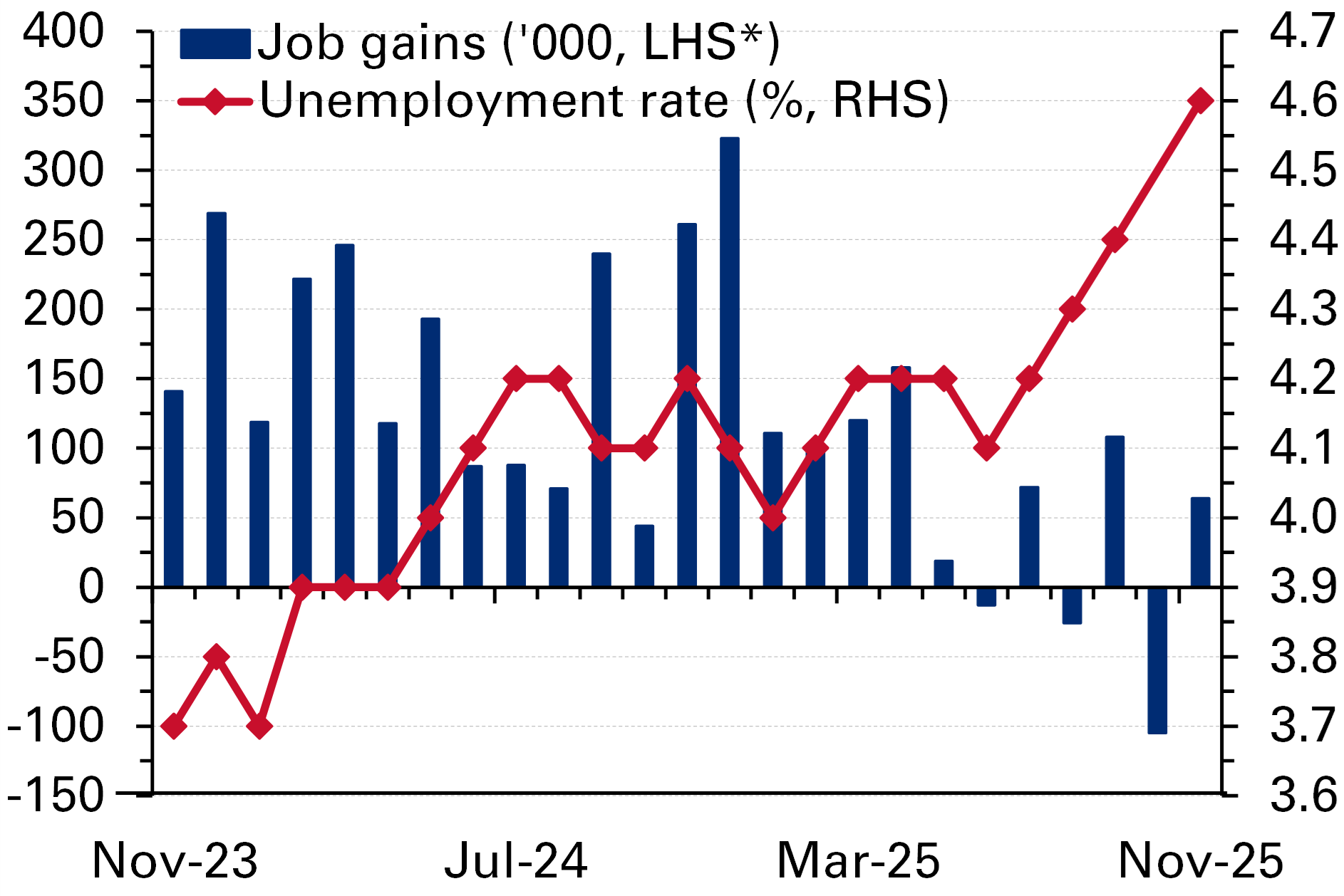
US: Labor market shows further signs of cooling amid mixed set of November data. Non-farm payrolls in November rebounded by a higher-than-expected 64K from a drop of 105K in October and a downwardly revised 108K gain in September. Recall that the BLS had cancelled the October job report due to the government shutdown and released only partial data from the month along with the November one. The outsized decline in jobs in October was due to a 157K decrease in government payrolls as the previously enacted DOGE-related and other reductions in Federal workforce took effect at the end of September. Even within the private sector, most job increases continued to be concentrated in a very few sectors such as healthcare and social assistance and construction, indicating a continued cooling in job creation at the broader level, as since May the economy has added just 17K jobs per month. The unemployment rate rose to 4.6% in November from 4.4% in September (October data not available), a four-year high, but mostly driven by a higher participation rate, which ticked up to 62.5% from September’s 62.4%. However, the BLS highlighted that due to the lapse in appropriations, the household survey response rate was below usual in November, and the data was “associated with slightly higher than usual standard errors,” suggesting quality issues in the estimation of the unemployment and participation rates, a matter that Fed chair Powell flagged in his press conference last week. Wage growth slowed to 3.5% y/y in November from 3.7% in both September and October, the lowest since May 2021. Despite sizeable distortions in the labor market data, the trend of gradual weakening has persisted in October and November, without yet signaling any rapid deterioration or an abrupt rise in joblessness, which is unlikely to change the Fed’s interest rate outlook at least for the January meeting. The futures market continues to signal no-change in rates in January but two cuts of 25 bps each by the end of 2026. More positively, core retail sales in October (excluding food services, auto, gasoline and building materials sales) jumped by 0.8% m/m following a drop of 0.1% in September, indicating solid consumer spending momentum at the start of Q4 that should help offset the adverse impact of the government shutdown. Though overall retail sales were unchanged in October from the previous month, dragged down by lower auto and gasoline store sales. Finally, the S&P Global flash PMIs for December showed a slowdown in business activity as both manufacturing and services decreased to 51.8 and 52.9 from November’s 52.2 and 54.1, respectively, as the expansion in new orders moderated. The survey also noted a sharp build up in inflationary pressures (the highest in nearly three years) due to high tariffs, while growth in employment also softened.
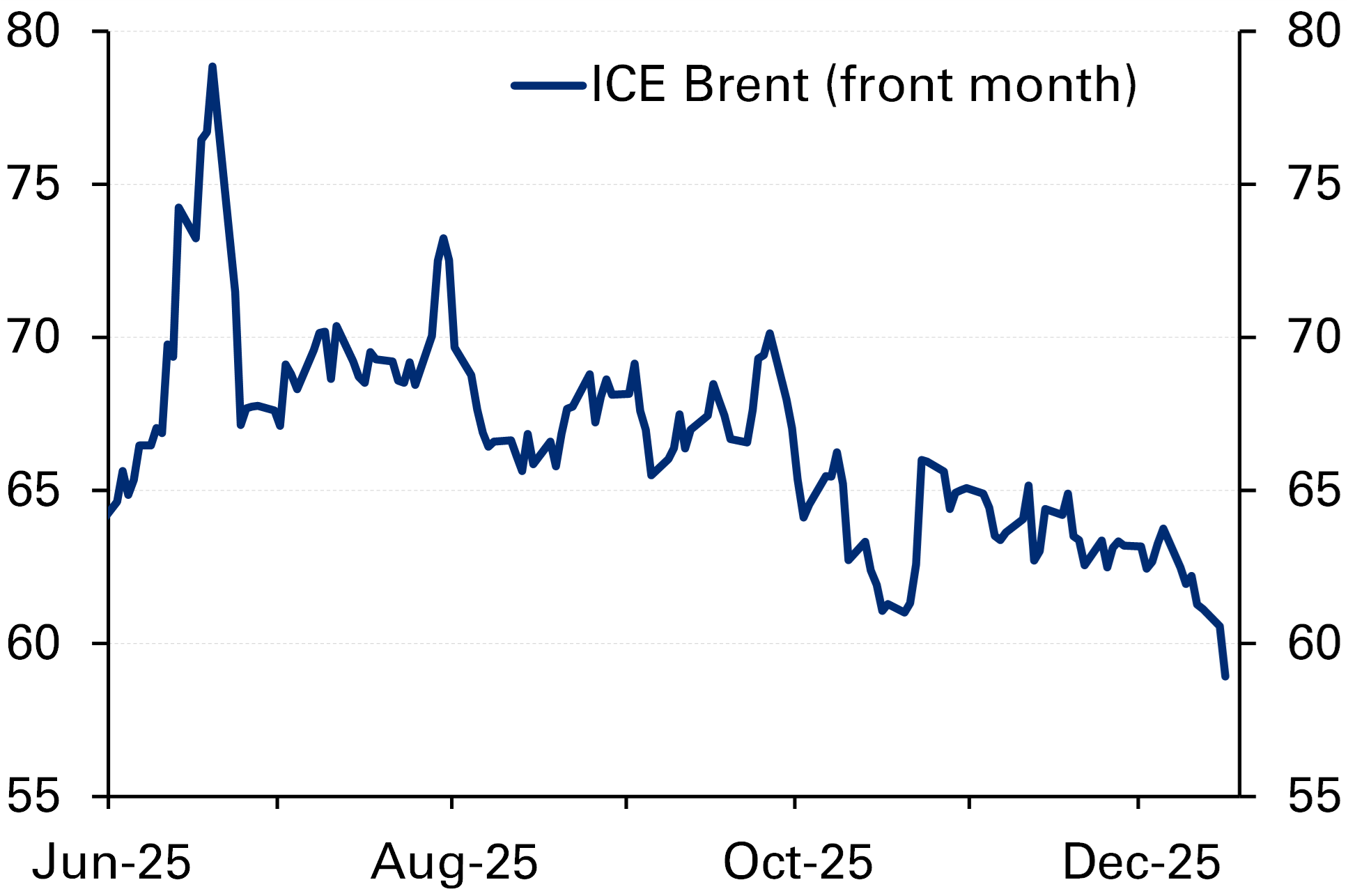
Oil: Prices drop to multi-year lows yesterday but recover on US blockade of Venezuelan oil tankers. Brent futures dropped 2.7% d/d yesterday to settle at $58.9/bbl, its lowest level since February 2021 amid improving prospects for a ceasefire between Russia and Ukraine and intensifying oversupply concerns. This morning, though, oil prices were firming on elevated geopolitical risk, with Brent up 1.3% to $59.7/bbl in Asian trading at the time of writing after US President Trump ordered a blockade on sanctioned oil tankers entering and leaving Venezuela. The dramatic escalation against the Maduro regime follows the seizure last week of one of its oil tankers by the US, which led to a notable reduction in the volume of tanker traffic, according to S&P Global. Risks to Venezuela’s supply are becoming more material, with the country’s roughly 700 kb/d of oil exports – the bulk of which is shipped to China – increasingly at risk. Given the magnitude of the IEA’s supply glut estimate for next year (+3.8 mb/d), the loss of Venezuelan supplies in an extreme scenario will not have a significant impact, though.
UK: Labor market continues to weaken but business activity accelerates sharply as budget overhang removed. Showing a consistent weakening in the labor market, UK payrolls (based on employment tax records) fell again in November by 38K from a smaller than previously estimated drop of 22K in October, taking the cumulative decline in jobs to 187K since the announcement of higher insurance contributions in 2024’s Autumn budget. Moreover, the unemployment rate rose in line with the street expectations to 5.1% in the August-October period from 5% in the July-September period, the highest since November 2020-January 2021, though the participation rate was steady at 63.9% for the third consecutive time, its best reading since the start of the pandemic in 2020. Pay growth slowed less than forecast, with regular wage growth easing to the lowest level since February-April 2022 to 4.6% y/y in August-October from an upwardly revised 4.7% in July-September, with total pay growth also moderating to 4.7% from 4.9%. Job vacancies slightly ticked up to 729K in September-November but remained near the lowest level in over four and a half years. On a positive note, the S&P Global flash PMIs for December increased more than forecast, recording broad-based improvements across manufacturing and services and reflecting a strong upturn in new orders (a 14-month high). The manufacturing measure rose to a 15-month high of 51.2 from November’s 50.2, and the services gauge strengthened to 52.1 from 51.3. Following the Autumn budget late last month, the survey noted a sharp enhancement in business optimism to the second-highest level since October 2024 but still slightly below the series average. However, inflationary pressures were stronger, and employment shrank for the 15th consecutive month, broadly mimicking the payroll data above. Overall, the surveys signal that business activity has stabilized after the pre-budget uncertainty, but a weak employment scene and a limited fiscal boost would curb further progress as we enter 2026.
Eurozone: Composite PMI softens in December, but from over a two-year high in November. The HCOB Eurozone Composite flash PMI fell to 51.9 in December, below consensus estimates of 52.7 and November’s over two-year high of 52.8 reading. Despite decreasing, the composite PMI remained in expansion territory for the 12th consecutive month, i.e. each and every month of 2025. The services PMI dropped to 52.6 (53.6 in November, 53.3 consensus) as cost inflation reached a nine-month high in December. The manufacturing PMI also decreased, falling to an eight-month low of 49.2 (49.6 in November, 49.9 consensus) as new orders only increased modestly and manufacturers cut their purchasing activity at the fastest pace since March.
Japan: Exports rebound as US shipments increase. Growth in exports rose to a nine-month high of 6.1% y/y in November (3.6% in October), beating consensus estimates of 4.8% as electrical machinery exports rose 7.4%. The growth was driven by an 8.8% y/y rise in exports to the United States (the first increase in eight months), while exports to China and the Middle East fell 2.4% and 1.5%, respectively. Meanwhile, imports fell short of consensus estimates of 2.5% y/y, instead rising by just 1.3% but remaining in positive territory for the third consecutive month. Overall, November’s trade data is a sign of strength for the Bank of Japan to consider before it meets on Friday, with markets expecting a 25bps rate hike in that meeting.
Egypt: Trade deficit hits a 10-year low as exports drive the improvement. Egypt recorded its lowest trade deficit in a decade during January–October 2025 compared to the same period in the previous years, according to figures presented by the Minister of Investment and Foreign Trade. The improvement was driven by stronger exports rather than import compression, marking an important qualitative shift in the country’s external performance. Non-petroleum exports reached a record $41 billion over the first ten months of the year, while total exports increased by $6.5 billion y/y, the largest annual gain in ten years. At the same time, total trade volume climbed to $108 billion, the highest level in a decade, reflecting a broad expansion in trade activity rather than a cyclical slowdown in imports. Looking forward, full-year 2025 figures are expected to maintain the same trajectory. Exports are projected to exceed $50 billion for the first time, while imports are expected to rise above $96 billion. This would place the full-year trade deficit at around $46 billion, with the total trade volume approaching $146 billion. The key takeaway is not just the narrowing deficit, but how it was achieved. Export-led improvement signals rising competitiveness, diversification, and better integration into global markets. If sustained, this momentum brings Egypt closer to its long-term ambition of reaching $100 billion in exports by 2030, though achieving that target would still require a robust compound annual growth rate of around 14.5% over the next five years.