
 +965 2292 4888


Daily Economic Update
22.11.2026
Kuwait: S&P Global affirms Kuwait's AA- long-term sovereign rating with a stable outlook. The rating reflects the country's exceptionally strong fiscal and external asset position, despite the adverse impact of regional conflict on oil production and exports. The agency forecasts a 14% contraction in real GDP and a fiscal deficit of 25% of GDP in 2026 but views the pressures that led to the declines as being manageable given Kuwait's substantial financial buffers, particularly its assets held by the Kuwait Investment Authority. Liquid government assets are estimated at over 600% of GDP, the highest among rated sovereigns. The agency projects GDP growth rebounding to 12.8% in 2027, supported by recovering oil production and continued government spending and project execution. On the fiscal side, the general government deficit is projected to widen to 26% in FY2026/27 (from 15%) before narrowing to 11% in FY2027/28 as oil production and revenues recover but is expected to remain elevated over the medium term at an average of 17% of GDP, with funding supported by the financing and liquidity law and enhanced access to sovereign wealth fund resources. Reforms, including the excise tax law, minimum domestic top-up tax, subsidy rationalization, expenditure controls, and domestic capital market development, are expected to gradually raise non-oil revenue from 5% of GDP to about 7% of GDP over the next two to three years and strengthen fiscal sustainability. Key downside risks include an escalation of regional tensions, prolonged disruption to oil exports or delays in fiscal and economic diversification reforms. Conversely, successful reform implementation, stronger non-oil growth, and deeper domestic capital markets could support a rating upgrade over the medium term. The report highlights that Kuwait's rating strength is underpinned by its exceptional sovereign wealth assets, strong net external creditor position, and low government debt relative to its financial resources, providing significant resilience against economic and geopolitical shocks.
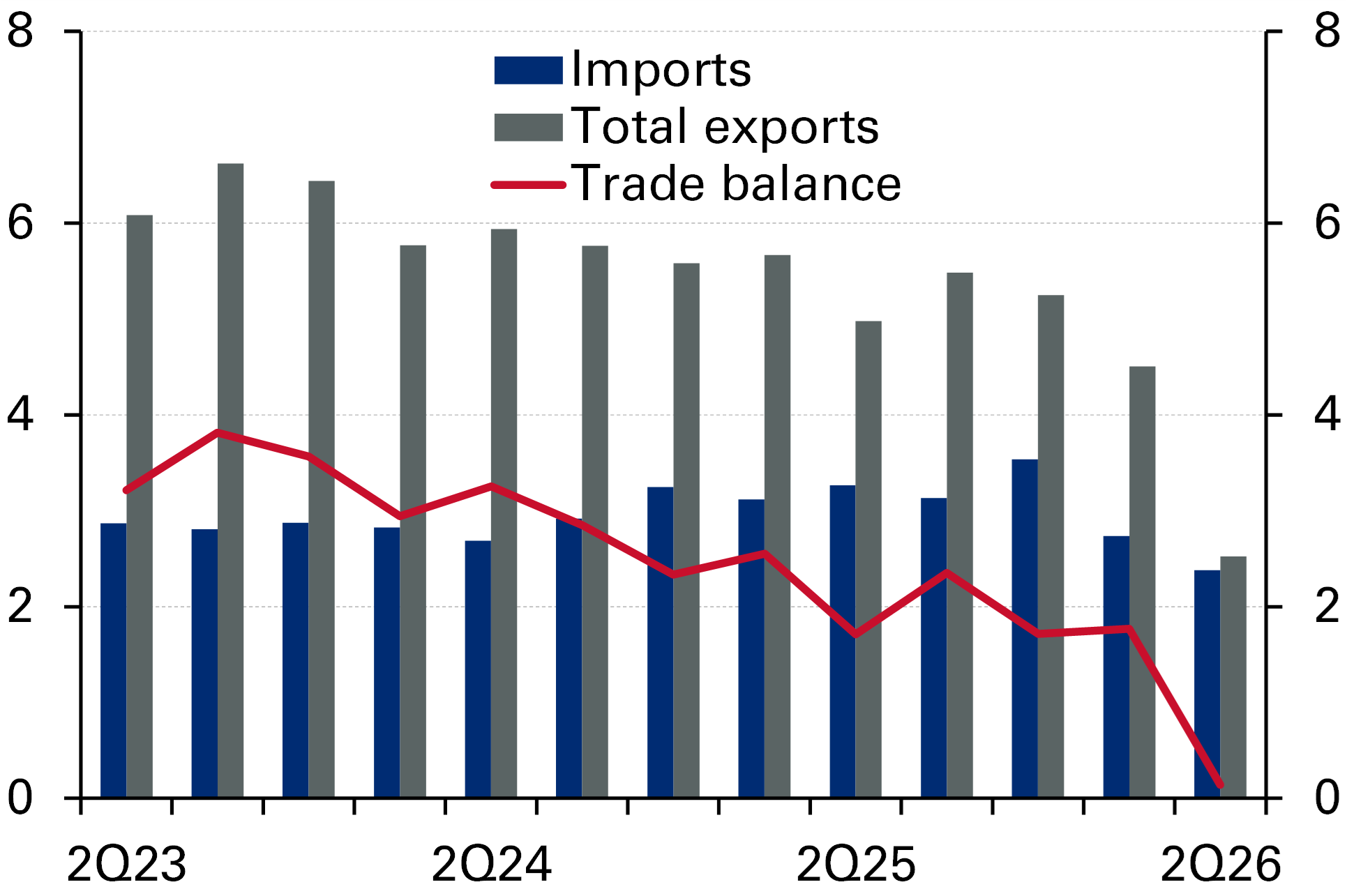
Kuwait: Trade activity contracted sharply in Q2 2026 amid US-Iran conflict disruption. Kuwait’s international goods trade declined by 41% y/y in Q2 2026, marking the steepest contraction since Q2 2020. The decline was driven by both exports and imports, highlighting the widespread impact of the regional conflict on trade flows and logistics. Total exports fell by 49% y/y (-21% in Q1), driven mainly by the halving of oil exports (-50% y/y versus -20% in Q1), which constitute about 90% of total exports, while non-oil exports contracted by a sharper -62% y/y (-35% in Q1). Re-exports also weakened, falling by -22% y/y after being broadly stable in Q1, reflecting the loss of momentum following the double-digit growth recorded through 2025. Trade patterns by transport mode further underscore the effects of the conflict, with sea-borne exports and imports plunging by -53% y/y and -77% y/y, respectively, consistent with disruptions stemming from the closure of the Strait of Hormuz. In contrast, land transport absorbed part of the shock, with exports and imports by land rising by 22% and 157% y/y, respectively, as trade routes were redirected through neighboring countries. The decline in exports and imports was broad-based across all major economic categories. However, non-oil exports remained concentrated in Saudi Arabia, the UAE, Iraq and Jordan (64% of total non-oil exports), while the UAE, Saudi Arabia, China and the US accounted for more than half of Kuwait’s imports during the quarter (52%).
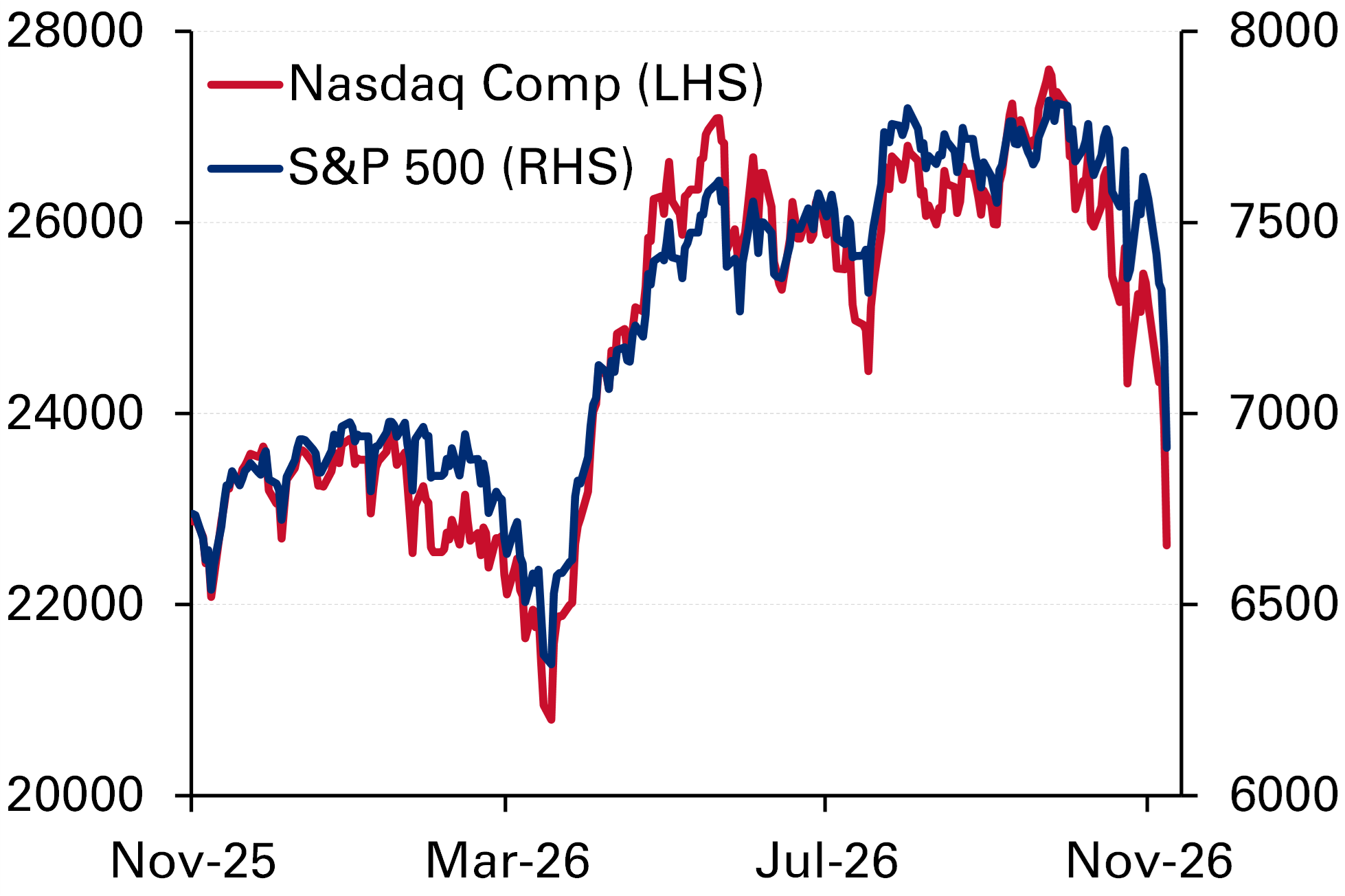
US: Equity market rout deepens as AI trade unravels with S&P 500 in correction territory; UST bond yields tumble. US equity markets sold off sharply last week, especially on Thursday and Friday, pressured by the AI-trade thesis that saw most AI-tech linked stocks, such as Nvidia, AMD and the recently listed Anthropic, tank on Friday. The S&P 500 and the Nasdaq Composite indices fell 3.7% and 5.3%, respectively, on Friday, and are now in correction territory, down 12% and 18% from their respective record highs seen in early October. However, we note that the recent 12% pullback in the S&P 500 is not unusual and not overly sharp from a historical perspective. The S&P 500 is now up only 0.9% YTD while the Nasdaq is down for the year. The equity market rout increased the demand for safe-haven assets including UST bonds and USD, as 10Y bond yields fell by around 10 bps on Friday (and down by around 23 bps for the week) and the USD (DXY index) stayed near its highest level in 19 months. But gold fell by 4.6% to its weakest level in over a year. Based on the recent commentary from several Fed officials and market expectations, the FOMC looks set to raise policy interest rates by 25 bps in the upcoming December 8-9 meeting. However, futures market pricing, which was indicating an around 10% probability of a bigger 50-bps hike in December along with a 90% probability for a 25-bps hike, now signals an 11% probability for no change and zero probability for an outsized 50-bps increase.
UK: Retail sales unexpectedly rebound in more signs of economic resilience; the UK and the EU agree to reset post-Brexit ties. Retail sales volumes in October jumped by 0.7% m/m (+2.3% y/y) from a bigger-than-initially-estimated drop of 0.6% (+0.7% y/y) in September and versus the consensus forecast of no change. The increase was partly driven by the government’s “Be Ready” campaign to stock up on essential long-life consumer goods in case of emergency which propelled grocery store sales. Favorable weather conditions also helped lift clothing sales during the month. The UK economy has shown sustained signs of resilience this year despite higher energy prices, with GDP growth surprising on the upside in recent quarters. However, that robustness will be retested as CPI inflation is expected to rise sharply over the coming months, squeezing consumer wallets, while the BoE is seen increasing policy interest rates further. Meanwhile, a decade after Brexit, the UK and the EU have agreed to closer ties, with deals including improved access for UK food products, better youth mobility between them, greater coordination on defense and immigration, and linking their respective carbon emission market platforms. These agreements will be rolled out in a phased manner over the coming years, with the UK government estimating the boost to GDP growth of up to 0.5% pts from the deals over the long term. However, some issues remain outstanding, such as reduced tuition fees for EU students in the UK and the UK’s participation in the EU electricity market.
China: APEC summit concludes with limited tangible outcomes; PBoC keeps LPRs unchanged in November. The APEC summit, held in China last week, concluded with limited tangible outcomes. The historic meeting, which brought together Presidents Xi, Trump and Putin, made headlines last week as the three came together to discuss nuclear arms reduction and global oil supply among other matters. The joint statement included a pledge to boost the latter. In his statements, Chinese President Xi emphasized the trilateral summit as a landmark first meeting among the three leaders. He also emphasized that cooperation among major powers is essential for maintaining global peace and stability, arguing that history shows confrontation among major powers leads to instability while cooperation promotes peace. Xi called on the three countries as major global powers to strengthen dialogue, address global challenges jointly, safeguard strategic stability, and contribute to world peace and development. He also highlighted China’s efforts to maintain stable relations with both Russia and the United States and advocated for a framework of major-power relations based on peaceful coexistence, stability, and balanced development. That said, the trilateral meeting produced few concrete outcomes on the disputes most relevant to the APEC region including trade with the US and issues surrounding Taiwan. Separately, the People’s Bank of China left its benchmark Loan Prime Rates unchanged on November 20, maintaining the 1-year LPR at 3.0% and the over-five-year LPR at 3.5%. This marked the 18th consecutive month in which both rates were left unchanged.
Japan: Inflation accelerates in October, supporting December BoJ rate hike. Headline CPI inflation accelerated to 2.3% y/y in October from 2.1% in September, while core inflation rose to 2.2% y/y from 2.1%, its highest level since December, though below forecasts of 2.3%. Meanwhile, core-core inflation eased to 2.2% from 2.4% in September. Energy prices rose 2.2% y/y, their fastest increase in almost a year, reversing September’s 0.6% decline. With the BoJ stating in October that underlying inflation had reached its 2% target, October’s release supports the case for further tightening, with markets pricing in around a 66% chance of a 25-bps hike at the December meeting as of Friday morning. BoJ Governor Ueda has continued to signal further rate hikes, telling parliament on 19 November that the bank “will continue to raise the policy interest rate and adjust the degree of monetary accommodation” and stressing the need to prevent underlying inflation from overshooting 2%. Similarly, hawkish board member Hajime Takata, the sole advocate for a rate hike in October, warned in a recent speech that inflationary pressures could become evident towards the second half of the current fiscal year (FY2026). The BoJ’s October Outlook forecasts core inflation at 2.5% in FY2026 and 2.6% in FY2027.