
 +965 2292 4888


Daily Economic Update
17.08.2026
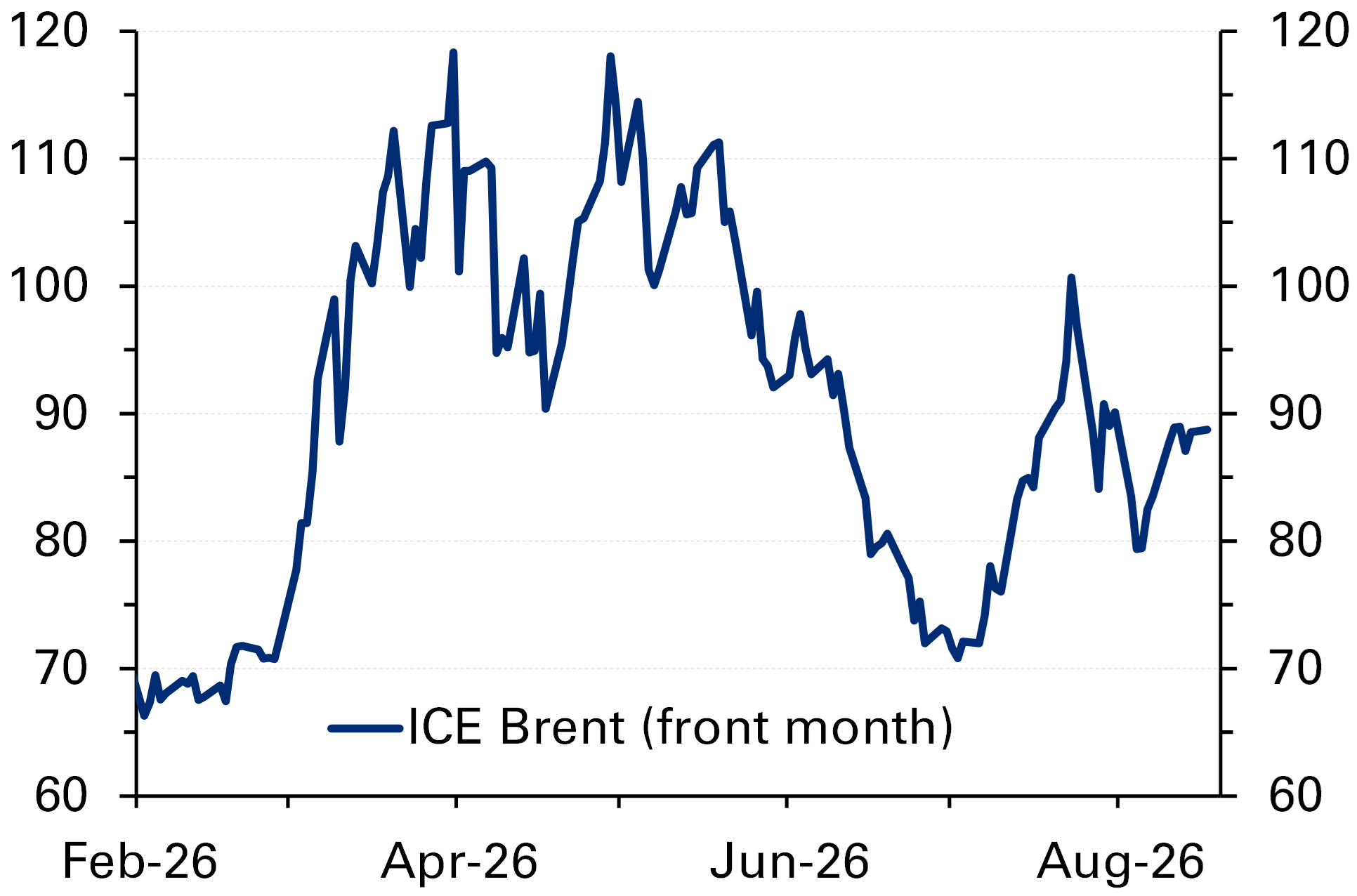
Oil: Prices gain on fading US-Iran deal hopes and continued Iranian strikes on shipping. Brent crude futures logged gains of almost 6% last week, closing on Friday at $88.5/bbl as fading optimism over a near-term US-Iran agreement and continued Iranian attacks on vessels transiting the Strait of Hormuz raised oil’s geopolitical risk premium once more. Gains came despite a more bearish backdrop for oil fundamentals, with both the IEA and OPEC lowering their 2026 oil demand forecasts last week and US weekly inventory data revealing an unexpected increase in commercial crude stocks. Market attention, however, remained firmly focused on geopolitical developments, particularly as both Washington and Tehran appear to be doubling down on their respective positions and looking to pressure the other to the negotiating table. Iran remains adamant about retaining influence over maritime traffic through the Strait of Hormuz despite the recovery in flows, estimated at around 5 mb/d by Bloomberg and nearly 9 mb/d by US Energy Secretary Chris Wright. Meanwhile, the US appears to be intensifying its campaign of economic pressure on the Islamic Republic, with President Trump recently threatening an indefinite blockade against Iranian shipping and ports with a “wall of steel”. He mused that “pretty soon I’ll be declaring the Hormuz strait a territory of the United States”.
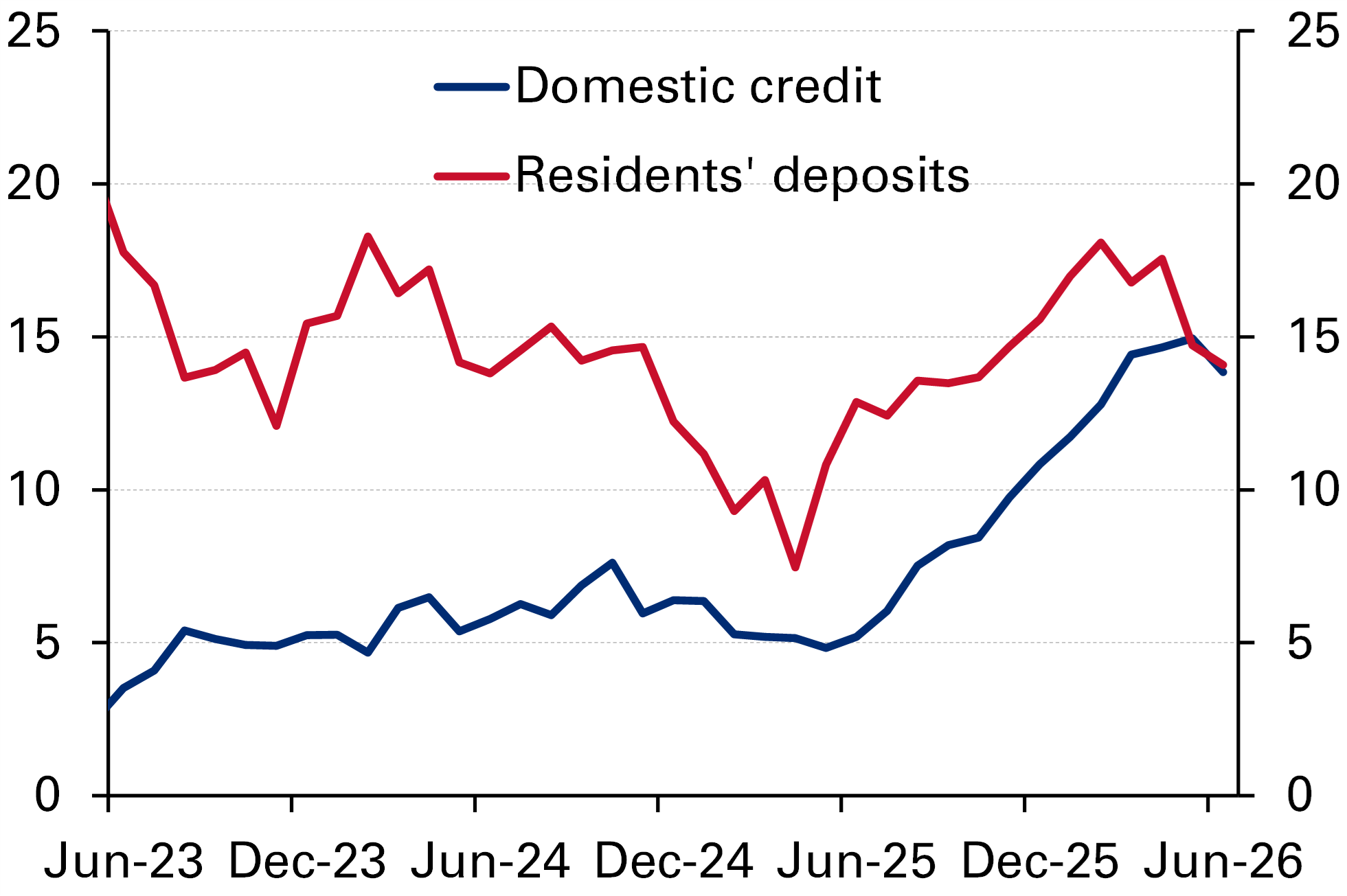
UAE: Domestic credit growth moderates in June as slowing corporate lending weighs on private lending. Domestic credit growth remained solid in June, though growth eased to 13.9% y/y from 15% in May. Private sector credit, which accounts for 71% of domestic credit, slowed markedly to 8.7% y/y from 11.2% in May, logging its weakest pace since May 2025. Within the private sector, corporate lending decelerated to 5.8% y/y, the slowest growth since September 2025. In contrast, personal lending remained resilient, edging up to 13.6% y/y from 13.4% in May. Meanwhile, public sector credit (government plus GREs) growth strengthened further to 28.1% y/y, up from 24.7% in May and extending its expansion streak to the tenth consecutive month. Foreign credit growth moderated for a fifth successive month but remained elevated at 37.5% y/y. On the liabilities side, resident deposit growth slowed for the second consecutive month to 14.1% y/y from 14.7%, reflecting softer growth in both private sector deposits (12.7%y/y versus 13.9% in May) and public sector deposits (14.5% versus 15.7%). The loan-to-deposit ratio eased to 68.4% in June from 69.0% in May. Looking ahead, credit growth should remain supported by strong public sector borrowing and resilient personal lending, though the impact of the regional tensions and uncertainties could weigh on credit demand (a feature already confirmed by a central bank lending survey covering Q1), suggesting a more moderate pace of credit expansion in the remainder of 2026.
Egypt: IMF flags high financing needs despite approving latest review. The IMF’s latest country report highlighted that large government financing needs remain one of the economy’s key vulnerabilities, despite acknowledging significant progress in macroeconomic stability. The report accompanied the successful completion of the seventh review under Egypt’s reform program, which unlocked $1.8 billion in fresh financing earlier this month. According to the IMF, Egypt entered the latest period of regional tensions from a stronger position than in previous crises, supported by ongoing economic reforms and improved policy credibility. However, the Fund projects gross financing needs to peak at around 42% of GDP in FY25/26, while public debt is expected to reach 91% of GDP before gradually declining to below 75% by 2031, supported by sustained primary fiscal surpluses. On monetary policy, the IMF reiterated the need to maintain a tight policy stance to ensure inflation continues on a downward path and inflation expectations remain well anchored. The Fund also noted that, if inflationary pressures persist, interest rate hikes may be needed to accelerate the disinflation process and bring inflation closer to the CBE’s target over the medium term.
Japan: GDP growth moderates in the second quarter, undershooting expectations. Preliminary estimates showed GDP expanding by 0.3% q/q in Q2, slowing from 0.5% in Q1 and falling short of market expectations for an unchanged 0.5% pace. Growth was supported by external demand, which contributed 0.5 percentage points to quarterly growth, while domestic demand contracted by 0.2% q/q, reversing a 0.2% expansion in the previous quarter. The contraction in domestic demand reflected subdued household spending, with private consumption flat during the quarter, undershooting expectations for a 0.5% increase as higher living costs weighed on consumer sentiment. Meanwhile, business investment fell by 1.2% q/q, highlighting continued caution among firms despite resilient export performance. The softer GDP outturn suggests that elevated living costs and higher energy prices stemming from the conflict in the Middle East continue to weigh on household spending and investment activity, even as exports benefit from a weaker yen and solid overseas demand.
Global: Flash PMIs, FOMC July meeting minutes, UK/Japan CPI inflation key matters this week. In the US, minutes from the FOMC July meeting will be released on Wednesday, revealing members’ views on higher inflation risks as well as about FOMC communications. The S&P Global flash PMIs for August (Friday) are expected to show easing in both manufacturing (to 53.7 from July’s 53.9) and services (to 53.9 from 54.6) activities. In the Eurozone, attention will be paid to the ECB's July monetary policy meeting accounts (Thursday), and August flash PMI figures (Friday), wherein both the manufacturing and services gauges are expected to inch down to 51.8 and 51.5 from 51.9 and 51.7, respectively. In the UK, the unemployment rate (Tuesday) in the April-June period is projected to fall to 4.8% from 4.9% in March-May, with slower regular wage growth of 3.3% y/y from 3.4%. The street forecasts CPI inflation in July (Wednesday) to rise to 2.9% y/y from June’s 2.6%, but a lower core rate of 2.5% from 2.6%. August’s flash PMIs (Friday) are seen softening to 51.5 from 51.9 in July for manufacturing and to 52 from 52.1 for services. Retail sales volumes (Friday) are forecast to fall by 0.3% m/m in July after a 1% increase in June. In Japan, July’s export growth (Thursday) is expected at 20% y/y and imports at 27% y/y. The flash manufacturing PMI (Friday) is seen increasing to 55.1 in August from 54.5 in July. Core inflation (also on Friday) is projected at 1.8% y/y in July from 1.6% previously. Finally, in China, the PBoC (Thursday) is widely expected to keep its one-year and five-year Loan Prime Rates unchanged at 3.0% and 3.5%.