
 +965 2292 4888


Daily Economic Update
13.07.2026
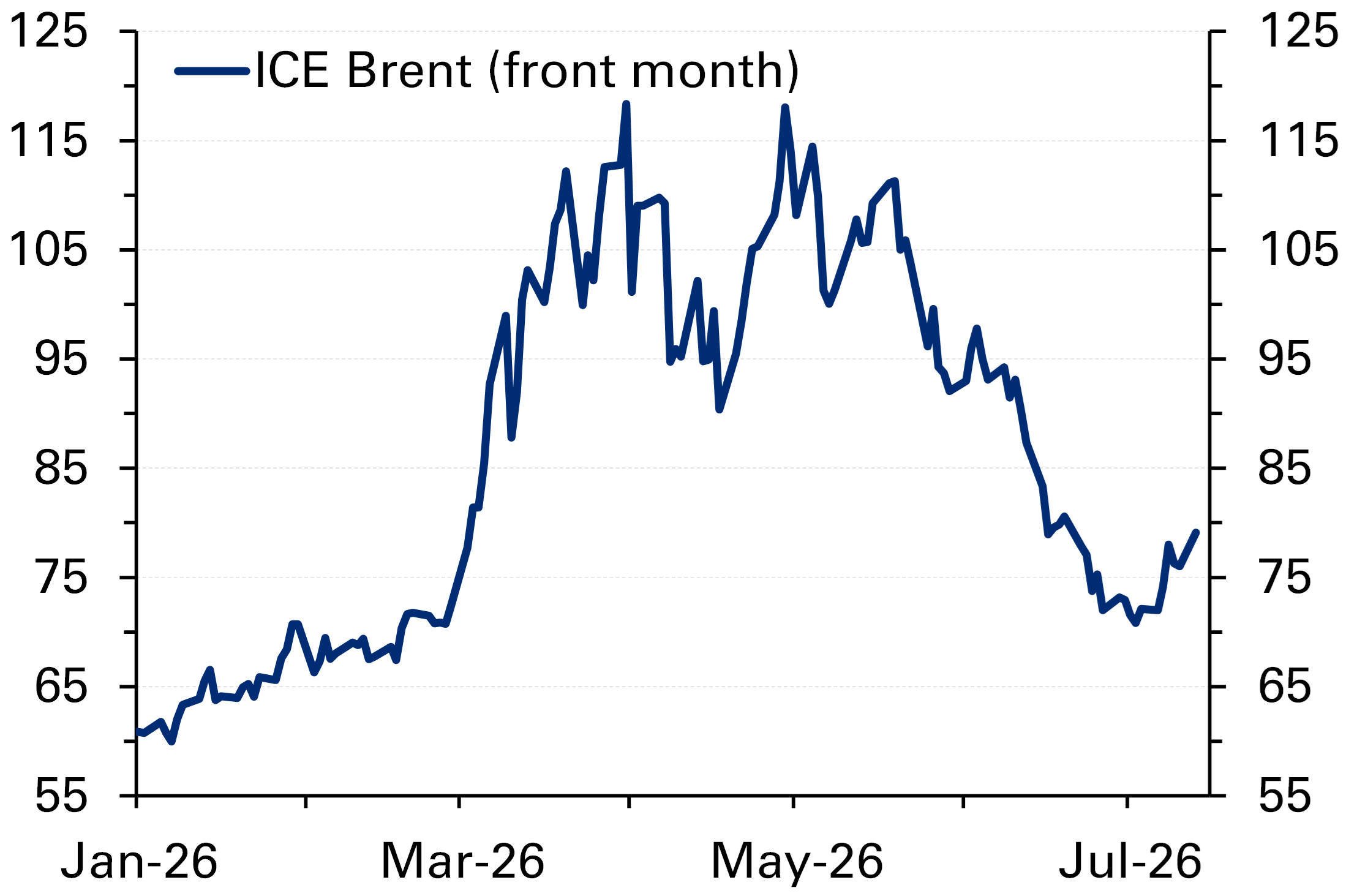
Oil: Brent opens higher after weekend spike in US-Iran hostilities. Brent crude futures opened higher this morning in Asian trading, ticking up by around 4% to just over $79/bbl at the time of writing as hostilities between the US and Iran continued to escalate over the weekend. This follows a gain of 5.4% w/w last week. Both sides have expanded military operations on Saturday and Sunday, with the IRGC claiming responsibility for strikes that included an offshore oil facility in Kuwait, raising concerns over the security of energy infrastructure across the Gulf and the risk of wider supply disruptions. That said, the fact that Brent has not breached the $80 level yet suggests that the market still views the tit-for-tat strikes as still operating within rather than beyond the boundaries of the June peace deal, albeit an increasingly fragile one. The IRGC’s announcement of the closure of the Strait of Hormuz until further notice is only likely to stoke market anxiety further, however. Shipping data and media reports indicated an absence of vessels transiting the Strait with active AIS transponders, although some traffic may still have occurred with tracking systems switched off. Regardless, the elevated security risks are likely to have weighed heavily on vessel movements through the critical waterway. Meanwhile, the International Energy Agency (IEA), in its latest monthly oil market report, improved slightly its oil demand outlook for 2026, with consumption now expected to contract by 1 mb/d rather than by 1.12 mb/d as per its June forecast. For 2027, growth is pegged at 2 mb/d, supported in part by pent-up demand once conditions normalize. On the supply side, the partial recovery in Middle East exports during June lifted regional crude flows by 6.5 mb/d m/m to 16.1 mb/d, although this remained roughly 8.3 mb/d below February levels. As a result, the IEA now expects global supply to decline by 3.7 mb/d this year, a smaller drop than previously anticipated, before rebounding by 7.5 mb/d in 2027. Overall, the IEA's projections imply a global supply deficit of around 900 kb/d in 2026, before swinging to a surplus of 4.6 mb/d next year as regional exports recover. However, the agency notes that this outlook is heavily dependent on a lasting US-Iran peace agreement and the effective reopening of the Strait of Hormuz. As far as oil supplies from Kuwait are concerned, according to mees estimates, oil production jumped by more than 1 mb/d in June, from 0.58 mb/d to 1,65 mb/d. While official figures are expected later today in the OPEC monthly oil market report, it seems clear that KPC was able to massively ramp up production in June by more than most were expecting and use its own fleet of tankers (KOTC) to navigate the Strait of Hormuz and supply oil to buyers through ship-to-ship transfers off the Omani coast.
Egypt: Alam El Roum helps push FDI to $13 billion despite portfolio outflows. Egypt’s balance of payments improved during the first nine months of FY25/26, with the overall deficit narrowing slightly to $1.8 billion, supported by stronger foreign direct investment inflows and resilient sources of foreign currency earnings, according to the latest data from the Central Bank of Egypt. The main highlight was a 32.6% y/y increase in net FDI inflows to $13 billion, boosted by large investment projects, most notably the Alam El Roum development project on the North Coast, alongside continued investments in the energy sector. In contrast, foreign portfolio flows remained volatile. The outbreak of hostilities in the Gulf during the first quarter of 2026 triggered significant outflows from Egyptian debt markets, leaving portfolio investments with a net outflow of $4.4 billion during the first nine months of the fiscal year. Meanwhile, the current account deficit widened to $14.6 billion as higher imports pushed the trade balance further into deficit ($14.8bn). Nevertheless, Egypt’s traditional sources of foreign currency continued to provide important support, with workers’ remittances increasing (+32% y/y to $34.9bn), tourism revenues expanding (+14.9% to $14.4bn) and Suez Canal revenues also rising (+22% y/y to $3.2bn).
Global: Fed’s Warsh testimony to Congress, US CPI/retail sales, and China’s Q2 GDP key matters this week. In the US, attention will be on Fed Chair Warsh’s testimony to Congress on Tuesday and Wednesday. CPI inflation for June is due on Tuesday, and consensus estimates for the core rate stand at 0.3% m/m, keeping the y/y increase steady at 2.9%. The Fed will publish its fifth Beige Book of the year on Wednesday, a report about current economic conditions that is published eight times a year. Finally, retail sales for June (Thursday) are seen increasing 0.3% m/m following solid 0.9% growth in May. In the Eurozone, industrial production for May (Wednesday) is projected to increase by 0.3% m/m after inching up 0.1% in April. In the UK, attention will be on May’s GDP (Thursday), which is expected to grow by 0.1% m/m after falling by 0.1% in April. Finally, in China, Q2 GDP growth (Wednesday) is expected to moderate to 4.4% y/y from 5.0% in Q1 while June activity data is seen presenting a mixed picture, with growth in industrial production edging higher to 4.7% y/y in June (+4.5% in May) and retail sales growth remaining in the red, declining by 0.1% y/y after a 0.6% drop in May. Meanwhile, trade data for June is due on Tuesday with both export and import growth projected to remain strong at 18% and 24% y/y, respectively, though easing from May’s readings of 19% and 27%.