
 +965 2292 4888


Daily Economic Update
09.03.2026
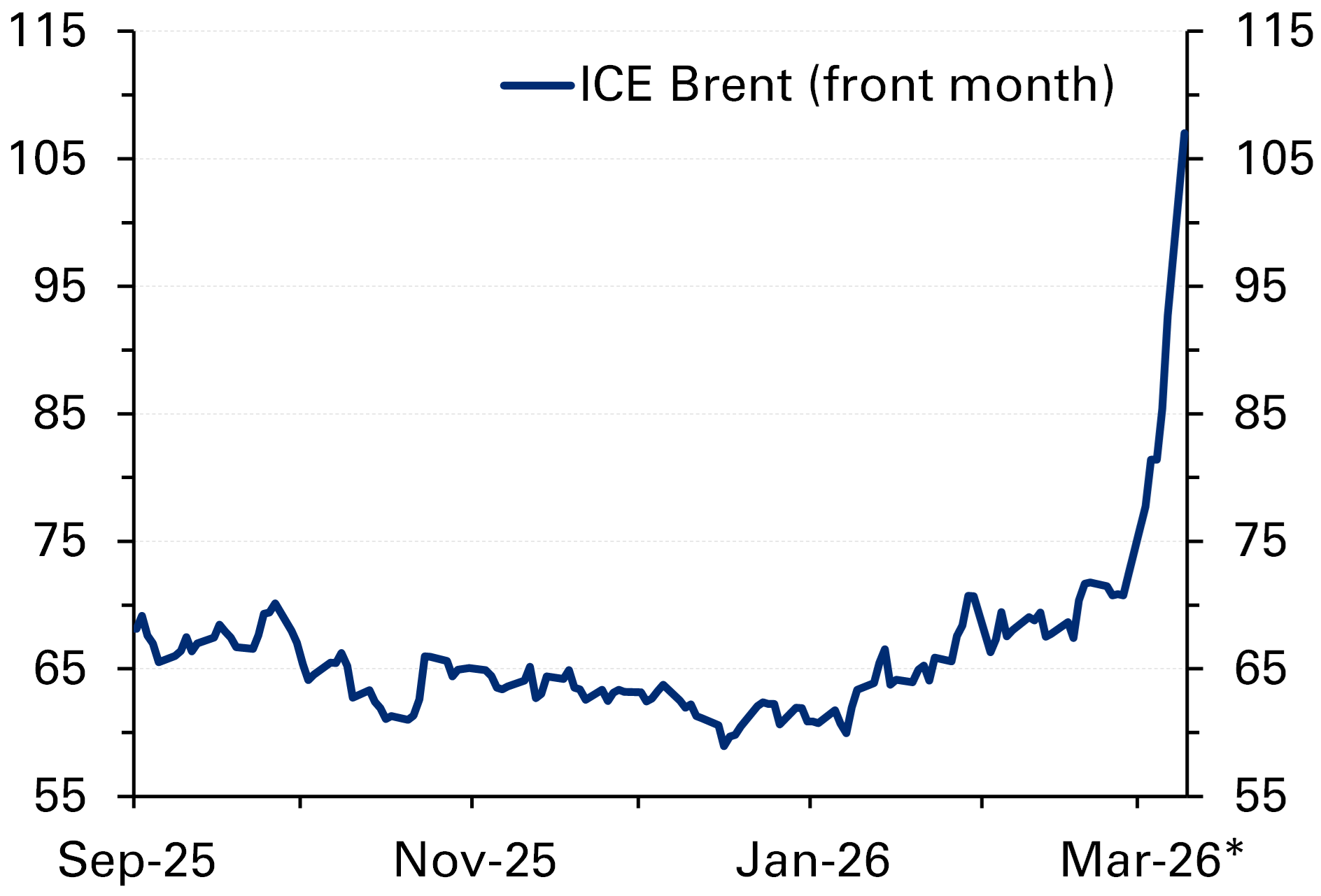
Oil: Brent initially tops $118 as Iran closes Strait of Hormuz amid conflict intensification. Brent futures surged 28% this morning in Asian trading to $118.9/bbl (+53% w/w), its highest level since the Russia-Ukraine conflict kicked off in 2022, as tanker traffic through the Strait of Hormuz remained at a near-standstill and regional hostilities intensify. President Trump sought to downplay the rise in oil prices as being “short-term” that will “drop rapidly”. Over the weekend, Israel attacked onshore Iranian oil storage facilities, as Iran announced hardliner Mojtaba Khamenei, the son of the late Ayotallah Ali Khamanei, as the new supreme leader, undoubtedly a provocative, defiant move against the Americans. This morning’s price action extends last week’s gain—the largest weekly rise in six years—as markets digest the implications to global oil and product prices of a potentially prolonged closure to the Strait of Hormuz. Around a quarter of global seaborne oil trade (20 mb of crude, condensates and refined products) and a fifth of global LNG trade passes through this narrow waterway every day, rendering the Strait a critical chokepoint for global energy supplies. Indeed, the cancellation of tanker insurance and the targeting of vessels attempting to transit the Strait by Iran’s IRGC have resulted in oil flows to the global market being reduced at source. With no outlet for exports, barrels have instead found their way into storage. Iraq was the first to announce a reduction in production, with officials last week saying that output was down by about 1.5 mb/d and could drop by a further 1.5 mb/d within days as the country runs out of storage tanks. Kuwait on Saturday declared force majeure, with media reports indicating that around 100 kb/d has already been taken offline from an estimated 2.6 mb/d of total crude production in February, a volume that could triple over the coming days. Refinery runs were also reduced. Kuwait is thought to have around 32 mb of storage capacity, roughly 12 days’ worth at current production levels. In extremis, KPC would likely reduce production to a level that would be sufficient to cover domestic demand only, which seasonally runs at around 327 kb/d, for mostly fuel oil (for power stations) and gasoline. The UAE also announced that it was paring back offshore production, while Qatar Energy was forced to shut down operations at its Ras Laffan LNG production facility, the world’s largest, after the complex was hit by an Iranian drone. Qatar’s Energy Minister, Saad Al-Kaabi, warned that it would take “weeks to months” for Qatar to restart LNG exports and that all GCC producers would have to sideline production within weeks, which could lead to oil prices spiking to $150/bbl. Saudi Arabia and the UAE do possess alternative export routes, including Saudi Arabia’s 5-7 mb/d East-West pipeline to the Red Sea port of Yanbu and the UAE’s 1.5 mb/d Abu Dhabi Crude Oil Pipeline (ADCOP) to Fujairah. Saudi Arabia has indeed begun rerouting crude overland, with terminal loadings in the first 5 days of March up 60% to 1.9 mb/d from February levels, according to LSEG data. That said, loading capacity at Yanbu, which is theoretically 4.5 mb/d, has never been tested above 2.5 mb/d, equivalent to 36% of Saudi Arabia’s total crude exports. As for the ADCOP outlet at Fujairah, loadings are vulnerable to attack given the area’s proximity to the Strait of Hormuz—only last week were storage depots attacked by Iranian drones. In sum, these exit routes for oil could alleviate some of the pressure on the Strait but are insufficient to accommodate the full volume of both countries’ exports and make a meaningful impact on oil flows to the global market. All told, at least 4 mb/d of supply could be taken offline over the next two weeks if exports through the Strait remain halted, particularly given the limited signs of de-escalation. The key risk for the market remains the duration of the disruption: US President Trump has called for unconditional surrender and has yet to outline a clear diplomatic off-ramp, while Iran appears intent on raising the cost of the conflict for all concerned including its regional neighbours to deter further US and Israeli attacks. Brent futures were paring back some of their earlier gains at the time of writing after G-7 members were reportedly exploring a joint release of oil from reserves.
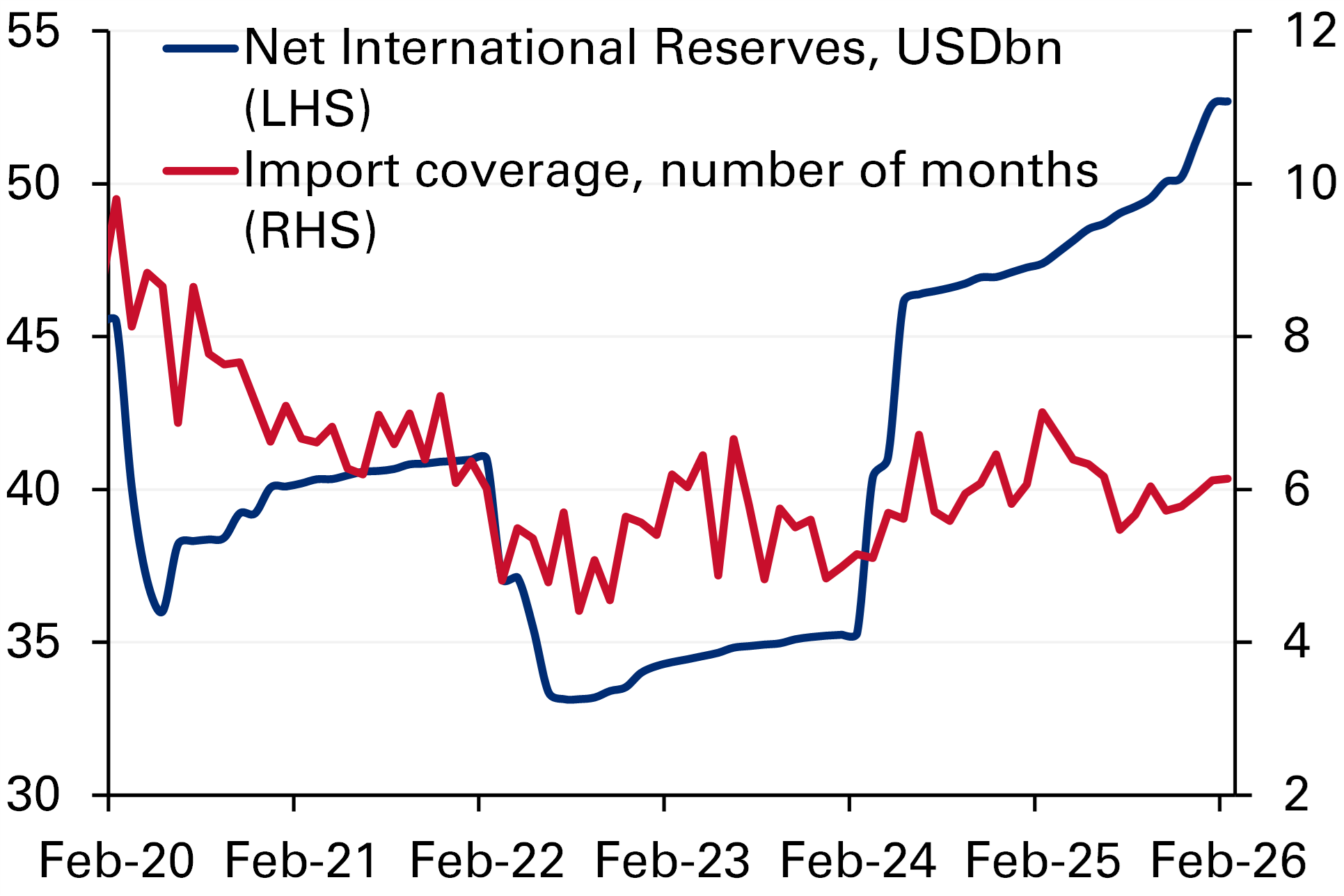
Egypt: CBE reserves set fresh high as the pound weakens amid portfolio outflows. Egypt’s net international reserves climbed to a new high of $52.7 billion at the end of February, according to Central Bank of Egypt (CBE) figures, strengthening the country’s external buffers at a time of heightened regional volatility. The increase was largely driven by a sharp rise in gold holdings, which surged 81% y/y, supported by higher global gold prices. Meanwhile, foreign currency reserves declined 14% y/y to $30.7 billion, reflecting shifts in the composition of reserve assets. Despite recent market pressures, the overall reserve position remains solid, covering around six months of imports, which provides Egypt with a comfortable cushion against external shocks. At the same time, the Egyptian pound weakened to a record EGP 52.2/1 USD, pressured by a renewed wave of portfolio outflows as geopolitical tensions in the region triggered a broader carry trade unwind across emerging markets. Egypt has seen roughly $5 billion in foreign withdrawals from the local debt market since the start of the conflict. Local banks have been supplying the necessary FX liquidity to meet demand, with interbank market volumes reaching $505 million on Sunday, compared with $710 million last Thursday. The banking sector still maintains a relatively strong buffer, with net foreign assets standing at $14.5 billion at the end of January, providing additional capacity to absorb short-term capital flow volatility. Overall, the combination of record international reserves and a positive net foreign asset position suggests that Egypt retains sufficient firepower to manage temporary portfolio outflows and navigate the current external pressures.
China: Inflation jumps to a three-year high and likely to rise further in the months ahead. Consumer price inflation rose to 1.3% y/y in February from 0.2% in January, easily beating expectations of 0.8% to set its highest reading in three years. The rise in prices was largely driven by the Lunar New Year holiday spending, with food inflation increasing to 1.7% y/y from -0.7% in January. Meanwhile, non-food items also contributed to the overall rise, with clothing (+1.9% y/y), healthcare (+1.9%), and education (+2.0%) posting strong increases. Core inflation, which excludes food and energy costs, rose to 1.8% y/y, a pace not seen since March 2019, while producer price inflation came in at -0.9% y/y, a much softer decline compared to January’s -1.4% reading, with rising costs for metals and commodities providing some support for factory-gate prices. February’s inflation readings came higher than expected and inflation is bound to rise further especially if the current energy price shock is sustained. It is worth noting that last week China left its inflation target for 2026 unchanged at around 2.0%.
Global: Military conflict in the Middle East remains the single most important matter globally; key data points this week concern US inflation. The military conflict in the Middle East continues to be the main issue globally. The markets’ reaction has been wild, and if the energy price shock is sustained, the global economy is bound to face a stagflationary shock. In terms of data releases, in the US, CPI inflation for February is due on Wednesday, with consensus forecasts pointing to a higher headline rate (2.5% y/y from January’s 2.4%) but a steady core rate of 2.5%. The Fed’s preferred inflation measure, PCE inflation, will be released on Friday and the street expects an unchanged headline reading of 2.9% y/y in January, but an increasing core rate of 3.1% (3% in December). The second estimate of Q4 GDP is also due on Friday, noting that the first estimate had showed a slower growth of 1.4% (annualized) down from Q3’s 4.4%. In the Eurozone, industrial production for January (Friday) is expected to increase by 0.6% m/m after dropping by 1.4% in December. In the UK, January’s GDP data will be released on Friday, and the consensus forecast is growth of 0.2% m/m, up from 0.1% in December. In China, trade data for January and February (combined) is due on Tuesday. Meanwhile, attention will remain on any new developments from the ongoing National People’s Congress, which concludes on March 12. Finally in Japan, household spending (Tuesday) is seen increasing 2.5% y/y in January after a disappointing 2.6% drop in December.