
 +965 2292 4888


Daily Economic Update
01.12.2025
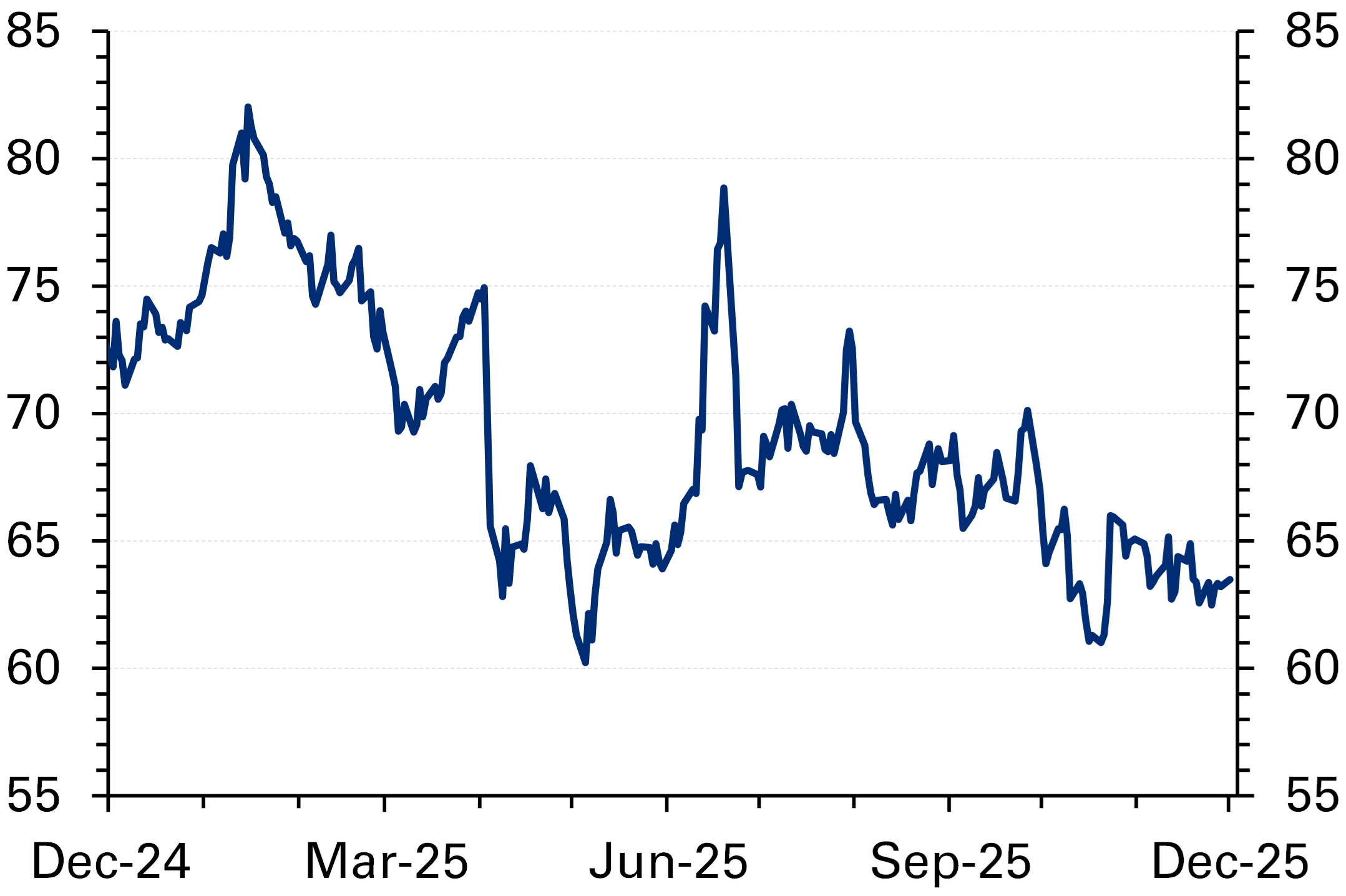
Oil: Prices gain last week; OPEC+ keeps output policy steady. Brent futures closed Friday up 1% w/w at $63.2/bbl as geopolitical risk moved back into view with US moves against Venezuela. Indeed, US President Trump upped the ante against the Maduro regime, announcing that the country’s airspace should be considered closed, which follows his previous announcement of imminent land action and his deployment of the US’s largest aircraft carrier, the USS Gerald Ford, to the Caribbean, an atypical theatre of operations for US strike groups. The heightened tensions threaten disruptions of Venezuela’ crude production, which has been slowly increasing in recent years and which topped 950 kb/d in October. China imports 800 kb/d of this. Meanwhile, OPEC+ ministers and the ‘Group of Eight’ met yesterday and reconfirmed their policy decision of early November to pause unwinding members’ voluntary production cuts for Q1 2026 due to “seasonality”. Markets had largely been expecting this outcome. In the broader OPEC+ meeting, members approved the mechanism to assess Maximum Sustainable Capacity (MSC), which will serve as a reference for 2027 production baselines for all OPEC+ members. The MSC refers to the maximum level of production that can be reached in 90 days and maintained for a year. In early Asian trading this morning, Brent was up, buoyed by increased pressure from the US on Venezuela and Ukrainian drone attacks on the Caspian Pipeline Consortium in the Novorossiysk port in Russia, which predominantly ships Kazakhstan’s crude oil (~1.48 mb/d).
Egypt: Budget deficit widens in July-October (FY25/26) as IMF mission arrives to advance key structural reforms. Egypt’s overall budget deficit widened to 3.2% of GDP during the first four months of FY25/26 (July-October), up from 2.6% of GDP during the same period last year, according to the Ministry of Finance. The widening gap reflects a sharp 37% y/y increase in expenditures to EGP 1.5 trillion (compared to EGP 1.1 trillion a year earlier). Much of this increase was driven by a 54% surge in interest payments (EGP 899 billion) that was largely due to elevated domestic interest rates. In terms of revenues, the increase was a solid 33% y/y to EGP 864 billion, supported by tax revenues that increased by almost 35%. However, this was not enough to offset the strong upward pressure on spending. Against this backdrop, the IMF mission arrived in Cairo to begin discussions on completing the fifth and sixth reviews under Egypt’s Extended Fund Facility. The visit, which runs until December 12, will pave the way for Egypt to access two tranches totaling around $2.4 billion in addition to an estimated $274 million from the Resilience and Sustainability Facility for climate-related financing. Key items on the agenda include the state’s ongoing divestment from economic activities in favor of the private sector, progress on structural reforms, and updates on negotiations to convert GCC deposits into strategic investments. On that, Kuwait is reportedly preparing to partially finance a planned $3 billion investment package by converting part of its deposits at the Central Bank of Egypt, while Saudi Arabia is considering converting some of the $10.3 billion it has in outstanding deposits into investments in real estate and other sectors. The developments outlined above illustrate both the extent of the fiscal pressures that Egypt is navigating and the importance of sustaining reform momentum—particularly as foreign investment conversion and IMF disbursements remain critical to bolstering external buffers and improving overall macro stability.
Japan: BoJ Governor Ueda hints at a possibility of a December rate increase. In a speech this morning, Bank of Japan (BoJ) Governor Ueda hinted that interest rates might be raised at the bank’s 18-19 December meeting. Ueda stated that the BoJ will “consider the pros and cons of raising the policy interest rate” and implied that financial conditions will remain accommodative even if rates were raised given that the real rate is at a “very low level”. Yen weakness – depreciating by 5.9% against the USD since early October – and ongoing elevated inflation that has been above the BoJ’s 2% target for over three years (latest at 3%) are likely drivers for the possible hike. According to media reports, Prime Minister Takaichi is expected to go along with the BoJ’s rate hike plans. Following Ueda’s comments this morning, the yen strengthened against the USD, government bond yields are up across all maturities, and Japanese stocks are down by nearly 2% at the time of writing.
Global: Delayed PCE inflation, ISM PMIs in the US and inflation in the Eurozone key data releases this week. In the US, the delayed September PCE inflation data will be released on Friday, with the consensus forecast indicating a slight uptick in the headline rate (to 2.8% y/y from 2.7% in August) but a steady core rate (2.9%). The ISM PMI surveys for November are due this week and are seen inching down for manufacturing (today) to 48.6 from October’s 48.7 as well as for services (Wednesday) to 52.1 from 52.4. Meanwhile, ADP private-sector monthly job growth (Wednesday) is forecast at 20K in November, down from 42K in October. In the Eurozone, November flash inflation data will be released on Tuesday with expectations for a slight uptick in the headline rate (to 2.2% y/y from 2.1% in October) and the core rate (2.5% from 2.4%). Retail sales for October are due on Thursday and are forecast to inch up 0.1% m/m after a 0.1% drop in September. In the UK, the Nationwide housing price index (Tuesday) is expected to show no change in November after a 0.3% m/m rise in October while the Halifax housing price index (Friday) is more upbeat and is seen increasing 0.4% m/m after a 0.6% rise in October. Finally in Japan, October’s household spending is due on Friday with the consensus expecting a 1% y/y increase, down from 1.8% in September, extending the higher spending to a six-month streak.