
 +965 2292 4888


Daily Economic Update
08.03.2026
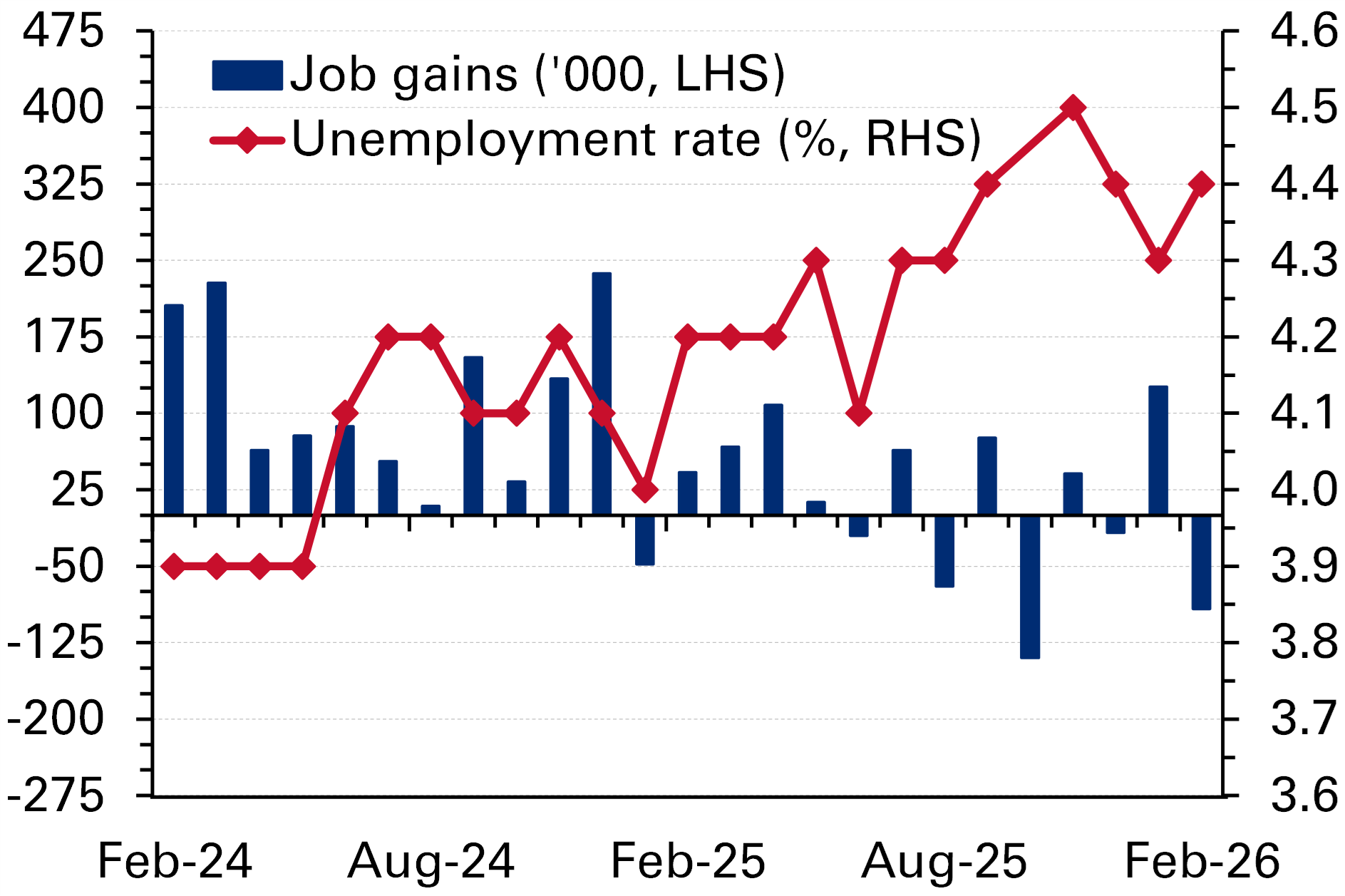
US: February’s jobs report weak but impacted by some one-offs. Non-farm payrolls in February declined by 92K after a solid increase of 126K in January, stalling the progress on stabilization seen in the previous month. Moreover, December’s payrolls were revised downward by 65K to show a decline in employment in that month. Still, February’s figures were adversely affected by strikes by healthcare workers (reflecting a 28K fall in those jobs) and bad weather conditions, which masked the true weakness in the employment scene. The unemployment rate also unexpectedly edged up to 4.4% after ticking down to 4.3% in January and the participation rate dropped to the lowest level in over four years at 62% from 62.1% in January (revised down from 62.5%) as the BLS updated annual population adjustments to the household surveys estimates. Wage growth increased to 3.8% y/y from 3.7% but stayed steady on a monthly basis at 0.4%. While February’s non-farm job report pointed to softness, other recent labor market readings were better, such as the modest levels of weekly jobless claims and the improved employment measures in the latest PMIs surveys. Meanwhile, labor productivity growth in Q4 slowed to a still robust 2.8% (annualized) from a very solid increase of 5.2% in Q3, taking the average growth in 2025 to 2.2% (though easing from 3% in 2024). Separately, retail sales in January fell 0.2% m/m after December’s flat reading, amid bad weather during the month, dragged down by a 0.9% fall in auto sales. However, a narrow measure of sales (excluding auto, gasoline, building materials and food services) increased by a higher-than-expected 0.3%, following an upwardly revised flat reading in December that suggests still resilient household spending. Amid the mixed economic data and the ongoing military conflict in the Middle East and the resulting spike in energy prices, the S&P 500 fell by 1.3% on Friday, and the UST 10 Y bond yield closed on Friday at a nearly one-month high of around 4.15%.
US: Fed commentary highlights diverging views amid mixed economic data and the energy price shock. Fed Governor Christopher Waller emphasized that the Middle East war and its impact on energy prices would be temporary on headline inflation, stating “about policy going forward, this is unlikely to cause sustained inflation,” while he preferred to look at core consumer price inflation when deciding on policy actions. Cleveland Fed President Beth Hammack (an FOMC voting member) mentioned that “policy should be on hold for quite some time as we see evidence that inflation is coming down and the labor market stabilizes further,” but also saw “two-sided risks to rates.” Boston Fed President Susan Collins (non-voting) also preferred to keep interest rates on hold for “sometime.” San Francisco Fed President Mary Daly (non-voting) expressed disappointment with the latest jobs data, saying “the hopes that the labor market was steadying, maybe that was too much.” Chicago Fed President Austan Goolsbee (non-voting) also echoed similar views, characterizing the jobs data as “a tough miss,” and highlighting that “if you got several months like that, that’d be a concerning spot for the labor market.” These diverging views about the labor market and inflation underscore that the incoming Fed Chair Kevin Warsh (if confirmed by the Senate) will face significant resistance from other Fed officials if he aggressively tries to push the administration’s agenda of lower interest rates.
Eurozone: Final Q4 GDP growth revised down to 0.2% q/q and retail sales up by a resilient 2% y/y in January. Final Q4 GDP growth was revised down to 0.2% q/q from an earlier estimate of 0.3%. On an annual basis, GDP expanded 1.2% in Q4, down from 1.4% in Q3. For full-year 2025, GDP increased by 1.4%, up from 0.9% in 2024. Separately, retail sales dipped by 0.1% m/m in January, following a 0.2% increase in December (revised up sharply from a 0.5% drop), missing expectations of a 0.3% rise. The decline in January was driven by a 1.1% m/m drop in automotive fuel sold in specialized shops and a 0.2% decline in non-food items, while food, beverages, and tobacco increased by 0.3%. The m/m decrease reflects some weakness in consumer sentiment, even before the recent spike in energy costs. However, putting aside the m/m volatility, on an annual basis, retail sales increased by 2.0% in January (+1.8% in December), indicating a generally robust level of consumer spending.
UAE: ADNOC announces onshore operations to continue while managing offshore output. The Abu Dhabi National Oil Company (ADNOC) has announced that onshore operations will continue while offshore operations are being actively managed to address storage constraints, preserve operational flexibility, and ensure the safety of the infrastructure in response to shipping disruptions in the Strait of Hormuz. The company has also announced that it will continue to utilize export routes that bypass the Strait of Hormuz and draw on its international storage network to maintain supply continuity. The Abu Dhabi crude oil pipeline (Habshan-Fujairah pipeline) transports oil from Abu Dhabi's fields directly to the port of Fujairah and has a capacity of 1.5 mb/d (roughly 44% of the country’s January crude oil output of 3.4 mb/d). This strategy reduces the likelihood of large-scale production cuts in the short run but the port of Fujairah itself remains vulnerable given its proximity to the Strait of Hormuz; storage depots in the vicinity were attacked only a few days ago.