
 +965 2292 4888


Daily Economic Update
19.10.2026
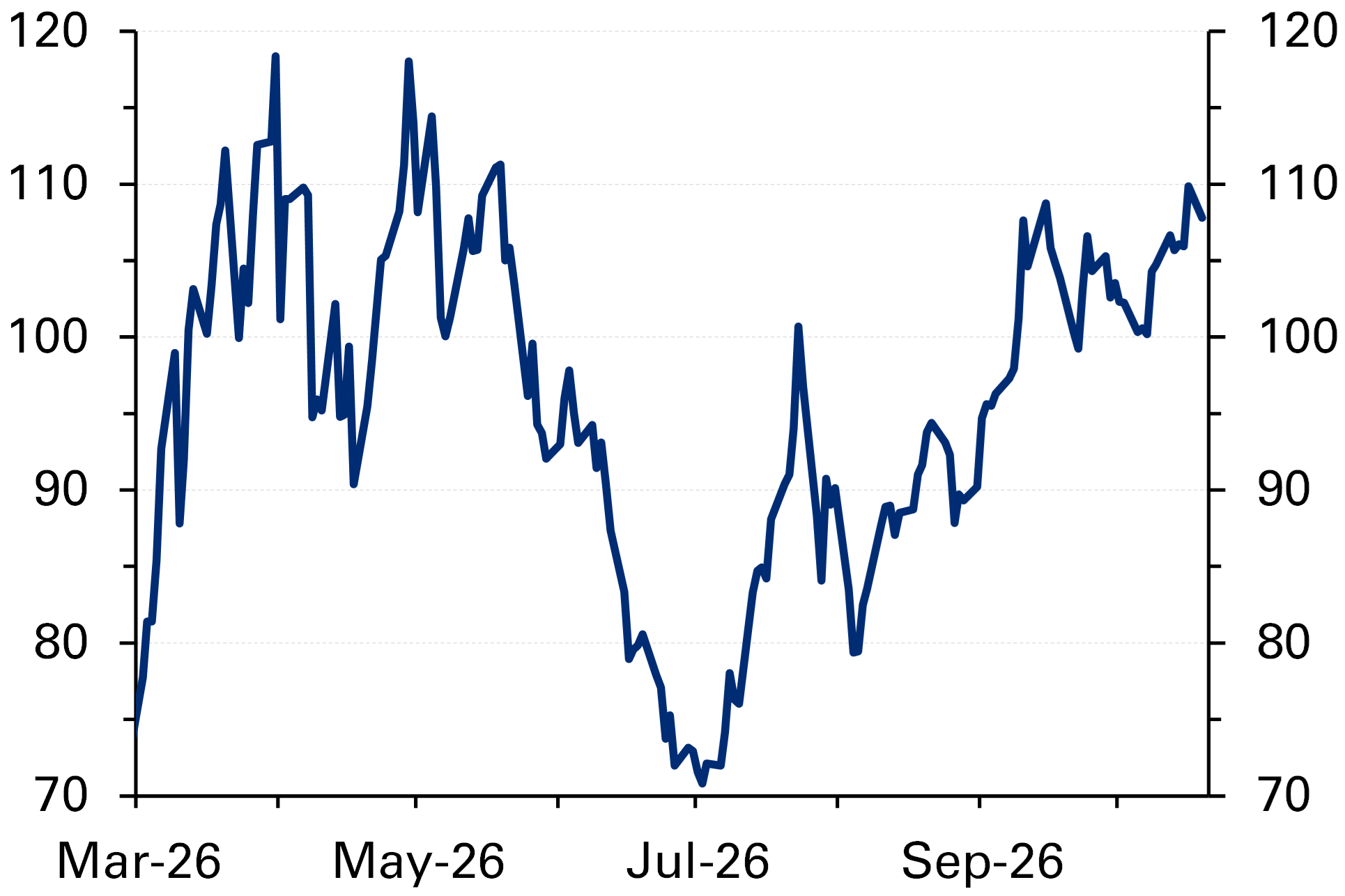
Oil: Prices fall from 5-month highs in early Monday trading after US-Russia diesel deal. Brent futures opened lower this morning in Asian trading, falling almost 2% from Friday to around $107.8/bbl at the time of writing as markets reacted to the news that President Trump had secured a diesel export deal with President Putin and delayed the imposition of further energy sanctions on Russia. The drop sees Brent falling from its close on Friday at a 5-month high of $109.9/bbl (+4.9% w/w), as escalating geopolitical tensions in the Middle East and renewed disruptions to refined product markets tightened the global energy balance. A spike in Iranian attacks on vessels transiting the Strait of Hormuz was a key driver of price gains, with at least nine incidents reported during the week. According to tanker tracking data firm Kpler, the escalation has weighed on Gulf crude flows and reinforced concerns over the security of regional export routes. Continued Houthi attacks on Saudi infrastructure was another factor, with the port of Yanbu, Aramco's headquarters and, though unconfirmed, the East-West pipeline all targeted. Outside the Gulf, the breakdown of the Russia-Ukraine "energy ceasefire" further tightened refined product markets. Ukrainian attacks on Russian refineries continued, nevertheless, defying the Trump administration’s calls and its effort to alleviate the US diesel shortage. Moreover, it was reported last week that the US administration is considering waiving sanctions on Russia's "shadow fleet" due to concerns about rising freight costs and tight product supply. These concerns were echoed in the IEA's latest monthly report, which warned that diesel shortages could extend into next year. Although the agency agreed to release an additional 20 mb of diesel from strategic reserves, the volume was below the 50 mb initially discussed and no timetable was provided. Meanwhile, EIA data showed US commercial crude inventories falling by 8.6 mb in the week-ending 9th October, the largest decline since February, reflecting weather-related disruptions in the Gulf of Mexico and reduced imports amid elevated oil prices.
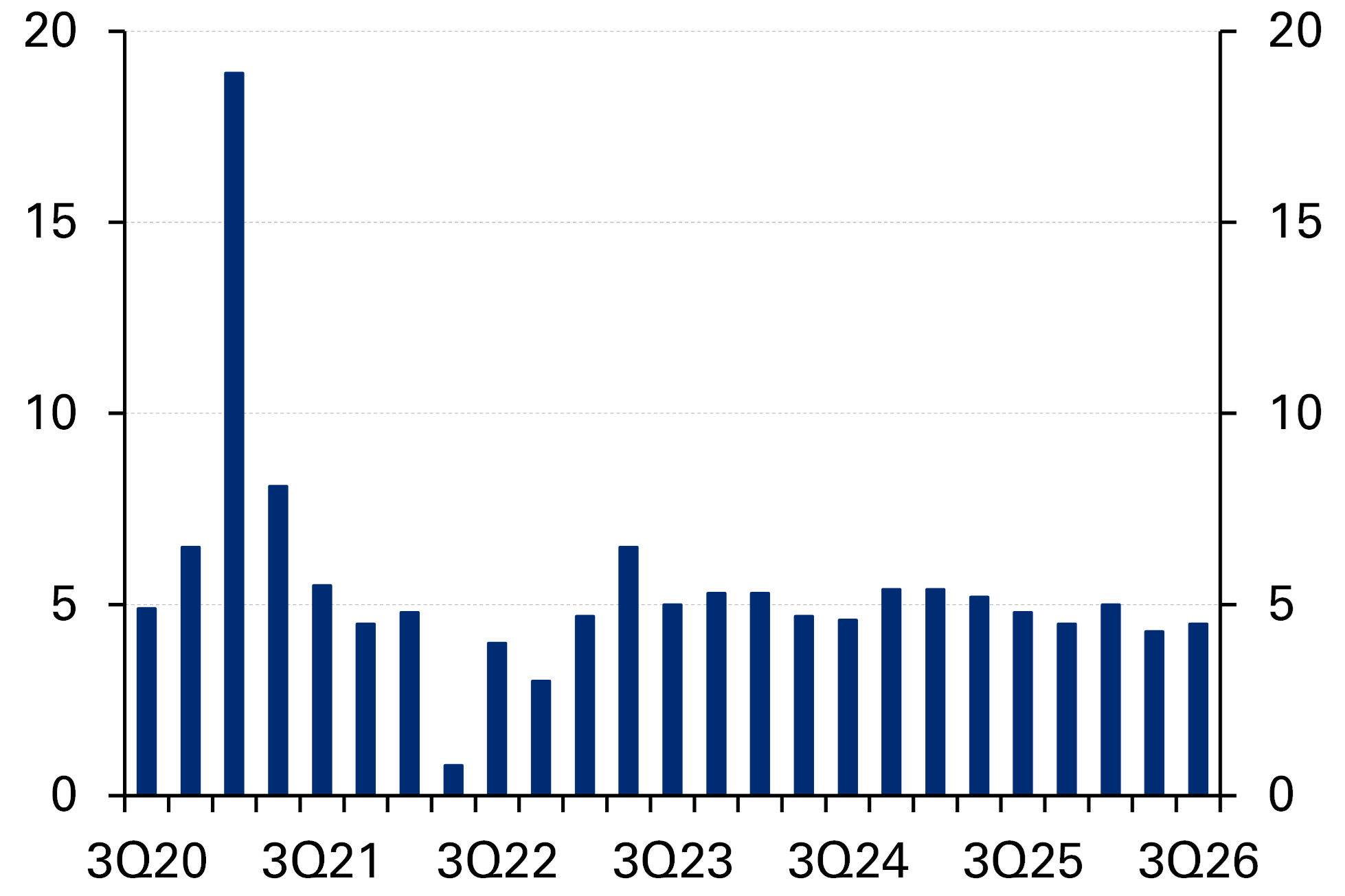
China: September’s improvement pushes up GDP growth to a higher-than-expected 4.5% y/y in Q3. China’s economy expanded by 4.5% y/y in Q3, accelerating from 4.3% in Q2 and slightly exceeding expectations (+4.4%). This was helped by an improvement in activity levels in September, following a relatively weak July and August. Growth was supported by strong external demand, with exports of AI-related components, high-tech goods and electric vehicles remaining key drivers. However, the overall growth backdrop remains uneven, with domestic demand remaining generally muted and the property sector continuing to be a key drag on activity. September data showed industrial production rising 5.5% y/y, up from 5.2% in August, while retail sales increased 1.1% y/y (0.4% in August), both beating expectations. Fixed-asset investment remained in contraction at 7.2% y/y in 9M2026, unchanged from August and underscoring persistent weakness in investment spending, though it came slightly better than expected. Meanwhile, new home prices remained under pressure, falling 2.8% y/y in September, although the pace of decline has moderated steadily since a recent trough in May. House prices have been on a downtrend trend for more than three years, continuing to be a big drag on confidence levels. The latest data suggests that while growth (+4.6% in 9M2026) remains on track to meet the government’s target range for the year (4.5%-5.0%), the recovery continues to rely heavily on external demand and manufacturing, with domestic demand and investment remaining the economy’s principal weak spots. The latest stimulus measures unveiled in late September and early October should ensure that full-year 2026 growth will land within the government’s target range.
Global: Global flash PMIs for October and UK/Japan September inflation key data releases this week. In the US, it is a relatively quiet week in terms of data releases. The S&P Global flash PMIs for October will be released on Friday, and the consensus forecast indicates slightly softer but still solid manufacturing (at 55.6 from Septembers’ 55.9) and services (57.9 from 58.8) readings. In the Eurozone, the flash October PMIs are due on Friday where the manufacturing PMI is expected to ease slightly to 52.8 (from 52.9 in September), and the services one to 52.8 (from 53.0). The flash consumer confidence index for October (Thursday) is expected to improve marginally to -16.0 from -16.5 in September. In the UK, CPI inflation for September (Wednesday) is seen rising to 3.4% y/y from 3.1% in August, while the core rate is expected to inch up to 2.7% from 2.6%. The unemployment rate for the June-August period (Tuesday) is forecast to tick up to 5% from 4.9% in May-July, while total pay growth is expected to soften to 3.8% y/y from 3.9%. Meanwhile, the street estimates the flash October PMIs (Friday) to fall slightly to 51.8 from September’s 51.9 for manufacturing and to 51.8 from 52.1 for services. In China, on Tuesday, the central bank is expected to keep rates unchanged, the one-year LPR at 3.0% and the five-year LPR at 3.5%. Finally in Japan, September’s trade data is due on Wednesday with the deficit expected to be ¥250 billion, noting that exports and imports have been increasing by double digits since March. Meanwhile, September’s inflation is due on Friday with the core rate seen accelerating to 2.1% y/y from 1.7% in August, the highest pace so far this year.
UAE: Dubai’s GDP contracts sharply in Q2. Dubai’s real GDP is estimated to have weakened significantly in Q2 2026, contracting by 6.6% y/y and a sharp reversal from growth of 2.4% in Q1. This is implied from the official data for the six months ending-June, which show that GDP growth came in at -2.3% y/y. The downturn coincided with extension of the US-Iran conflict in Q2, which weighed on trade, logistics, investment sentiment, and travel-related activity (overall visitor arrivals to Dubai in 8M26 were down 44% y/y to around 7mn). The decline was seen across key sectors, including transportation & storage (-7.4% y/y), wholesale & retail trade (-6.0%), real estate (-2.5%), and manufacturing (-0.9%), as reported by Dubai media office. In contrast, several other sectors remained resilient, led by human health and social work (+14.3%), financial & insurance activities (+8.8%), electricity, gas and water (+5.4%), information & communication (+2.7%), construction (+2.4%), and education (+1.2%). As for Q3, the economy may exhibit some improvement from the very steep decline recorded in Q2 as regional hostilities somewhat abated. The broader outlook over Q4 2026 and beyond depends on the course of the conflict.
Egypt: External debt edges higher in Q2 2026 as $61 billion in repayments loom. Egypt’s external debt rose by $1.7 billion q/q to $166.5 billion in Q2 2026, up from $164.8 billion in Q1, according to World Bank data. Debt held by other sectors increased to $23.4 billion from $21.4 billion, while government, central bank and commercial bank debt declined slightly. The more pressing challenge is the $60.9 billion in external debt repayments due in FY26/27, including $53.8 billion in principal and around $7.1 billion in interest. The central bank accounts for the largest share at $21.7 billion, followed by commercial banks at $16.1 billion, other sectors at $12.9 billion and the government at $10.3 billion. Repayments are concentrated in the first half of the fiscal year, with $19.4 billion due in Q1 and $17.3 billion in Q2. Around $19.1 billion of these obligations relate to deposits and currency liabilities owed by the central bank, most of which are held by Gulf countries. Egypt is negotiating with Saudi Arabia to renew $5.3 billion in deposits due in October, although the renewal period has yet to be agreed. Saudi Arabia also holds a separate $5 billion in short-term deposits at the central bank, which are renewed annually.