
 +965 2292 4888


Daily Economic Update
01.03.2026
US/Middle East: US and Israeli strikes on Iran kill Supreme Leader and trigger broader regional fallout. The US and Israel’s commencement of military strikes across Iran on Saturday morning resulted in the death of Iranian Supreme Leader Ayatollah Ali Khamenei as well as various senior leaders of Iran’s defense establishment. Indications at present are that the conflict may be time-limited, especially given the large but predominantly naval-based nature of the US military build-up in the region. In addition, it is unlikely that President Trump will want the confrontation to drag. He may put an end to it in a matter of days if he thinks that he can renegotiate and get major concessions from the Iranians, now that the regime has been dealt a significant blow. However, Iran’s retaliatory strikes targeting not just US military but broader civilian buildings and infrastructure in all GCC countries (other than Oman) signal its willingness to do wider damage and escalate the complexity of the war much further. Moreover, although Khamenei – leader for 37 years – has now been removed, this alone will not be considered the ‘regime change’ that the US and Israel are supposedly seeking, which is likely to require a more comprehensive dismantling of the Iranian higher command and its military and geopolitical ambitions. The economic fallout of the conflict on the Gulf region will be tied to how long the conflict persists, the severity of any infrastructure damage, the impact on investor sentiment and any disruption to oil trade via the Strait of Hormuz that curbs regional energy exports and pushes oil prices up. Iran claimed to have “effectively” closed the Strait yesterday but it will remain to be seen over coming days if this claim is accurate and more importantly long-lasting, or posturing in an attempt to trigger further alarm (see below).
Oil: US-Israel strikes on Iran to roil global oil markets. Oil markets are set for volatility upon the open of trading tomorrow following the US–Israel led strikes on Iran. Crude flows through the Strait of Hormuz, which handles around 20% of global oil trade, have reportedly already seen disruption: S&P Global reports that tanker traffic fell by 50% on Saturday compared to the previous day. Iran’s semi-official Tasnim news agency further announced that the Strait had been effectively “shut down.” Among Gulf energy exporters, alternative, lower capacity trade routes are available only to Saudi Arabia and the UAE. Still, a prolonged shutdown of the Strait seems unlikely given the overwhelming US aerial and naval presence in the Gulf, though fleet performance and operational continuity may deteriorate if the conflict drags on. Beyond chokepoint risks, direct disruptions to Iranian crude supplies could also push prices sharply higher. Iran produced 3.1 mb/d in January, according to OPEC secondary sources, exporting about 1.6 mb/d. The loss of these volumes would leave the global market with very limited spare capacity. Our current estimates put OPEC+ spare capacity at roughly 3.5 mb/d, most of which lies within the GCC producers. Given all these developments, it seems possible that Brent could rise from Friday’s close of $72.5/bbl toward $80/bbl upon the start of trading tomorrow, but the eventual impact will depend heavily on the nature and duration of the conflict. A greater risk would emerge if Iran or its regional proxies strike oil production facilities within the GCC, which could push prices up substantially further as markets price in both immediate supply losses and the potential for prolonged regional instability. Against this backdrop, the OPEC-8 are scheduled to meet later today, though it remains unlikely that the alliance will raise production above the previously agreed 137 kb/d hike.
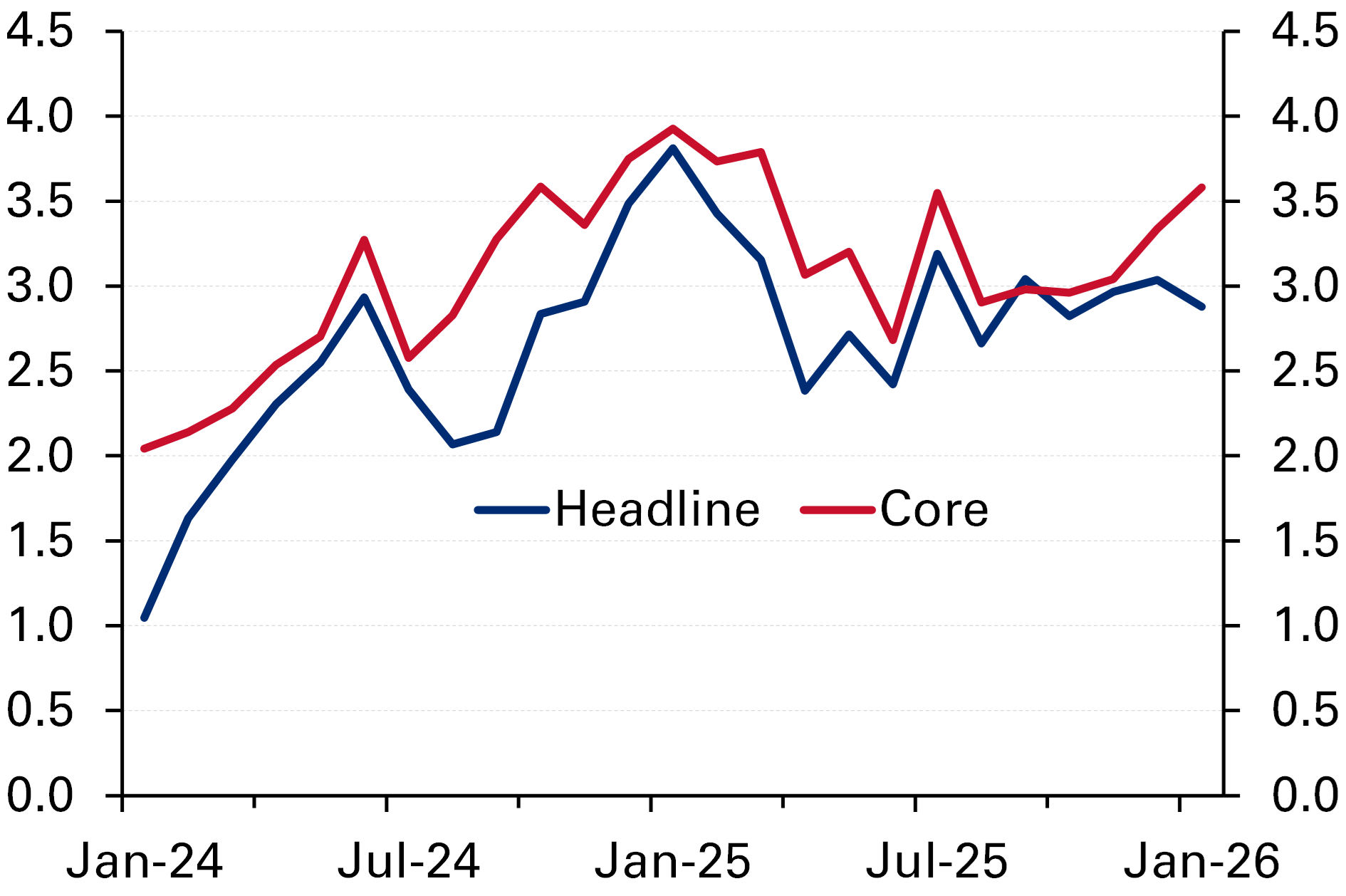
US: PPI inflation much hotter than expected for the second straight month, signaling bumpy CPI inflation progress. PPI inflation in January slowed less than expected to 2.9% y/y from 3% in December, while the core rate accelerated to a 10-month high of 3.6% from 3.3%, mainly driven by higher wholesale services costs. Within services, margins received by wholesalers and retailers climbed by 2.5% m/m as businesses looked to further pass higher input costs to end consumers. While recent CPI inflation prints have been mild (partly due to data distortions given the government shutdown in October-November), a much hotter than expected PPI inflation, and for the second straight month, signals that the path towards the Fed’s 2% consumer price inflation goal will be bumpy, which may drive caution from the FOMC over the coming period. Meanwhile, President Trump, in his annual State of the Union address, didn’t delve much into new or upcoming economic policies, but reiterated his resolve to recreate the tariff wall using other legal mechanisms that don’t require congressional approvals. Finally, after the US and Israel launched attacks on Iran, Democrat lawmakers pressed for a vote in Congress to limit the president’s war powers without Congressional support. However, given swift developments in Iran, procedural hurdles to agree on any congressional measure and given the president’s veto authority, this is unlikely to have any immediate impact on the current Middle East situation.
Japan: Tokyo inflation nudges up; retail sales and industrial production improve. Tokyo’s consumer price inflation ticked up to 1.6% y/y in February, after recording a nearly four-year low of 1.5% in January. However, core inflation (excluding fresh food) decreased for a third consecutive month, falling to a 16-month low of 1.8% y/y but slightly higher than consensus expectations of 1.7%. Meanwhile, retail sales growth bounced back to hit a seven-month high in January (+1.8% y/y), beating consensus estimates of a 0.4% decline. Elsewhere, industrial production increased 2.2% m/m, much lower than consensus estimates of a 5.3% rise but improving from December’s 0.1% decline. Overall, recent data shows that economic conditions seem to be improving, with PM Takaichi still expected to submit her consumption tax suspension bill later this year. The IMF’s recent article IV report on Japan noted the resilience of the economy, although warning against the fiscal costs of reducing or suspending the consumption tax, given Japan’s already high public debt levels.
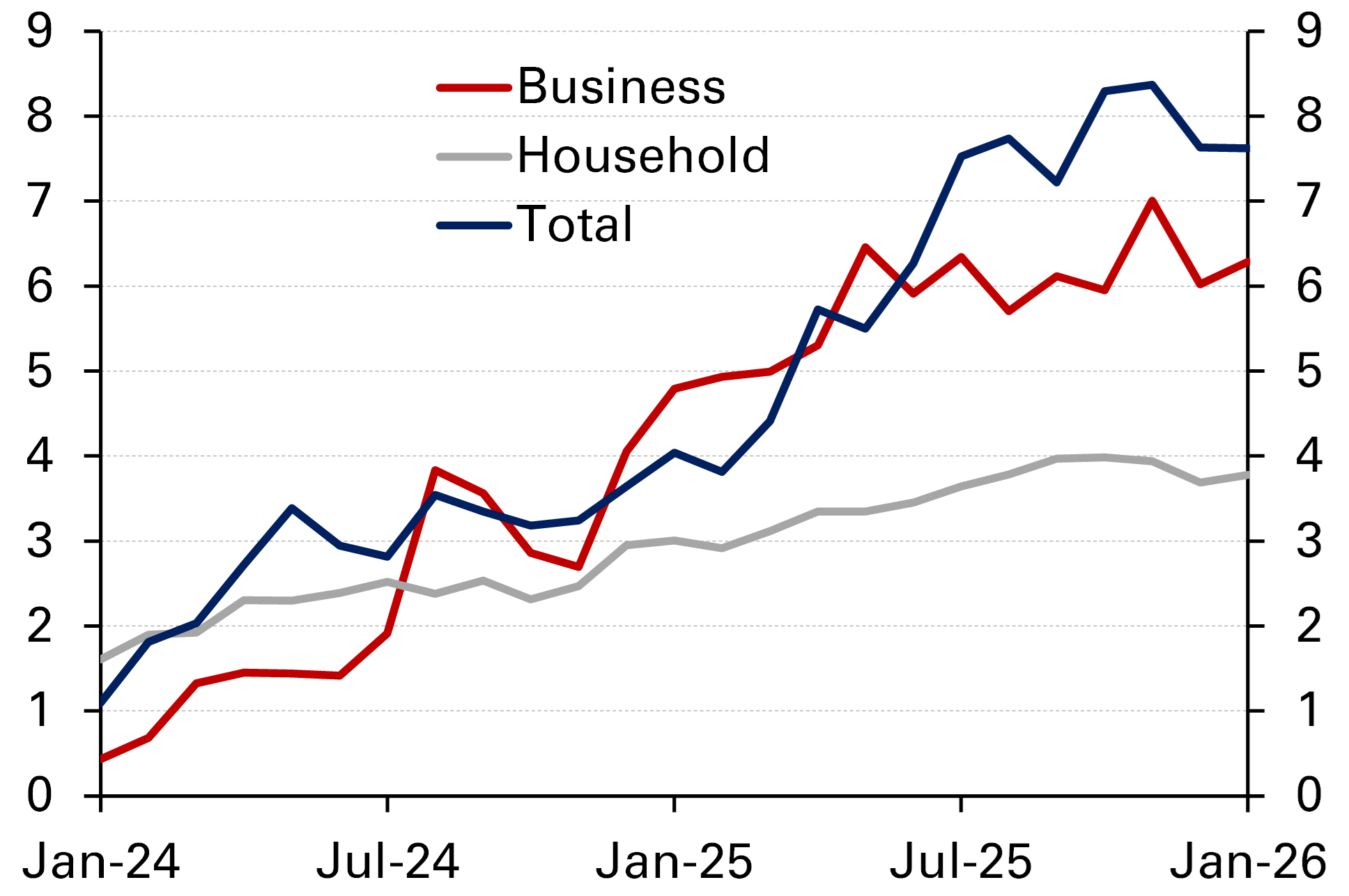
Kuwait: Solid business lending activity at the start of 2026. Domestic credit rose by 0.2% m/m in January 2026 (0.2% in December), keeping the annual growth rate steady at 7.6% y/y. Underlying growth was firmer, as both lending for securities purchases (-1.4% m/m) and credit to banks/financial institutions (-3.9% m/m) continued to decline. Growth remained driven by business credit, which rose a solid 0.9% m/m (6.3% y/y) after the monthly decline seen in December (0.5%). The pickup was led by public services (5.9% m/m), construction (3.2% m/m), and trade (1.4% m/m). Credit to real estate also increased by 0.8% m/m, logging its strongest monthly increase since September 2025. Meanwhile, household credit posted a moderate 0.3% m/m gain (3.8% y/y), improving from December’s flat reading. Overall, bank lending made a solid start to the new year. Meanwhile, credit to non-residents rose 5.1% m/m (December 4.3%), pushing annual growth to a sharp 43% y/y. On the other side, residents’ deposits grew by 0.8% m/m in January (0.4% in December), supported mainly by a strong rebound in government deposits, which rose 9.5% m/m after three consecutive m/m declines. Private sector deposits were broadly stable (0.1% m/m), while public sector deposits growth softened from December’s 3.1% m/m to 0.2% m/m. Annual deposit growth held steady at 4.7% y/y, with private sector deposits at 3.8% y/y, public sector deposits moderating to 21% y/y, and government deposits still down by -11.8% y/y, albeit improving from December’s -21%. Within private sector KD deposits, time deposits increased by 0.8% m/m while CASA fell by 1% m/m and foreign currency deposits growth slowed to 0.6% m/m (2.2% in December). Non-resident deposits rebounded strongly (7.4% m/m) after December’s decline (-1.4%m/m), lifting annual growth to a huge 90% y/y.