
 +965 2292 4888


Daily Economic Update
11.11.2026
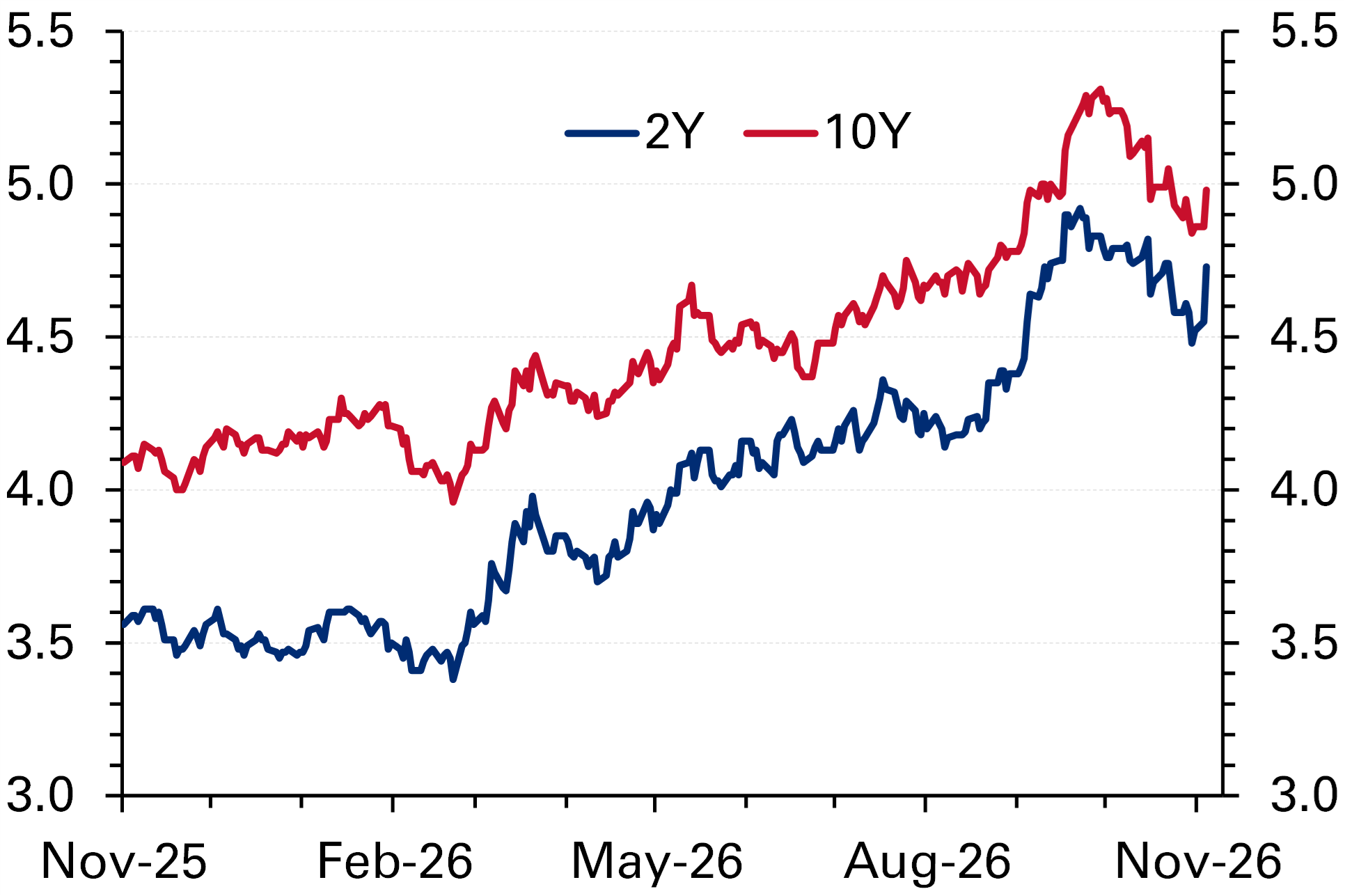
US: October’s CPI inflation hotter than expected; bond yields surge as more Fed officials pitch to tighten monetary policy further. CPI inflation in October came in above consensus forecasts at 0.4% m/m after 0.6% in September as energy prices rose by 0.7%, though at a much softer pace versus September’s 5.2%. Core inflation stood at 0.3% m/m for the third consecutive month, higher than the street’s forecast of 0.2%. Core CPI has now risen by an annualized rate of 3.75% over the last three months. The BLS didn’t report y/y figures due to the unavailability of comparable data in October 2025 given the government shutdown. As we have written before, the argument for not hiking rates in October was thin and the fact that a 50bps hike is now a possibility for the December meeting (see below) makes the skip in October look like a mistake. Meanwhile, Chair Warsh’s communication strategy has left a void that is unsurprisingly being filled by the other FOMC members. This ongoing Fedspeak is shifting the market’s expectation about future interest rate decisions, which risks leaving Warsh cornered ahead of FOMC meetings, highlighting the drawback of his communication strategy. Persistently high inflationary pressures were seen across most CPI categories including shelter (0.3% m/m), non-durable goods (0.5%), recreation (0.8%), and transportation services (0.8%). However, new and used vehicle prices fell 0.5% after two months of rises. A key services gauge that excludes energy and rents stood at an elevated 0.4% m/m, in line with September. October’s CPI print indicates that price pressures are broadening beyond energy that should drive a hawkish Fed stance ahead. Several Fed officials expressed higher inflation concerns yesterday, noting the need to raise interest rates further. Governor Waller, just ahead of the release of the CPI data, stated his preference to support a larger 50 bps rate hike at the FOMC’s December meeting if core inflation remained at or above 0.3% m/m, saying “hiking only 25 bps would put our credibility at risk, a risk I am not eager to take.” But so far, Waller appears to be the only Fed official calling for a bigger 50 bps increase in December. Governor Bowman noted “there is still work to do to bring inflation closer to 2%,” given persistent inflation. Two regional Fed presidents who are FOMC voting members in 2026 also saw the need for additional tightening in monetary policy. Lorie Logan (Dallas) stated that “the FOMC needs to implement at least two more 25 bps rate increases,” and Anna Paulson (Philadelphia) mentioned that “further gradual tightening seems appropriate.” Kansas Fed president Jeff Schmid (non-voting in 2026/2027) saw the current policy stance being in fact accommodative. These remarks follow comments from several other Fed officials who expressed similar concerns, which, along with hotter CPI data, boosted the market expectations for further rate hikes. The futures market currently signals around 85% probability of a 25bps rate increase at the December meeting, and a 15% probability for a 50 bps hike. The bond markets also came under heavy selling pressure yesterday, with yields rising across the curve as 2Y yields jumped by almost 20 bps, while 10Y ones rose by more than 10 bps.
Japan: Reuters Tankan index signals sustained business confidence. Japan's November Reuters Tankan survey, a leading indicator of the quarterly Tankan survey, points to improving business sentiment, highlighting the economy's resilience despite rising borrowing costs. The manufacturers' index rose to +27 in November from +22 in October, its highest level since August 2021, as robust semiconductor demand underpinned optimism. Meanwhile, sentiment among non-manufacturers edged up to +35 in November, the highest since June 2018. Looking ahead, manufacturers expect confidence to improve further, with the index projected to rise to +28 over the next three months. Despite the optimistic outlook, respondents identified rising input costs, inflation, and the possibility of higher interest rates as factors that continue to weigh on profitability.
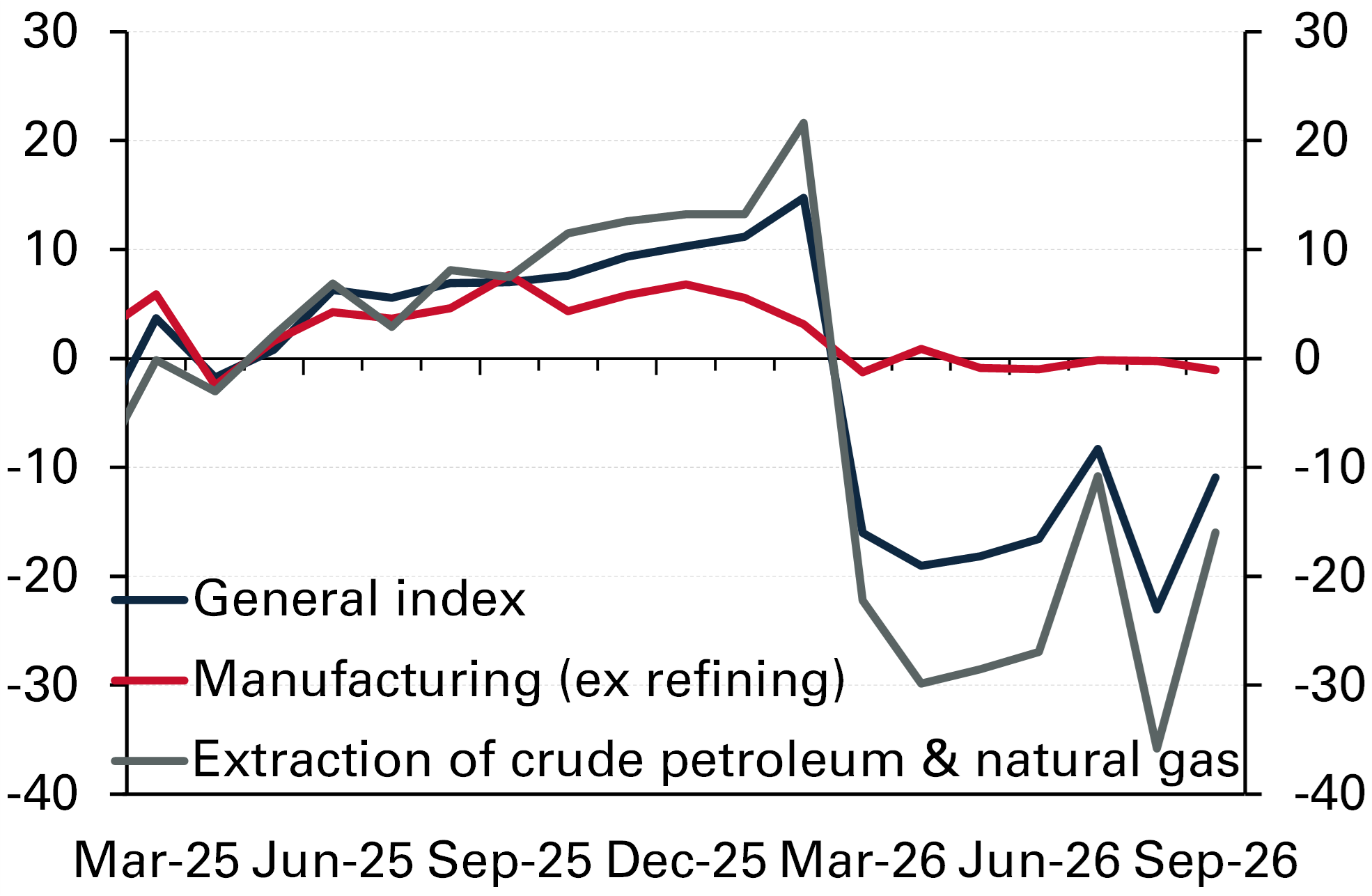
Saudi Arabia: Oil production drives industrial recovery, while non-oil activity remains weak. Saudi Arabia’s Industrial Production Index (IPI) fell by 10.9% y/y in September, a much smaller decline than the 23.5% recorded in August, as oil production began to recover, according to GASTAT. On a monthly basis, industrial production jumped by 15.6%, largely reflecting the rebound in crude output, while non-oil activity remained broadly unchanged. The annual decline was concentrated in the oil sector, with oil activity falling by 15.5% and mining and quarrying by 16%. In contrast, non-oil activity edged up by 0.1%, supported by growth in electricity and gas (6.4%) and water and waste management (7.3%). The monthly recovery was led by oil activity, which increased by 24.7%, while mining and quarrying rose by 29.9%. Saudi crude exports also recovered to around 5.4 mb/d in September, up from 2.45 mb/d in August, following the earlier production cuts and shipping disruptions. Manufacturing output remained under pressure, declining by 5.4% y/y, although it increased by 2.8% m/m. Oil-related industries were the main drag, with coke and refined petroleum products falling by 13.6% and chemicals by 3.8%. Meanwhile, basic metals and beverages recorded growth. Looking ahead, non-oil manufacturers continue to face challenging conditions. Shipping disruptions and higher transport and insurance costs are weighing on export competitiveness, with export orders declining for eight consecutive months. Higher input costs, the planned increase in the minimum wage for Saudi workers from April 2027, and slower construction activity are adding to the pressure. However, stronger domestic demand and increased reliance on locally sourced inputs are providing some support.
Oman: IMF highlights economic resilience and structural reform priorities. According to the IMF’s concluding statement for the 2026 Article IV Mission, Oman’s economy continues to demonstrate resilience amid the ongoing US-Iran conflict, supported by largely unaffected energy infrastructure, robust logistics activity, sound macroeconomic fundamentals, and prudent policymaking. Real GDP growth accelerated in 2025 and remained strong in the first half of 2026, expanding by 3.8%, as stronger hydrocarbon activity offset weakness in some non-oil sectors. Inflation, although rising due to higher food and transportation costs, remained manageable, while fiscal and external positions stayed firmly in surplus, with the fiscal surplus reaching 1.9% of GDP, the current account surplus estimated at 3.7% of GDP, and government debt declining to 30.4% of GDP at the first half of 2026. Looking ahead, the IMF projects GDP growth to accelerate to 4.5% in 2026, driven by stronger hydrocarbon production and continued non-oil sector expansion. The Fund underscored the importance of maintaining fiscal prudence, rebuilding buffers from additional oil revenues, and advancing diversification efforts. It also called for continued progress on financial sector resilience and structural reforms under Vision 2040 to strengthen private sector-led growth and economic competitiveness. The IMF outlook is in line with our view that non-oil growth will strengthen as regional pressures ease and investment under the Vision 2040 development pipeline progresses, while continued efforts to expand hydrocarbon production capacity will further support growth over the medium term.
Egypt: Remittances reach a record $38.2bn in the first nine months of 2026. Remittances from Egyptians working abroad rose by 20.4% y/y to $13 billion in Q1 FY26/27 (July-September), according to the Central Bank of Egypt. On a calendar-year basis, inflows reached a record $38.2 billion during January-September 2026. The continued strength in remittances reflects the recovery in confidence in the banking system following the monetary reforms introduced after the March 2024 exchange rate liberalization, which helped narrow the gap between the official and parallel exchange rates. This confidence has been broadly sustained despite renewed volatility in the pound since the regional conflict began in February, including its recent depreciation to around EGP56/$1. Remittances have consequently become one of Egypt’s most reliable sources of foreign currency. If the current pace of inflow continues, total remittances could exceed $50 billion in 2026.
Download Full Report >