
 +965 2292 4888


Daily Economic Update
27.11.2025
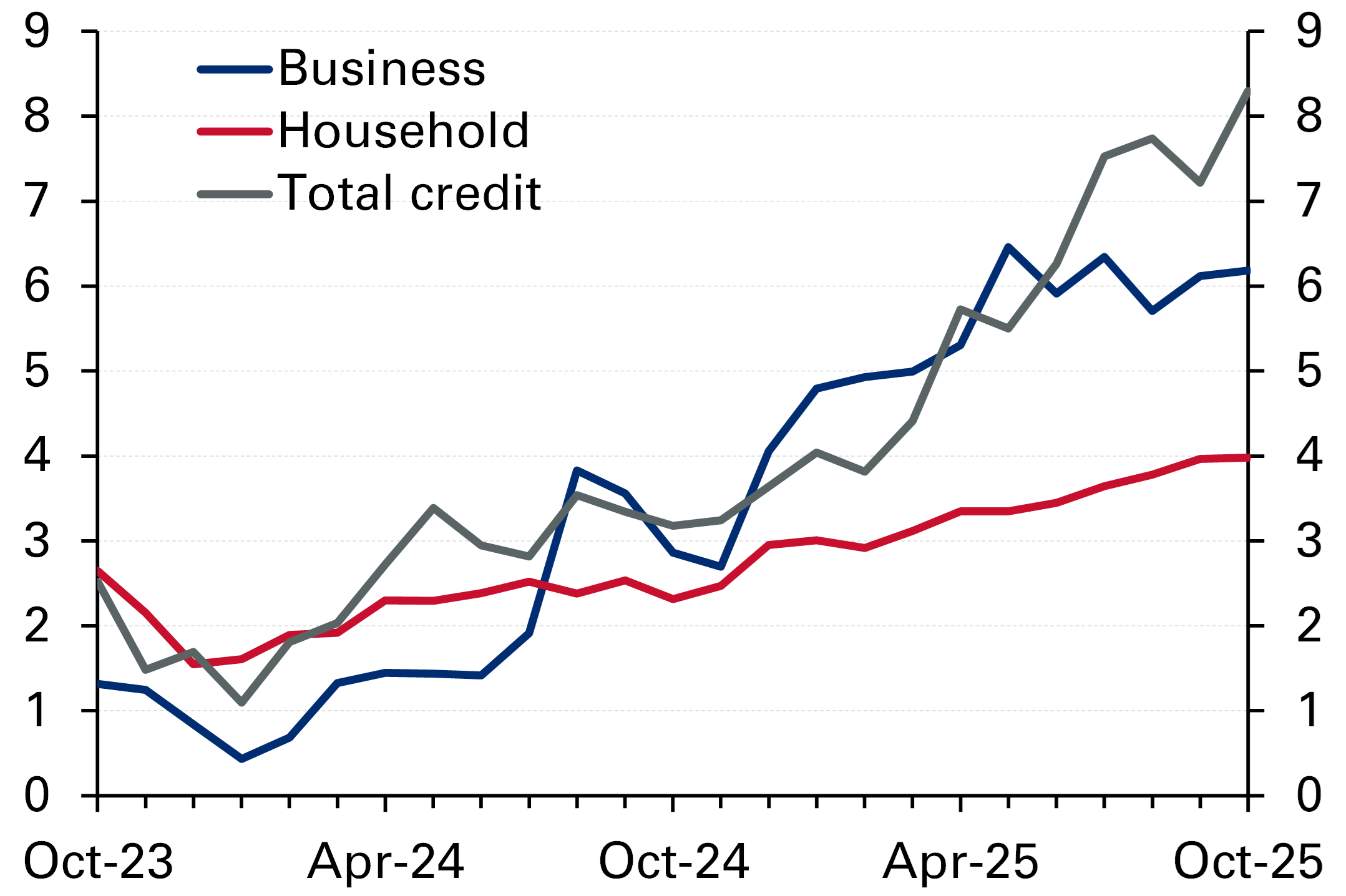
Kuwait: Ongoing strong underlying credit growth in October. Driven by soaring lending to banks and financial institutions, domestic credit increased by 1.4% in October, resulting in YTD growth of 7.5% (8.3% y/y). While headline growth has been volatile (very strong in October after being negative in September), underlying growth continues to be solid and steady. Business credit increased by a decent 0.3% in October, driving up YTD growth to 5.7% (6.2% y/y). Strong growth of more than 1% m/m for ‘trade’, ‘industry’, ‘construction’, and ‘other services’ was countered by an outsized drop (-3.6%) in credit to the oil/gas sector and a 0.7% fall in the heavyweight real estate sector. On a YTD basis, ‘other services’ (+10.4%), ‘industry’ (+7.6%), and ‘trade’ (+6.1%) are in the lead. The recovery in household credit continued (+0.5% m/m), pushing the YTD increase to 3.5% (4% y/y, highest since mid-2023). Over the past six months, household credit has increased by an annualized 5.4%. As mentioned, lending to banks and financial institutions soared by 26% m/m (KD 675 million) in October. On a YTD basis, this was up by a whopping 46%, accounting for 27% of total growth despite its small share (6%) of total domestic credit. Meanwhile, resident deposits increased by 0.6% m/m in October driven by a jump in the volatile public-sector deposits while private sector deposits dropped for the second straight month. On a YTD basis, resident deposits are up by a relatively limited 3.5%, dragged down by a 14% fall in government deposits while private-sector and public-sector deposits increased by 3.5% and 17%, respectively.
Saudi Arabia. Revisions to excise tax on sugary drinks. Starting January 1, 2026, Saudi Arabia will implement a new tax system on sweetened beverages, replacing the current flat-rate excise tax of 50% of the retail price with a tiered volumetric approach based on sugar content per 100 milliliters. Under the new structure, drinks with higher sugar concentrations will face higher tax rates, while low-sugar and sugar-free beverages will be exempt, creating a strong incentive for manufacturers to reformulate products. Developed in collaboration between Saudi and other GCC authorities, the initiative reflects a growing trend toward health-focused fiscal policies in the Gulf region and aligns with global best practices in preventive health measures. The tax will apply to a wide range of products, including ready-to-drink beverages, concentrates, powders, gels, and extracts. While the primary goal is public health improvement, the policy is also expected to influence consumer behavior and encourage innovation in the beverage industry, while still supporting sustainability objectives. Although revenue generation is not the main objective, the revised system is still expected to deliver notable revenue, though at a reduced level compared to the previous system as it prioritizes public health over tax income.
UK: Chancellor announces several ‘backloaded’ tax raising measures; markets cheer the extra headroom. Chancellor Reeves, in the much-awaited Autumn budget, created a much bigger fiscal headroom of £21.7bn versus £9.9bn in the previous budget to achieve the self-imposed rule of meeting current spending from revenues only. The latest budget included an increase of £26bn in tax revenues over the next five years but raised welfare spending by £16bn compared to the March budget. Key revenue measures included a freeze on individual income tax thresholds for another three years after 2028 (pushing more people into either paying tax or into higher tax brackets), levies on electric cars, higher duties on gambling, surcharge on homes valued above £2mn, higher taxes on dividends, a reduction in tax-free saving allowance (to £12K from £20K), and a £2K cap of pension deductions from National Insurance contributions. In terms of offsetting measures, the budget saw a ‘temporary’ extension of freeze on fuel duties, the removal of a two-child cap for household welfare benefits, a cut in household energy bills, and a freeze on rail fares. She also announced a 4.1% hike in national living wages. The Office for Budget Responsibility (OBR), as widely expected, trimmed its optimistic real GDP growth forecast for 2026 to 1.4% from 1.9% earlier and to 1.5% per year through 2030 on downgrades to productivity growth. But it lifted the GDP growth estimate for 2025 to 1.5% from 1% previously. The markets cheered the extra fiscal headroom in the budget as the UK pound, gilts and stock markets rose, with yields on 10Y gilts falling by 7bps to around 4.42%. However, the budget included little in terms of growth-boosting actions and the outlook remains uninspiring. Moreover, measures related to revenue hikes were mostly backloaded but big-ticket spending ones were front-loaded, adding an element of additional uncertainty to the fiscal forecasts especially with a general election scheduled for 2029. Based on these budgetary measures, the OBR forecasted higher fiscal deficits of 4.5% and 3.5% in 2025-26 and 2026-27 from 3.8% and 3.0% in the March projection, respectively.
US: Weekly unemployment claims fall to an over seven-month low but continuing claims elevated. Initial weekly jobless claims unexpectedly dropped to 216K (w/e November 22) from 222K in the previous week, the lowest since mid-April, further indicating that layoffs continue to be modest for now. However, underscoring that hiring has also remained soft, continuing claims were elevated near a four-year high at 1.96mn (w/e November 15), though the prior week’s figures were revised downward to 1.95mn from 1.97mn.