
 +965 2292 4888


Daily Economic Update
12.03.2026
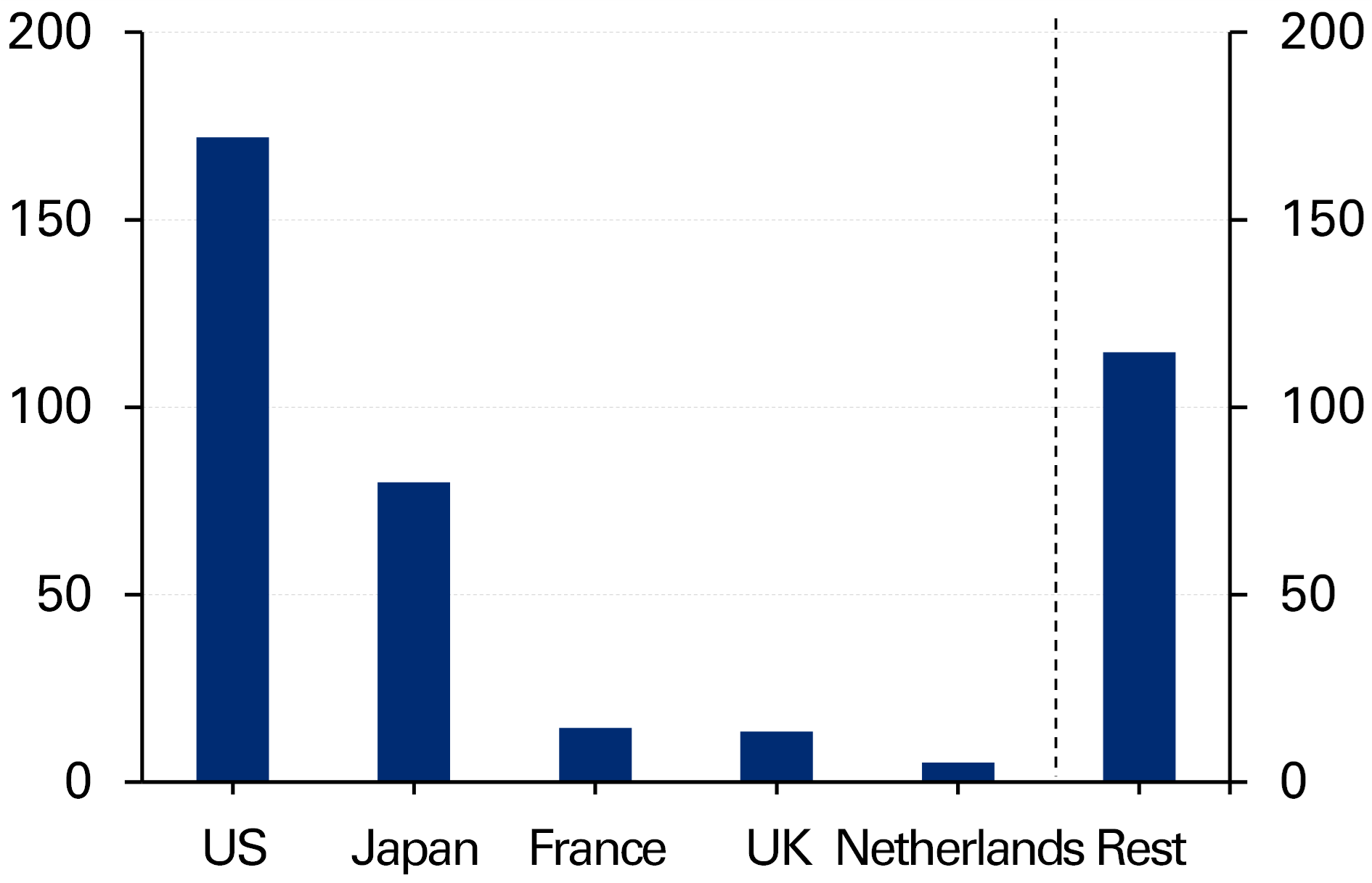
Oil: Brent back over $100 as shipping targeted and despite record IEA oil release. Prices were back above $100/bbl this morning in Asian trading, advancing further on yesterday’s close at $92/bbl (+4.8% d/d) after two oil tankers in Iraqi waters were hit. Several other vessels were also attacked and Oman was forced to evacuate its Mina Al-Fahal oil export terminal on the Gulf of Oman side of the Strait of Hormuz. Oil’s surge comes despite the IEA announcing the largest ever release of oil from members’ strategic reserves (400 mb). While the agency did not provide a detailed breakdown on the composition or the timing of the SPR releases, some members did outline partial plans: the US will release 172 mb from its SPR “starting next week” over a 120-day period, equivalent to around 1.43 mb/d, according to the Department of Energy; Japan will release 80 mb (roughly 45 days’ worth of domestic consumption) from public and private inventories beginning next Monday; France, the UK, and the Netherlands will release 14.5 mb, 13.5 mb, and 5.3 mb, respectively, though implementation timelines have yet to be announced. The market’s reaction to the SPR release has been fairly muted because the announcement had already been priced-in following IEA communiques beforehand and which reflected in Monday’s price decline, and because actual physical delivery of these barrels to the market is likely to take time. Moreover, the unprecedented size of the release suggests that policy-makers’ are concerned about a longer-lasting conflict in the Gulf, certainly in terms of a more severe impact on oil supplies. The IEA reported that less than 10% of pre-conflict oil volumes are transiting the Strait, implying a supply loss of roughly 18 mb/d—around one-fifth of global seaborne oil trade. At current global demand levels, the planned stock release would cover this supply gap for roughly 22 days, which is insufficient without a downward adjustment to oil demand. Separately, OPEC, in its monthly oil market report published yesterday, made little reference to the ongoing conflict, stating that “the impact of the ongoing geopolitical events on growth estimates is too early to determine”. It therefore left its oil demand forecasts unchanged at 1.4 mb/d for 2026 and 1.3 mb/d for next year. A more notable observation from the report is that Saudi Arabia’s official oil production submission to the OPEC Secretariat for February – a month in which OPEC-8 was supposed to have paused output gains – showed output rising to 10.8 mb/d to its highest level since November 2022, while supply-to-market volumes stood at 10.1 mb/d, with the difference likely directed toward offshore storage. This appears to have been a calculated contingency move by the Saudis ahead of potential US and Israeli strikes on Iran. The reporting of these figures separately echoes a similar strategy used during the 12-day conflict in June 2025. OPEC secondary sources show that DoC-wide production rose 445 kb/d m/m in February to 42.8 mb/d, with most of the increase driven by Kazakhstan (+236 kb/d) and Venezuela (+80 kb/d). Production in Iran also rose by a more modest 34 kb/d, as the country sought to maximize exports ahead of anticipated military action by the US and Israel.
Egypt: Public debt ratio declines after Alam El-Roum proceeds, while carry trade outflows accelerate. Egypt’s public debt declined to 78% of GDP by the end of December 2025, down from 83.8% in June 2025, according to the Ministry of Finance (MoF). The improvement was partly supported by proceeds from the Alam El-Roum investment deal, from which the treasury received $3.5 billion and directed entirely towards debt reduction. Nevertheless, the MoF expects public debt levels to rise again to around 81.8% of GDP by June 2026 to reflect the government’s sizable financing needs, which it estimates at EGP 6.3 trillion (30.4% of GDP) during the first half of 2026. This includes about EGP 5.73 trillion for debt refinancing, largely related to domestic obligations, and EGP 572 billion for budget deficit coverage. Meanwhile, foreign portfolio outflows from the local debt market continued to intensify, with foreign investors recording net sales of about $1.2 billion in the secondary market for government securities on Wednesday, marking a second consecutive day of outflows exceeding $1 billion. In total, foreign investors have withdrawn around $6.7 billion from Egypt’s secondary government debt market since February 19, which has increased pressure on the Egyptian pound. The EGP has depreciated by roughly 11% m/m to around EGP 52/$1.
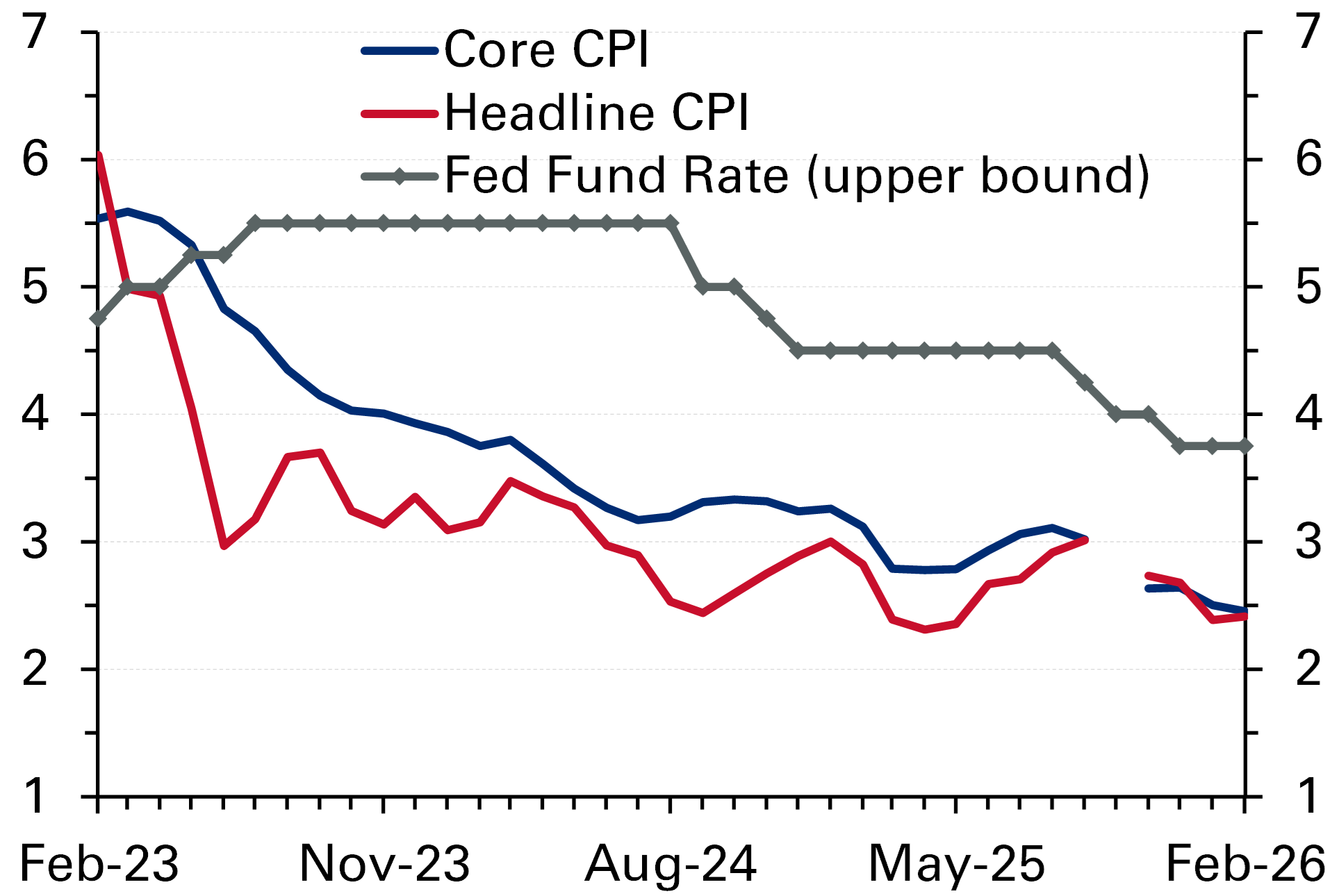
US: CPI inflation in February steady but will reaccelerate over the coming months on surging energy prices. Both headline and core CPI inflation in February were unchanged from January at 2.4% y/y and 2.5%, respectively, matching the consensus forecast. On a monthly basis, overall CPI inflation ticked up to 0.3% from 0.2% in January, but the core rate eased to 0.2% from 0.3%. Core goods and durable goods inflation moderated further to 1% y/y and 0.1% from their recent peak of 1.5% and 1.9% last summer, respectively, signaling that the peak tariff impact may be abating steadily. Core services inflation was steady at 2.9% y/y, the lowest since September 2021, helped by a sustained easing in the heavy-weight shelter component. We note that the prior government shutdown is still distorting some y/y price comparisons, which will continue to be the case until April most likely. Importantly, PCE inflation, the Fed’s preferred inflation measure, seems to have been less distorted by the shutdown and that remains materially higher than the CPI at 2.9% y/y for the headline rate and 3% for the core rate through December. Nonetheless, if the surge in energy prices (WTI crude up almost 35% since the start of the military conflict in the Middle East) is sustained, inflation will reaccelerate, while the second-round effect on food and other components will likely keep it elevated over the coming months. Amid these developments, the Fed will likely exercise greater restraint on further monetary policy easing in upcoming FOMC meetings, with the futures market now seeing the next interest rate cut in September.
US: Administration initiates section 301 investigation into 16 trade partners to recreate the tariff wall. The US administration initiated trade investigations into 16 countries under section 301, in line with President Trump’s vows to recreate the tariff wall. These trade partners are China, the EU, Mexico, India, Japan, South Korea, Taiwan, Switzerland, Norway, Indonesia, Singapore, Thailand, Malaysia, Cambodia, Vietnam, and Bangladesh. However, among the top trading partners, Canada is excluded from these investigations for now. The latest efforts are part of reinstating the IEEPA tariffs cancelled by the Supreme Court last month as US Trade Representative Jamieson Greer emphasized that “the tools may change, depending on the vagaries of courts and other things, but the policy remains the same.” Previously, following the Supreme Court decision, Trump imposed 10% baseline tariffs on all countries for a maximum of 150 days without needing congressional approval.
China: “Two Sessions” meeting wraps up and the 15th five-year plan approved. China’s largest annual legislative meeting came to a close, with the National People's Congress approving the 15th five-year plan, an economic roadmap for 2026-2030. This listed economic targets for 2026 including: GDP growth of “4.5% to 5%”, which is the slowest rate in nearly three decades; inflation at 2.0% y/y; a fiscal deficit of 4% of GDP; and an urban unemployment rate at around 5.5%. The country’s objectives for the next five years focus on achieving industrial self-sufficiency and boosting government backing for sectors like AI, aerospace, aviation, biomedicine, and integrated circuits. Additionally, China aims to advance emerging technologies, such as future energy sources, quantum computing, embodied AI, brain-computer interfaces, and 6G telecommunications. This emphasis on technology underscores China’s efforts to actively replace foreign technology as its competition with the United States for dominance in key technologies intensifies. Attention has also focused on government “work reports” from China’s ministries, revealing progress on national goals and future policies. The overall tone was one of cautious optimism, emphasizing the need to balance complex international issues, slower economic growth and technological competition while also advancing domestic modernization.