
 +965 2292 4888


Daily Economic Update
16.12.2025
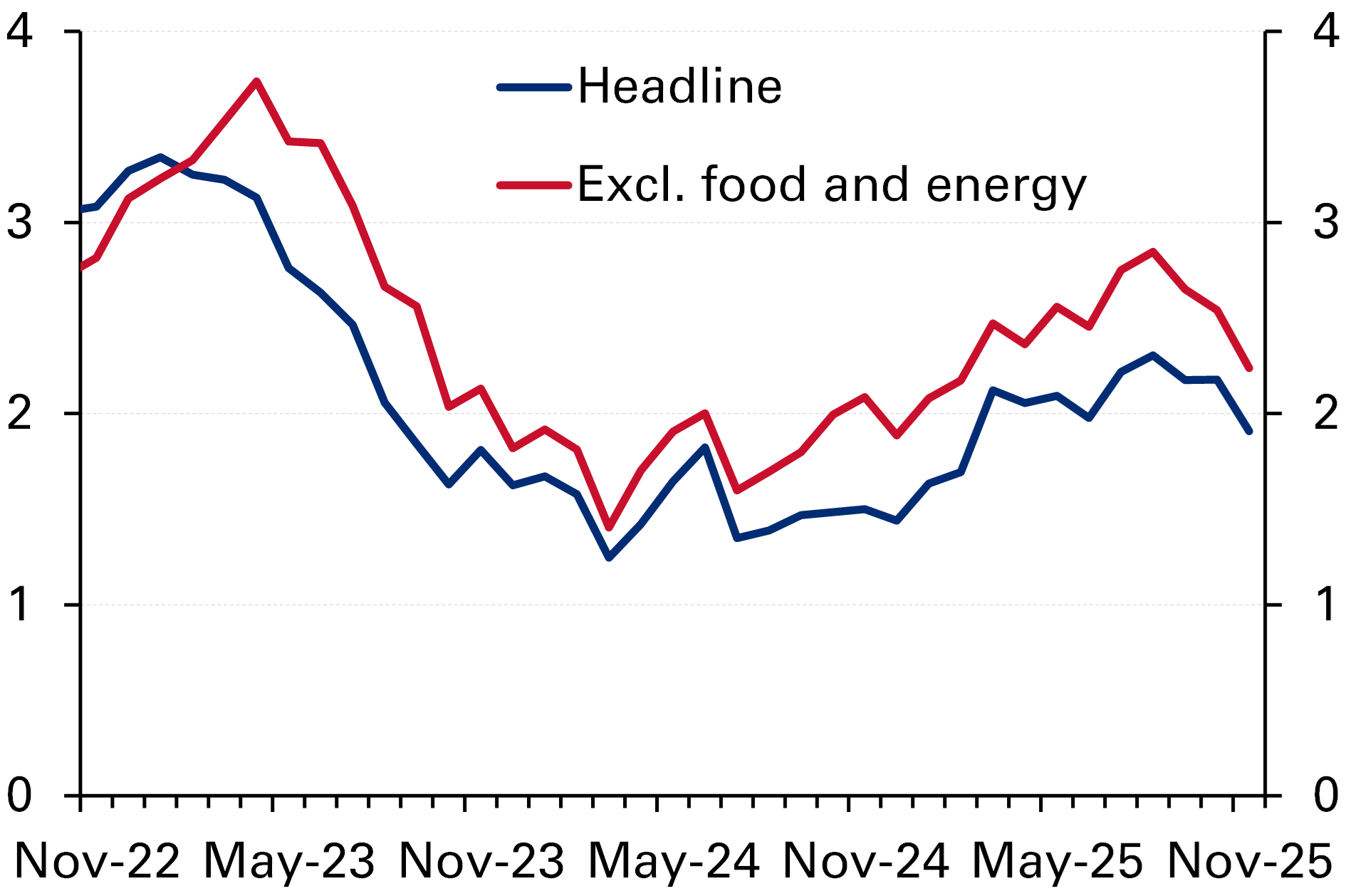
Saudi Arabia: Inflation eased to nine-month low in November. Consumer price inflation eased to 1.9% in November, the lowest since February, from 2.2% in October. The lower reading was due to softer inflation in several categories, most notably in recreation & culture (1.3% from 2.4%), restaurants & accommodation (-0.5% from 1.1%) and food & beverages (1.3% from 1.5%). In addition, housing & utilities inflation eased for the eighth consecutive month to 4.3% in November from 4.5% the previous month and is expected to continue to drop over the course of 2026 due to the freeze on rent increases in Riyadh implemented in September. Core inflation (excluding food and energy) also eased to the lowest since February (2.2%). Inflation is expected to average 2.1% in 2025 and remain steady in 2026 as the projected drop in housing inflation is offset by price pressure in other categories stemming from strong domestic demand and rising input costs.
UAE: Dubai’s CPI inflation slows in November on lower transport price growth. CPI inflation in Dubai slowed from its 2025 peak of 3.4% y/y in October to 2.7% in November. Slower inflation came on softer rises in the transport (0.2% y/y versus 4.2% in October) and recreation segments (4.0% versus 6.7% in October). In addition, inflation in the housing subcomponent softened slightly from to 5.3% in November while price growth in the food segment remained subdued (0.7%). In the first eleven months of 2025, inflation averaged 2.8%, easing from 3.3% y/y in the same period of 2024. Inflation in Dubai is expected to continue slowing in 2026 on declining pump fuel prices and slower growth in housing rents.
Oman: Inflation accelerated for the third consecutive month in November reaching a 33-month high. Consumer price inflation accelerated to 1.7% y/y in November (0.1% m/m), marking its fastest pace since February 2023, according to the National Center for Statistics and Information. The uptick was mainly driven by the same factor as in the previous month, which is the continuous increase in prices of miscellaneous goods & services (9% versus 8.8% in October), followed by higher costs of transportation (4.4% versus 3.9% in October), and restaurants & hotels (2.7% same as in October). Also, food & non-alcoholic beverages prices continued to add more pressure on the inflation rate (0.9% versus 0.4% previously), the second-largest CPI component with a 21% weight only after housing expenses that remained stable with 32% weight. Recreation & culture remained the only item that recorded a decline (-0.3% same as in October). Despite the continued acceleration in inflation, the average inflation rate for January–November remained at 0.9%, keeping price pressures within a low-to-moderate range.

US: The New York Fed President, a key FOMC member, sees monetary policy well positioned for 2026. The latest Fed speech following last week’s FOMC meeting continued to see divided opinions among officials. A member of the ‘FOMC leadership’, New York Fed President John Williams, echoing Chair Powell’s comments in last week’s press conference, said that the monetary policy was “well positioned”, with the stance having moved towards neutral going into 2026, as he highlighted “the labor market is clearly cooling” through an ongoing and gradual process and “the upside risks to inflation have lessened somewhat.” He projects a 2.25% GDP growth in 2026, up from an estimated 1.5% this year, with inflation falling to 2.5% y/y next year before hitting the Fed’s 2% goal in 2027. Meanwhile, Fed Governor Stephen Miran, whose temporary term ends in January, continued to be the only FOMC voice advocating for a substantial easing in interest rates as he saw a softer inflation outlook and the possibility of a quick and nonlinear deterioration in the labor market. On the other hand, Boston Fed President Susan Collins (a non-voter in 2026), while supporting a rate cut last week, labeled it a close call as she remained “concerned about potential inflation persistence.” Though she also noted that “scenarios with a notable further rise in inflation seem somewhat less likely,” reflecting “the decline in some measures of longer-term inflation expectations, recent trade-policy changes suggesting a lower effective tariff rate, and a softening labor market.” For now, the Fed seems set to keep interest rates unchanged at its next meeting in January; the futures market is signaling two 25bps cuts by the end of 2026.
Eurozone: October’s industrial production increases by a five-month high of 2% y/y. Industrial production increased by 0.8% m/m in October, accelerating from September’s 0.2% growth, driven by higher production of capital goods and consumer goods. On an annual basis, industrial production grew by a five-month high of 2% in October (1.2% in September), slightly ahead of consensus expectations (1.9%). October extended industrial production’s positive year-on-year growth streak to nine months. This momentum bodes well for economic growth in the Eurozone, with ECB President Lagarde recently hinting that an upgrade in GDP growth projections is likely when the bank releases new projections this Thursday. In September, the ECB had upgraded the Eurozone’s 2025 growth to 1.2% from 0.9%.
Japan: Composite PMI falls in December driven by services, but the manufacturing PMI beats expectations. Flash estimates for Japan’s S&P Global composite PMI fell to 51.5 in December, retreating from the three-month high of 52 achieved last month. The fall was led by the services PMI, which declined from 53.2 to 52.5, recording its lowest reading since June with inflation remaining a headwind. Meanwhile, the manufacturing PMI exceeded consensus expectations of 48.8 to reach 49.7 in December (48.7 in November) but remained in contraction territory for the sixth consecutive month. New orders improved in December after two consecutive months of decline, with Japanese firms expecting further expansion in the new year.