
 +965 2292 4888


Daily Economic Update
02.12.2025
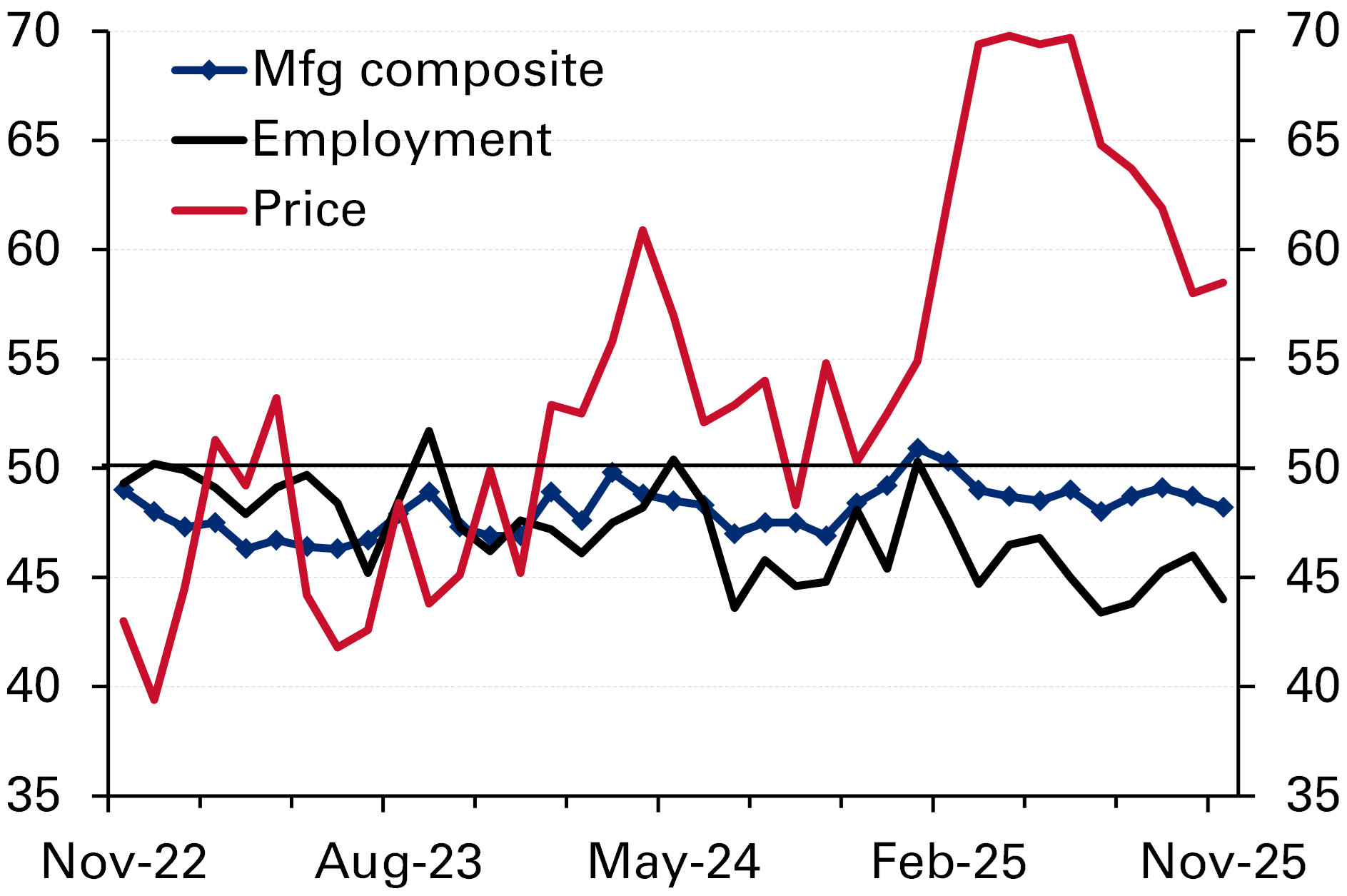
US: Contraction in manufacturing activity worsens in November. The ISM manufacturing PMI for November sank further into contraction territory, dropping to a four-month low of 48.2 from October’s 48.7. Most key subcomponents weakened, and the index has now languished below the 50-neutral mark for the ninth straight month. The gauge of input prices remained elevated, however, accelerating to 58.5 versus 58 in October but down from a recent peak of 69.8 in April, while employment shrank for the 10th consecutive month and at a steeper pace in November (44 versus 46). Moreover, signaling weak demand ahead, new orders fell further to a four-month low of 47.4 from 49.4 in October. On a positive note, the production subindex rebounded to 51.4 from 48.2. Overall, the ISM survey highlights that tariff-related costs have continued to weigh on business sentiment, adversely affecting manufacturing activity. However, still-robust consumer spending and booming AI/tech investment have kept underlying momentum strong so far in 2025, offsetting weaknesses elsewhere in the economy amid softer labor market conditions.
EU: European firms confront rising economic risks as China export controls disrupt supply chains. The European Union Chamber of Commerce in China has reported that China’s increasingly stringent export controls are prompting a significant share of European companies to reconsider their reliance on Chinese supply chains, underscoring a growing economic risk for Europe. According to the chamber’s flash survey, slower and less transparent export-license processing—now frequently exceeding the promised 45 days—has heightened uncertainty, with many firms facing production delays, rising compliance costs, and potential exposure to intellectual-property risks. Nearly 70% of surveyed firms depend on Chinese components covered by the controls, and half expect suppliers or customers to be affected soon, with some companies projecting losses amounting to 20% of global revenues. While some sectors remain insulated, the overall trend suggests mounting pressure on Europe’s manufacturing base and a potential erosion of China’s economic leverage as foreign firms accelerate diversification efforts, adding further strain to an already fragile global trade environment.

Saudi: Bank credit growth eases again in October. Bank credit growth slowed to 13.6% y/y (0.4% m/m) in October, according to the latest figures from the Saudi Central Bank. This is the sixth consecutive month of moderation since April’s peak of 16.5%, a near-four-year high. The slowdown is entirely private sector-related (12% y/y) as lending to public sector enterprises increased for a second month in a row in October and was increasing strongly (37% y/y). The largest destinations for bank credit classified according to economic activity, the real estate, wholesale & retail trade and the manufacturing sectors, posted growth rates of 27% y/y, 6.7% and 12.6%, respectively, in October.
Egypt: Government updates State Ownership Policy Document and moves toward January electricity price hike amid improved inflation outlook. The government has begun revisiting and updating the State Ownership Policy Document in parallel with the arrival of the IMF mission in Cairo, an expected step as the government prepares to demonstrate progress on structural reforms. The update will rest on four central pillars: 1) activating the State-Owned Enterprises (SOE) Restructuring Unit to accelerate reform efforts; 2) optimizing state asset utilization through the Sovereign Wealth Fund; 3) expanding the private sector’s role across priority sectors; and 4) strengthening governance frameworks. These adjustments aim to sharpen the government’s divestment strategy at a time when the IMF is assessing progress on Egypt’s structural commitments under the Extended Fund Facility. At the same time, the government is preparing to introduce a long-delayed round of electricity price adjustments starting January 2026. The Electricity Ministry is reviewing scenarios that include increases ranging between 15–25%, depending on usage brackets, as part of efforts to narrow the gap between production costs and consumer prices. Egypt had frozen electricity price hikes since August 2024 to contain inflation and support monetary easing. But with the inflation outlook improving and fuel price hikes implemented in October, the government is gradually returning to its energy subsidy reform path. This move also aligns with Egypt’s long-term plan to phase out electricity subsidies and transition toward a cost-reflective, market-based electricity framework. Egypt’s expanding renewable energy capacity is expected to help moderate future price increases and support cost recovery in the sector by next fiscal year.