
 +965 2292 4888


Daily Economic Update
27.09.2026
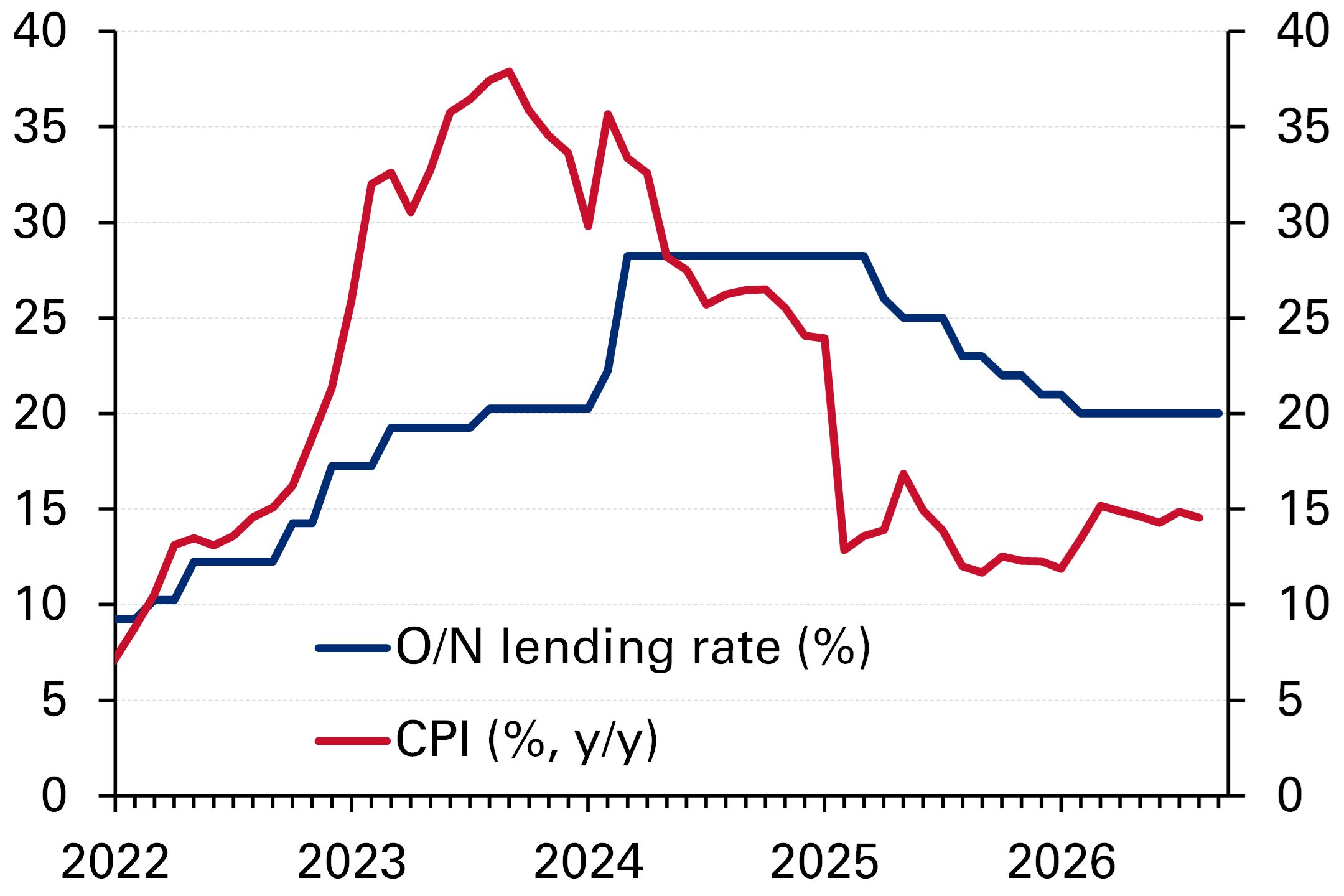
Egypt: Central bank keeps interest rates unchanged as expected. The Central Bank of Egypt’s (CBE) Monetary Policy Committee kept its key policy rates unchanged at its September meeting, in line with our expectations. The overnight deposit rate remained at 19%, the lending rate at 20%, the main operation rate at 19.5%, and the discount rate at 19.5%. The decision reflects the CBE’s cautious approach amid mixed inflation signals. Headline inflation eased to 14.5% y/y in August from 14.9% in July and the committee’s post-meeting statement noted that inflation has turned out more favorably than expected of late, but the potential for another fuel price increase at the Fuel Pricing Committee’s expected October meeting remains an upside risk. Higher fuel prices could put renewed pressure on transportation and other costs, generating second-round effects on inflation. At the same time, real interest rates remain above 5%, keeping monetary conditions relatively tight and giving the CBE room to maintain a wait-and-see approach. This is particularly relevant amid continued regional tensions and their potential impact on inflation, capital flows and the exchange rate.
Saudi Arabia: PIF considers first allocation to Gulf government bonds. Saudi Arabia’s Public Investment Fund (PIF) is considering an initial $500 million mandate with Pacific Investment Management Co. (PIMCO) to invest mainly in Gulf government bonds, according to people familiar with the matter. If approved, this would be PIF’s first allocation to PIMCO, although the asset manager already has an established presence in the Gulf. The potential investment comes after a significant decline in Gulf bond prices amid the regional conflict. Investors are now demanding around 121 basis points more in yield to hold Gulf government debt than before the conflict, with Qatar and the UAE experiencing the largest drop in the price, followed by Saudi Arabia. The move would also increase PIF’s exposure to fixed income. The sovereign wealth fund’s portfolio has traditionally focused more heavily on equities, private investments and Saudi development projects, with a relatively smaller allocation to bonds compared with some regional peers, such as the Abu Dhabi Investment Authority. The potential mandate is still at an early stage, and no final decision has been made. PIF’s consideration of Gulf government bonds nevertheless comes as valuations have become more attractive following the recent sell-off, while also potentially supporting greater diversification of its investment portfolio.
US/China: Trump-Xi summit extended trade truce, lowered some tariffs, and agreed on a dialogue about AI, but did not deliver any substantive breakthrough. During their meetings on Thursday/Friday, US President Trump and Chinese President Xi agreed to extend the existing US-China trade truce by two months, i.e. until 10 January 2027 (from the previous expiry date of 10 November 2026), providing additional time to negotiate unresolved trade issues while reducing the risk of a near-term tariff escalation. Trump described the talks as a "great meeting" and emphasized the importance of maintaining stable relations between the world's two largest economies, while Xi stressed the need to manage competition responsibly and expand dialogue. Despite the constructive tone, the summit yielded limited progress on several key sticking points, including tariffs, rare-earth exports, agricultural purchases, and technology restrictions. However, both sides agreed on a reciprocal tariff reduction on $30 billion of goods from each country. Additionally, discussions also covered artificial intelligence (AI), Iran, and broader geopolitical issues, though no major breakthroughs were announced. That said, the two sides agreed to establish a dedicated dialogue on AI, covering both its opportunities and risks, with the next round of discussions scheduled for November. Overall, in line with expectations, the summit preserved stability in bilateral relations but did not resolve the deeper structural issues underpinning US-China tensions.
US: Three FOMC voting members see need for further policy tightening amid inflation risks. Several other FOMC members, in their latest remarks, highlighted the need to tighten monetary policy further after the Fed raised interest rates by 25bps earlier this month. John Williams, the New York Fed President (a permanent voting member) stated that “it's likely that another rate hike may be appropriate by the end of the year,” and “we still have a lot of work to do,” as “Inflation has been above target for five years.” Cleveland Fed President Beth Hammack (voting member in 2026) noted that the setting in of an inflationary mindset was the biggest risk, therefore, the policy needs to be “at a restrictive stance to help bring things [inflation] back down to target,” which currently is not restraining investment in the economy. Similarly, Philadelphia Fed President Anna Paulson (voting member in 2026) mentioned that inflation has been “stubbornly elevated” and “if conditions evolve as I expect, some modest further tightening may be warranted.” However, she also mentioned that “the best I can say about underlying inflation this year is that it hasn’t gotten worse.” The recent commentary highlights that the FOMC's bias is increasingly becoming more hawkish as inflation remains higher than the Fed's 2% goal. The market-implied pricing currently signals an over 90% probability of at least one rate hike by this December.