
 +965 2292 4888


Daily Economic Update
23.11.2026
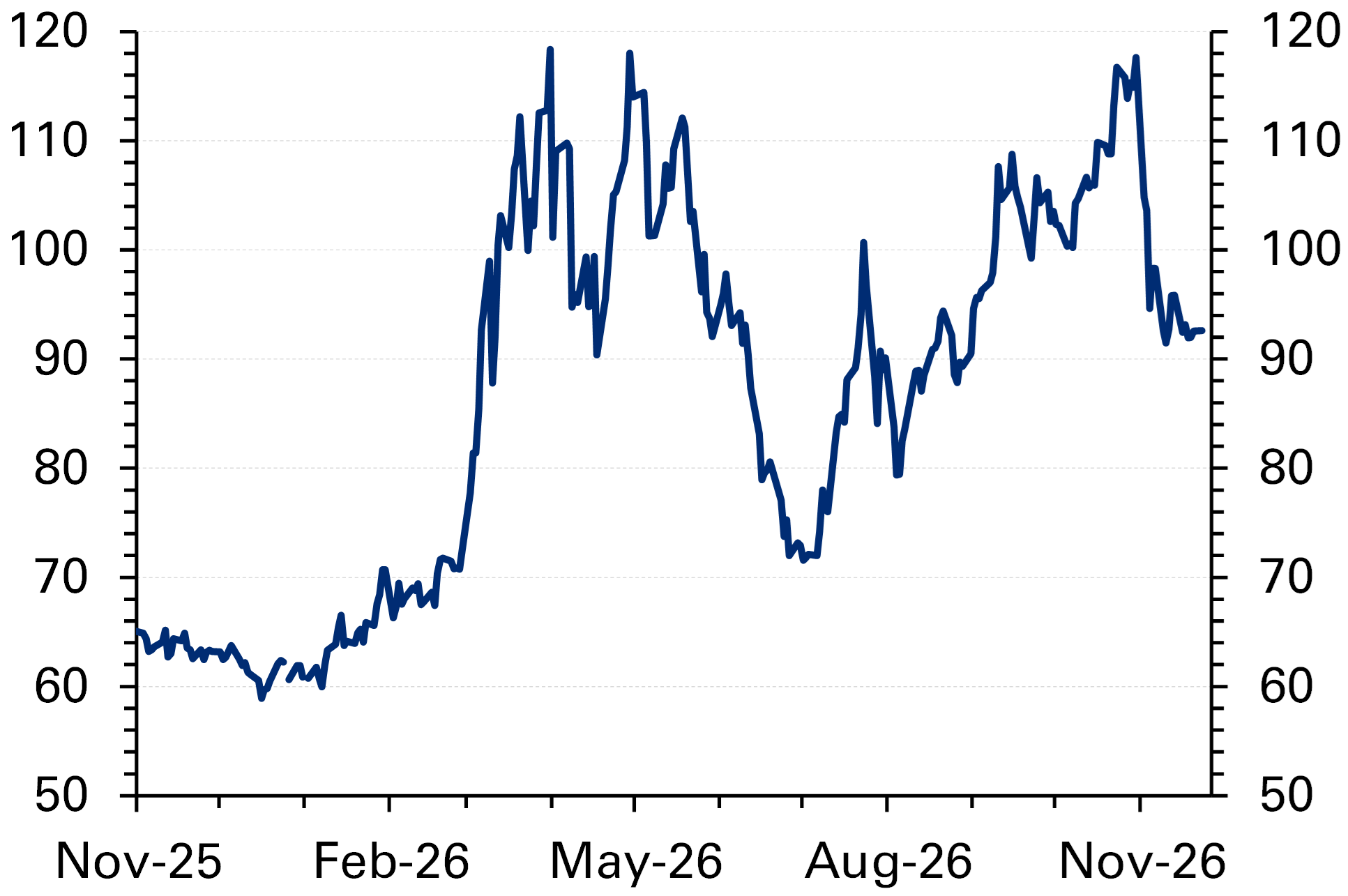
Oil: Prices fall for a third week; IEA notes potential shift away from Hormuz. Oil prices fell for a third consecutive week, with Brent futures closing 3.4% w/w lower on Friday to $92.6/bbl as improving physical supply conditions continued to outweigh ongoing geopolitical tensions and intermittent skirmishes, most recently the Iranian and Houthi strikes on Bahrain and Saudi Arabia, respectively. It was also reported that two oil tankers struck naval mines last week, bringing the daily average of attacks in November to one a day. Oil prices were little changed this morning in Asian markets. A key driver in oil’s retreat has been the recovery in oil flows through the Strait of Hormuz, as seen in the latest OPEC monthly oil market report. The IEA estimates that Gulf oil exports excluding Oman have recovered to around 82% of pre-war levels, significantly easing concerns over supply availability. The IEA went further and estimated that oil supply had outpaced oil demand to the extent that the oil market had entered surplus territory in Q4. As such, markets appear increasingly focused on physical barrels rather than geopolitical headlines, especially as Gulf production and exports continue to recover. Meanwhile, the IEA's flagship World Energy Outlook estimated that the US-Iran conflict and related disruptions in the Strait of Hormuz have resulted in cumulative losses of 2.8 bn barrels of oil and 60 bcm of natural gas from the Gulf region. Looking ahead, the agency expects a gradual shift away from reliance on Hormuz through new bypass pipelines, alternative supply sources, and lower import demand. Under its "Low Hormuz" case, oil flows through the Strait could decline from more than 20 mb/d before the conflict to 8.5 mb/d by 2030 and to less than 2 mb/d by 2035. Despite this, the IEA's central scenario remains constructive on long-term oil demand, with consumption projected to rise to 106 mb/d by 2035 and to 114 mb/d by 2050, supported initially by petrochemical feedstock demand and later by growth in vehicle fleets across emerging markets, while demand in advanced economies gradually declines amid broader EV adoption. Assumptions about global adoption of electrification proceeding inexorably upwards are looking a little less certain, however, after the collapse of the UN climate talks (COP31) in Istanbul on Sunday. Negotiations ended without agreement after oil and gas producers successfully resisted the inclusion of commitments to transition away from fossil fuels, while Turkey’s bid for official endorsement of a 35% voluntary electrification target for which it had secured the buy-in of 75 countries also failed. Moreover, Saudi Arabia, looking to include wording in the final document that would formalize the adoption of carbon capture and storage technology (which would extend fossil fuel usage) was also ultimately unsuccessful. COP31 was attended by nearly 200 nations, though the US, the largest fossil fuel producer, did not officially participate for the second time in a row.
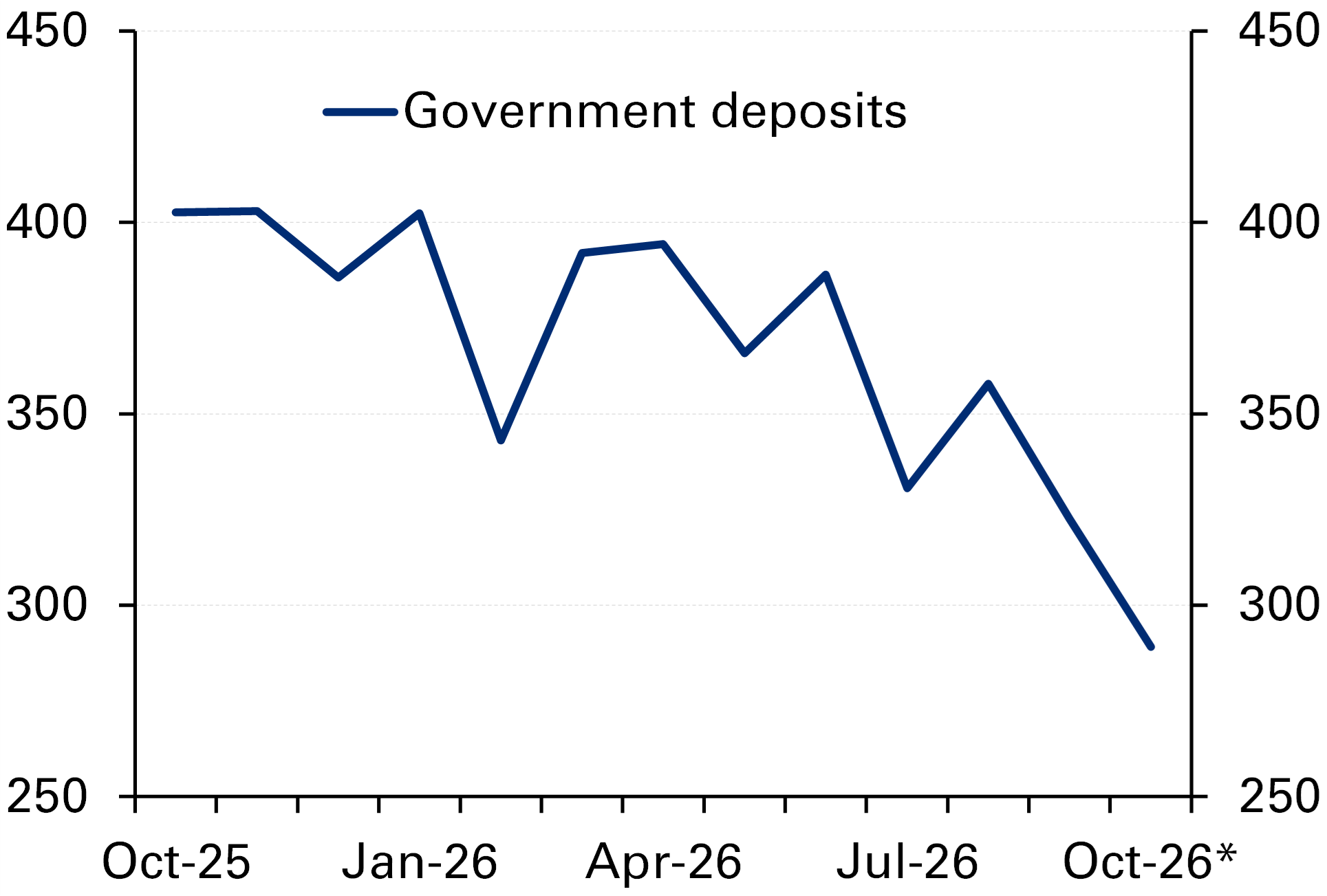
Saudi Arabia: Government deposits at SAMA fall sharply amid fiscal pressures. Government deposits at the Saudi Central Bank (SAMA) fell by 28% y/y to SAR289 billion ($77bn) in October, their lowest level in at least a year and the sharpest annual decline over this period, according to preliminary data. Deposits also declined by 10.4% m/m from September, suggesting that the government is increasingly drawing on its central bank balances to help meet financing needs. Meanwhile, the external reserves remained broadly stable on an annual basis, with official reserve assets rising by 1.1% y/y to SAR1.68 trillion ($447bn). Net foreign assets also increased by 1.4% to SAR1.59 trillion ($424bn). However, both indicators declined on a monthly basis, with reserve assets falling by 3.9% and net foreign assets by 4.1%, pointing to some recent weakening in external buffers. The decline in government deposits comes amid growing fiscal pressures. The budget deficit reached SAR244 billion ($65bn) in the first nine months of 2026, already close to the government’s full-year forecast of around SAR245 billion and well above the initially budgeted deficit of SAR165 billion. Overall, the data suggest that the government is increasingly relying on its deposits to manage financing requirements, while maintaining relatively stable foreign reserve buffers.
Egypt: Suez Canal revenues nearly double as shipping traffic recovers. The Suez Canal’s monthly revenues almost doubled in October, rising by 94% y/y to $724 million, compared with $373 million in October 2025. The recovery was supported by a 32% increase in the number of transiting ships, which reached 1,490, up from 1,128 a year earlier. Net ship tonnage also rose significantly, increasing by 86% y/y to 88 million tons, compared with 47 million tons in October 2025. If this recovery continues, it could bring annual Suez Canal revenues closer to their pre-crisis levels of around $8-9 billion. The canal, one of Egypt’s key sources of foreign currency, has faced a sharp decline in revenues since 2024 due to Houthi attacks on commercial vessels in the Red Sea, which forced many shipping companies to reroute their vessels away from the canal.
Global: US October PCE inflation and flash PMIs across major countries key data releases this week. In the US, core PCE inflation for October (Wednesday) is expected to increase to 3.2% y/y from September’s 3.1%. The second estimate of Q3 GDP will be released on Wednesday, which, in the first estimate showed solid growth of 3.4% q/q (annualized), following 2.2% in Q2. The Fed’s Beige Book, providing anecdotal takes on the economy, is also due on Wednesday. The S&P Global flash PMIs for November (later today) are seen softening for manufacturing (to 54.6 from October’s 54.9) and for services (to 55.8 from 56.1). In the Eurozone, November’s S&P Global flash PMIs are due later today, with both manufacturing and services seen edging up from October, the former to 52.8 (from 52.7) and the latter to 51.8 (from 51.4). On Thursday, the ECB will release the minutes of its October monetary policy meeting. In the UK, the S&P Global flash PMIs for November (today) are expected to inch up to 53.0 from 52.8 for both manufacturing and services. Finally in Japan, Tokyo’s CPI, a leading indicator for the nationwide CPI, will be released on Friday with the core-core rate (excluding fresh food and energy) expected to accelerate to 3.0% y/y in November from 2.6% in October. Meanwhile, the S&P Global flash PMIs for November will be released on Tuesday with the manufacturing one seen inching up to 53.5 from 53.3 in October.