
 +965 2292 4888


Daily Economic Update
23.11.2025
Kuwait: S&P upgrades sovereign credit rating on reform progress. S&P Global Ratings upgraded Kuwait’s sovereign credit rating by one notch to AA-/A-1+ with a stable outlook, citing progress on fiscal and economic reforms under Kuwait Vision 2035. Key drivers include the new financing and liquidity law, which diversifies funding sources and reduces fiscal constraints, and strong government and external asset positions: the government’s liquid assets are projected to average over 500% of GDP through 2028. Large fiscal deficits are expected to persist over the medium term, forecasted to average 7% of GDP over 2025-2028, as reliance on hydrocarbons remains high (around 90% of public revenues), despite prospective reforms such as excise taxes, subsidy rationalization, and public service repricing which should provide a boost to non-oil revenue. Kuwait issued $11.3 billion in international bonds in October 2025, the first issue since 2017, and further issuance is expected alongside drawdowns from the General Reserve Fund. Economic growth according to S&P is expected to average 2% through 2028, supported by infrastructure projects and modest oil output increases, though per capita growth remains flat. The main downside risks are slower than expected reform implementation and oil price volatility, while upside potential exists if reforms deepen capital markets and lead to accelerated economic diversification and growth. Compared to regional peers, the upgrade puts Kuwait’s rating one notch above Saudi Arabia (A+) and one notch below the UAE and Qatar (AA).
Egypt: CBE holds interest rates steady as we expected. The Central Bank of Egypt (CBE) kept its key policy rates unchanged during Thursday’s Monetary Policy Committee (MPC) meeting, maintaining the overnight deposit rate at 21%, the lending rate at 22%, and the main operation rate and discount rate at 21.5%. This marks the first hold after two consecutive cuts, aligning with our expectations that the CBE would pause despite having notable room to cut. The decision comes against the backdrop of October’s inflation reading, which showed a pickup in both headline and core inflation but did not yet capture the full impact of the recent fuel price hike. With the inflationary effects of fuel adjustments expected to materialize over the coming 2–3 months, the MPC opted to prioritize caution and wait for clearer evidence on inflation dynamics before resuming its easing cycle. The CBE also implicitly signaled its commitment to the inflation-targeting framework, especially ahead of the anticipated IMF mission to conclude the fifth and sixth reviews in the first two weeks of December, as announced by the Egyptian Prime Minister. By holding rates, the CBE sends a message of discipline and credibility, crucial at a time when external partners are monitoring the consistency of Egypt’s monetary stance. Despite the still-elevated real interest rate hovering around 10%, which provides ample space for future cuts, the CBE preferred to anchor expectations and preserve stability until the inflation trajectory becomes more predictable. The stance aligns with the bank’s broader objective of sustaining the current improvement in market sentiment, capital inflows, and exchange rate stability. Looking ahead, we still expect the easing cycle to resume once inflation begins to settle again, likely in December’s meeting or in early 2026, provided no new supply-side shocks emerge.
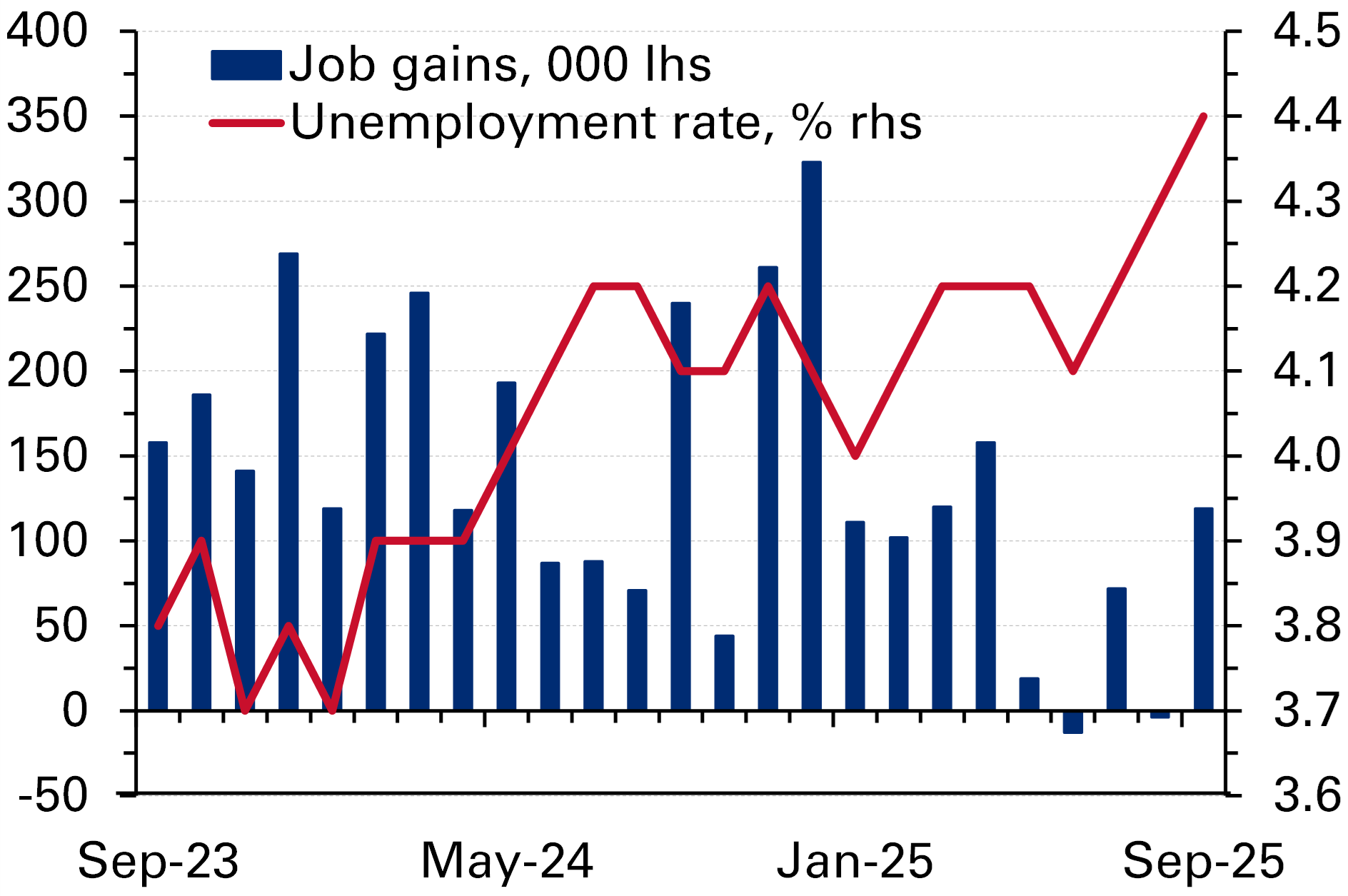
US: Job growth in September relatively robust; Fed Williams remarks lift December’s interest rate cut bets. Non-farm payrolls in September rebounded by an above-consensus 119K from a drop of 4K in August but July-August data was revised down by a combined 33K. However, the unemployment rate rose to a four-year high of 4.4% from 4.3% in August, as the participation rate ticked up to a four-month high of 62.4% from 62.3%. Though still tentative, the pickup in participation should help ease worries about supply-side weakness in the job market. As for unemployment, initial weekly jobless claims have remained relatively modest in the last 10 weeks through November 15, trending in the 220-235K range, signaling no material rise in joblessness. Still, with continuing claims hovering near their highest since late 2021, finding new roles is becoming increasingly difficult. Wage growth stayed at 3.8% y/y in September, steadily down from 4.2% in November 2024, underscoring further easing in demand conditions. Overall, the labor market shows signs of gradual loosening but is still holding up relatively well. Meanwhile, a key FOMC voting member, New York Fed President John Williams saw “room for a further adjustment [in the policy interest rates] in the near term”. Given Williams’ closed alignment with Chair Powell on monetary policy and the New York Fed President being one of the “FOMC leadership”, his comments revived hopes for an interest rate cut at the FOMC December meeting, with futures market boosting the chance for a 25-bps reduction to over 70% from below 40% at one point last week. Finally, underlining the continued resilience of the US economy, the S&P Global flash composite PMI rose to a four-month high of 54.8 in November from October’s 54.6, as the services measure increased to 55 from 54.8 but manufacturing dropped to 51.9 from 52.5. Firms continued to add workers across sectors, but the pace of gains weakened. Input price pressures strengthened to the second highest in three years on tariffs and higher wages, but output prices rose at a softer rate amid intensifying competition. Business optimism further improved to the highest since January, led by the services sector.
Japan: Inflation rises as Takaichi approves key stimulus package. Headline inflation edged up to a three-month high of 3% in October, increasing for the second month in a row after hitting 2.7% in August. Similarly, core inflation (which excludes fresh food) also rose to 3% (2.9% in September), coming in line with consensus expectations, while the “super core” measure (excluding fresh food and energy) that is closely followed by the BoJ, increased to 3.1%. These high inflation figures were driven by a 6% increase in food inflation (led by 40% rice inflation), which remains uncomfortably high despite decreasing for the third consecutive month. The stubbornly high inflation figures highlight a key problem for PM Takaichi and the Bank of Japan, with the prime minister reportedly telling BoJ governor Ueda that she is displeased with the high price levels in the country. Given that, Takaichi approved the largest stimulus package since the pandemic, signing a ¥21.3 trillion ($135.5 billion) bill that has three pillars: first addressing the inflation issue, second achieving a strong economy, and third strengthening defense and diplomatic capabilities. Separately, imports beat expectations of a 0.7% y/y decline, instead rising by 0.7%, while exports rose 3.6% y/y in October (vs. 1.1% consensus expectations) despite exports to the US declining 3.1% y/y. These factors, combined with the escalating geopolitical uncertainty with China, drove the yen to its lowest levels since January, hitting JPY157/$ after the stimulus package was announced. Despite that, the flash composite PMI for November rose to a three-month high of 52 as the manufacturing PMI rose to 48.8 and the services PMI was constant at 53.1.
UK: Business activity weakens, and retail sales fell as the economic outlook deteriorates ahead of the government budget. The S&P Global flash composite PMI dropped to 50.5 from 52.2 in October as the services gauge declined to 50.5 from 52.3 but manufacturing rebounded to a 14-month high of 50.2 from 49.7. The agency highlighted delayed investment and spending decisions ahead of the upcoming budget later this week, which weighed on business activity. Additionally, retail sales volumes in October fell 1.1% m/m (the first decline in five months) from an upwardly revised increase of 0.7% in September on muted consumer spending prior to year-end festive shopping amid concerns about potential tax rises in the budget. Weak data underscores a deteriorating business outlook, adding pressures on the government to find ways to support the faltering economy. Meanwhile, government borrowing rose 8.4% y/y in the first seven months of the current fiscal year (ending March 2026) to £117bn, overshooting the official target by 9% for the seven-month period. Weaker public finances this year, relative to the official projections have further intensified pressure on Chancellor to improve the government’s fiscal situation.
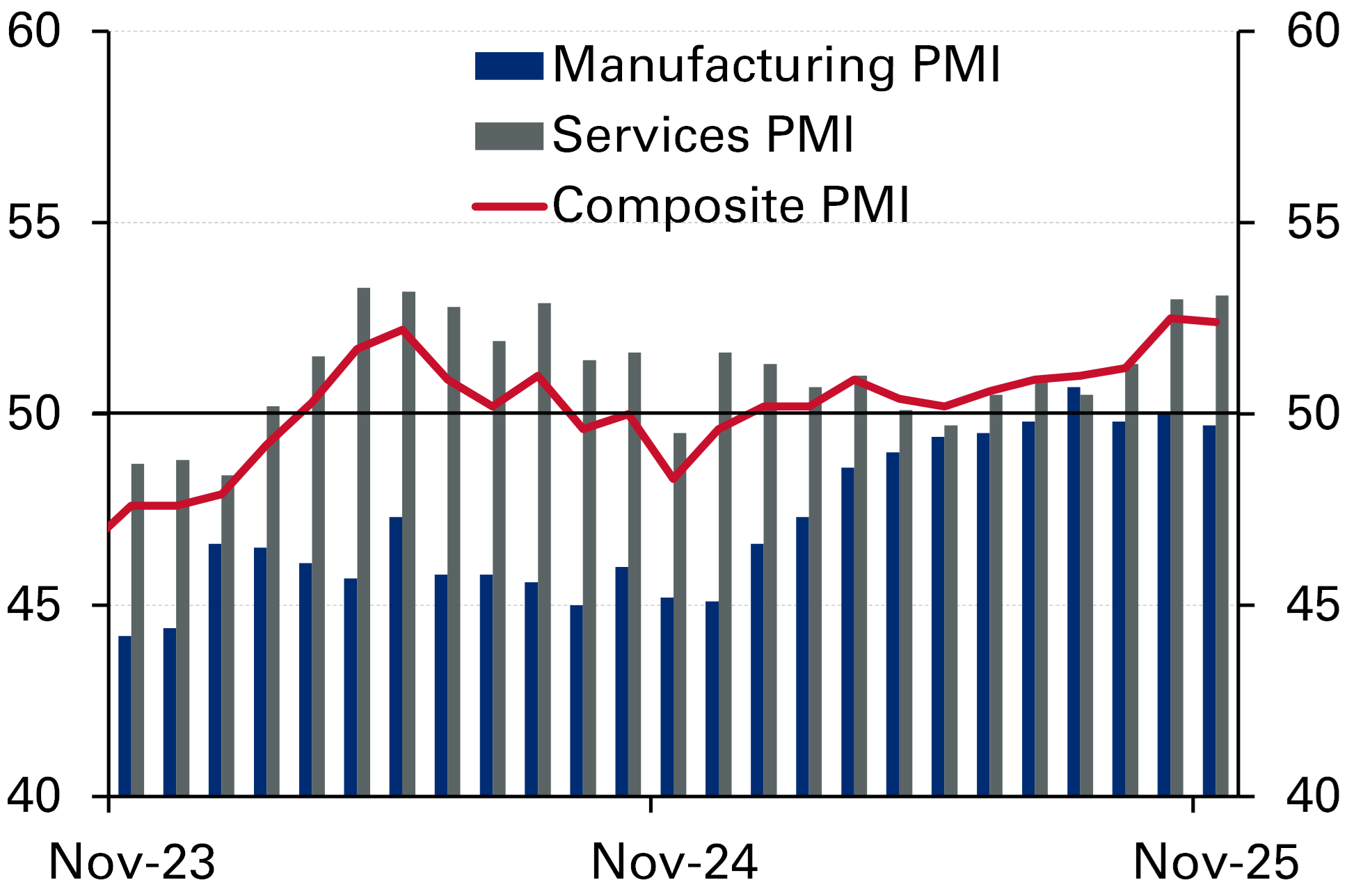
Eurozone: Business activity holds steady despite the manufacturing drag. The flash HCOB Composite PMI for the Eurozone stood at 52.4 in November, a slight drop from October’s 52.5, but still reaffirming the region’s continued expansion in private sector activity. While the services sector spearheaded growth with an 18-month high reading of 53.1 in November – up from 53.0 in the month prior – manufacturing lingered below the crucial 50.0 threshold, recording a contractionary 49.7 (50 in October). The data reveals softer new business conditions, driven mainly by weaker export demand, which has further dampened factory order books. In response, firms maintained a cautious hiring stance, keeping employment broadly unchanged for the month. Meanwhile, input cost inflation approached levels unseen since March, albeit with output price inflation easing to the lowest point in over a year. Despite these pressures, business sentiment inched higher, signaling guarded optimism amid subdued demand. Germany showed tentative improvement in services but remained weighed down by manufacturing contraction, whereas France saw softer momentum overall, hinting at an uneven recovery across the bloc. On the policy front, with inflation across the Eurozone close to the ECB’s 2% objective, and with growth prospects broadly stable, the ECB is likely to keep its policy rates unchanged in the short term.