
 +965 2292 4888


Daily Economic Update
28.09.2026
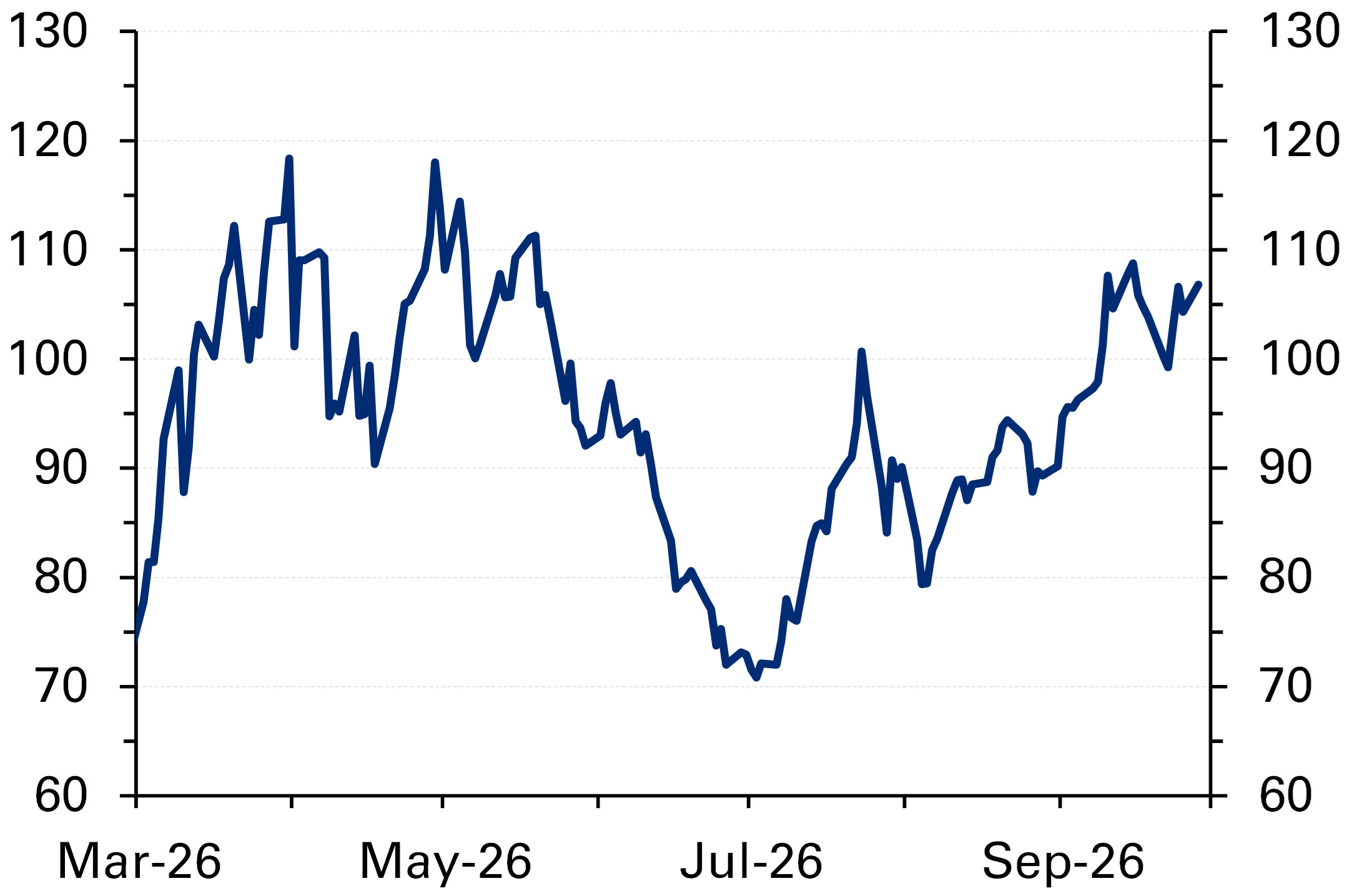
Oil: Prices rise in early trading after Trump rejects Iran’s deal. Oil prices remained volatile last week as market participants weighed the prospect of renewed US-Iran negotiations against continued Houthi attacks on Saudi assets. Ultimately however, Brent futures ended the week little changed, rising just 0.4% w/w, before gaining a further 2.4% in early Asian trading today to reach $106.8/bbl after US President Donald Trump rejected Iran's latest peace proposal, keeping geopolitical tensions firmly in focus. Iran's proposal, delivered through Qatari mediators, included reopening the Strait of Hormuz and restarting discussions on its nuclear program within seven days. In exchange, Tehran sought an end to the US naval blockade, the release of part of its frozen assets, the restoration of sanctions waivers covering Iranian oil exports, and a broader ceasefire across the region. Trump's rejection suggests that significant gaps remain between the two sides despite ongoing diplomatic contacts. Nevertheless, Iran's latest initiative could reflect changing dynamics in regional oil flows. Despite continued tensions and periodic disruptions, Gulf oil exports have recovered significantly since the onset of the conflict as producers increasingly rely on alternative pipelines, export routes, and ship-to-ship transfers. According to Kpler, crude exports from major Middle East producers have rebounded to 12.8 mb/d in September, the highest since the conflict began in February. This gradual improvement in export flows has weakened Iran's leverage over regional oil flows, although elevated geopolitical risks continue to underpin crude prices.
Kuwait: Amendments to tenders’ law to improve efficiency. Decree-Law No. 94 of 2026 was issued amending the Public Tenders Law to streamline government procurement, accelerate project execution, and enhance transparency and governance. The amendments grant greater procurement flexibility by raising the threshold for direct government contracting without approval from the Central Agency for Public Tenders to KD 1 million, while prohibiting the use of local or commission agents in tendering procedures. The decree strengthens support for domestic industry and SMEs by giving priority to selected local products in government purchases, allowing SMEs to win tenders when their bids are within 10% of the lowest compliant offer, and requiring contractors to source at least 30% of eligible products from local manufacturers. In addition, it reorganizes the grievance process, permits suspension of procurement procedures pending appeals, and introduces measures aimed at improving procurement efficiency while maintaining fair competition and accountability. The reforms are expected to improve the speed and efficiency of public investment delivery, increase participation of local businesses and manufacturers in government spending, and support private-sector growth while reducing procurement bottlenecks. The law will take effect three months after publication in the official gazette.
Saudi Arabia: CMA proposes tighter rules for overseas financial transactions. Saudi Arabia’s Capital Market Authority (CMA) has invited market participants, experts and specialists to provide feedback on proposed regulations governing transactions by Saudi financial market institutions in overseas markets. The proposed rules come around two weeks after the CMA required managers of public money market funds to reduce investments outside Saudi Arabia to no more than 5% of net asset value. The new provisions would strengthen the regulatory framework governing how Saudi financial institutions deal with clients in foreign markets. They include requirements covering margin trading and rules on when firms must assess whether an investment is suitable for a particular client. Overall, the measures point to the CMA’s efforts to strengthen oversight of Saudi institutions’ activities in overseas financial markets while providing greater protection for investors.
Egypt: Food exports reach record high in the first eight months. Egypt’s food industry exports reached a record $5.1 billion during the first eight months of 2026, surpassing the $5 billion mark for the first time, according to the Food Export Council. Exports increased by $499 million, or 10.8% y/y, from $4.6 billion in the same period of 2025, marking the sector’s highest export value for the first eight months of any year. The increase was supported by stronger exports to the European Union and other key markets, alongside a broader export base. 110 markets increased their imports of Egyptian food products, while the number of active exporting companies reached 2,731, supplying products to 179 markets worldwide. The sector has now recorded cumulative export growth for eight consecutive months. The continued expansion of food exports strengthens Egypt’s position as a regional food-exporting hub and provides an important source of foreign currency. Sustained growth across non-oil exports would help improve the trade balance and support the government’s target of raising total exports to $100 billion by 2030, as part of efforts to move towards a more sustainable and eventually positive trade balance.
China: Industrial profit growth eased further in August as weak domestic demand continued to weigh on earnings. Profits at industrial firms rose 15.7% y/y in 8M2026, slowing from 17.6% y/y recorded through July and marking a fourth consecutive month of deceleration. The strongest profit growth was recorded in computer, communications, and electronic equipment manufacturing, where earnings more than doubled (+110% in 8M2026), while gains across the broader industrial landscape were more uneven. The latest figures highlight the divergence between strong performance in AI and technology-linked manufacturing segments and continued weakness in some other segments, reinforcing concerns that domestic demand remains the key constraint on more broad-based growth momentum.
Global: September jobs report and August PCE inflation in the US and September inflation in the Eurozone key matters this week. In the US, attention will be on the jobs report for September (Friday), with consensus estimates indicating 100K jobs added (162K in August) and a tick up in the unemployment rate to 4.2% from 4.1%. PCE data for August is due on Wednesday with core inflation seen at 0.3% m/m, driving up the y/y rate to 3.4% from 3.3%. Meanwhile, Fed speak will continue in full force with at least seven FOMC members scheduled to speak this week. While Chair Warsh opted for reduced communication with the media and Fed watchers, other FOMC members did not, effectively filling the void left by the Chair. In the Eurozone, flash inflation for September (Friday) is expected to show the headline rate rising to 3.5% y/y, the highest reading since September 2023, while the core rate is seen edging up 2.6% (2.4% in August), matching the 13-month high recorded in May. In the UK, the Nationwide House Price Index for September is due on Wednesday and is expected to show house prices rising 0.2% m/m, matching the increase recorded in August. In China, attention will be on the NBS PMI readings for September (Wednesday), which are expected to signal a slight pickup in activity across manufacturing (to 50.1 from 49.8 in August) and services (to 49.3 from 49.0). Finally in Japan, on Wednesday, August’s industrial production is expected to rebound 1.7% m/m (-0.2% in July) while growth in retail sales is seen slowing to 3.3% y/y from 4% in July. On Friday, Tokyo core CPI is projected to accelerate to 2.4% y/y in September from 1.8% in August, providing an early signal on the country-wide inflation trends.