
 +965 2292 4888


GCC & Egypt Outlook
07.12.2025
The global economic outlook for 2026 is underwhelming, with the IMF forecasting growth at a lackluster 3.1% while lingering inflationary pressures prevent steeper or more rapid interest rate cuts. Oil prices are forecast lower at $65 (average) on weaker oil market fundamentals including rising OPEC+ supply. By contrast, confidence in the GCC economic outlook remains high. GDP will benefit from expanding oil output, while ongoing reform and investment trends maintain non-oil growth at a robust 4%. We see the aggregate fiscal deficit narrowing despite the projected drop in oil prices. Meanwhile, GDP growth in Egypt is expected to hit at least 5% in FY25/26 as macro stabilization paves the way for investment and consumption to drive growth.
Global economic growth outlook lackluster
Despite a resilient performance by the global economy in 2025, which led to two growth upgrades by the IMF, and less tariff-related uncertainty, the outlook remains underwhelming. The IMF sees lackluster 3.1% growth in 2026, a second consecutive annual moderation from 3.3% in 2024. The US economy is expected to grow by just over 2% in 2026 (2.0% in 2025), supported by robust consumer spending, the tech/AI investment boom and expected fiscal stimulus in 2026. The arrival of the US mid-terms should also help restrain any tendency towards chaotic policy measures by the US administration, especially on trade. For the Eurozone and the UK, the IMF pegs growth in 2026 at 1.1% and 1.3%, respectively (roughly the same as 2025). Japan’s growth is seen slowing to 0.6% from 1.1% in 2025. China will most likely achieve the “around 5%” growth target in 2025 but 2026 is expected to be a slower 4.2%, given ongoing weak domestic consumption and investment as well as unresolved property market stress.
For the monetary policy outlook in the US, given its implications for GCC interest rates, we see fewer cuts in 2026 than the three-to-four the market anticipates. This is in view of still-sticky, above-target inflation, solid GDP growth forecasts for 2026 and a stabilizing labor market. However, the appointment of the next Fed Chair in May 2026 will likely strengthen the dovish bias.
Oil prices weaker as market tips into oversupply
Current oil market dynamics suggest a period of oversupply is likely through 2026. Oil consumption is weakening, according to the International Energy Agency, and 2026’s projected increase in oil demand (+0.77 mb/d on average) is well below the historical trend rate amid sluggish economic prospects. Meanwhile on the supply side, non-OPEC oil flows are seen rising and OPEC+ is fast-tracking the unwinding of members’ voluntary cuts from 2023-24 to recapture market share. OPEC-8, which includes Saudi Arabia, Kuwait, Oman and the UAE, is expected to resume unwinding the second tranche of supply cuts (+1.65 mb/d) after suspending increases for Q1 2026 to head off faster stock builds. Our baseline Brent oil price forecast for 2026 of $65/bbl – down from $69 in 2025 - acknowledges these dynamics but is at the higher end of the consensus range, reflecting our view that oil consumption will be firmer (stimulated in part by lower oil prices) and supply growth less aggressive than expected due to oil producer capacity constraints and OPEC compensatory cuts. We also accommodate some element of geopolitical risk given recent history and the US impulse to tighten oil sanctions on a still intransigent Iran, while we do not envisage sizeable post-sanctions Russian oil flows in the event of a ceasefire in the Russia-Ukraine conflict.
GCC growth boosted by oil output gains, investment focus
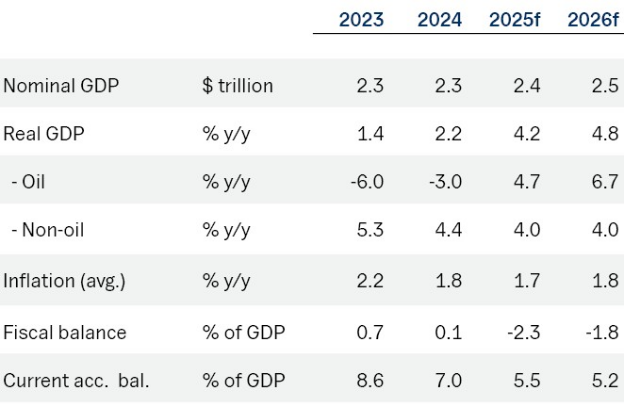
Confidence in the economic outlook for the GCC remains high despite the prospect of lower oil prices. The unwinding of OPEC-8 output cuts will deliver sizeable real oil GDP gains for the GCC energy producers in 2026. GCC non-hydrocarbon sector growth, meanwhile, is forecast unchanged from 2025 at a robust 4%, with the UAE and Saudi leading with 4.5% and 4.0%, respectively – a testament to their transformational, investment and reform-driven approach. Kuwait will also benefit from greater focus on domestic investment and ongoing traction in the projects market, especially following the easing of liquidity constraints post-debt law. Headline GCC growth is expected to quicken to its fastest in four years (to 4.7% from 4.2% in 2025), with the additional OPEC oil volumes also useful in partly offsetting the expected decline in oil revenues due to lower oil prices on fiscal outcomes. In fact, we project the aggregate GCC fiscal deficit narrowing to 1.8% of GDP next year from 2.3% of GDP in 2025, with only Oman and Bahrain’s deficits widening (the latter remaining on the radar of the rating agencies). GCC inflation is projected to remain below 2%, despite the robust growth outlook.
Egypt’s economy strengthening post-2024 reset
In Egypt, government macro-stabilization measures, including a more flexible exchange rate, fiscal discipline and subsidy reform, have substantially improved the outlook. GDP growth is seen reaching at least 5% in FY2026 while inflation moderates, providing scope to loosen monetary policy more aggressively to further stimulate economic activity. Sustained investment, macro-fiscal and business reforms are essential to the outlook, as they are for GCC oil producers as well. The region as a whole would stand to benefit from a period of stability in geopolitics and international relations.
Click below for Individual outlook reports covering