 +965 2292 4888


Daily Economic Update
15.02.2026
Egypt: CBE advances easing cycle; retail government debt trading launched. The Central Bank of Egypt last Thursday delivered a 100 bps policy rate cut, as we expected (see our preview here), continuing its cautious easing cycle. The decision was backed by moderating inflation, a still elevated real interest rate buffer, and improving FX liquidity conditions. Additionally, the CBE reduced the reserve requirement ratio by 200 basis points to ease emerging liquidity tightness, reinforcing a calibrated policy mix aimed at supporting growth while preserving macro stability. In parallel, retail investors can now directly trade government T-bills and bonds on the secondary market, as the Egyptian Exchange officially launches its new Government Fixed-Income Trading system, G-FIT. The platform enables individuals to buy and sell sovereign debt instruments through licensed brokerage firms with the same ease as equities, broadening market access and deepening domestic debt liquidity. So far, five brokerage firms have secured the necessary licenses to offer the service. The timing is particularly notable. The launch coincides with the maturity of high-yield certificates of deposit, offering individuals an alternative short-term, tradable investment with attractive returns. This step supports financial inclusion, enhances price discovery in the secondary market, and aligns with broader efforts to diversify the investor base and strengthen domestic funding channels.
Saudi Arabia: Fahd Al Saif appointed as new Minister of Investment. Saudi Arabia has appointed Fahd Al Saif, a senior executive at the Public Investment Fund, as the new Minister of Investment, marking a leadership change at a pivotal time for the Kingdom’s investment agenda. The outgoing minister, Khalid Al Falih, former Energy Minister and ex CEO of Aramco, spent the past four years positioning Saudi Arabia more prominently on the global investment map. His tenure focused on expanding the Invest Saudi platform and signing hundreds of memoranda of understanding with international partners. The transition comes as foreign direct investment reached around $32 billion in 2024, still well below the Kingdom’s $100 billion annual target by 2030. The Investment Ministry is aiming to raise inflows to $46 billion this year and $58 billion by 2027, with a stronger emphasis on diversified structures, including public private partnerships. The appointment also coincides with the expected rollout of new five-year investment and diversification strategies by the government and the PIF, which are set to prioritize high return sectors and gradually pivot away from capital intensive construction driven projects. Al Saif brings deep knowledge of the sovereign balance sheet. He founded the National Debt Management Center at the Ministry of Finance, effectively establishing the Kingdom’s modern sovereign debt issuance framework. At the PIF, he served as Head of Global Capital Finance and Head of Investment Strategy, giving him direct exposure to both funding strategy and capital allocation. Overall, the appointment signals a shift toward a more financially-disciplined and capital markets-oriented phase of Saudi Arabia’s investment strategy.
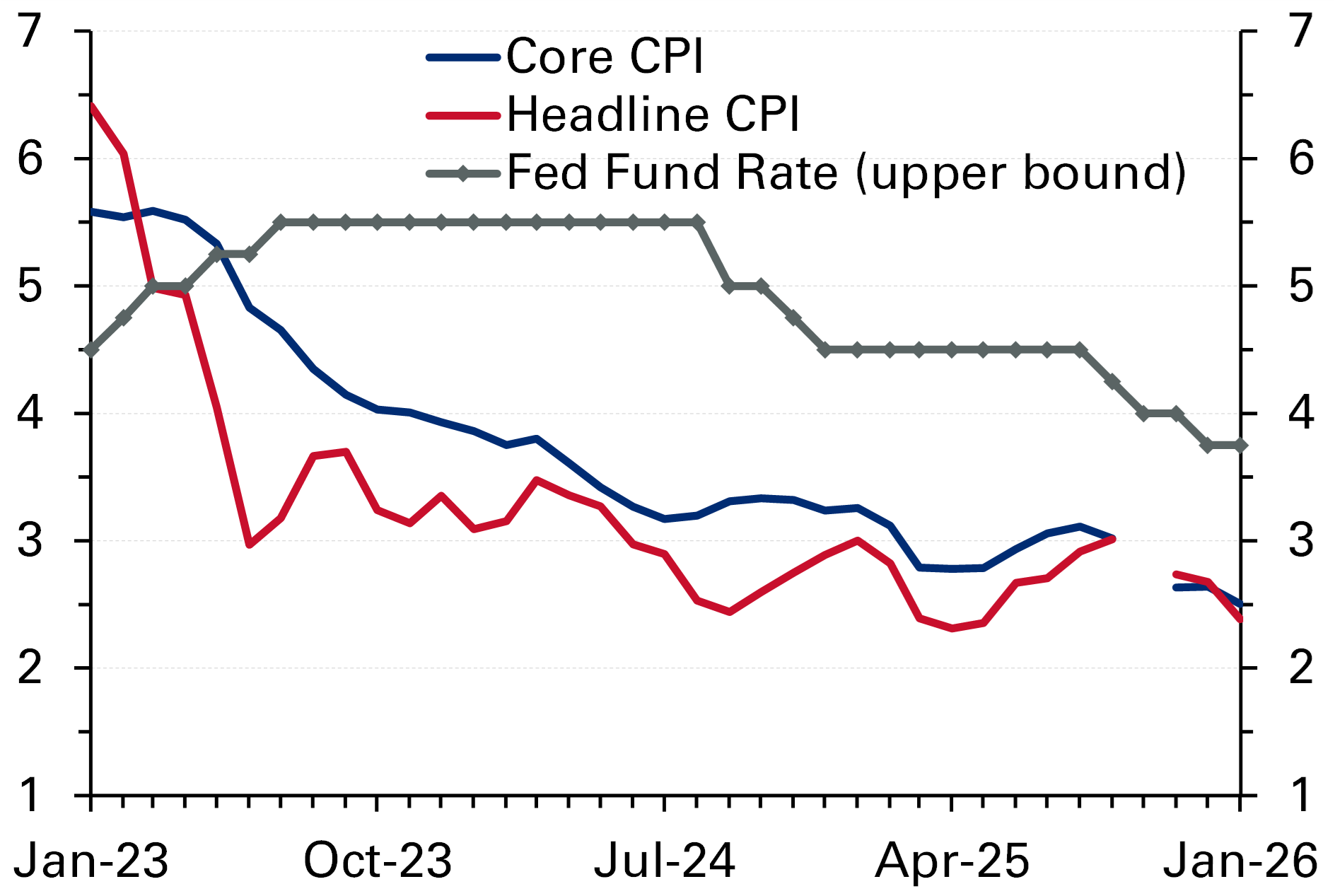
US: Headline CPI inflation eases below estimates, core rate drops to a near five-year low. CPI inflation in January eased to the lowest level since May 2025 at 2.4% y/y (0.2% m/m) from 2.7% (0.3% m/m) in December, slightly below the consensus forecast of 2.5% as energy commodities prices fell 3.3% m/m. The core rate also moderated to hit a near five-year low of 2.5% y/y from 2.6% in December, matching expectations, but accelerated on a m/m basis to 0.3% from 0.2% earlier. We note that the prior government shutdown is still distorting some y/y price comparisons, which will continue to be the case likely until April. Price rises in core goods and durables goods eased to the softest since July and May 2025, respectively, while core services inflation (at 2.9% y/y) also moderated to the lowest reading since September 2021, helped by a sustained easing in the heavy-weight shelter component. Still, several other goods and services categories showed sharply higher increases m/m such as certain food products, appliances (+1.3% m/m), new cars (+0.5% m/m), and airfare (+6.5% m/m), indicating a bumpy path towards the Fed’s 2% inflation target amid still steady tariff passthroughs. Following the release of the relatively benign inflation print, the futures market boosted the chances of two Fed interest rate cuts by the end of this year to over 80%, with the probability of a third cut at around 50%. Meanwhile, initial weekly jobless claims (w/e February 7) moderated less than forecast to 227K after such claims reached an eight-week high of 232K in the prior week amid bad weather conditions, while continuing claims (w/e January 31) ticked up to 1.86 million from 1.84 million the week before. Finally, media reports cited that the Trump administration, given its current focus on tackling the affordability problem, is considering scaling back some tariffs on metal products. Separately, Congress couldn’t agree on a funding package/Continuing Resolution for the US Department of Homeland Securities, resulting in a lapse of funding for that government agency.
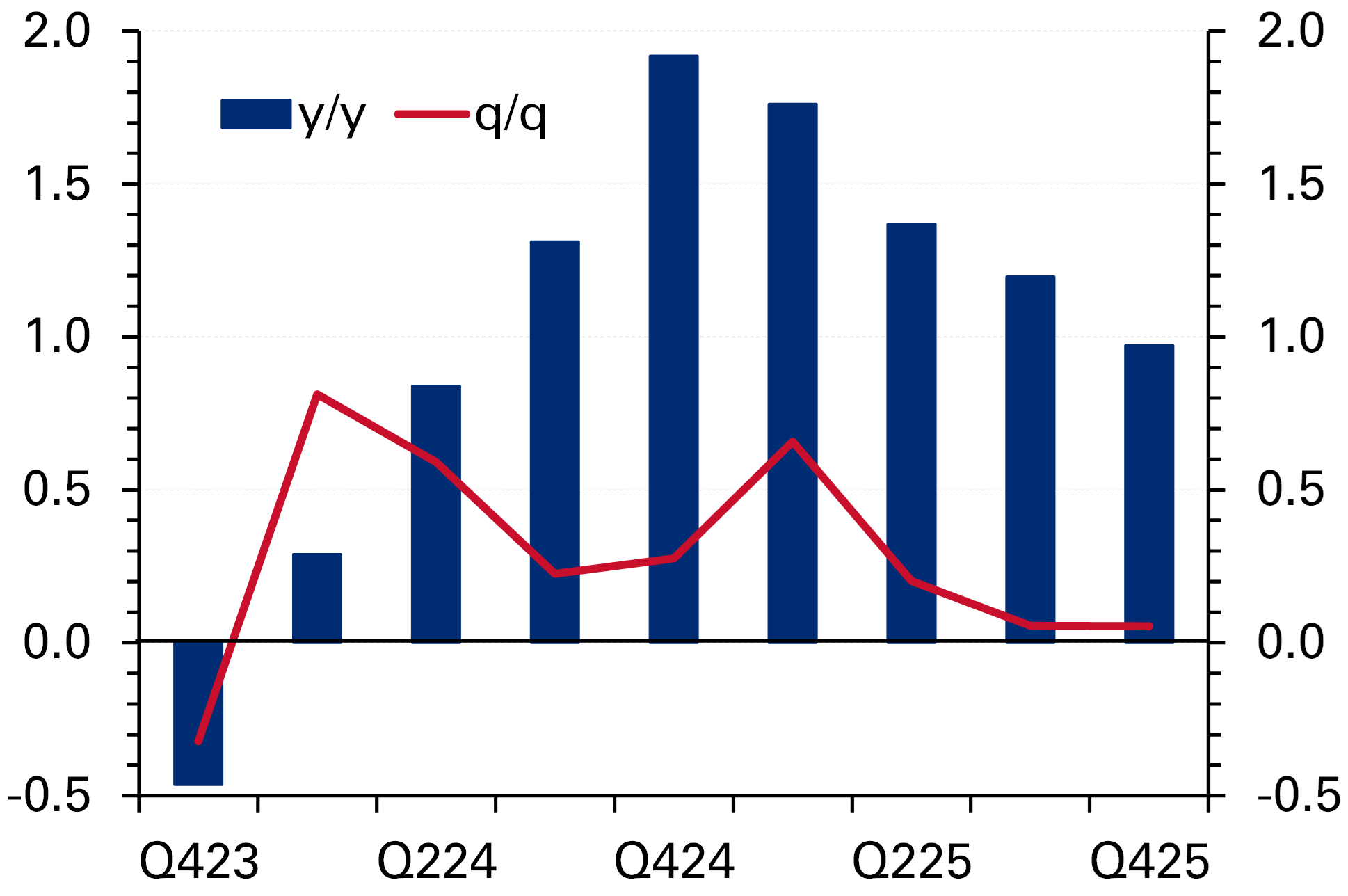
UK: GDP in Q4 grows 0.1% q/q, missing forecasts. The UK economy grew 0.1% q/q (1% y/y) in Q4, matching the pace seen in Q3 but slower than the BoE and the consensus forecast of a 0.2% rise. The services sector stagnated while construction output fell 2.1%, but production rose 1.2%. For the full year 2025, GDP growth stood at 1.3%, up from 1.1% in 2024. A loss of momentum in the second half of 2025 highlighted that the underlying conditions had remained uninspiring amid a weak labor market and uncertainty leading up to the government’s Autumn budget that was announced in late November. Moreover, the BoE recently revised down its GDP growth forecast for 2026 to 0.9% from 1.2% previously. Though on a positive note, the previously reported January PMI reading signaled signs of renewed optimism, with the manufacturing gauge reaching a 17-month high of 51.8 and the services measure at a five-month high of 54, but it is yet to be seen whether this momentum will sustain over the coming months.
China: The y/y drop in house prices steepened again in January. New house prices fell by 3.1% y/y in January, steeper than the 2.7% drop in December, marking 31 consecutive months of decline. The y/y decrease in house prices had been on a softening trend, but this has reversed since November, reflecting Beijing’s ongoing difficulty in stabilizing the protracted property downturn. On a monthly basis, house prices fell by 0.4% for the third straight month.