
 +965 2292 4888


Daily Economic Update
22.04.2026
Oil: Brent posts second day of gains on Tuesday as Trump announce ceasefire extension. Oil prices closed higher for the second day in a row on Tuesday, settling at $98.5/bbl (+3.1% d/d), after a volatile trading session characterized by sharp intraday swings. Prices initially firmed after US Vice President J.D. Vance canceled his planned trip to Islamabad for the second round of talks with Iran, topping $100/bbl briefly, as markets perceived a heightened risk of conflict escalation. However, gains were later pared back after President Trump unilaterally announced an indefinite extension of the ceasefire. The US naval blockade of Iranian ports, however, will remain in place. Trump attributed the delay in talks to fractures within Iran’s leadership, which he said were preventing a unified negotiating position. His comments could also be read as laying the groundwork for de-escalation. In contrast, media reports suggest Tehran declined to attend negotiations while the blockade persists, opting not to send a delegation absent a concession from Washington. Regardless of the diplomatic back and forth, oil supply losses continue to mount. Though the fighting has paused, maritime exports through the Strait of Hormuz are still halted, keeping prices supported despite the ceasefire remaining intact.
US: Fed Chair nominee Warsh vows to remain independent, advocates a new inflation framework but a slow reduction in the Fed’s balance sheet. In a hearing before the Senate Banking Committee for approving his Fed Chair nomination, Kevin Warsh vowed to remain “an independent actor” and insisted that President Trump never instructed him to commit to any interest rate path. He underscored that “the Fed must stay in its lane,” and it “needs to get out of the fiscal business and focus on the monetary business.” However, how much Warsh will be able to truly act independently given President Trump’s insistence on dropping interest rates remains to be seen. For example, when asked during the hearing, he refused to say that Trump lost the 2020 Presidential election. Moreover, in his prepared remarks, he mentioned that “simply stated, Fed independence is largely up to the Fed” and that “Fed independence is placed at greatest risk when it strays into fiscal and social policies where it has neither authority nor expertise”. Such statements do not augur well and will possibly not be received favorably by other members of the FOMC. He repeated his previous stance of “a regime change” in Fed’s policy framework, including a new inflation framework (likely a new way to monitor/measure inflation but didn’t provide many details) and reduced public communication, while emphasizing that he didn’t “believe in forward guidance.” He continued to advocate for a substantial reduction in the Fed’s current $6.7 trillion balance sheet but advised that it should be done “slowly and deliberately” as well as be “well-choreographed.” He highlighted that “the balance sheet tool disproportionately helps those with financial assets,” but “the interest-rate tool hits the entire economy.” He was ambiguous about his inclination towards any interest rate path but noted that “the trajectory on inflation is improving but there’s more work to do.” About AI, he said that “the supply side of the economy is changing dramatically,” which could affect the policy decisions. As we noted previously, no voting took place to confirm the nomination as Senator Thom Tillis continued to oppose the approval process related to the DOJ’s investigation into current Chair Powell. However, Tillis welcomed the proposal about Congress opening its own investigation into the matter instead of the DOJ. For more on the nomination of Kevin Warsh to be the next Fed Chair, please click here to view our report published in March. Trump, meanwhile, on Tuesday, didn’t show any intention to drop the investigation but, given that he has taken numerous U-turns previously, the possibility of the DOJ withdrawing the case remains present. Powell’s term will end on May 15, but if his successor is not confirmed by then, he will continue as chair pro tempore as he previously indicated. On the data front, retail sales in March rose by 1.7% m/m after a 0.7% increase in February, helped by higher gasoline prices. A narrow measure of sales (excluding auto, gasoline, food services and building materials) increased by 0.7% following a 0.6% rise in the previous month, supported by higher than usual tax refunds this year following newer tax breaks enacted by the Trump administration last year.
UK: Latest employment data mixed with the Middle East war clouding the outlook; PM Starmer strives to defend his premiership. UK payrolls fell by 11K in March (based on real-time payroll data), following a drop of 6K (revised down from a gain of 20K) in February, indicating renewed hiring weakness in the UK labor market after signs of stabilization in the previous two months. However, the unemployment rate unexpectedly fell to 4.9% in the three months through February from the five-year high of 5.2% in the three months through January, as the participation rate dropped to 63.8% from 64%, the biggest decrease in two and a half years. Wage growth continued to slow, albeit less than forecast, with regular pay growth easing to an over five-year low of 3.6% y/y in the December-February period from 3.8% in November-January and total pay growth also moderating to 3.8% from 4.1%. Finally, job vacancies dropped further to 711K in the January-March period to hit a nearly five-year low. The Middle East war and the resulting higher energy prices as well as the ongoing shipping disruptions have raised economic uncertainty significantly, which will likely weigh on the UK job market over the coming months. Moreover, the anticipated BoE policy interest rate hikes (1-to-2 hikes of 25 bps each currently expected) this year should drive additional headwinds. Meanwhile, Keir Starmer’s PM position appeared shaky once again as the fallout continued from Peter Mandelson’s appointment and subsequent firing as the ambassador to the US. Starmer claimed that information about Mandelson’s failure to clear the vetting process was not shared with him previously but Olly Robbins, who was recently sacked as the head of the Foreign Office and who had been tasked with the vetting clearance, expressed that there was an “atmosphere of pressure” to appoint Mandelson soon. Despite Starmer’s weakened position and the growing calls for him to step down, given the upcoming local elections and a lack of strong alternatives within the Labor Party, we think Labor MPs may exercise restraint for now, helping Starmer to remain as PM.
Japan: Exports jump in March as stronger US and China demand offset Middle East disruptions. Japan’s exports in March rose by 11.7% y/y, accelerating from February’s 4% rise and slightly ahead of the consensus forecast of an 11% increase. While dispatches to the Middle East contracted sharply amid ongoing shipping disruptions that impacted auto exports, stronger demand for tech products in the US and China helped post solid growth in overall exports in March. Imports also grew more than expected, by 10.9%, from a rise of 10.3% in February. However, given the Middle East war and the resulting supply chain snarls that have the limited the availability of key feedstocks, the outlook for manufacturing has clouded, which could weigh on Japan’s external sector over the coming months.
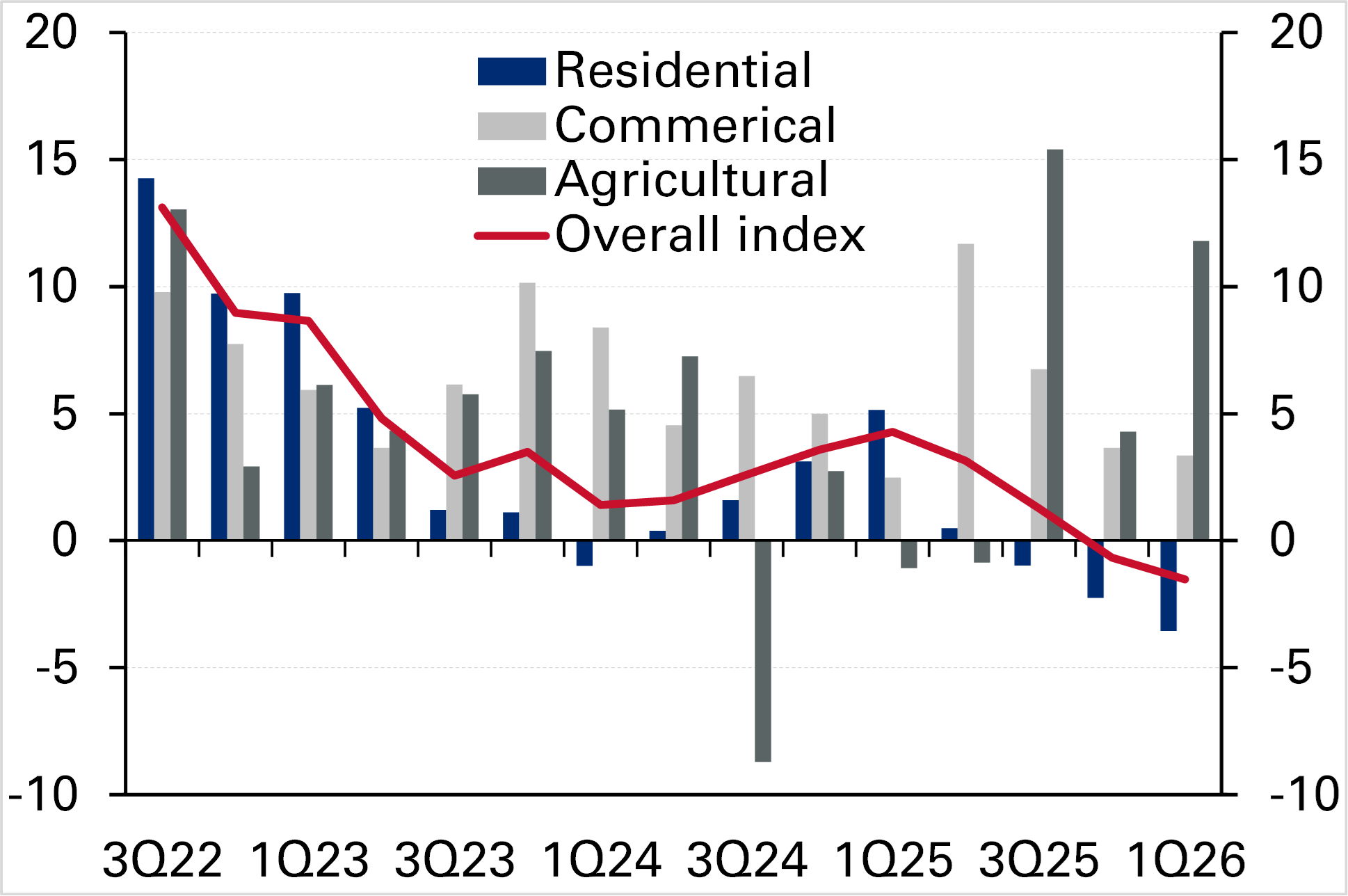
Saudi Arabia: The Real Estate Price Index extended its decline into Q1 2026. Saudi Arabia’s real estate market continued to soften in the first quarter of 2026, with the overall price index declining by 1.6% y/y, following a 0.7% drop in Q4 2025, according to GASTAT. The downturn was led by the residential sector, which represents 73% of the total weight, where prices fell by 3.6% y/y. Within this segment, villa prices recorded the sharpest decline at 6.1%, followed by land prices (-3.9%) and apartments (-1.1%). In Riyadh, prices dropped by 4.4% y/y, suggesting that recent policy measures, including the White Land Tax and rent control initiatives, are starting to ease price pressures and address affordability concerns. Regionally, the steepest declines were recorded in Al Baha (-9.2%), Hail (-8.0%), Northern Borders (-6.6%), and Al Qassim (-5.1%), highlighting a broad-based correction across several regions. In contrast, prices in the commercial sector continued to expand, rising 3.4% y/y, supported by increases in commercial land and building values, despite a decline in showroom prices. The agricultural sector also remained strong, posting an 11.8% y/y increase. Overall, the data points to a continued normalization in residential real estate prices, while non-residential segments maintain upward momentum.
Egypt: Government braces for prolonged regional fallout while highlighting fiscal resilience. The Prime Minister addressed the House of Representatives yesterday, outlining the economic implications of the ongoing regional conflict and signaling that policymakers are preparing for a prolonged period of pressure that could potentially last through to the end of the year even if tensions ease sooner. He highlighted that the impact is already being felt across key sectors, with rising electricity generation costs, expected softness in tourism, and increased fiscal pressures weighing on the economy. Despite these challenges, the government emphasized the economy’s resilience, pointing to the flexible exchange rate as a shock absorber, an inflation-targeting framework, and record foreign reserves as key outcomes of sustained economic reforms. On the fiscal front, interest payments are projected to reach EGP2.4 trillion in FY26/27, slightly higher than EGP2.3 trillion in the current fiscal year. However, debt servicing is expected to decline as a share of total expenditures to 46% from 50%, and fall to 68% of tax revenues, compared to 82% currently, supported by an increase in tax revenues to around EGP3.5 trillion. The Ministry of Finance is also advancing its debt strategy by extending average maturities to 2.5–3 years, a move aimed at easing the interest burden and improving debt sustainability over time. Overall, while external shocks are intensifying pressures, the government is relying on policy discipline and structural reforms to maintain stability and navigate the ongoing crisis.