
 +965 2292 4888


Egypt Economic Brief
04.11.2026
Overview
Egypt’s economic resilience continues to be tested by regional conflict pressures that have raised energy and shipping costs, disrupted trade, and weakened tourism and Suez Canal receipts. The pound has seen renewed pressures, dropping to a record low in late October as investors reassessed regional risks. Meanwhile, the central bank delivered its first interest rate hike since March 2024 to contain inflationary risks, anchor expectations, and support currency stability. Still, while these developments add to the headwinds, we continue to expect economic growth – which slowed slightly to 4.7% y/y in Q2 2026 – to hold up relatively well over the coming year at 4.8% in FY26/27 given pre-conflict momentum and assuming that external pressures do not significantly intensify. We also see exchange rate flexibility – together with record foreign reserves and positive bank net foreign assets – as helping to absorb external shocks and limit the risk of renewed foreign currency shortages. Moody’s in October upgraded Egypt’s sovereign credit rating one notch while maintaining a positive outlook, expecting fiscal discipline to continue after the IMF program ends in December and signaling further gains in policy credibility.
Latest developments
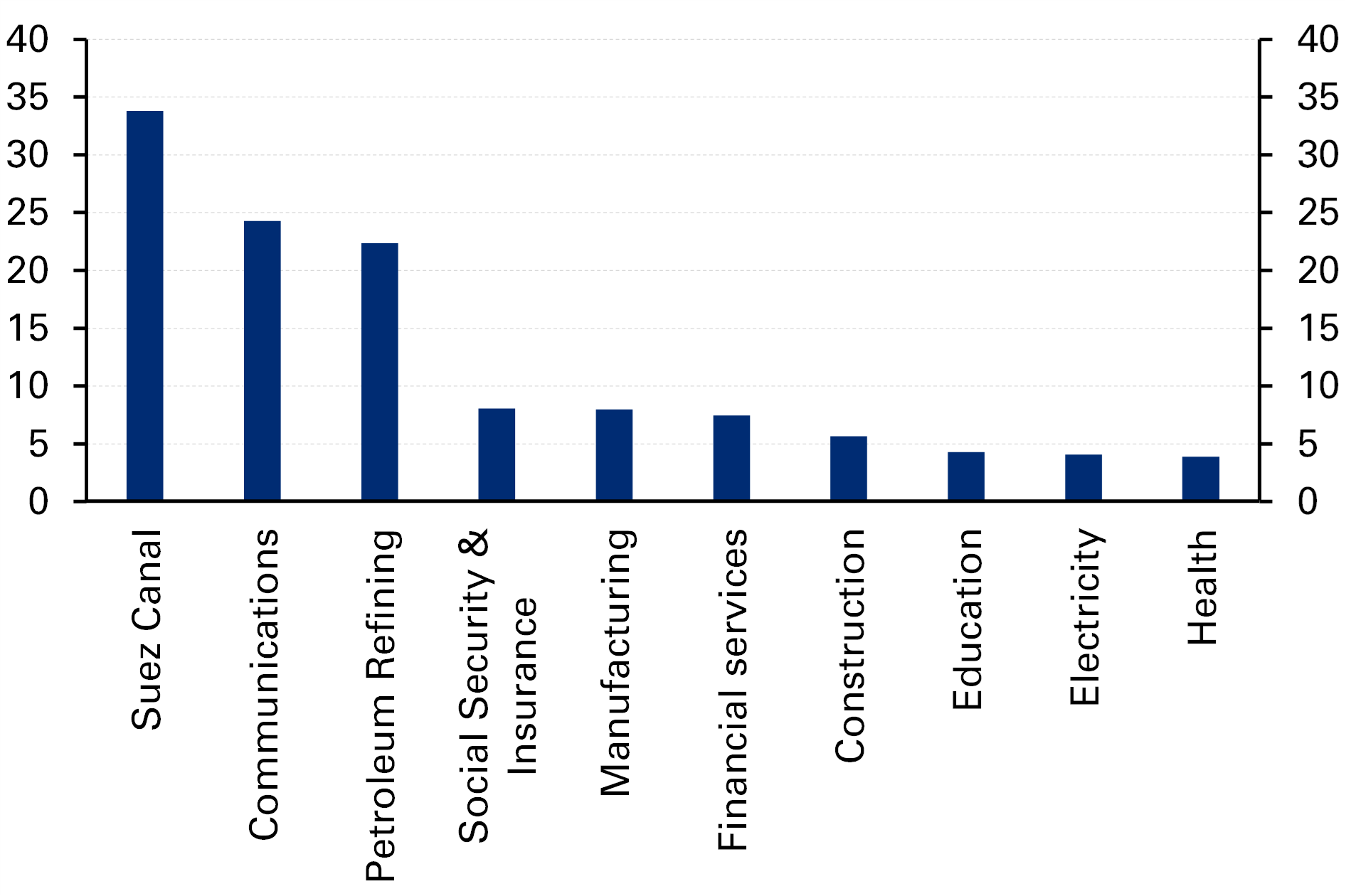
• Growth proves resilient amid geopolitical headwinds. According to the Ministry of Planning, GDP growth slowed to 4.7% y/y in Q2 2026 (April-June), down from 5% in the previous quarter and the corresponding quarter of last year. The slowdown was primarily driven by a sharp deceleration in household consumption growth to 1.5% y/y from 18.5% a year earlier, potentially reflecting more cautious spending amid regional uncertainty. The prolonged US-Iran conflict and renewed Houthi attacks on Saudi Arabia have heightened concerns about further regional escalation, supply-chain disruptions, and higher global oil prices. Private investment was the largest contributor to growth, followed by household consumption and government spending, while net exports continued to weigh on activity amid higher import costs. Sectoral performance was positive across the non-oil economy with the exception of tourism, which contracted by 4.2% y/y. Activity in the Suez Canal sector rebounded strongly (+33.8% y/y), followed by communications (+24.3%), manufacturing (+8%) and construction (+5.6%). (Chart 1.) The refining sector also posted strong growth for the third consecutive quarter (+22.4%) as international energy companies increased operations following the government’s settlement of outstanding arrears.
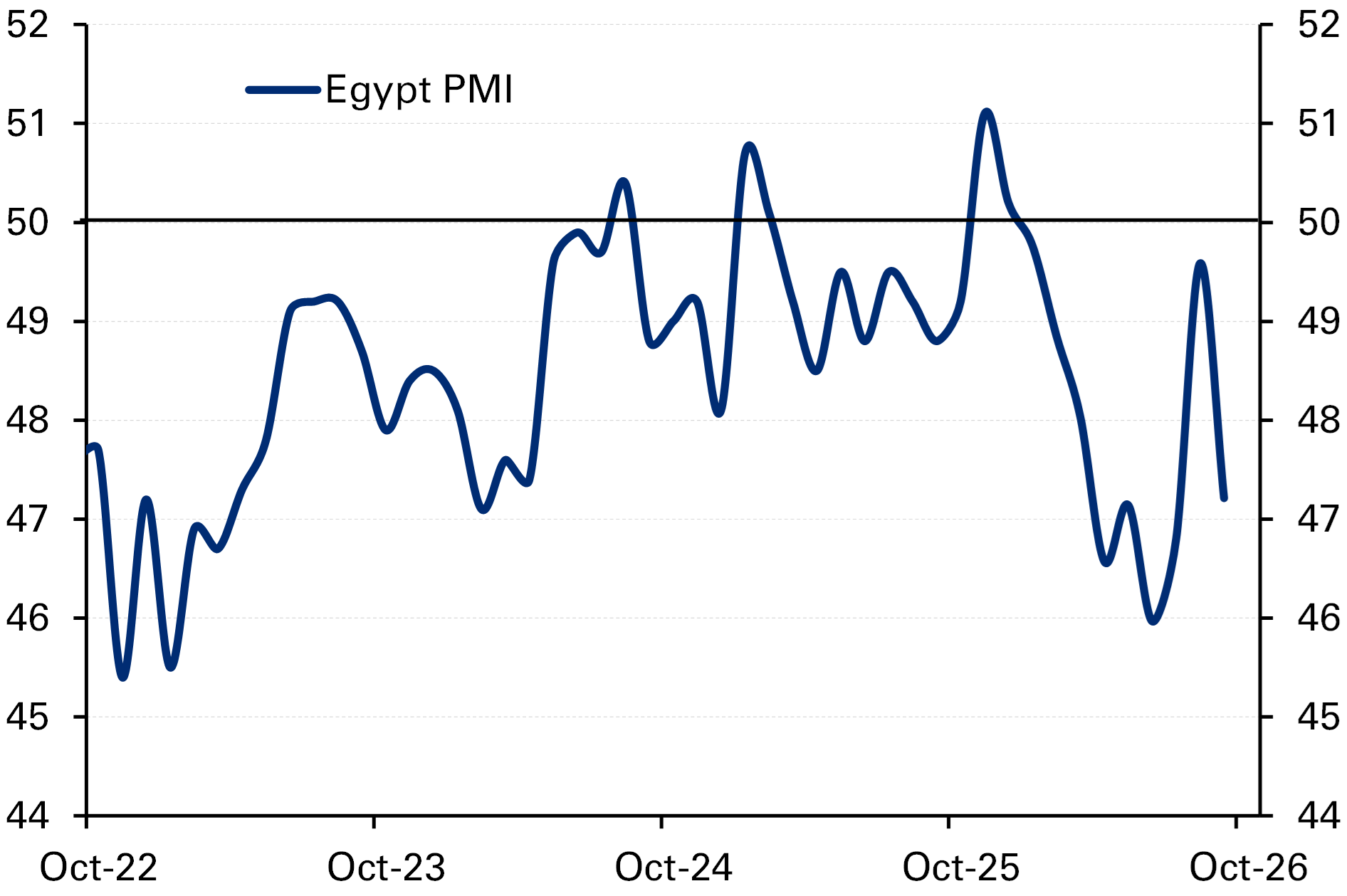
• PMI falls as demand weakens. Egypt’s non-oil Purchasing Managers’ Index (PMI) fell to 47.2 in September and was unchanged in October, down from 49.6 in August, signaling a sharper deterioration in business conditions. (Chart 2.) The decline reflected faster contractions in output and new orders as firms faced weaker customer demand, geopolitical disruptions, and persistent inflationary pressures. The average PMI reading in Q3 2026 (July – September) was consistent with a slowdown in annual GDP growth to around 4.3%. Meanwhile, supply-side pressures intensified. Firms reported longer delivery times, the sharpest deterioration since June, due to maritime disruptions, material shortages and slower customs procedures. Input cost inflation also accelerated to its highest level since May, driven by higher import, energy and shipping costs, as well as the weaker Egyptian pound. Companies responded by raising selling prices at the fastest pace since June, hence, higher costs are gradually passed on to consumers. Firms expressed concerns that regional conflicts, persistent inflation and supply-chain disruptions would weigh on activity over the coming year.
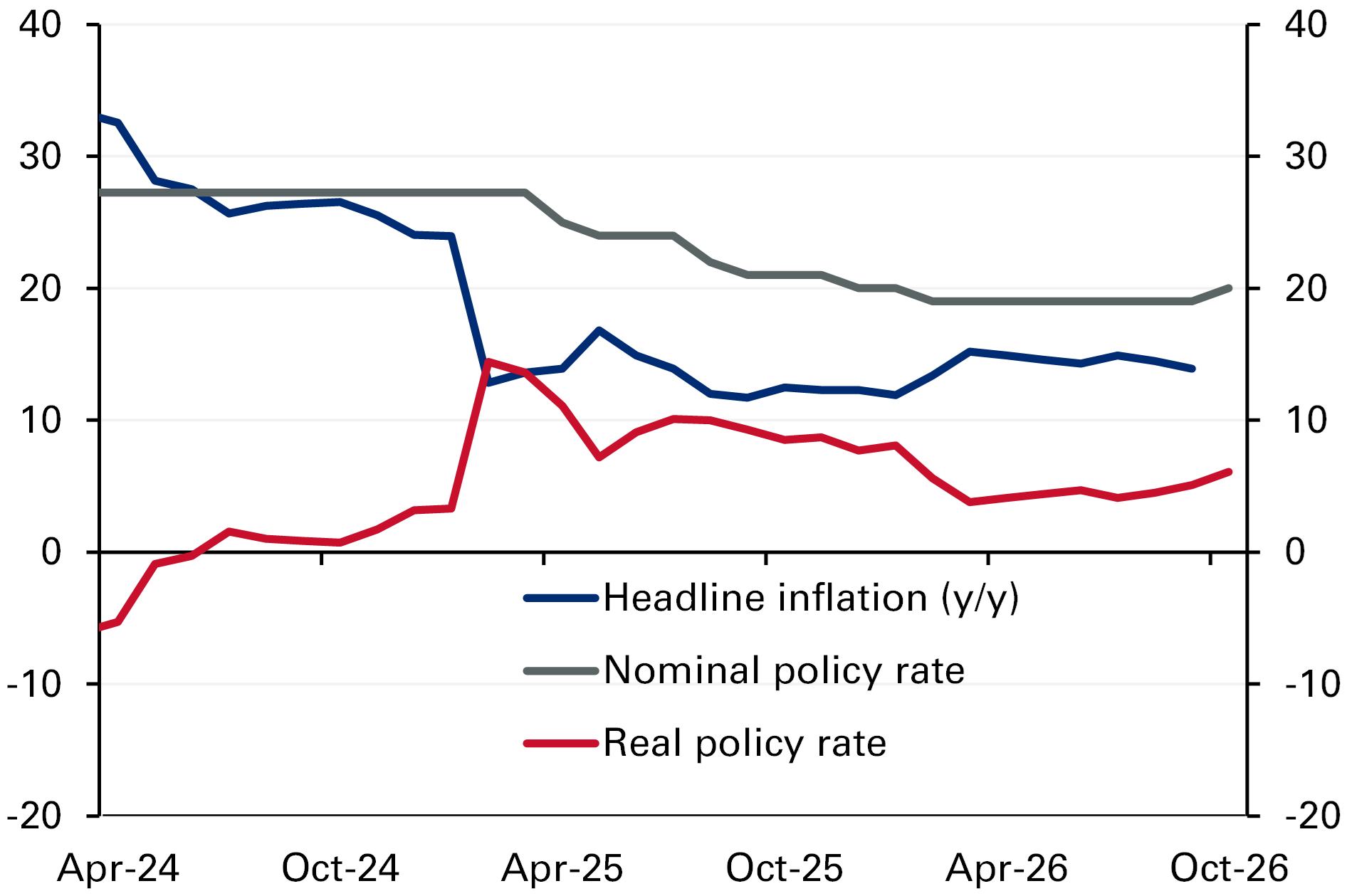
• Inflation eases in September, but CBE surprises markets with 100 bps rate hike, reversing the easing cycle. The Central Bank of Egypt (CBE) raised its key policy rates by 100 basis points (bps) on October’s Monetary Policy Committee (MPC) meeting, surprising markets that had largely expected another hold. This marks the first rate increase since March 2024 and reverses the easing cycle that began in April 2025, during which the CBE cut rates by a cumulative 825 bps across six moves. The overnight deposit rate was raised to 20.0% from 19.0%, the overnight lending rate to 21.0% from 20.0%, and the main operation and discount rates to 20.5% from 19.5%. The decision came despite a further slowdown in annual inflation, with headline inflation easing to 13.9% in September and core inflation to 14.1%. However, the CBE highlighted a renewed acceleration in monthly price increases. The MPC described the hike as a pre-emptive measure to contain imported inflationary pressures and prevent them from feeding into domestic prices. The real interest rate has increased to around 6% from 5% before the decision, further tightening financial conditions. (Chart 3.)
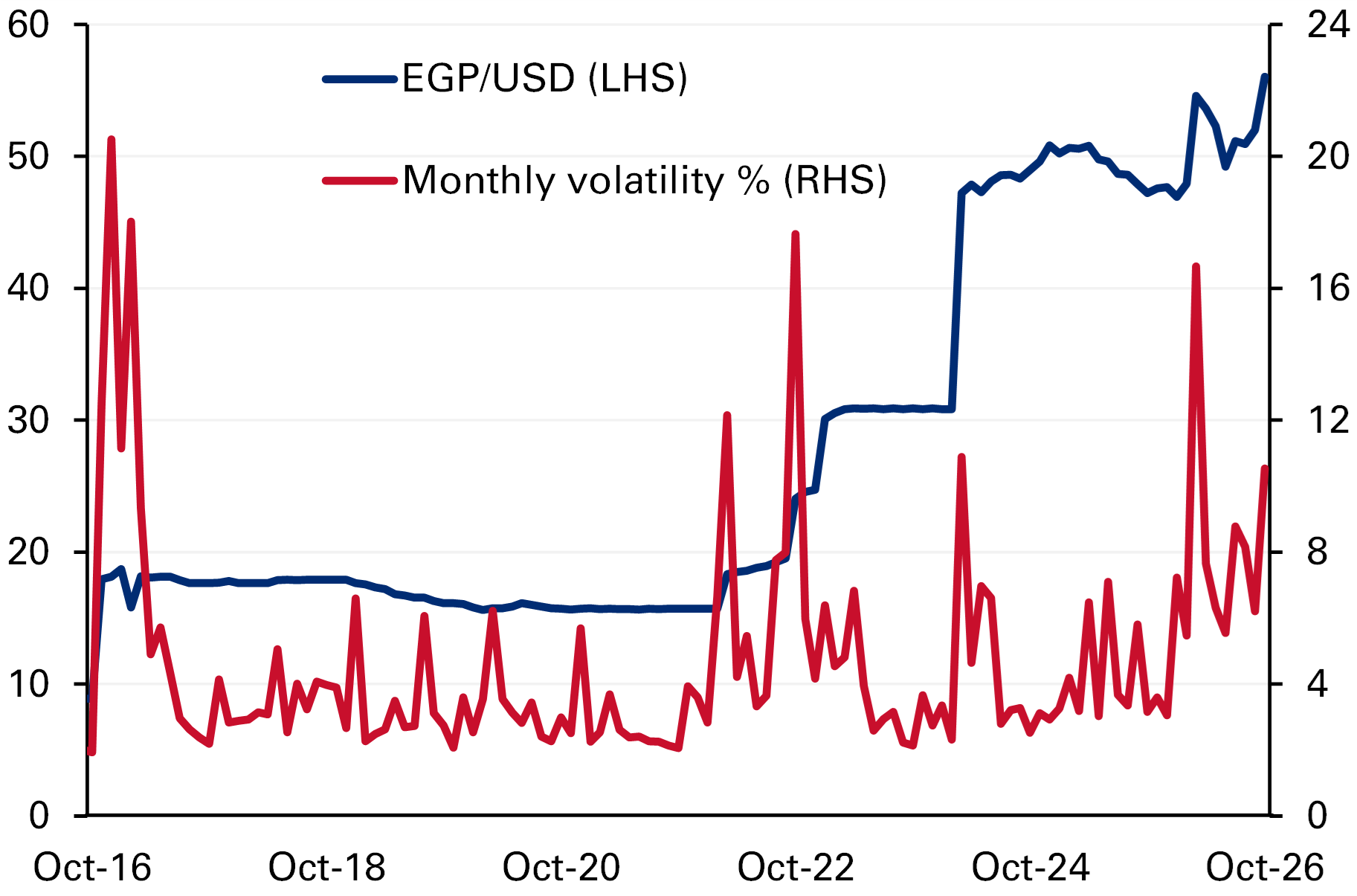
• Capital flow volatility continues to drive sharp FX swings. Heightened regional tensions have weighed on foreign investor sentiment and increased volatility in portfolio flows into Egypt’s domestic debt market. Carry-trade inflows, which averaged $2.1 billion per month before the conflict, turned negative in July before recovering to net inflows of around $100 million in August and $730 million in September. This improvement continued into the first two weeks of October, when net inflows reached $1.6 billion, before reversing to a net outflow of $3.2 billion in the last two weeks, highlighting the market’s continued sensitivity to geopolitical developments. A sustained improvement in regional risk sentiment, alongside further progress in Egypt’s external financing position and disinflation, would support a more durable recovery in portfolio inflows. Meanwhile, monthly exchange rate volatility has reached around 10.5%, compared with an emerging market average of approximately 8% and the pound’s historical average of around 4%. The increase in volatility, alongside US dollar strength, contributed to a 10% depreciation of the Egyptian pound against the dollar in the last couple of months driving the pound to an all-time high. (Chart 4.)
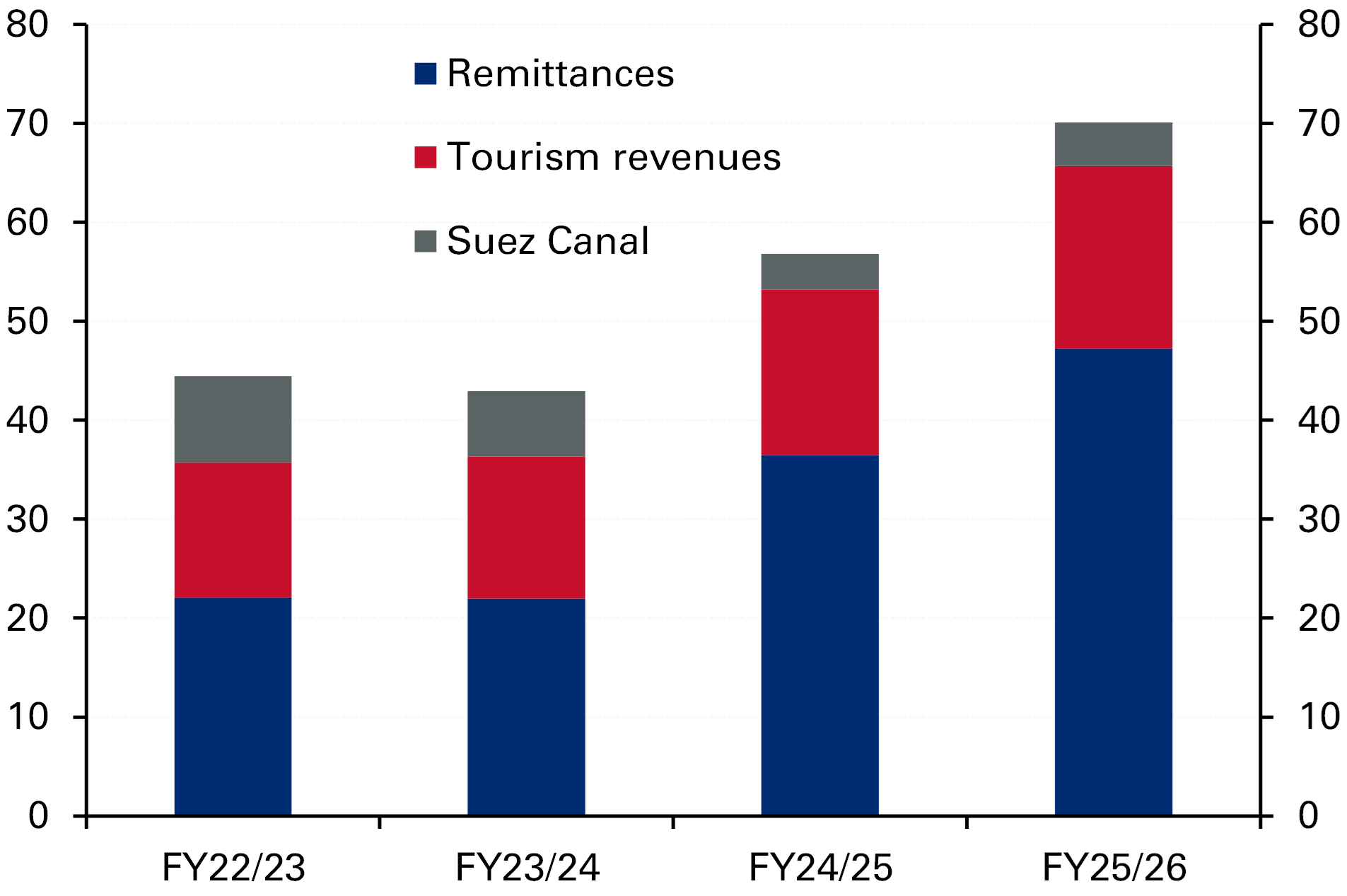
• Current account deficit widens, but overall balance of payments returns to surplus. The current account deficit widened significantly to $22.5 billion in FY25/26, from $15.4 billion a year earlier, reflecting a larger trade deficit and higher investment income outflows. The trade deficit increased by more than a quarter to $64.8 billion, as the oil trade deficit widened by almost a third to $18.3 billion amid higher oil imports. The non-oil trade deficit also increased by a quarter to $46.6 billion, partly driven by a 16.9% rise in non-oil imports to $83.9 billion. Meanwhile, the investment income deficit widened by a third to $21.2 billion. Stronger remittances and services receipts partly offset these pressures. Remittances from Egyptians working abroad rose to a record $47.3 billion (+29.6%), while the services surplus increased to $16.7 billion (+10.5%), supported by tourism revenues of $18.4 billion and Suez Canal receipts of $4.4 billion. (Chart 5.) Despite the wider current account deficit, the overall balance of payments recorded a surplus of $2.8 billion in FY25/26, compared with a deficit of $2.1 billion a year earlier. This improvement reflected net capital and financial account inflows of $23.2 billion, more than double the $10.2 billion recorded in FY24/25. Foreign direct investment (FDI) generated net inflows of $17.8 billion, while portfolio investments recorded net inflows of $4.1 billion. Nevertheless, the widening current account deficit underscores Egypt’s continued reliance on remittances, tourism, and capital inflows to meet its external financing needs.
• Moody’s upgrades credit rating to B3 with a positive outlook. Moody’s upgraded Egypt’s local and foreign currency ratings to B3 from Caa1 maintaining a positive outlook. The agency attributed the upgrade to several years of fiscal consolidation and structural reforms, noting that the shift to a flexible exchange rate and tighter monetary policy has helped the economy withstand higher oil prices and regional uncertainty. Moody’s expects fiscal discipline to continue after the IMF program ends in December. The upgrade brings Moody’s rating closer to those of S&P and Fitch, which affirmed Egypt’s B rating in October, both with stable outlooks.
Forecast
Growth firm despite conflict pressures
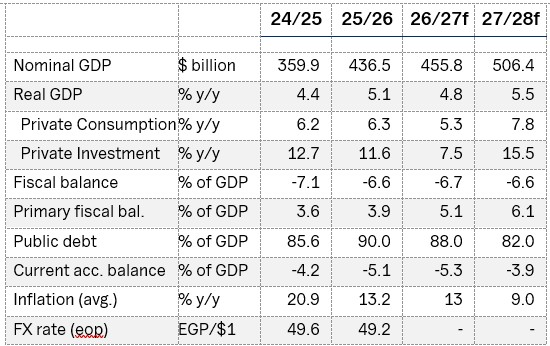
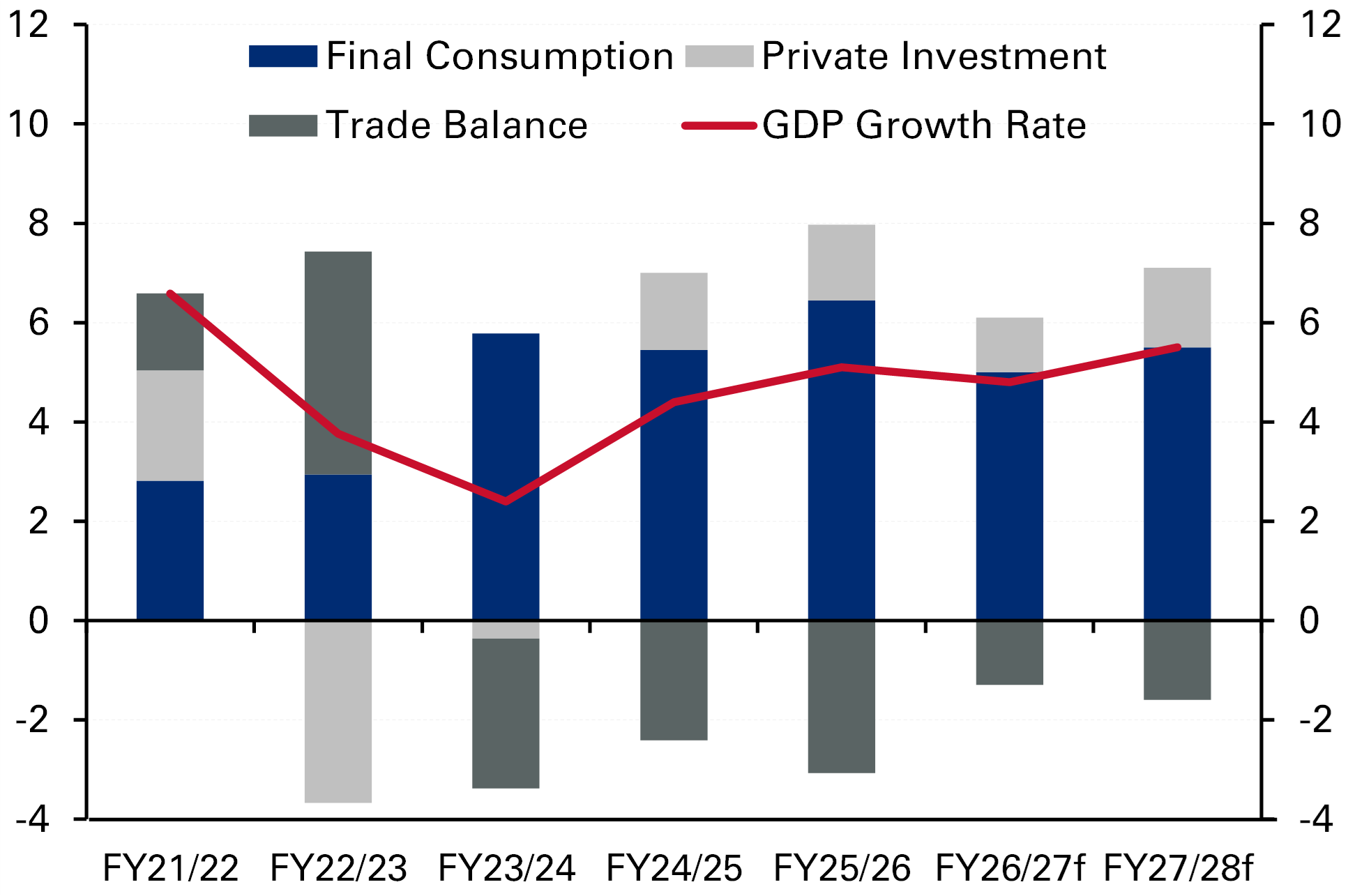
Based upon performance so far, we expect the growth climate to remain reasonably positive over the coming quarters even in the event that the regional conflict does not fade quickly. GDP growth is forecast to slightly drop to 4.8% in FY26/27 (July 2026 to June 2027), before accelerating to 5.5% in FY27/28. (Chart 6.) Growth is expected to take a hit in the short run from the tightening measures adopted by the CBE, with higher borrowing costs weighing on private-sector investment, raising financing costs for businesses and passed on to consumers. But we expect the hiking cycle to be short lived and from H1 2027, an easing in US-Iran tensions (as per our baseline assumption), lower oil prices, a more competitive pound, improved tourism and Suez Canal activity, the start of interest rate cuts and a recovery in global growth will breathe new life into the domestic economic cycle.
Policy rates and EGP subject to regional pressures
The Egyptian pound is expected to remain volatile through the remainder of 2026, reflecting elevated geopolitical risks and fluctuations in foreign portfolio flows. We expect the currency to trade within a range of EGP 52-58 per US dollar, with prolonged regional conflict potentially pushing it towards the weaker end of this range. However, high T-bill yields, record foreign reserves, positive net foreign assets at banks, and exchange rate flexibility help limit the risk of a disorderly adjustment. While interest rate differentials with the US could narrow in 2027, potentially working against the pound, the currency has so far shown sensitivity to US-Iran war developments and a resolution to the conflict if one materialized could also see the currency recover ground.
Despite recent currency pressures and a possible Fed December rate hike, we expect the CBE to keep its overnight lending and deposit rates unchanged at 21% and 20%, respectively, in December’s MPC meeting, before starting the monetary easing in 2027 with cumulative cuts of 400 bps. The latest 100 bps hike in October is expected to raise T-bill yields even more, therefore, keeping borrowing costs elevated. Interest payments already absorb a substantial share of government revenue and the hike will have negative implications on debt-servicing costs, investment, and economic activity.
Inflation expectations remain broadly anchored, supported by the CBE’s tightening and the Fuel Automated Pricing Committee’s decision to keep retail fuel prices unchanged through end-2026. We expect inflation to ease gradually from Q2 2027, although a prolonged regional conflict could prompt a fuel price increase of at least 10% by Q1 2027 and the recent EGP depreciation if sustained could trigger renewed upward pressures. Average inflation for now is forecast to slightly decline to 13% in FY26/27, from 13.2% in FY25/26, creating room for 100 bps of rate cuts during H1 2027 to reverse the hike made in October 2026. Inflation is expected to fall to an average of 9% in FY27/28, bringing it to the edge of the CBE’s target range (7% ±2 percentage points) and providing space for a further 300 bps of easing in H2 2027 followed by another 200 bps in H1 2028.
High interest costs keep the deficit elevated
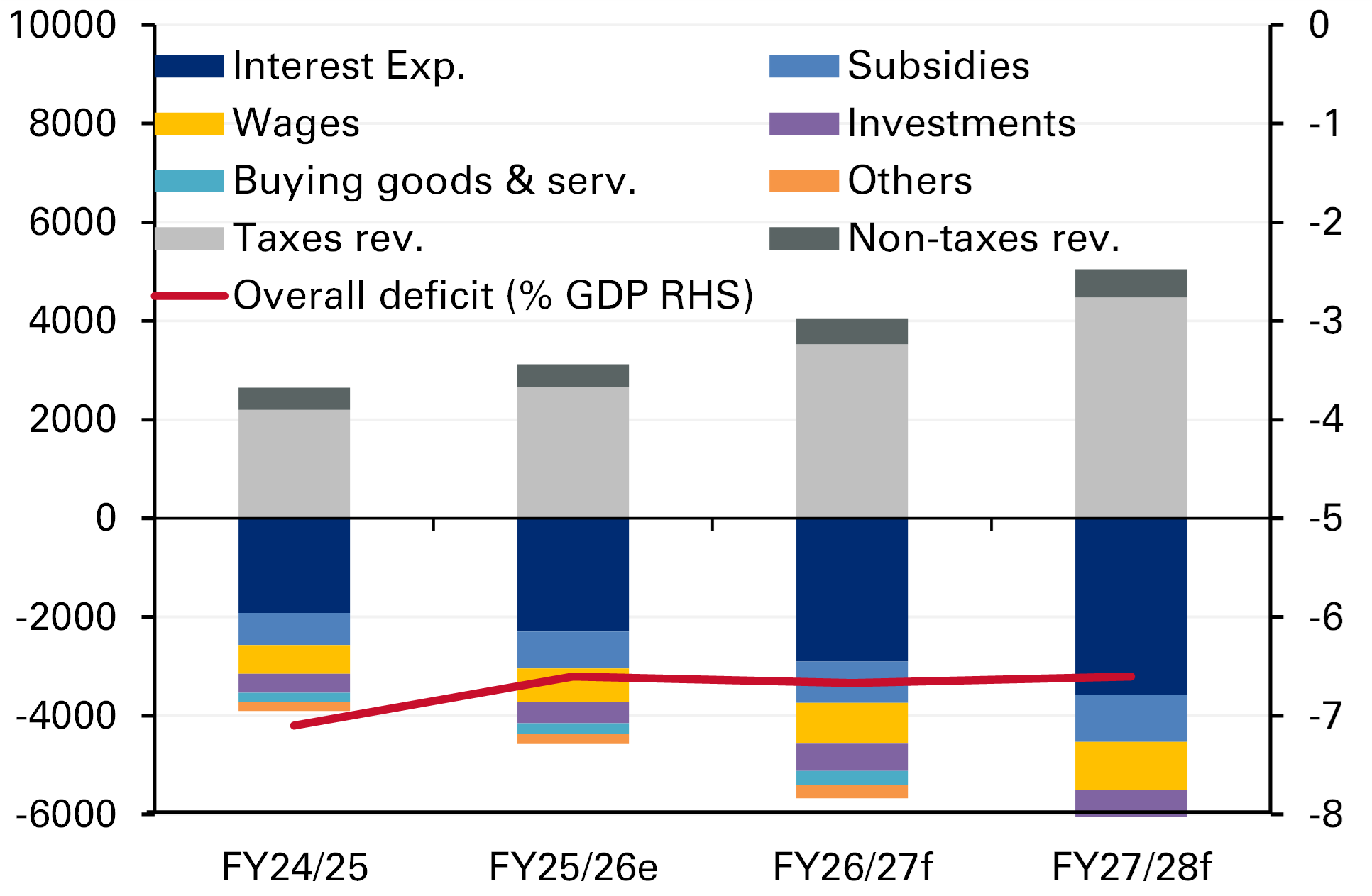
The fiscal deficit is expected to remain close to 6.6% of GDP in both FY26/27 and FY27/28, as high borrowing costs, elevated oil prices and pound weakness offset the expected improvement in regional conditions later in the fiscal year. (Chart 7.) Interest payments account for around half of government expenditure and absorb roughly 80% of tax revenue, leaving public finances highly vulnerable to elevated domestic yields. Borrowing costs remain well above the budget assumption of 18% for FY26/27 and are expected to average around 24% by June 2027.
Meanwhile, Brent crude prices averaging above $95 per barrel in H2 2026 will increase subsidy costs, while pound depreciation will raise the cost of foreign-currency-denominated spending. These pressures are assumed to ease later in FY26/27 as shipping through the Strait of Hormuz gradually normalizes and regional risk sentiment improves. Nevertheless, the deficit is expected to remain broadly stable as a share of GDP over the coming years. Public debt, however, is forecast to edge down from an estimated 90% of GDP at end-FY25/26 to 88% by end-FY26/27, as strong nominal GDP growth outpaces the accumulation of additional debt.
External balances to weaken but manageable
Currency flexibility and more robust reserve levels have reduced exposure to severe external imbalances since 2024, though fallout from the regional conflict has led to some near-term weakening. The current account deficit is forecast to slightly widen from 5.1% of GDP in FY25/26 to 5.3% in FY26/27. Higher energy prices and transportation costs on top of the weaker Egyptian pound are pushing up import costs, while travel receipts were down in Q2 and Suez Canal revenues are still less than half of peak 2023 levels. An eventual easing of some of these pressures in 2027 plus the boost to competitiveness from a weaker EGP will help narrow the deficit to 3.9% of GDP in FY27/28. Despite substantial external financing needs of $30 billion in FY26/27, Egypt’s financing position is expected to remain manageable, supported by foreign reserves, positive net foreign assets at banks, planned international debt issuance, IMF and EU financing, foreign portfolio inflows, FDI, and potential asset divestments.
Regional tensions and capital flows pose risks
The economic outlook remains broadly positive, though longer-term growth prospects are still constrained by the large fiscal deficit, high interest rates, inflation and debt-servicing costs as well as other structural challenges such as the state’s large economic footprint, competition and regulatory issues and low investment rates. Regional escalation poses the main downside risk in the near term with a renewed US-Iran escalation or intensified Red Sea attacks potentially raising energy and shipping costs, weakening tourism and Suez Canal revenues, and pressuring the pound and the fiscal balance due to higher subsidies. Rising foreign investment in T-bills also creates potential for outflows if sentiment comes under pressure. As we go on, limited progress on privatization and continued reliance on state-linked entities could further discourage private investment and undermine policy credibility after the IMF program ends in December 2026.
On the upside, a resolution to regional tensions could lower energy costs and boost tourism and Suez Canal activity. Faster reforms and a quicker deceleration in inflation could also allow the CBE to accelerate monetary easing, lowering borrowing costs, and potentially kick-starting a new private-sector investment cycle.