+965 2292 4888


UAE Outlook
11.11.2026
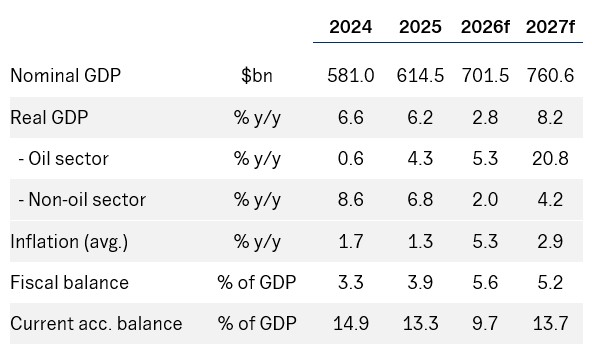
Parts of economy prove resilient to conflict pressures: The regional conflict dealt a blow to what had been a super-strong recent UAE growth record, with GDP expanding 6.2% per year on average in 2022-2025 and non-oil growth an even better 7.4%. But while attacks on infrastructure and the disruption of shipping in the Strait of Hormuz weighed on the economy, parts of it have also proven very resilient, with oil production surpassing pre-war levels in September (3.92 mb/d) thanks to the alternative Habshan-Fujairah pipeline route and bank credit still rising by a very robust 15% y/y in August amid strength in household borrowing. While non-oil growth stood at -1.1% y/y in Q2 2026, this may have been the low point, with the PMI survey pointing to a recovery since then. We see this economic resilience as underpinned by trade optionality, expansive domestic infrastructure, large government financial buffers, high levels of economic diversification versus some peers, robust popularity with expatriate labor and international corporates, and emerging strength in tech and AI. We expect a strong growth rebound next year to 8.2% from what is a still respectable 2.8% in 2026. This will be led by a 21% recovery in oil output as post-conflict trade patterns normalize and given the UAE’s position outside OPEC and therefore not bound by quota limitations, plus the planned increase in production capacity to 5 mb/d by 2027 (from 4.85 mb/d as stated by ADNOC).
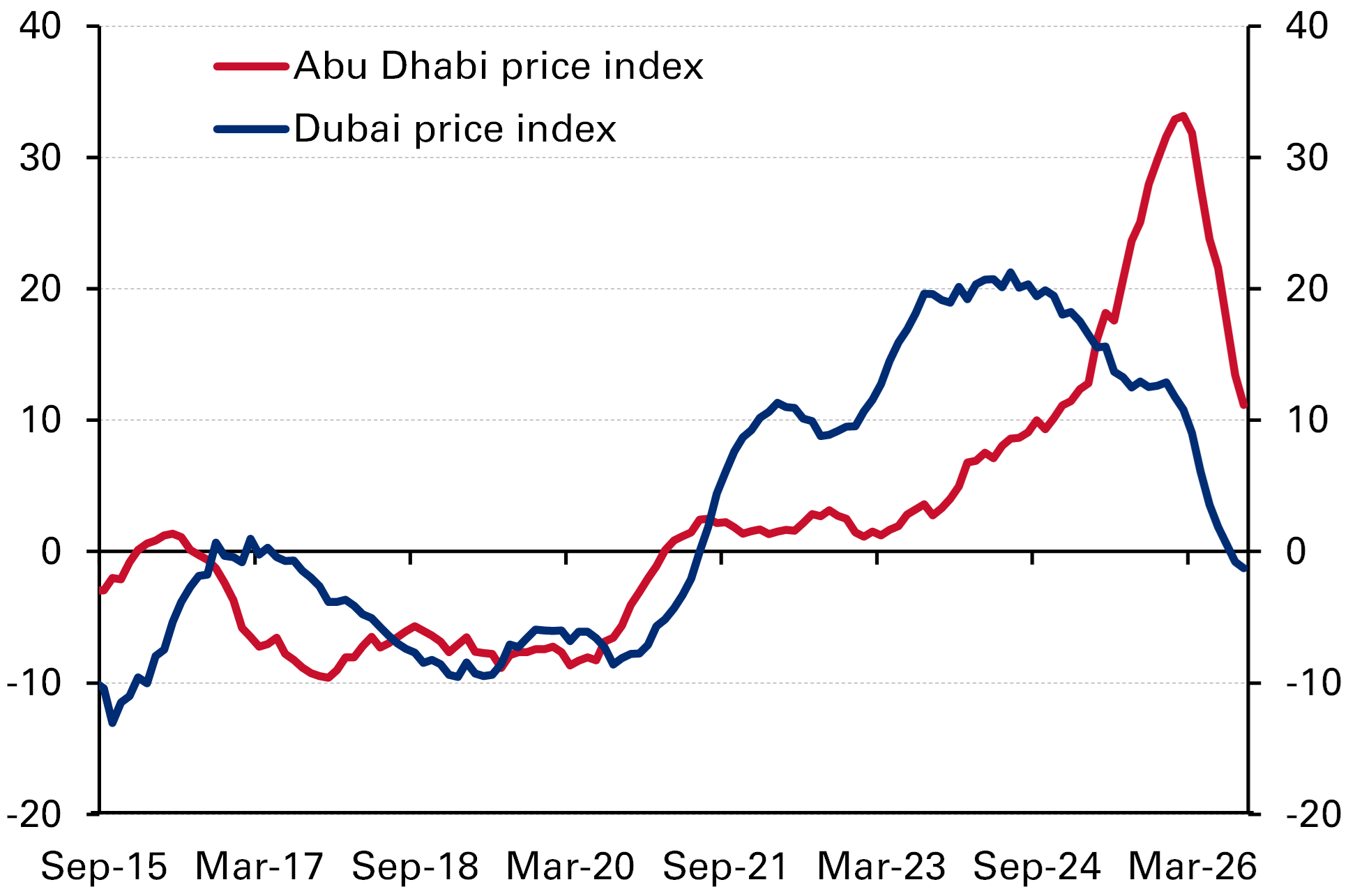
Property sales fell but prices have stabilized: The property market was hit by a negative confidence shock from the conflict, with prices in Abu Dhabi and Dubai down 1% and 5% respectively from February levels by September and Dubai transaction levels down about 50%. However, the correction was from historically elevated levels after exceptional strength in previous years and prices had stabilized by Q3 2026. Given this, property’s popularity as an asset class and our broader economic growth outlook, we tend to view recent market softness as a confidence-driven moderation rather than a cycle-ending event and see scope for a recovery once the geopolitical climate improves. Modest interest rate hikes are unlikely to provide too much of a headwind as cash sales exceed 70% of sales in both Abu Dhabi and Dubai. Strong expected supply growth in 2027-30 in both emirates will unwind some of the underlying market tightness, with Abu Dhabi in particular positioned to absorb additional units given its smaller residential stock and the recent move to expand financing for off-plan sales.
Inflation surge should reverse once energy market pressures ease: Inflation had surged to 6.5% y/y in June – comfortably the highest in the GCC – from 2.1% in February and emirate-level figures show it still above 5% in Dubai in September. The jump was driven mostly by food and transport prices, the latter reflecting the higher cost of fuel in the UAE’s relatively liberalized energy market, but there are also signs of broader price pressures from the PMI survey. We interpret recent price strength as mostly supply and cost driven rather than demand-led and expect inflation to cool significantly in 2027 (to below 3.0%) as these pressures recede – although easing rental inflation will also help. Separately, despite major disruptions in the oil sector, the government’s financial resilience is underscored by the consolidated fiscal surplus increasing to 5.6% of GDP in 2026, with higher oil prices more than offsetting the impact of production shut-ins during March-May. Abu Dhabi has retained its AA credit rating through the crisis, with huge SWF assets estimated at $1.8 trillion or 216% of UAE GDP.